Bridging the Knowledge Gap: AWS Launches Web Search for Amazon Bedrock AgentCore
In a significant expansion of its generative AI portfolio, Amazon Web Services (AWS) has announced the general availability of Web Search for Amazon Bedrock AgentCore. This new capability marks a pivotal shift in how enterprise-grade AI agents interact with the real world, providing a secure, governed, and highly efficient mechanism for agents to ground their responses in up-to-the-minute web intelligence. By integrating directly with the Bedrock AgentCore Gateway, this tool enables businesses to move beyond the limitations of static training data, allowing AI agents to perform complex reasoning based on live, cited information without ever leaving the secure confines of the AWS ecosystem.
Main Facts: Bringing Real-Time Intelligence to Enterprise AI
The core value proposition of Web Search on Bedrock AgentCore lies in its ability to synthesize external information with high-fidelity, enterprise-grade security. Traditionally, Large Language Models (LLMs) suffer from "knowledge cutoffs"—a state where their training data becomes outdated the moment it is finalized. While RAG (Retrieval-Augmented Generation) has mitigated this for internal documents, accessing live internet data has often introduced significant security and compliance risks.
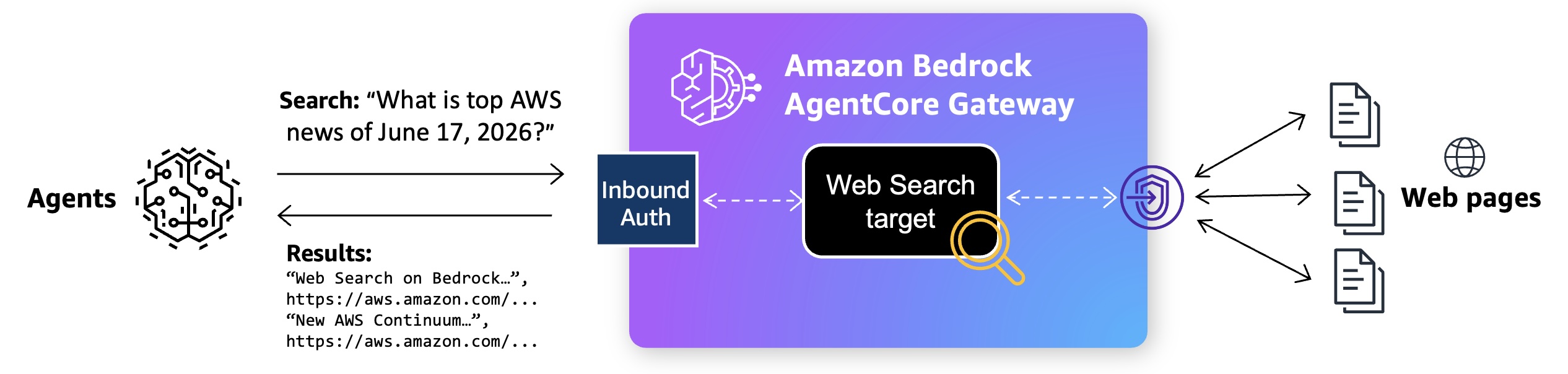
Web Search on Bedrock AgentCore solves this by utilizing a built-in connector target on the Bedrock AgentCore Gateway, leveraging the Model Context Protocol (MCP). When an agent is presented with a query, it can now dispatch a natural-language request to the Web Search tool. In return, the tool provides the agent with a wealth of data: relevant snippets, verified source URLs, document titles, and publication timestamps. This allows the LLM to perform "grounded reasoning"—a process where the model cross-references its own logic against verified live data before generating an output.

Perhaps most importantly for enterprise customers, the tool ensures zero data egress from the secured AWS environment. By relying on Amazon’s proprietary search infrastructure—honed through years of refinement in products like Alexa+, Amazon Quick, and Kiro—AWS ensures that sensitive prompts and proprietary retrieval queries remain within the customer’s controlled infrastructure.
A Legacy of Search: The Evolution of Agentic Intelligence
The development of this tool did not occur in a vacuum; it is the culmination of over a decade of research into how machines interact with human-generated information. To understand the significance of this launch, one must look at the chronology of Amazon’s search-related investments.
- The Foundational Years: Early work in Alexa’s voice-query capabilities taught Amazon the critical importance of low-latency retrieval. The challenge was never just finding a webpage, but identifying the "snippet" that directly answered a user’s specific intent.
- The Rise of Knowledge Graphs: Amazon shifted from keyword-based search to entity-based knowledge graphs. By mapping facts into structured relationships, Amazon ensured that search results were not just links, but verified assertions.
- The Integration Era (2024–2025): As generative AI took center stage, the focus shifted to "Agentic Search." Projects like Kiro and Amazon Quick experimented with how AI agents could take action based on search results. This proved that a successful agent needs more than just a search bar; it needs a gateway that can translate user intent into precise API calls.
- The 2026 Breakthrough: The release of Web Search for Bedrock AgentCore represents the democratization of these internal technologies. By wrapping these capabilities into a standardized MCP-compliant gateway, AWS has effectively turned a complex, custom-engineered search pipeline into a plug-and-play service for any business building on AWS.
Supporting Data: Infrastructure and Technical Implementation
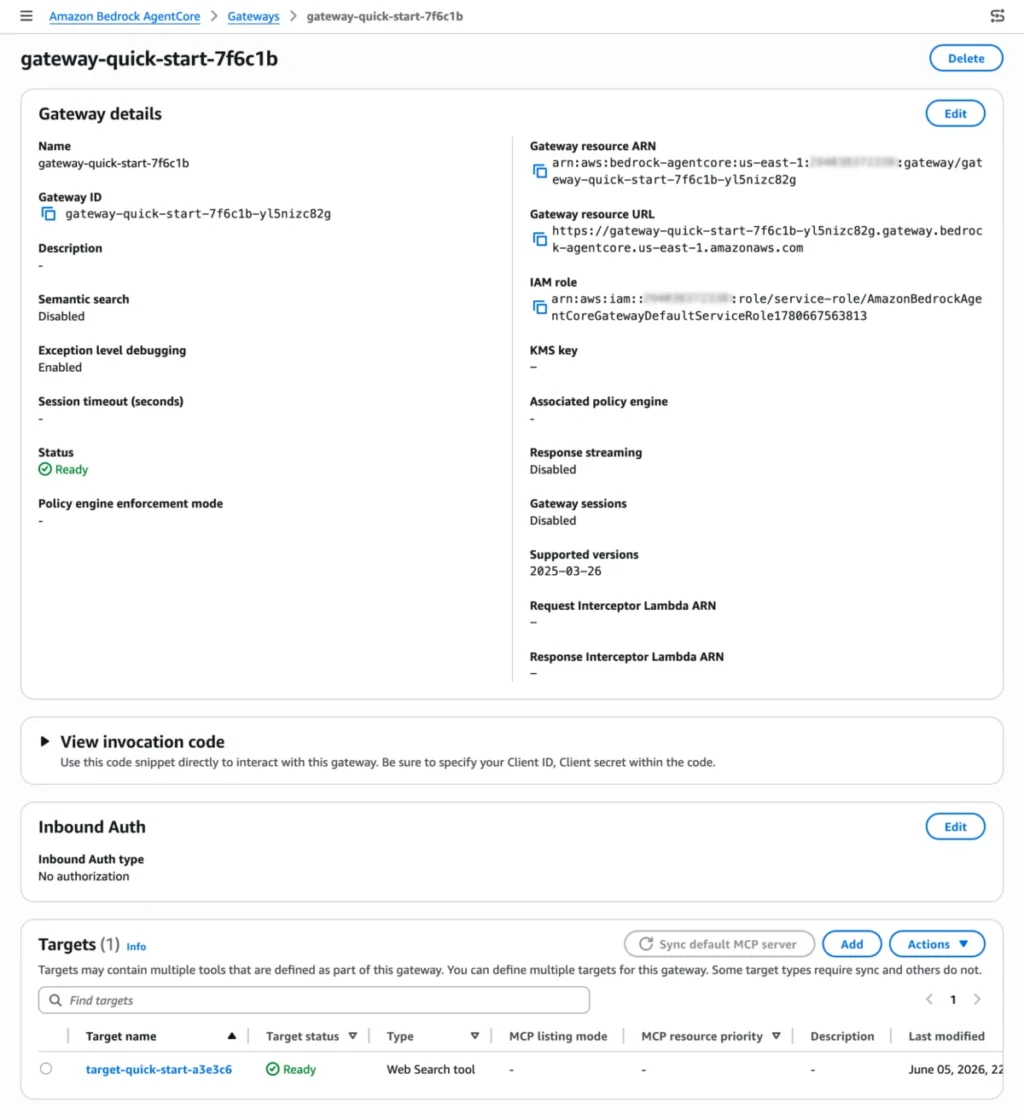
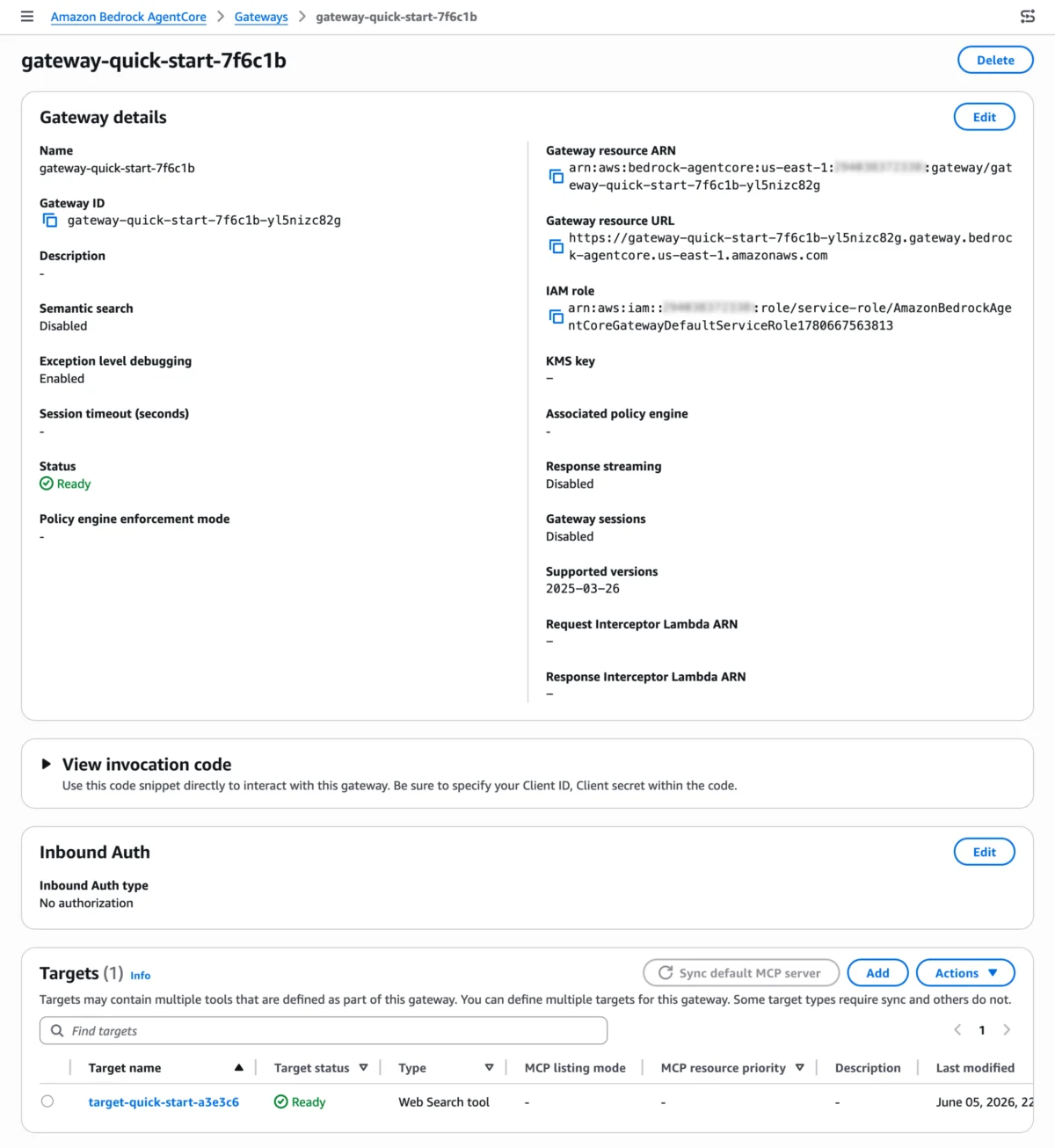
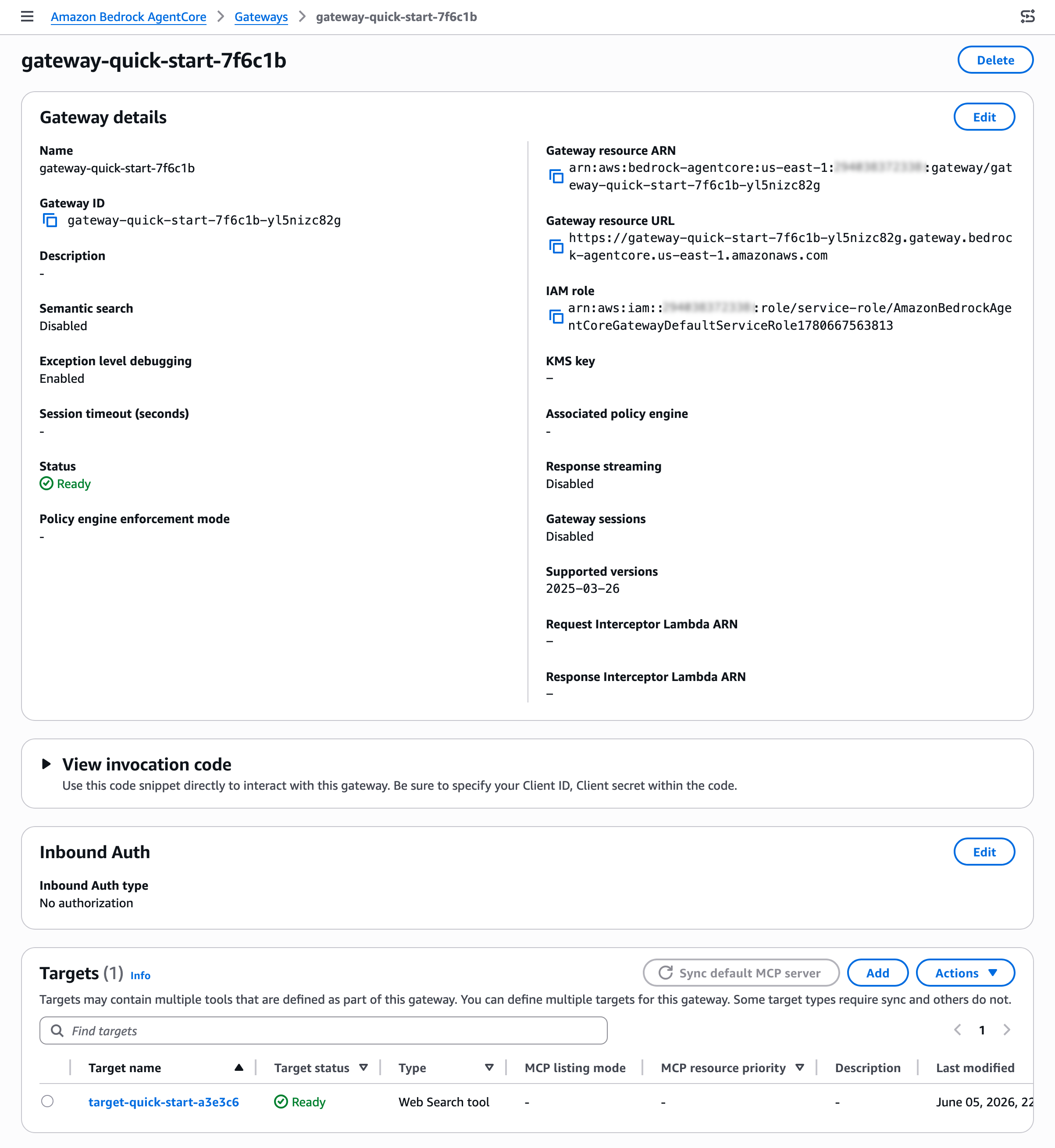
The architecture of the Web Search tool is designed for developers who demand both simplicity and granular control. At the heart of the implementation is the Bedrock AgentCore Gateway, which acts as the intermediary between the agent and the world.

Configuring the Gateway
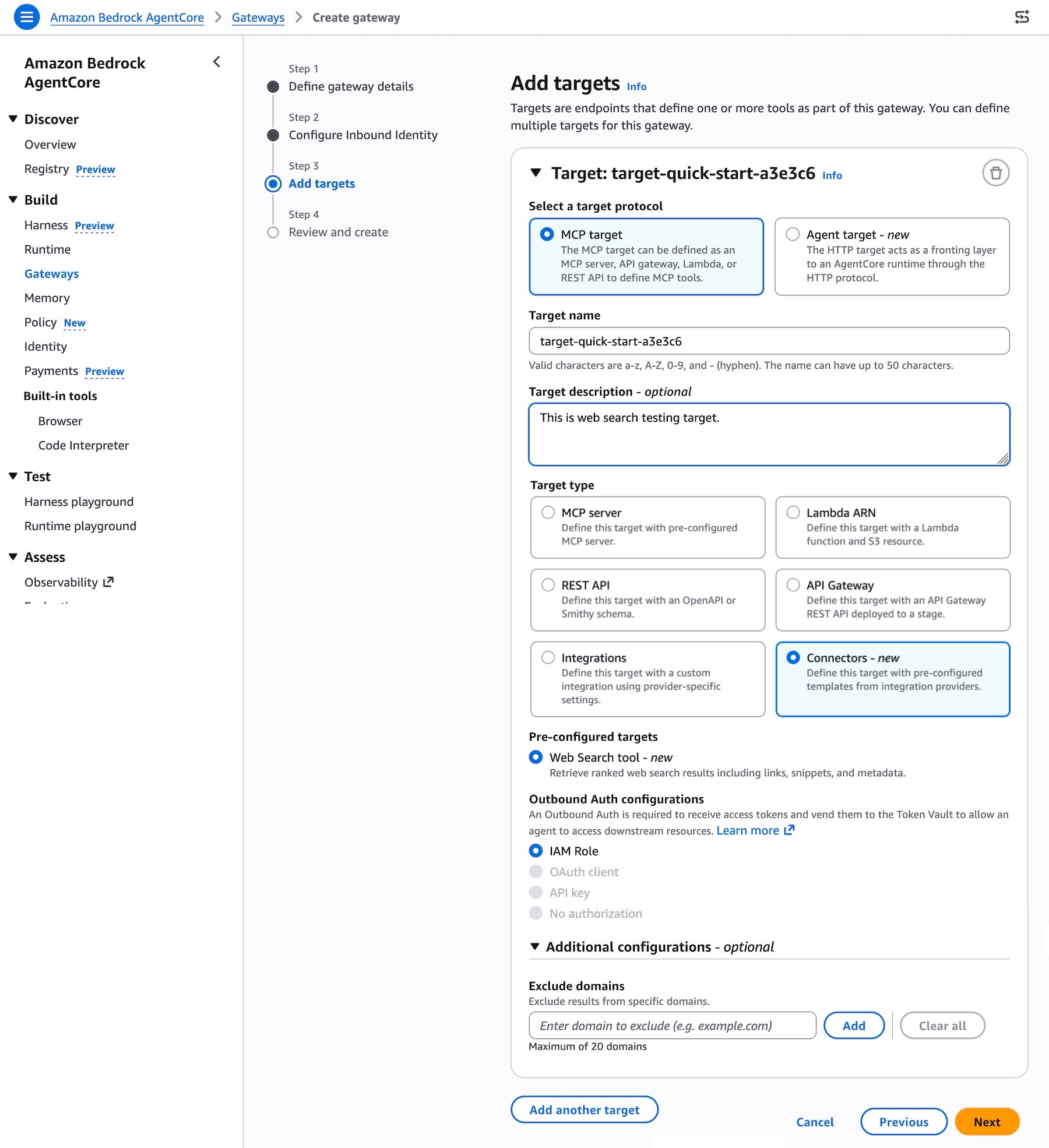
To deploy Web Search, developers utilize the Bedrock AgentCore console. The setup process involves:
- Gateway Initialization: Creating a new gateway resource.
- Target Protocol Selection: Choosing the Model Context Protocol (MCP) as the communication standard, which ensures compatibility with a vast ecosystem of third-party tools.
- Connector Assignment: Selecting the "Web Search" target. Once configured, the gateway exposes an endpoint that the AI agent can query at runtime.
The Role of the MCP Inspector
For developers, the "black box" nature of AI can be a significant hurdle. AWS has addressed this by integrating the Web Search tool with the MCP Inspector. This developer-centric utility allows teams to:
- Trace Queries: Visualize exactly what the agent is asking the search tool.
- Inspect Payloads: Review the raw data returned by the search index, including snippets and metadata.
- Debug Logic: Test how the LLM interprets various search results, allowing for fine-tuning of the "grounding" prompts that steer the AI’s behavior.
Official Responses: What Industry Leaders Are Saying
The early-access phase of this technology involved several high-profile enterprise partners who have already begun integrating Web Search into their production workflows. Their feedback highlights the tangible business benefits of shifting to a grounded AI model.
Benchling: Accelerating Scientific R&D
Nicholas Larus-Stone, Head of AI Agents at Benchling, emphasizes the power of combining private data with public research. "Scientists using Benchling AI can now ask about a target they’re actively working on and get answers grounded in both their institutional data in Benchling and published literature," Larus-Stone explains. "The result is more complete science and hypothesis generation done right. Because we’re using the Web Search tool on Amazon Bedrock AgentCore, customers have a secure, governed environment to bring that high-quality published data into their workflows."
Gen Digital: Enhancing Consumer Safety
For companies like Gen Digital, the priority is maintaining trust while providing up-to-date security intelligence. Iskander Sanchez-Rola, Senior Director of AI & Innovation at Gen Digital, noted: "With the Web Search tool on Amazon Bedrock AgentCore, Norton Revamp helps professionals build their online reputation with current, grounded content ideas shaped by what’s actually happening in the world today. What we value most is that AWS uses its own search index and keeps queries within our trusted AWS environment."
Implications: The Future of Enterprise AI Agents
The introduction of this tool has profound implications for the enterprise software landscape.
1. The Death of the "Knowledge Cutoff"
For years, the Achilles’ heel of enterprise LLMs was their static nature. By providing a low-friction path to real-time, cited data, AWS has effectively bridged the gap between static training and dynamic awareness. This makes AI agents viable for use cases that were previously impossible, such as financial market analysis, regulatory compliance monitoring, and real-time news summarization.
2. Standardized Governance
Before this, companies often had to build their own "glue" code to connect LLMs to external search APIs. This was not only inefficient but also created significant security vulnerabilities, as sensitive data could potentially leak through third-party search providers. By centralizing this through the Bedrock AgentCore Gateway, AWS provides a single point of control for compliance teams to audit what information is being retrieved and how it is being used.
3. Economic Accessibility
The pricing model—$7 per 1,000 queries—is designed to be predictable and scalable. By removing the need for upfront infrastructure investment and complex licensing for third-party search APIs, AWS is lowering the barrier to entry for mid-sized enterprises. The inclusion of AWS Free Tier credits further encourages experimentation, allowing teams to prototype agentic workflows before committing to full-scale production.
4. A New Era of Reliability
Perhaps the most important implication is the shift toward verifiability. Because the Web Search tool mandates the inclusion of citations, source URLs, and timestamps, it forces the AI to provide evidence for its claims. This reduces the propensity for hallucinations, as the agent is effectively required to "show its work." In high-stakes environments—like the scientific research conducted by Benchling or the cybersecurity protections provided by Gen Digital—this level of accountability is not just a feature; it is a fundamental requirement.
Conclusion
The general availability of Web Search on Amazon Bedrock AgentCore represents a mature step forward in the lifecycle of generative AI. It is no longer enough for an AI agent to be "smart" in a vacuum; it must be connected, verifiable, and secure. By leveraging its deep expertise in search infrastructure and its commitment to enterprise-grade security, AWS has provided the building blocks for a new generation of autonomous agents that are as well-informed as they are capable.
As businesses continue to experiment with these tools, the focus will undoubtedly shift toward even more sophisticated applications of agentic workflows. However, for now, the message from AWS is clear: the era of the "disconnected" AI agent is coming to an end, and the era of the "grounded" agent has officially begun. Developers interested in exploring these capabilities are encouraged to visit the Bedrock AgentCore console, where the tools are now ready for immediate deployment in the US East (N. Virginia) region.