The Future of Distributed Computing: Inside openEuler’s Vision for AI-Driven OS Architecture
The global discourse surrounding artificial intelligence and open-source infrastructure is frequently dominated by Silicon Valley, but a seismic shift is occurring in the East. At the recently concluded LEAP East 2026 conference, the openEuler community unveiled a series of technological breakthroughs that challenge traditional notions of operating system capabilities, particularly regarding AI-native orchestration and high-performance computing (HPC).
As the demand for compute-intensive AI workloads grows, the bottleneck has shifted from raw processor speed to the efficiency of inter-node communication and resource management. With the introduction of the SuperPoD OS and the UB Service Core, openEuler is positioning itself at the vanguard of a new era in infrastructure software.
The Evolution of the SuperPoD: A New Paradigm in Clusters
At the heart of the recent announcements lies the SuperPoD OS, an extension of the openEuler ecosystem designed specifically for UnifiedBus-based computing environments. To understand the significance of this, one must first appreciate the "messy" reality of modern AI clusters.
A SuperPoD is essentially a massive aggregate of powerful computing nodes that must function as a single, cohesive entity. In traditional architectures, scaling AI workloads across hundreds of machines often leads to significant overhead. Data must be shuttled between nodes, memory addresses must be managed across disparate hardware, and network contention can lead to catastrophic performance degradation.
The UB Service Core: The Glue of Distributed Computing
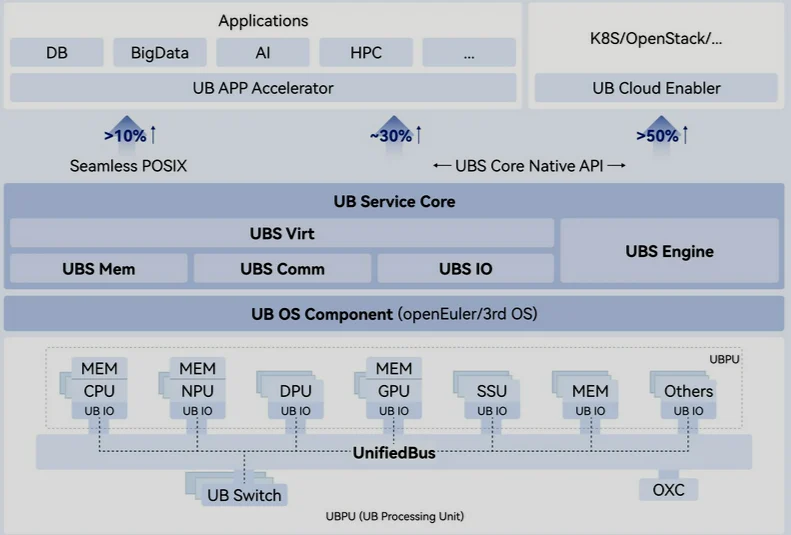
The solution presented by openEuler is the UB Service Core, an open-source software layer that abstracts the complexity of cluster-level management. It provides five foundational services that transform a loose collection of servers into a unified, high-performance engine:

- Engine (Dynamic Orchestration): This service serves as the brain of the cluster, pooling DPU (Data Processing Unit) resources and memory. It enables dynamic scheduling and, perhaps most crucially, automatic failover. If a node within the SuperPoD fails, the Engine redistributes the workload in real-time, ensuring continuous operation for critical AI training tasks.
- Memory (Unified Addressing): By implementing unified-memory programming, the Memory component allows software to treat the cluster’s collective RAM as a single addressable space. This eliminates the latency-heavy process of moving data between local and remote buffers.
- Communication (Interconnect Efficiency): Leveraging the UnifiedBus architecture, this service provides high-performance networking that remains compatible with standard Socket and Verbs interfaces. This is a vital feature, as it allows existing legacy applications to benefit from the performance boost without requiring a complete rewrite.
- I/O (Global Data Caching): AI inference tasks often involve repeated access to massive datasets. The I/O service handles global read/write caching, drastically reducing the time spent fetching data from primary storage and optimizing the pipeline for GPU/NPU utilization.
- Virtualization (Elastic Migration): The Virt component manages virtualization pooling and live-migration policies. It enables administrators to move running virtual machines between nodes without downtime, optimizing communication efficiency between containers and VMs.
According to technical documentation released by the openEuler project, this architecture yields a 30% to 50% performance improvement over conventional distributed systems. By optimizing the "peer-to-peer" nature of the UnifiedBus interconnect, openEuler has successfully minimized the latency that typically plagues AI-scale computing.
Chronology of the openEuler Project
The rise of openEuler is a testament to the maturation of the Asian open-source ecosystem. Incubated and operated under the OpenAtom Foundation, the project has evolved rapidly from a localized Linux distribution into a global powerhouse for enterprise infrastructure.
- Foundation & Early Growth (2019-2021): OpenEuler was established as an open-source OS project, aiming to foster an ecosystem for digital infrastructure. It quickly gained traction among major enterprises in the financial and telecommunications sectors.
- The LTS Milestone (2022-2024): With the release of various Long-Term Support (LTS) versions, the community began focusing on server-side optimization and hardware-software synergy, particularly for ARM-based architectures.
- The AI Pivot (2025): The integration of AI capabilities began in earnest, with the project shifting its focus toward "AgentOS" models, where the operating system itself acts as an intelligent layer for system management.
- LEAP East 2026 (The Present): The showcase of the SuperPoD OS and the formalization of the "Agentic AI in the OS" initiative mark the project’s transition from a standard Linux distro to a specialized, AI-native infrastructure provider.
Agentic AI: The OS as an Autonomous Assistant
Perhaps the most consumer-facing innovation discussed at LEAP East is the integration of Agentic AI directly into the openEuler desktop environment. In version 24.03 LTS SP4, the project introduced "openEuler Intelligence," a desktop AI assistant powered by an agent runtime and Model Context Protocol (MCP) tools.
Beyond the Command Line
While Linux has long been defined by the terminal and manual configuration, openEuler is proposing a future where the OS anticipates the user’s needs. The current iteration of the built-in AI agent is capable of controlling system-level settings within the UKUI desktop environment.
Rather than navigating through complex sub-menus to adjust display brightness, system volume, or wallpaper rotation, users can leverage the agent to execute these tasks via natural language commands. While this may seem like a quality-of-life feature, the technical implications are profound. By building an agentic runtime into the OS, openEuler is creating a framework where developers can build "skills" for the OS—essentially allowing the AI to manage, debug, and optimize system operations autonomously.

This shift toward an "AgentOS" model signals a move away from static desktop environments toward dynamic, reactive interfaces that bridge the gap between human intent and machine execution.
Implications for the Global Open-Source Community
The rapid expansion of openEuler, marked by the recent launch of the Hong Kong User Group, highlights a shift in how open-source innovation is organized. By fostering local user groups that feed into a global pool of contributors, the OpenAtom Foundation is successfully decentralizing the development process.
Impact on Enterprise AI
The SuperPoD architecture directly challenges the status quo for data centers. For enterprises struggling with the exorbitant costs of AI infrastructure, the prospect of a 50% performance increase using open-source, vendor-neutral software is highly attractive. It suggests that the future of AI computing may not be locked behind proprietary, hardware-specific stacks, but rather enabled by software-defined clusters that leverage existing commodity hardware.
Collaborative Innovation
The emphasis on international collaboration, despite the geopolitical complexities often associated with the tech industry, is a central pillar of the openEuler mission. The Hong Kong User Group serves as a regional hub for researchers and organizations to bridge the gap between theoretical research and practical implementation. This model of "community-based ecosystem expansion" ensures that the innovations developed within the project are rigorously tested in diverse environments, from academic laboratories to large-scale industrial data centers.
Conclusion: A New Frontier
As we move further into 2026, the lines between traditional operating systems and AI orchestration layers are blurring. OpenEuler’s recent announcements at LEAP East demonstrate a clear roadmap: optimize the hardware-software interconnect for the AI era and embed intelligence directly into the system’s core.
By prioritizing open-source, high-performance distributed computing and intelligent, agent-based user interfaces, openEuler is doing more than just building another Linux distribution. It is crafting an infrastructure backbone capable of supporting the next generation of global AI workloads. For developers, researchers, and enterprise architects, the message is clear: the most significant developments in infrastructure are increasingly coming from a global community that refuses to be constrained by the limitations of the past.
As the project continues to scale, its ability to maintain this momentum—balancing rapid innovation with the stability required for enterprise production—will likely define its long-term legacy in the annals of open-source history. Whether through the massive, distributed power of the SuperPoD or the quiet convenience of a desktop AI assistant, openEuler is undeniably setting the pace for the future of the OS.