The Ultimate Retro-Revival: OpenSpand Brings Modern Superpowers to the Sinclair ZX81
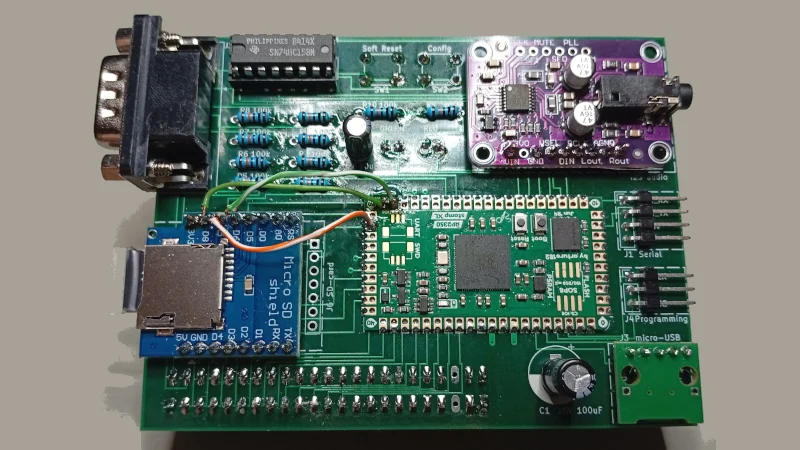
The Sinclair ZX81 remains an icon of British engineering—a device that defined the minimalist aesthetic of the early 1980s home computing revolution. Designed by Sir Clive Sinclair, the machine was a triumph of extreme cost-optimization, offering users a Zilog Z80 processor, a membrane keyboard, and a staggering 1KB of RAM. Today, over four decades after its debut, the ZX81 has been thrust into the modern era thanks to OpenSpand, an ambitious all-in-one expansion project developed by [adam.klotblixt]. This hardware suite effectively transforms the humble 1981 machine into a powerhouse capable of feats that would have seemed like science fiction to the original users.
Main Facts: A Modern Swiss Army Knife for 1981 Hardware
The OpenSpand project is not merely an expansion; it is a total hardware revitalization. By utilizing the RP2350 microcontroller—the latest high-performance silicon from the Raspberry Pi foundation—the device acts as a "bus master" that intercepts and enhances the ZX81’s native operations.
At its core, OpenSpand addresses the most significant bottlenecks of the original architecture. The primary features include:
- Configurable RAM Expansion: Gone are the days of struggling within the 1KB limit. OpenSpand provides access to the full 64KB address space, allowing for sophisticated software that the original machine could never dream of running.
- SD Card Integration: The project cleverly hijacks the standard Sinclair BASIC
LOADandSAVEcommands, allowing users to store and retrieve data from modern SD cards instead of the unreliable cassette tapes of yesteryear. - High-Resolution Graphics and Emulated Sound: By offloading processing to the RP2350, the project enables high-resolution graphical modes and emulated sound chip capabilities, adding multimedia dimensions that were missing from the standard mono-output ZX81.
- Peripheral Connectivity: The expansion includes a joystick port, serial connectivity, and a crisp composite video output, solving the notorious "wobbly" signal issues that plagued the original UHF-based television connections.
Chronology: From Minimalist Roots to Modern Ubiquity
To understand the magnitude of this achievement, one must look at the timeline of the Sinclair ecosystem.
1981: The Genesis
The ZX81 launched as the successor to the ZX80. Its design philosophy was centered on the "Ula" (Uncommitted Logic Array), which reduced the chip count to an absolute minimum. It was a machine that required the user to be a programmer just to make it functional. For the average 1980s schoolchild, the ZX81 was often a gateway to computing that was hampered by its lack of memory and the prohibitively expensive "official" expansion modules.
1982–1990: The Add-on Era
Throughout the 80s, a cottage industry emerged. Third-party manufacturers produced RAM packs (which were notoriously prone to crashing if touched), high-res interfaces, and specialized sound boards. However, these components were fragmented, expensive, and often incompatible with one another.
2024–2025: The Rise of Modern Emulation
The retro-computing community began shifting from "restoration" (keeping original parts alive) to "modernization." Projects utilizing FPGAs and microcontrollers began to appear, aiming to bridge the gap between vintage hardware and modern interfaces.
2026: The OpenSpand Breakthrough
The introduction of the RP2350 microcontroller served as the catalyst for [adam.klotblixt]. By leveraging the immense processing overhead of the RP2350, the OpenSpand project was able to effectively "hide" the limitations of the Z80. The microcontroller now handles the heavy lifting, essentially emulating the environment around the Z80 while allowing the original CPU to believe it is still in 1981.
Supporting Data: Technical Disparity and Hardware Synergy
The disparity between the original ZX81 hardware and the OpenSpand expansion is vast. The original machine operated on a 3.25 MHz Z80 processor with a memory footprint that was, by modern standards, microscopic. The RP2350, by contrast, operates at significantly higher clock speeds with multi-core capabilities and vastly superior I/O throughput.
Hardware Comparison Table
| Feature | Original ZX81 (1981) | With OpenSpand (2026) |
|---|---|---|
| RAM | 1 KB (expandable to 16KB) | 64 KB (User-configurable) |
| Storage | Cassette Tape | SD Card (BASIC compatible) |
| Video Output | UHF/RF Modulator | Composite Video |
| Processing | Z80 @ 3.25 MHz | Z80 (Original) + RP2350 (Co-processor) |
| Audio | None | Emulated Sound Chip |
The technical brilliance of OpenSpand lies in its "transparent" nature. It does not replace the Z80; rather, it disables the original machine’s onboard RAM and ROM and substitutes them with its own high-speed memory modules. This allows the ZX81 to run at full speed without the wait-states or glitches that were common in the original hardware.
Official Responses and Community Impact
The response from the retro-computing community has been overwhelmingly positive. On platforms such as Codeberg and various enthusiast forums, the OpenSpand repository has become a focal point for developers looking to write "modern" software for 8-bit machines.
Industry observers note that this project marks a shift in how we preserve computing history. Rather than keeping these machines in glass cases, the OpenSpand approach turns them into "living" computers. By creating a standardized expansion that covers almost every requirement—save for the legacy printer interface—[adam.klotblixt] has effectively lowered the barrier to entry for new ZX81 hobbyists.
"It is the expansion we all dreamed of as children," one forum user noted. "Back in the 80s, you had to choose between a RAM pack or a better keyboard interface. Now, you get everything in one sleek package that plugs into the back."
Implications: The Future of Retro-Computing
The implications of the OpenSpand project extend far beyond the Sinclair community. It sets a new benchmark for how we integrate modern silicon with legacy hardware.
1. The Death of "Hardware Scarcity"
One of the biggest hurdles in retro-computing has been the scarcity of original, functional add-ons. By utilizing accessible microcontrollers like the RP2350, OpenSpand ensures that the expansion will never go out of production. The hardware is open-source, and the components are widely available, ensuring the longevity of the ZX81 for decades to come.
2. Software Renaissance
With 64KB of RAM and SD card storage, developers are now revisiting the ZX81 with new eyes. We are beginning to see the emergence of games and utilities that are far more complex than the original BASIC programs of the 80s. This is not just emulation; it is the evolution of the platform’s potential.
3. A Template for Other Systems
The methodology used in OpenSpand—using a powerful modern microcontroller to act as a "bus interceptor"—could be applied to other systems of the era, such as the Commodore 64, the Apple II, or the ZX Spectrum. This "wrapper" approach allows users to maintain the tactile feel of the original keyboard and chassis while enjoying the stability and speed of 21st-century technology.
Conclusion
The Sinclair ZX81 was a machine of compromise. It was a computer built for those who wanted to learn the fundamentals of code at a price point that democratized technology. Forty-five years later, the OpenSpand project has removed those compromises. By fusing the iconic, minimalist Z80 hardware with the raw power of the RP2350, [adam.klotblixt] has achieved the impossible: the ZX81 is no longer just a museum piece; it is a viable, high-performance computing platform.
As we look toward the future, projects like OpenSpand remind us that technology—no matter how old—is never truly obsolete. It merely waits for the right interface to bring it back to life. For the ZX81, that interface has arrived, and it is more capable than Sir Clive Sinclair could have ever imagined.