Gravity Linux: The "Distro with an Expiry Date" and the New Frontier of Apple Silicon
In the rapidly evolving landscape of Linux development, few projects have generated as much intrigue as Gravity Linux. Unlike traditional distributions that aspire to build a permanent user base, ecosystem, and corporate legacy, Gravity Linux is an anomaly: a project designed with a built-in expiration date. By positioning itself as a temporary Fedora Remix for Apple Silicon, the project aims to solve the complex puzzle of hardware support for newer Mac architectures, with the ultimate goal of making itself obsolete.
The Genesis of Gravity: A Clean-Room Philosophy
Gravity Linux is the brainchild of developers Cody Ho and Niklas Sheth. The project, which officially entered its alpha stage recently, is built on a foundation of rigorous "clean-room" reverse engineering. This methodology is central to the project’s identity, ensuring that no proprietary Apple source code, disassemblies, or leaked technical documentation are utilized in the creation of its drivers or kernel modules.
The impetus for the project stems from a divergence in development philosophy, specifically concerning the role of Artificial Intelligence in open-source coding. While other notable projects in the Apple Silicon space, such as Asahi Linux, have maintained their own distinct contribution guidelines, Ho and Sheth sought a more experimental approach. This is evident in the Gravity Linux commit history, where kernel branches feature explicit Assisted-By tags. These tags provide transparent attribution to AI coding tools, acknowledging the collaboration between human ingenuity and machine-learning assistance in navigating the complexities of Apple’s proprietary silicon.
Chronology: From Concept to Alpha Release
The timeline of Gravity Linux is short but packed with significant technical milestones.
- Early 2026: Initial conceptualization of a Fedora-based approach to Apple Silicon hardware support begins, driven by the need for a more modular, "remix" style distribution.
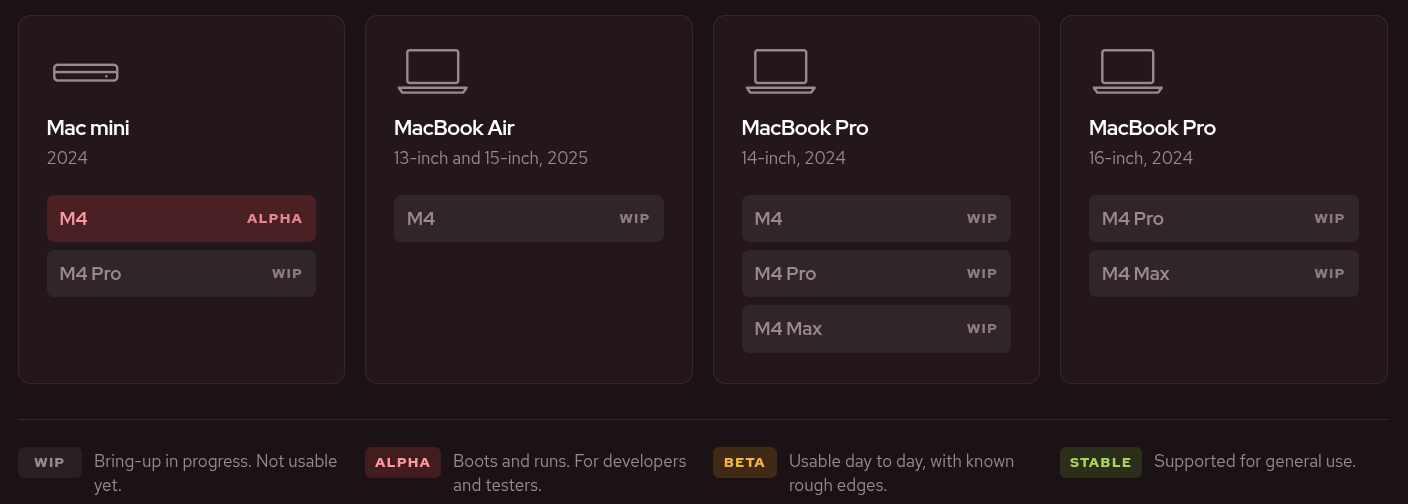
- Mid-2026: Development intensifies, focusing on the M4 Mac mini as the primary target for the first alpha release.
- September 2026: The project officially drops its first public alpha build. This release demonstrates a surprising level of hardware maturity, including functional display controller (DCP) and GPU support.
- Late 2026 (Current Status): The team is currently balancing hardware enablement for the remaining M4 lineup while navigating firmware roadblocks imposed by Apple on the M5 series.
By choosing Fedora as its base, the team leverages a robust, well-supported upstream ecosystem. By defaulting to KDE Plasma on Wayland, they provide a modern, high-performance desktop experience that aligns with the graphical capabilities of the M-series chips.
Technical Foundations and Hardware Support
The first alpha release of Gravity Linux for the M4 Mac mini is a testament to the effectiveness of the team’s reverse-engineering efforts. The inclusion of hardware-accelerated graphics—boasting OpenGL ES 3.0 and OpenGL 3.3 compliance—from the very first boot is a notable achievement for a project of this scale.
However, the team is transparent about the "developer-focused" nature of this release. As with any alpha software, the limitations are substantial:
- Power Management: Suspend/Resume functionality is currently non-functional, which is a major hurdle for laptop-based users.
- Connectivity: Thunderbolt and USB4 support are currently absent, limiting the peripheral ecosystem.
- Display Output: While HDMI output is functional, USB-C (DisplayPort) output remains unsupported.
- Stability: Shutdown and reboot sequences are described as "inconsistent," with the physical power button serving as the primary, albeit clunky, workaround.
- Safety Measures: For hardware longevity, speaker volume levels are currently capped, a precautionary measure against potential driver-related hardware damage.
Crucially, the team has issued a stern warning to early adopters: There is no upgrade path. When the beta release arrives, users will be required to perform a full system wipe and reinstall. This emphasizes that Gravity Linux is currently a laboratory, not a desktop operating system for the casual user.

The M5 Challenge and Future Roadmaps
The project’s roadmap is dictated as much by hardware iteration as it is by software progress. While support for the M4, M4 Pro, and M4 Max is currently the top priority, the M5 series presents a unique technical wall.
Current internal tests indicate that on M5 Pro and M5 Max hardware, macOS 27.0 (Beta 5) firmware leaves the devices in a misconfigured state at boot. This misconfiguration prevents the initialization of secondary CPU cores, rendering the hardware effectively unusable for a standard Linux kernel environment. The Gravity Linux team has decided to pause all M5 development, opting to wait until Apple releases a firmware update or until a reliable method to bypass this configuration error is discovered. This approach ensures that the project remains stable and does not introduce "hacky" fixes that could be easily broken by future Apple firmware updates.
The Philosophy of Obsolescence: Upstreaming as the Goal
The most radical aspect of Gravity Linux is its stated goal: to cease existing. Unlike commercial distributions that rely on market share, Gravity Linux is an engineering project with an "end-of-life" mandate.
The team’s core mission is to document their reverse-engineering processes and contribute every driver, patch, and kernel modification to the official Linux upstream. By working within the GitHub organization to maintain forks of the Linux kernel, Mesa, and U-Boot, the developers are actively preparing their work for integration into the mainline Linux kernel.
Once these drivers are successfully upstreamed, the need for a "Gravity Linux" distribution disappears. Any user running a standard, mainline-compatible Linux distribution (like Fedora, Debian, or Arch) would find their Apple Silicon hardware working out of the box, with full acceleration and peripheral support. At that point, the team intends to "sunset" the project, essentially declaring victory and moving on to the next challenge.
Implications for the Linux Ecosystem
The emergence of Gravity Linux carries several profound implications for the open-source community:
- Transparency in AI Development: By openly acknowledging the use of AI in their kernel commits, Ho and Sheth are setting a precedent for how modern open-source projects might handle machine-assisted development. This move invites a broader conversation about intellectual property, code quality, and the ethics of AI integration in low-level systems programming.
- Modular Distribution Models: The "Remix" approach highlights the viability of creating specialized, short-term Linux distributions to bridge the gap between proprietary hardware and upstream support. This model could potentially be applied to other locked-down architectures in the future.
- The "Asahi" Effect: The existence of Gravity Linux does not necessarily compete with the Asahi Linux project; rather, it diversifies the approach. By having multiple groups attacking the same hardware problem from different philosophical and technical angles, the entire Linux community benefits from a more robust and battle-tested set of drivers.
- Hardware Freedom: The project underscores the inherent struggle of running open-source software on closed, vertically integrated hardware. It serves as a reminder that the work done today by developers like those at Gravity Linux is not just about convenience—it is about ensuring that users have the right to choose the operating system that runs on the hardware they own.
Conclusion: A Project That Wants to Die
Gravity Linux is an unconventional project in a world that usually prizes longevity and growth. In the context of the Apple Silicon ecosystem, however, this temporary existence is its greatest strength. By focusing exclusively on the bridge between current hardware and a future where Apple Silicon is treated as a first-class citizen in the Linux kernel, the project serves a critical purpose.
Whether it succeeds in its mission of total upstreaming remains to be seen. The path is littered with firmware complexities, hardware security measures, and the ever-shifting landscape of Apple’s silicon releases. Yet, the existence of the project itself—transparent, experimental, and inherently selfless—offers a refreshing glimpse into the future of open-source development. It is a project that works tirelessly toward its own extinction, ensuring that one day, the term "Linux on Mac" will be as unremarkable as "Linux on a PC."