AWS Unveils Enhanced Custom Event Bus in Amazon EventBridge to Revolutionize Enterprise Serverless Architectures
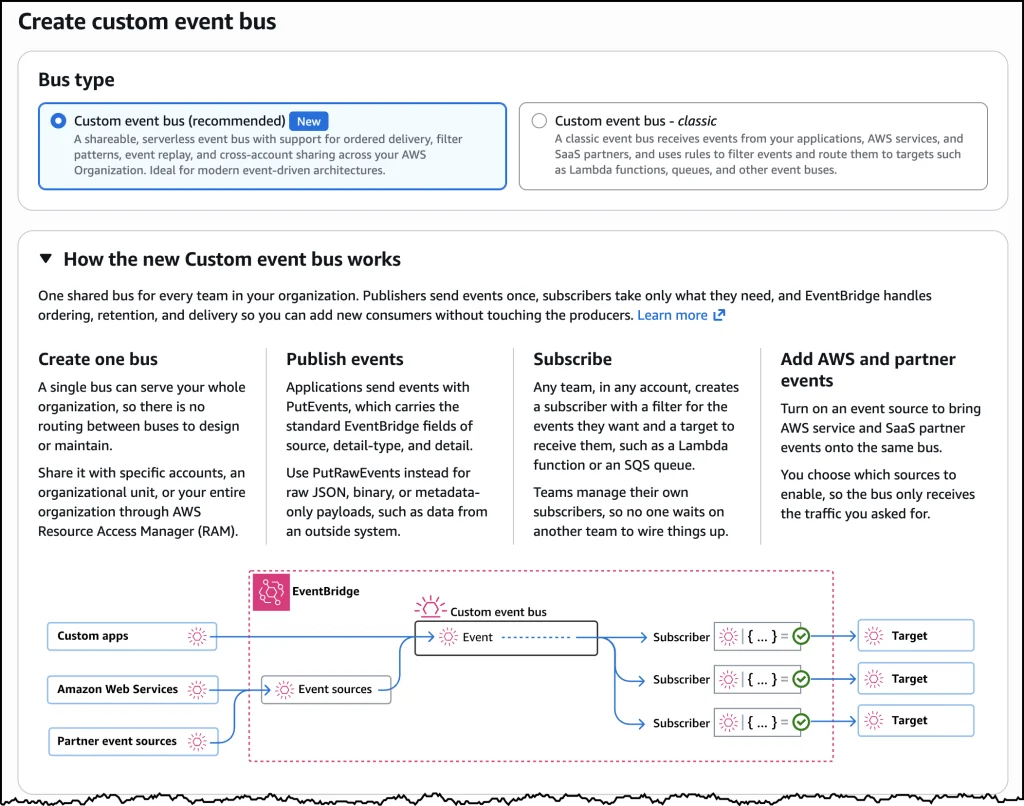
SEATTLE — In a major development for cloud architects and serverless developers, Amazon Web Services (AWS) has announced the rollout of an enhanced custom event bus for Amazon EventBridge. Purpose-built to address the operational friction of scaling event-driven applications across complex, multi-account enterprise environments, the new offering introduces a centralized, organization-wide event backbone.
The launch aims to eliminate the complex webs of cross-account rules and bus-to-bus configurations that organizations have historically relied upon as their cloud footprints expand. By integrating native event ordering, simplified subscriber management, content-based deduplication, and an overhauled pricing model, AWS is positioning this release as a foundational shift in how large enterprises handle distributed asynchronous workloads.
Main Facts
The newly introduced enhanced custom event bus transforms how teams build and manage event-driven architectures within AWS organizations. Rather than forcing individual teams to deploy fragmented, siloed event buses across multiple AWS accounts, platform engineering teams can now provision a single, centralized event bus and share it securely across an entire AWS organization.
Key capabilities of the enhanced custom event bus include:
- Organization-Wide Resource Sharing: Powered by AWS Resource Access Manager (AWS RAM), platform teams can share a single event bus across accounts, organizational units, or specific IAM roles and users without manually configuring cumbersome cross-account resource policies.
- Native Event Ordering: While asynchronous architectures generally thrive on out-of-order execution, the new bus supports strict sequencing via an
EventGroupId. Subscribers can opt into ordered delivery for specific streams—such as logistics tracking or financial transactions—while other consumers on the same bus continue to process events asynchronously. - Streamlined Subscriber Resource: The new "Subscriber" resource consolidates event filtering, target configuration, retry policies, and dead-letter queue (DLQ) destinations into a single, cohesive management unit.
- Advanced Event Evaluation: The architecture now supports content-based deduplication (collapsing identical payloads arriving within a five-minute window), JSONata-based event transformations, and automatic deserialization of Apache Avro or Protocol Buffers payloads.
- Throughput-Based Pricing Model: Shifting away from traditional per-event fees, the new model splits costs between ingress (paid by publishers for events ingested) and egress (paid by subscribers for events delivered), providing predictable economics at scale.
Legacy event buses remain fully supported and will now be designated as "Custom event bus — classic," ensuring seamless continuity for existing enterprise workloads while offering teams an opt-in migration path.
Chronology of Scale: From Single-Bus Simplicity to Multi-Account Complexity
To understand the necessity of this release, industry analysts point to the typical lifecycle of an enterprise adopting Amazon EventBridge.
Phase 1: The Single-Account Inception
When organizations first begin building event-driven applications on Amazon EventBridge, they almost universally adopt a straightforward, centralized topology. A single custom event bus resides within a single AWS account. A handful of microservices publish events, and a corresponding set of rules route those events to downstream consumers like AWS Lambda functions, Amazon Simple Queue Service (SQS) queues, or third-party SaaS endpoints. At this stage, operational overhead is minimal, visibility is absolute, and team velocity is high.

Phase 2: The Multi-Account Explosion
As cloud adoption accelerates, organizational growth dictates decentralization. Following AWS best practices, companies transition from a single-account model to a multi-account structure. Each development team—whether focused on billing, user management, inventory, or shipping—operates within its own isolated AWS account for security and billing isolation.
However, this structural shift introduces architectural friction. To bridge the isolation, teams are forced to create secondary event buses in their local accounts and stitch them together using complex cross-account resource policies and bus-to-bus routing rules.
Phase 3: The Operational Bottleneck
Over time, this workaround effectuates the very operational complexity that serverless computing was designed to eradicate. Platform engineering teams lose centralized visibility into subscription graphs; cross-account routing charges compound unpredictably; and teams requiring strict event ordering or payload transformations are driven to build fragile, custom proxy layers or adopt entirely different message-brokering technologies.
The introduction of the enhanced custom event bus marks AWS’s definitive response to Phase 3, reclaiming the simplicity of the single-bus model while preserving the security boundaries of multi-account governance.
Supporting Data and Technical Architecture
The technical underpinnings of the enhanced custom event bus reflect a deep response to enterprise feedback regarding scaling constraints, payload handling, and delivery guarantees.
Quotas and Capacity
To mitigate the fragmentation caused by legacy subscriber limits, the enhanced custom event bus launches with a default quota of 10,000 Subscribers per bus, with provisions for enterprises to request higher limits. This high-density capacity allows entire corporate engineering organizations to funnel telemetry, business transactions, and system states through a unified pipeline without tripping artificial ceilings.
Synchronous Invocations and Reliability Workarounds
In traditional EventBridge configurations, ensuring sequential processing of correlated events often required interposing an Amazon SQS FIFO queue between the event bus and the target compute resource, such as AWS Lambda.

The enhanced custom event bus eliminates this architectural boilerplate. By supporting synchronous invocation modes for targets like Lambda, the system waits for explicit confirmation of successful downstream processing before acknowledging the event. Paired with the EventGroupId parameter, this enables developers to maintain strict ordering semantics for critical entities—such as individual IoT sensors, user shopping sessions, or vehicle telemetry—without sacrificing the broader benefits of serverless elasticity.
Payload Processing and Transformations
Handling diverse data formats has historically burdened consumers with parsing logic before they can even evaluate an event’s relevance. The new bus addresses this through:
- Payload Deserialization: Native capability to unpack Apache Avro and Protocol Buffers directly into JSON.
- JSONata Integration: Advanced transformation syntax allowing subscribers to reshape, filter, and compute new values inline before payloads reach downstream APIs.
- Content-Based Deduplication: Built-in cryptographic hashing of meaningful payload attributes, identifying and discarding duplicate retries arriving within a five-minute window to deliver true exactly-once execution characteristics.
Official Responses and Industry Perspectives
AWS product leadership has emphasized that the enhanced custom event bus was engineered specifically to bridge the gap between developer agility and enterprise platform governance.
"Organizations want the agility of event-driven architectures, but as they scale across dozens or hundreds of AWS accounts, managing the interconnectivity becomes a full-time job," noted senior engineering leadership during the product launch briefing. "With the enhanced custom event bus, we are returning to the elegance of a single, shared backbone. Publishers don’t need to know who is listening, subscribers self-manage their streams securely through AWS RAM, and platform teams regain total observability without sacrificing multi-account security boundaries."
Early enterprise adopters participating in the preview phase have lauded the architectural relief provided by the new Subscriber resource and the revised pricing model. Financial services and logistics organizations, in particular, highlighted the removal of compounding cross-account data transfer charges as a major financial win for high-throughput event pipelines.
Industry analysts suggest that this release significantly strengthens AWS’s competitive posture in the enterprise enterprise-integration space, neutralizing criticisms that serverless message routing at scale becomes cost-prohibitive or operationally brittle.
Implications for Enterprise Cloud Strategies
The deployment of the enhanced custom event bus carries far-reaching implications for cloud architects, platform engineers, and financial controllers managing enterprise AWS spend.
1. Shift from Decentralized Sprawl to Governed Centralization
Platform engineering teams can now reclaim control over their enterprise event mesh. Rather than acting merely as account provisioners, platform teams can establish a corporate-wide event spine. They retain granular visibility into event catalogs, access control lists, and publishing volumes, ensuring compliance and security without throttling developer velocity.
2. Economic Predictability Through Ingress/Egress Separation
The transition to a throughput-based pricing model—charging publishers for ingestion and subscribers for delivery—fundamentally alters the financial calculus of multi-tenant event busses. In legacy models, routing events across accounts triggered multiple fee layers that scaled non-linearly. The new model aligns costs directly with utility and consumption, enabling more accurate cost allocation and chargeback models across business units.
3. Simplification of Application Topologies
By natively supporting advanced features that previously required auxiliary services—such as content-based deduplication, inline JSONata transformations, and direct SQS-free ordered delivery—architects can deprecate custom proxy functions, validation layers, and intermediary queues. This reduction in component count directly translates to lower maintenance overhead, fewer points of failure, and accelerated time-to-market for new microservices.
Availability and Migration
The enhanced custom event bus is available immediately across a broad footprint of global AWS Regions, including US East (N. Virginia, Ohio), US West (Oregon), Europe (Ireland, Frankfurt, Stockholm, Spain), and Asia Pacific (Hong Kong, Malaysia, Mumbai, Singapore, Sydney, Thailand, Tokyo).
Organizations can begin provisioning the new resource today via the AWS Management Console, the AWS Command Line Interface (AWS CLI), or infrastructure-as-code tools utilizing EventBridge APIs. Because legacy buses remain fully operational under the "classic" designation, enterprises can adopt the enhanced architecture incrementally, migrating mission-critical, high-scale workloads at their own operational pace.