
AlmaLinux Revolutionizes Ecosystem Validation: A New Era of Open-Source Certification


In a move that marks a significant shift in how enterprise-grade Linux distributions interact with hardware and software vendors, the AlmaLinux OS Foundation has unveiled a comprehensive overhaul of its certification ecosystem. By decentralizing the validation process and introducing a lightning-fast, hardware-agnostic testing suite, AlmaLinux is not only lowering the barrier to entry for independent developers but is also creating a massive, crowdsourced public catalog of hardware and software compatibility.
For years, the Linux landscape has been plagued by a persistent challenge: the "compatibility gap." While the kernel supports an immense range of hardware, formal certification—the "seal of approval" that enterprise IT departments demand—has historically been an expensive, time-consuming, and exclusive process reserved for large-scale vendors. With this latest update, AlmaLinux is attempting to democratize that process, allowing the community to prove compatibility for virtually any device or application.
The Core Philosophy: Decentralized Validation
At its heart, the new AlmaLinux certification model operates on a simple but powerful premise: trust, but verify, and share the results. The project has bifurcated its certification efforts into two main branches—Software Certification and Hardware Certification—both of which feed into a unified, public-facing catalog.
Software Certification
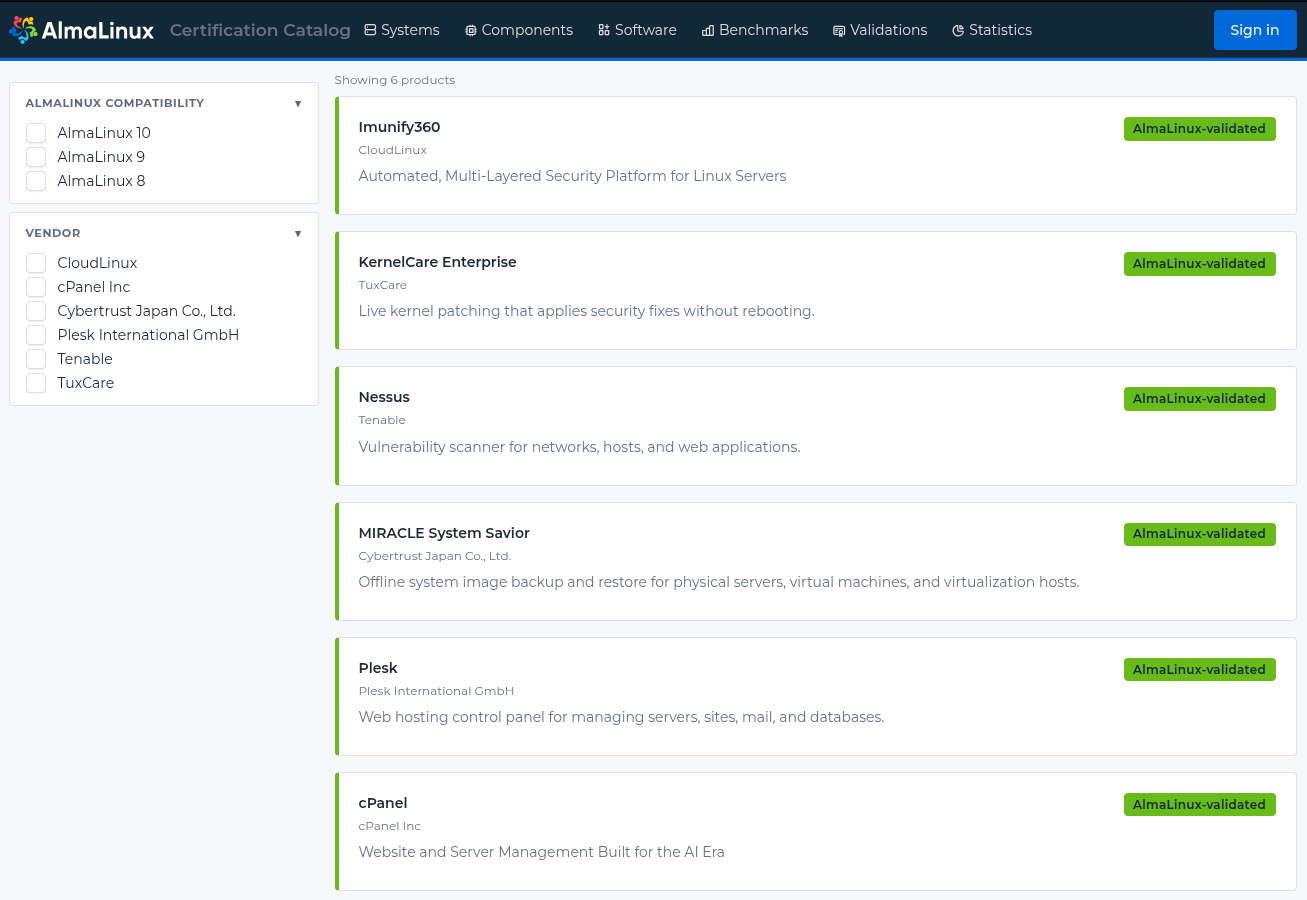
Previously, verifying that a proprietary or open-source software application was "AlmaLinux-ready" was a nebulous task. The new system formalizes this by allowing publishers to list their products and specify which major versions of AlmaLinux they support.
The innovation here is the "confirmation" mechanism. Instead of requiring a centralized laboratory to test every piece of software, AlmaLinux relies on a community-driven verification loop. Users running the software on their own production systems can submit findings to the portal. These submissions act as crowdsourced proof-of-functionality. While this requires a registered account to prevent spam, it creates a living, breathing database of real-world success stories.

Hardware Certification
The most striking technical advancement lies in the complete rewrite of the alma-certify tool. Historically, hardware validation required a clean install of the operating system, which is a significant deterrent for organizations that cannot afford the downtime or the labor cost of wiping production machines.
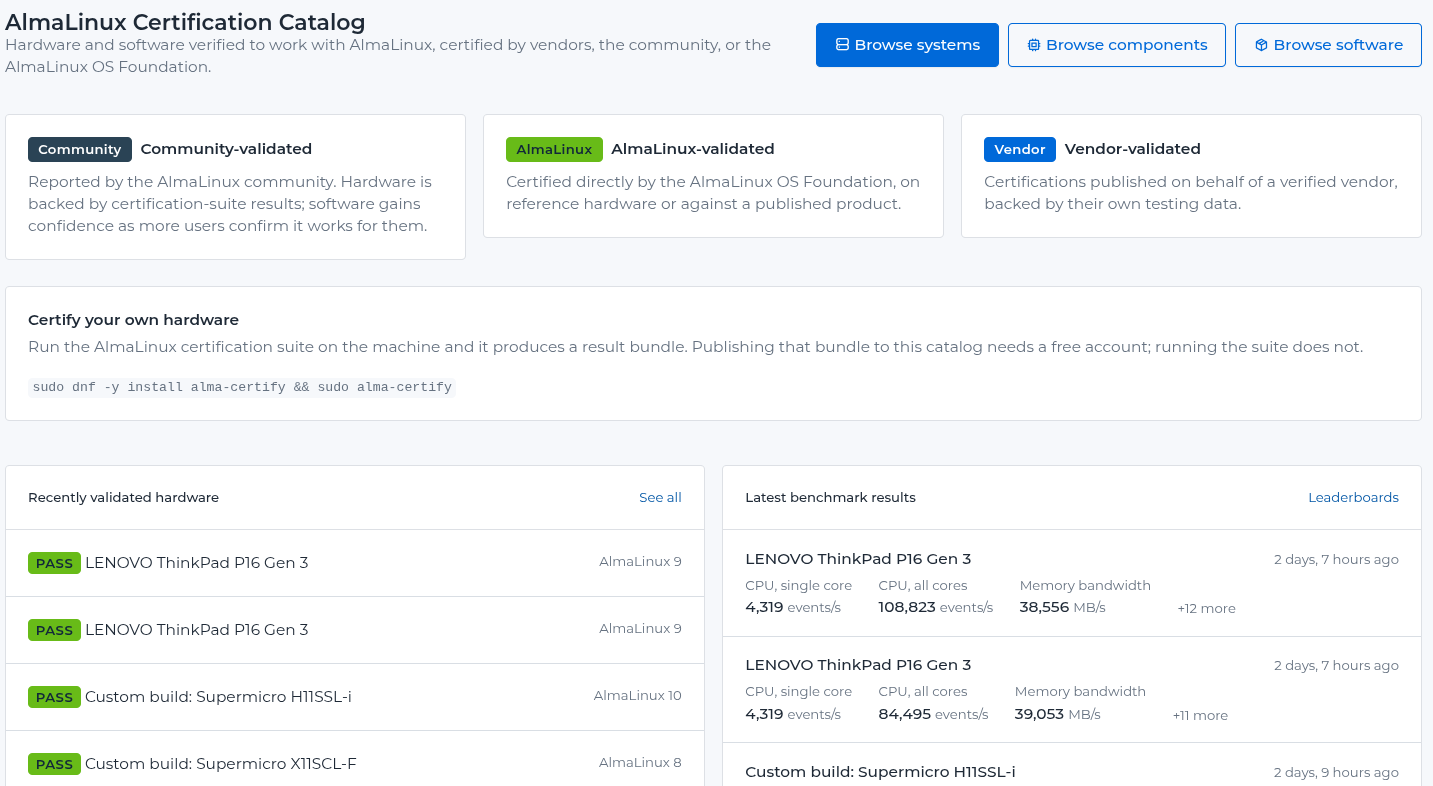
The new iteration of alma-certify is fully portable. It can be run from live media or directly from an existing installation, eliminating the need to re-provision hardware. Furthermore, the tool has been optimized for speed, with developers reporting that most certification runs now complete in under 10 minutes. By integrating a QR-code-based registration flow, the tool captures granular details about a machine’s architecture—including specific driver versions and firmware states—and subjects the system to a rigorous suite of diagnostic checks.
Chronology of Development: From Concept to Community Tool
The evolution of this certification framework did not happen overnight. It is the result of a deliberate strategy to position AlmaLinux as the premier enterprise alternative following the shift in the CentOS ecosystem.
- The Foundation Phase: Following the transition of CentOS Linux to a rolling-release model, the AlmaLinux OS Foundation was established to maintain a binary-compatible, community-governed enterprise distribution. The primary focus was on stability and RHEL compatibility.
- The Infrastructure Gap: As the user base grew, the Foundation identified a bottleneck. Enterprise users were hesitant to migrate critical workloads without official hardware support lists (HCLs). The existing manual certification methods were too slow and too costly for a community-driven project.
- The Engineering Sprint: Throughout 2025, the infrastructure team, led by Jonathan Wright, began developing the
alma-certifytool. The focus was on modularity—ensuring that the tool could be updated to support new hardware generations without requiring a complete overhaul of the certification logic. - The 2026 Rollout: In September 2026, the Foundation officially moved the new certification catalog out of beta. This rollout introduced the web-based portal, the streamlined API, and the new, faster CLI tool, marking the transition from an internal project to a public-facing service.
Supporting Data: The Anatomy of a Certification Run
What does "certification" actually look like under the hood? The alma-certify tool is designed to be comprehensive, ensuring that the term "certified" carries real weight in an enterprise environment.
The diagnostic suite assesses multiple layers of the system architecture, including:

- Compute & Memory: Stress tests to detect ECC memory errors, CPU instruction set issues, and thermal throttling under load.
- Storage Subsystem: Health checks on SSDs and HDDs, including SMART data retrieval and performance consistency tests for NVMe drives.
- Network Stack: Verification of throughput, latency, and driver compatibility for various NICs, ranging from standard 1GbE interfaces to high-speed 100GbE data center interconnects.
- Kernel & Virtualization: Ensuring that the kernel state is optimal for KVM virtualization, verifying that IOMMU groups are correctly configured and that virtualization extensions are enabled and functional.
- Peripherals & GPU: A specialized check for modern accelerators (GPUs/TPUs) to ensure that the necessary drivers are present and that the device is correctly exposed to the user space.
All of these metrics are stored in the AlmaLinux catalog. Because each major version of the distribution is tracked separately, users can filter by OS release, ensuring they only view data relevant to their specific environment. The inclusion of benchmark figures allows potential users to compare performance across different hardware configurations, turning the catalog into a valuable resource for hardware procurement teams.
Official Perspectives: The Value of Community Validation
Jonathan Wright, the Infrastructure Lead for AlmaLinux, has been a vocal proponent of this model. In his recent blog post regarding the update, he emphasized that the project’s goal is not to replace vendor support, but to supplement it with community-verified data.
"Two things would make all of this worth it," Wright noted. "A lot of people and organizations want proof that AlmaLinux runs on the hardware they already own before they’ll give it a try, and now they can get that proof themselves. Every result that gets submitted makes the case to hardware and software vendors that supporting AlmaLinux officially is a low-effort thing to do."
This reflects a sophisticated understanding of the enterprise market. By creating a high-volume, crowdsourced database of successful deployments, AlmaLinux effectively "de-risks" the OS for hardware vendors. When a vendor sees thousands of successful validation reports for their hardware on AlmaLinux, the business case for official, paid-for support becomes undeniable.
Implications for the Open Source Ecosystem
The launch of this platform has profound implications for the future of enterprise Linux.
Lowering Barriers for Independent Vendors
For smaller software vendors or hardware manufacturers, the cost of formal certification with major distributions can be prohibitive. By providing a free, accessible, and automated path to "certification," AlmaLinux is enabling smaller players to participate in the enterprise market on equal footing with industry giants.
Data Transparency and Portability
The decision to provide a free, read-only API for the certification catalog is a major win for transparency. It allows third-party tools, dashboards, and internal corporate compliance systems to pull data from AlmaLinux directly. An IT administrator in a large enterprise could, for example, write a script to check their entire server fleet against the AlmaLinux catalog to identify potential hardware compatibility risks before a mass OS migration.
The Power of "Stacking" Validations
One of the most interesting aspects of the new portal is that validations "stack." If one user validates a specific server model, and a second user does the same, the confidence level for that hardware increases. This creates a reputation system for hardware, where common enterprise machines will quickly become "verified" through the sheer volume of community participation.
Looking Forward: A Call to Action
The success of this initiative rests entirely on the community. For the catalog to be truly useful, it needs scale. The AlmaLinux Foundation is actively encouraging users to run the alma-certify tool on their own systems—not just to prove that things work, but to help build a comprehensive map of the Linux hardware ecosystem.
As independent Linux news coverage continues to highlight, the strength of an operating system lies not just in its kernel, but in its ecosystem. With this new certification framework, AlmaLinux has provided the community with the tools to build that ecosystem themselves, brick by brick, test by test. Whether you are a sysadmin in a data center or a developer with a custom-built workstation, the ability to contribute to the collective knowledge of the Linux world has never been easier.
The transition to this new system is a bold bet on the power of community, and if the early adoption metrics are any indication, it is a bet that is likely to pay off for the entire Linux community. As the catalog grows, it will inevitably become a standard reference point for anyone looking to deploy AlmaLinux in a professional, mission-critical environment.








