Empowering the Edge: Sixfab and DEEPX Bring 25 TOPS AI Acceleration to Raspberry Pi 5
By Tech & Engineering Desk
For years, the discourse surrounding artificial intelligence and machine learning at the edge has been dominated by a false binary: either developers run resource-constrained models on local general-purpose CPUs with mixed performance, or they stream mission-critical data to energy-heavy, latency-prone, and privacy-vulnerable cloud architectures.
While the majority of routine edge computing workloads belong comfortably on the host CPU, a small yet vital minority of applications—such as real-time computer vision, local sensor processing, and compact multimodal interactions—demand dedicated hardware acceleration.
To bridge this gap, hardware ecosystems are evolving rapidly. Raspberry Pi has long democratized computing access for millions of engineers, students, and industrial makers. Now, collaboration within the ecosystem is pushing the hardware past the threshold of simple demonstration scripts.
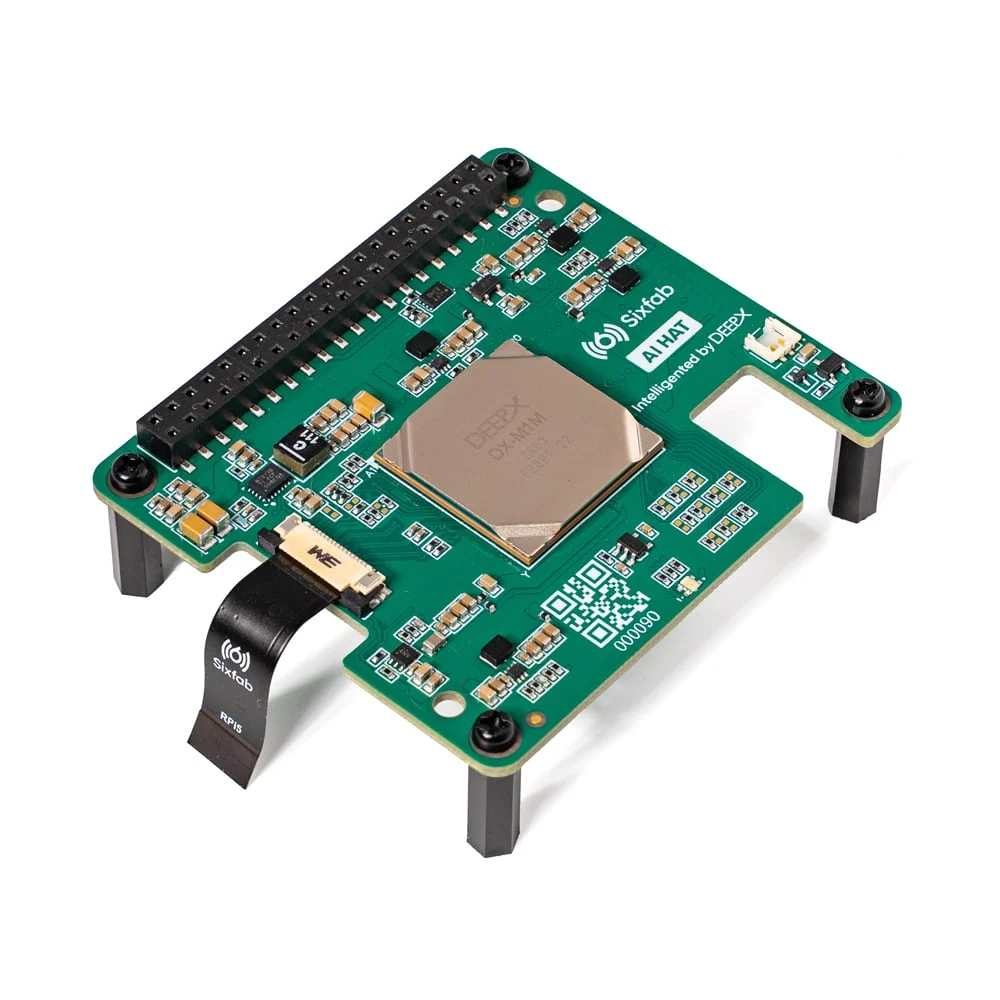
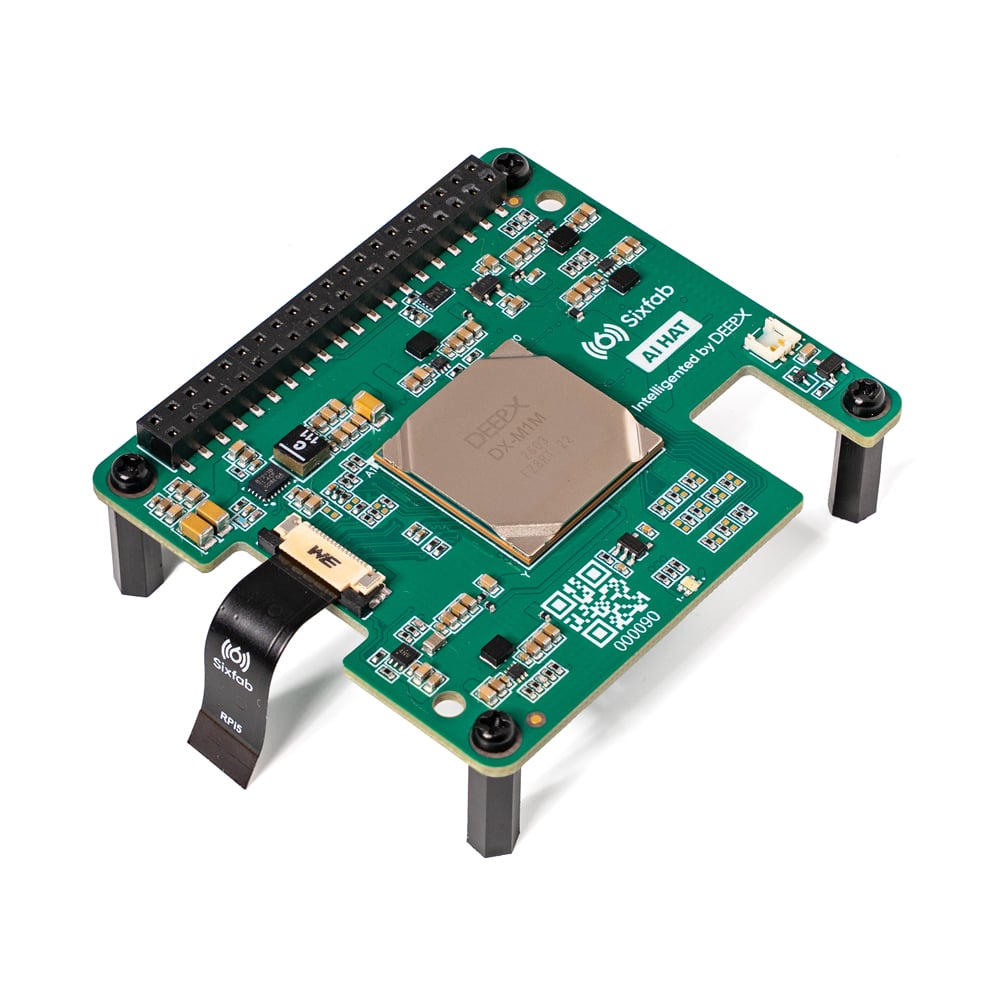
Through a new partnership between Sixfab and DEEPX, Raspberry Pi 5 users gain access to a powerful new hardware tier: the Sixfab AI HAT+. Powered by the DEEPX DX-M1M Neural Processing Unit (NPU), this add-on board delivers 25 TOPS (Tera Operations Per Second) of dedicated AI computing power while consuming a mere 3 watts of sustained operational energy.
By offloading heavy tensor mathematics to the NPU, the Raspberry Pi 5’s CPU remains entirely free to handle camera streams, complex application logic, peripheral connectivity, and physical device control.
Main Facts: The Anatomy of the Sixfab AI HAT+
The release of the Sixfab AI HAT+ marks a significant milestone in edge computing hardware design. Built specifically to integrate with the standard form factor and header layout of the Raspberry Pi 5, the board leverages DEEPX’s advanced silicon architecture to achieve high-density computing without requiring active, noisy cooling solutions or hefty power supplies.
Key Technical Specifications:
- Host Compatibility: Raspberry Pi 5 (fully compatible with Raspberry Pi OS).
- NPU Architecture: DEEPX DX-M1M (offering up to 25 TOPS of dedicated AI performance).
- Power Consumption: Approximately 3 watts of typical sustained NPU power under heavy workloads.
- On-Module Memory: 2 GB of dedicated LPDDR4x memory dedicated to handling vision models, vision-language models (VLMs), and small language models (SLMs).
- Software Ecosystem: Comprehensive support through the DX-COM compiler, DX-RT runtime environment, DX-Stream GStreamer integration pipelines, and a well-populated ModelZoo.
Unlike cloud-dependent solutions that require constant broadband connectivity, the Sixfab AI HAT+ enables fully offline, local decision-making. This capability is paramount for enterprise deployments, security installations, and field robotics where network reliability cannot be guaranteed.
Chronology: The Evolution of Edge AI on Raspberry Pi
The journey toward localized, high-performance edge computing on low-cost single-board computers did not happen overnight. It is the result of years of iterative hardware development and software optimization.
Phase 1: The CPU-Only Era
In the early days of Raspberry Pi AI integration, developers relied exclusively on the main processor cores. While adequate for lightweight image classification or rudimentary text processing, complex neural networks bogged down the system, causing thermal throttling, soaring power consumption, and unacceptably low frame rates for video processing pipelines.
Phase 2: Early USB and PCIe Accelerators
As the demand for computer vision grew, early adopters began experimenting with USB-connected accelerators and rudimentary PCIe add-on modules. While these devices proved that edge inference was possible, they often suffered from driver instability, complex compilation toolchains, and awkward physical integration that undermined the compact nature of the Raspberry Pi.
Phase 3: Native HAT Architecture and the Rise of NPUs
The introduction of the Raspberry Pi 5 brought native PCIe peripheral exposure to the maker community, unlocking high-bandwidth communication channels. Raspberry Pi soon launched its own official AI HAT lines, validating the form factor.
Simultaneously, silicon designers like DEEPX began engineering application-specific NPUs optimized not just for raw benchmark numbers, but for real-world thermal efficiency. The development of the DX-M1 and DX-M1M chips culminated in the hardware integration seen today in the Sixfab AI HAT+, merging high-TOPS performance with sub-watt efficiency classes.
Supporting Data: Efficiency, Accuracy, and Benchmarks
When evaluating edge AI hardware, marketing departments frequently lean on peak TOPS (Tera Operations Per Second) figures. However, seasoned systems engineers know that real-world deployments live and die by their power envelopes and thermal dissipation budgets.
Why Three Watts Matters
An accelerator that consumes 3 watts under sustained load allows for compact enclosures, passive heatsinks, and continuous, 24/7 operation. If an edge device requires massive active cooling fans or high-wattage power management ICs, its deployment footprint expands dramatically, disqualifying it from remote sensor nodes, vehicle interiors, and industrial tight spaces.
Engineering Note: The ~3-watt figure refers exclusively to the typical sustained power draw of the DX-M1M NPU under heavy inference load, not the total wall power of the complete Raspberry Pi system. Engineers are always advised to measure their custom builds—accounting for cameras, NVMe storage, wireless networking, and peripheral loads—under real-world operational conditions.
Real-World Performance Metrics
Benchmarks recorded on a Raspberry Pi 5 (8 GB configuration) running the official Sixfab software release demonstrate the raw throughput capabilities of the NPU architecture:
| Workload & Dimensions | DX-M1M (NPU) Performance | DX-M1 (NPU) Performance |
|---|---|---|
| MobileNet_v2 (240 × 240) | 2,361 FPS | 3,223 FPS |
| DeepLabV3Plus (512 × 512) | 155 FPS | 231 FPS |
| Qwen3-1.7B (96 prefill tokens) | TTFT: 599.04 ms TPS: 4.64 tok/s |
TTFT: 544.58 ms TPS: 11.60 tok/s |
*Note: Performance variances between the DX-M1 and DX-M1M are primarily attributed to memory bandwidth differences, as the DX-M1 utilizes LPDDR5 while the DX-M1M utilizes LPDDR4x.
Official Responses and Engineering Philosophy: One NPU for Three Classes of Intelligence
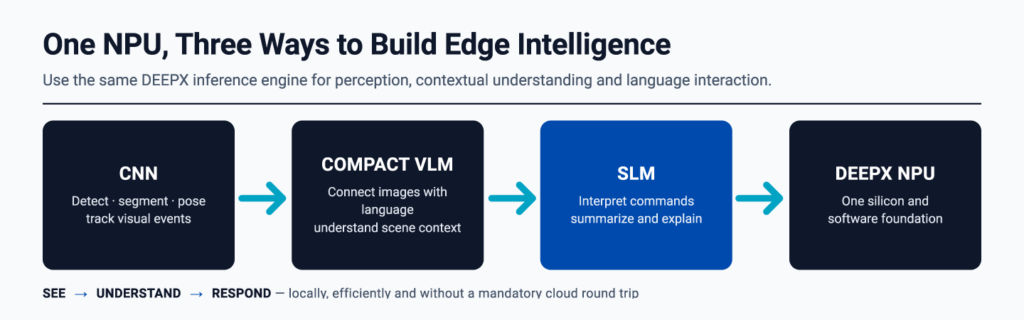
Engineers at Sixfab and DEEPX designed the platform to break away from single-purpose accelerators. Modern edge applications rarely rely on just one type of artificial intelligence model; instead, they require a tiered approach to perception, context, and interaction.
1. Convolutional Neural Networks (CNNs) for Visual Perception
Perception is the foundation of any smart edge system. Whether detecting objects on a factory line, segmenting work areas, estimating human poses, or filtering out background noise, CNNs translate raw camera pixels into structured events. The DEEPX ModelZoo provides pre-optimized examples—including YOLO-family object detectors and pose estimation models—which integrate seamlessly into GStreamer camera pipelines via DX-Stream.
2. Compact Vision-Language Models (VLMs) for Context
Moving beyond simple bounding boxes, modern edge systems must understand context. A compact VLM running on the edge can describe a visual scene, answer targeted questions about an input image, or interpret an anomalous event in natural language—all without leaking proprietary visual data to external cloud servers.
3. Small Language Models (SLMs) for Local Interaction
To make edge devices truly interactive, small language models can interpret human voice commands, summarize local operational events, or generate concise system logs. This creates a natural conversational interface for robotics and automated machinery without requiring constant internet connectivity.
Accuracy-Aware INT8 Deployment
Raw speed is meaningless if a model hallucinates or fails in adverse conditions. DEEPX treats INT8 quantization not as a simple post-processing compression step, but as an accuracy-aware engineering lifecycle.
Edge cameras routinely face difficult operating environments: low-light conditions, intense glare, motion blur, complete occlusion, and unpredictable viewing angles. The deployment toolchain ensures that performance optimizations do not come at the cost of real-world inference reliability.
Implications: Practical Applications and Boundaries
The availability of a 25 TOPS, 3-watt AI accelerator on a ubiquitous platform like the Raspberry Pi 5 unlocks transformative use cases across multiple industries, while also establishing clear technical boundaries.
What You Can Build Today
- Smart Home & Automation: A workbench camera that monitors a 3D print in progress, immediately spotting failure states and texting a snapshot with a natural-language description. A front-door security system that differentiates between a courier, a stray pet, and a suspicious loiterer, compiling a local daily summary without cloud subscription fees.
- Industrial Monitoring: Low-power visual quality assurance and safety compliance tracking situated directly beside active manufacturing production lines.
- Robotics & Autonomous Systems: Compact multimodal perception units running locally on mobile robots, leaving the Raspberry Pi free to execute ROS 2 (Robot Operating System) navigation and motor control logic.
- Privacy-Aware Retail Analytics: Localized customer behavior tracking and occupancy analytics that adhere strictly to local data privacy regulations by processing video streams on the physical device.
Where the Platform Excels—and Where It Doesn’t
Like any engineering tool, the Sixfab AI HAT+ has specific design boundaries. It is not engineered to compete with multi-GPU cloud server clusters. Applications that require massive world knowledge, immensely long conversational contexts, or continuous cloud-scale model training will always require centralized server infrastructure.
The DX-M1M shines when deployed as a tightly scoped, always-on intelligence node sitting directly beside a sensor or camera—where data privacy, zero-latency feedback, complete offline resilience, and a single-digit-watt power budget dictate project success.
Getting Started: From First Boot to First Inference
For developers eager to test the hardware, the process from unboxing to running an inference pipeline has been streamlined for Raspberry Pi OS.
Developers can initialize the environment using standard terminal commands:
sudo apt update && sudo apt install apt-repo-sixfab
sudo apt update && sudo apt install sixfab-dx
dxrt-cli -s        # Confirm device and software status
run_hello_world    # Run a packaged demonstration example
dxtop              # Monitor real-time NPU utilization
From this starting point, developers can select an optimized workload from the ModelZoo or bring their own custom ONNX models through the DX-COM compiler. The resulting .dxnn files execute efficiently via DX-RT’s C++ or Python APIs, empowering the host Raspberry Pi to orchestrate cameras, user interfaces, networking, and physical machine control.
The Complete Software Stack
| Component | Functionality |
|---|---|
| DX-COM | Optimizes and compiles supported ONNX models into native DEEPX .dxnn execution artifacts. |
| DX-RT | Executes compiled .dxnn models using robust C++ or Python APIs on the target hardware. |
| DX-Stream | Constructs high-efficiency GStreamer-based pipelines for video capture, inference, and post-processing. |
| ModelZoo | A repository of pre-optimized example models spanning detection, classification, segmentation, and pose estimation. |
| dxrt-cli / dxtop | Real-time diagnostic utilities tracking device status, hardware utilization, temperatures, clock speeds, and memory allocations. |
Availability and Next Steps
The hardware ecosystem surrounding this release is fully open and documented. Developers can access the open-source DX-AllSuite and ModelZoo repositories on GitHub, while the DEEPX Developer Portal hosts comprehensive documentation, user guides, and community support forums.
The 25 TOPS Sixfab AI HAT+ for Raspberry Pi 5 is available immediately for order through Sixfab’s distribution network, with a complementary 13 TOPS variant slated for release toward the end of 2026. As edge computing continues to mature, hardware pairings like the Raspberry Pi 5 and the Sixfab AI HAT+ prove that high-performance artificial intelligence no longer requires a data center—it belongs right at the edge, in the hands of the creators.