Unlocking Performance: How Tinder Revolutionized Its Android Architecture with the R8 Configuration Analyzer
In the high-stakes world of mobile dating, where user experience is measured in milliseconds, technical debt is more than just a nuisance—it is a barrier to connection. For Tinder, one of the world’s most popular social applications, the challenge was to maintain a seamless, "fun" interface while grappling with an Android codebase that had ballooned into a complex, unoptimized monolith.
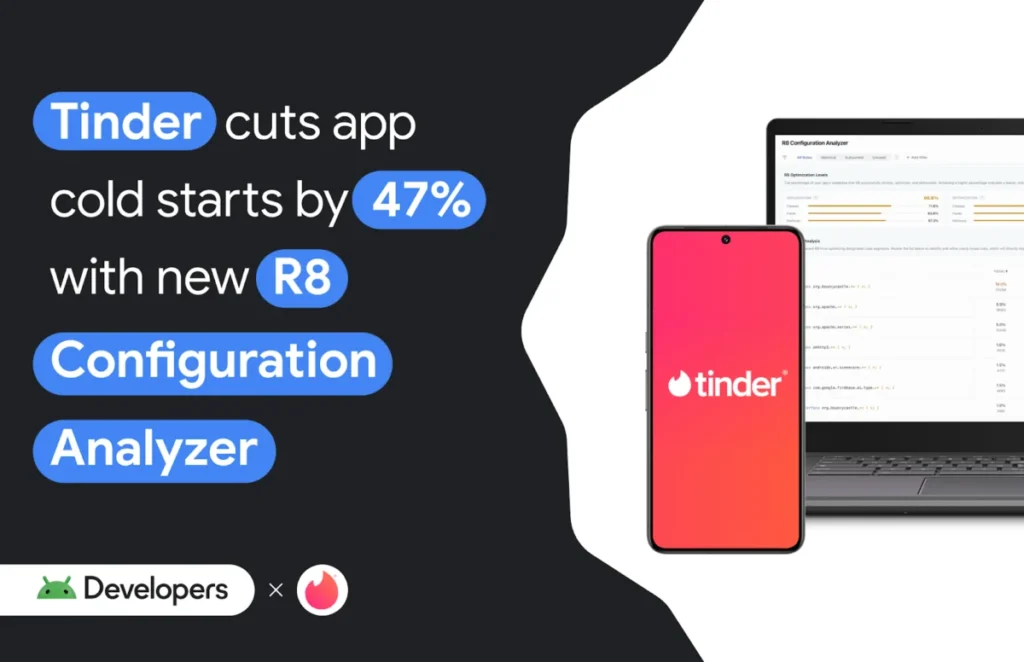
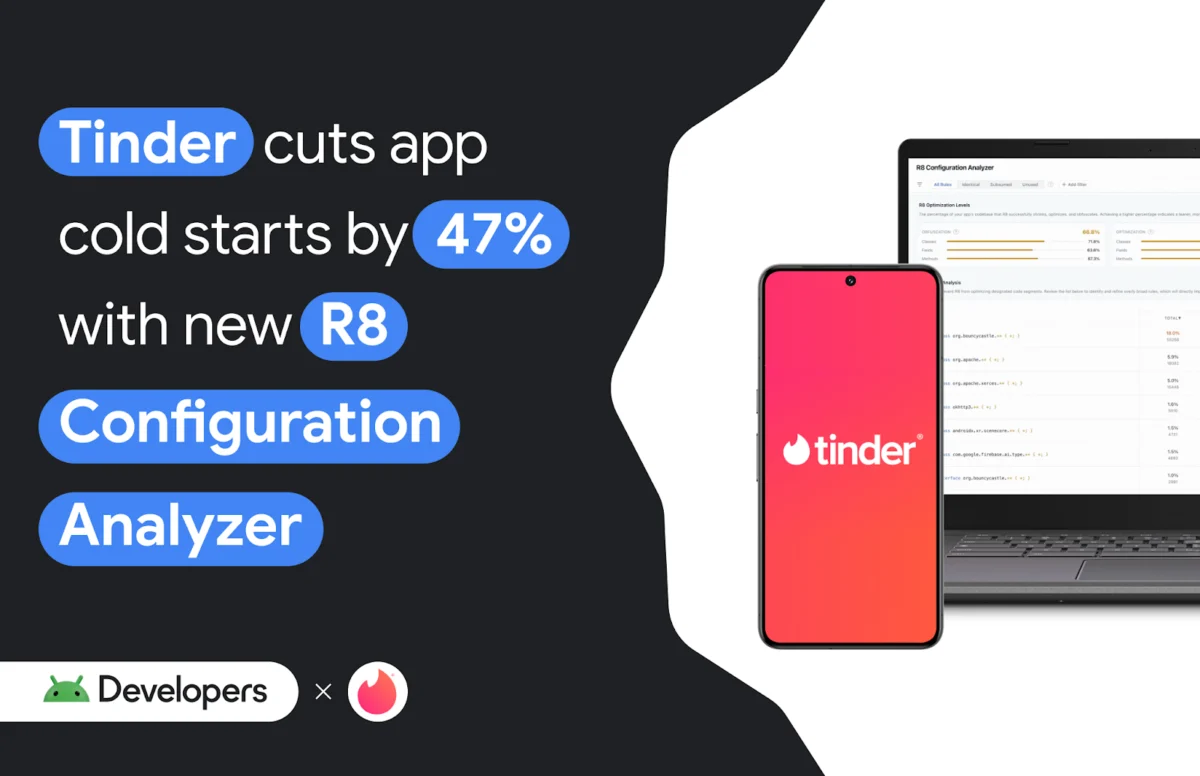
Recent data reveals that Tinder has successfully navigated this technical crossroads. By leveraging the new R8 Configuration Analyzer, the team achieved a staggering 47% reduction in cold start times and a nearly 29% decrease in application download size. This transformation marks a turning point in how large-scale Android applications manage code minification and optimization.
The State of the Monolith: Tinder’s Technical Landscape
Before the intervention, Tinder’s Android application was burdened by legacy architectural choices. Despite utilizing R8—the industry-standard tool for shrinking, obfuscating, and optimizing Android code—the application remained sluggish.
The scope of the problem was significant: 70% of the application remained unoptimized. The codebase was fragmented into 17 distinct dex (Dalvik Executable) files, with three dedicated exclusively to the startup sequence. This fragmentation resulted in excessive overhead, leading to a high frequency of "Application Not Responding" (ANR) errors. For users, this meant a slower entry point into the app, which directly contradicted Tinder’s mission to make meeting people "easy and fun."
The core issue was a "black box" of configuration rules. While R8 was enabled, its potential was severely throttled by thousands of "keep rules"—directives that tell the compiler to leave specific pieces of code untouched. Because the team lacked visibility into which rules were actually necessary and which were merely "dead weight" or over-inclusive, they were effectively flying blind.

Chronology of an Optimization Overhaul
The path to performance optimization began with a comprehensive diagnostic phase. The Tinder engineering team, in collaboration with Google’s Developer Relations, identified that their R8 "Full Mode" was operating at only 28% efficiency.
Phase 1: Identification and Discovery
The team integrated the R8 Configuration Analyzer into their workflow to audit their existing keep rules. The tool provided, for the first time, a granular view of which rules were acting as "optimization blockers."
The investigation quickly revealed a "smoking gun." An internal library, long considered stable and reliable, was inadvertently sabotaging the app’s performance with an excessively broad keep rule:
-keep public class *
    public protected *;
This "wide" rule essentially acted as a blanket shield, preventing the R8 compiler from shrinking or optimizing almost any public-facing code across the entire application. Because this rule prevented runtime crashes, it created a false sense of security; developers continued to rely on it, unaware that it was stifling the compiler’s ability to prune unused classes and methods.
Phase 2: Targeted Refinement
With the R8 Configuration Analyzer providing a map of the "bloat," the team moved from passive observation to active surgery. They began stripping away the broad rules and replacing them with precise, scoped directives. This process required a delicate touch—ensuring that classes required for reflection remained intact while exposing the rest of the codebase to the full force of R8’s optimization engine.

Phase 3: Validation and CI Integration
Following the successful refactoring, the team implemented a continuous integration (CI) monitor. By adding an automated job to their pipeline, they ensured that any future code changes resulting in a regression of optimization scores would be flagged immediately. This shifted the culture from "fix-it-once" to "proactive maintenance."
Supporting Data: The Quantitative Impact
The results of this optimization initiative serve as a masterclass in the importance of build-tooling. By peeling back the layers of unnecessary keep rules, Tinder realized the following improvements:
- Cold Start Latency: A 47% reduction, transforming the user experience from a "loading screen" wait to near-instant availability.
- Application Footprint: A 28.98% reduction in download size, bringing the app down to 61.5 MB. This is particularly crucial for emerging markets where bandwidth is constrained and every megabyte counts toward user retention.
- Stability Metrics: A 28% reduction in user-perceived ANRs, significantly enhancing the app’s reputation for reliability.
- Optimization Efficiency: The R8 optimization score jumped from 28% to 50%, with the team currently working to push this number even higher.
Official Perspectives on the R8 Configuration Analyzer
The R8 Configuration Analyzer is designed to demystify the often-opaque process of Android code shrinking. According to the engineering teams at both Google and Tinder, the tool provides three critical metrics: shrinking scores, optimization scores, and obfuscation scores.
By tracking these, developers can see exactly how much of their code is being removed versus how much is being preserved. More importantly, the tool highlights the "top five most impactful keep rules." By focusing on these five, developers can often resolve 80% of their optimization issues, a classic application of the Pareto Principle in software engineering.
To further aid in this, Google has released an R8 Analyzer Skill for agentic tools. This allows AI-driven development workflows to automatically parse the report, identify the most egregious blockers, and present them to the developer in a concise, actionable format.

Implications for the Industry
The success of this project carries significant implications for the broader Android ecosystem.
The "Internal Dependency" Trap
A primary lesson from Tinder’s journey is that technical debt is often hidden in "stable" internal libraries. Developers often assume that if a library works, its configuration is perfect. Tinder’s experience proves that internal, long-standing projects can be the primary culprits for code bloat. The industry standard is shifting toward treating library configuration rules with the same level of scrutiny as production code.
The Business Case for Performance
Often, engineering performance is viewed as an internal technical KPI. Tinder’s case study highlights the direct link between engineering excellence and business growth. A lighter, faster application is more likely to be downloaded by users in developing regions and is less likely to be uninstalled due to "app lag." In the competitive social discovery market, performance is a feature.
A New Standard for CI/CD
Tinder’s decision to integrate optimization monitoring into their CI/CD pipeline suggests a new industry standard. In the future, "Optimization Score" will likely be as vital as "Unit Test Coverage" or "Code Complexity" when measuring the health of a codebase. By automating the auditing process, teams can prevent "rule drift," ensuring that the codebase remains as lean on day 1,000 as it was on day one.
Conclusion: A Blueprint for the Future
The journey from a 28% optimization rate to 50% is not merely a story of technical triumph; it is a blueprint for any engineering organization managing a large, aging codebase. By utilizing the R8 Configuration Analyzer, Tinder didn’t just fix a performance issue—they gained total visibility into their architecture.

For Android developers looking to replicate this success, the directive is clear: start by auditing the "keep" rules that govern your internal dependencies. Use the R8 Configuration Analyzer to identify the broad rules that are acting as anchors, and treat your build configuration as a living part of your codebase that requires continuous monitoring and refinement.
As Tinder continues to iterate, the goal remains the same: ensuring that the technology powering human connection is as fluid and efficient as the connections themselves. With the right tools and a disciplined approach to configuration, every Android developer has the opportunity to turn their "bloated" monolith into a high-performance, user-centric application.