The Silicon Maverick: How the ESP32-C3 is Redefining Low-Cost Satellite Telemetry
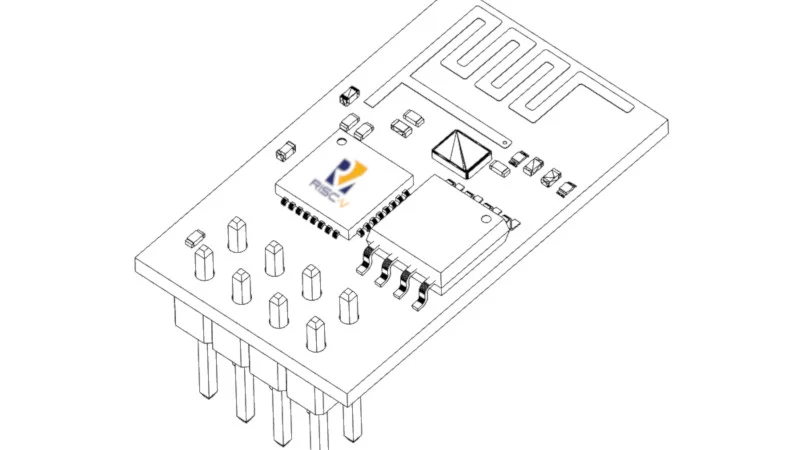
In the world of radio frequency (RF) engineering, the barrier to entry has traditionally been defined by expensive, specialized hardware. For decades, broadcasting a DVB-S2 (Digital Video Broadcasting – Satellite – Second Generation) signal was the domain of satellite operators, high-end broadcast equipment manufacturers, and well-funded laboratories. However, a recent breakthrough by developer [SP8ESA] has shattered this paradigm, utilizing the humble, sub-$2 ESP32-C3 microcontroller to transmit DVB-S2 compliant signals. This development, known as the ESP32-DATV project, represents a fascinating collision between consumer-grade IoT hardware and professional-grade telecommunications standards.
Main Facts: The ESP32-DATV Breakthrough
The ESP32-DATV project is a pioneering implementation that leverages the raw RF capabilities of the Espressif ESP32-C3 chip. Traditionally, the ESP32 series is marketed for its Wi-Fi and Bluetooth capabilities in the 2.4 GHz spectrum. However, [SP8ESA] has bypassed the standard firmware abstraction layers, allowing the chip to output raw samples that conform to the DVB-S2 digital modulation standard.
The architecture of this system relies on a two-tier approach:
- The Host Application: A PC-based software suite handles the computationally expensive tasks, including video encoding, transport stream multiplexing, and DVB-S2 frame encapsulation.
- The Transmitter: The ESP32-C3 acts as the final stage, receiving these prepared samples and driving its internal RF block to transmit the signal, entirely bypassing the need for external modulation hardware or complex FPGA-based signal chains.
This approach is revolutionary because it eliminates the requirement for dedicated Digital-to-Analog Converters (DACs) or external I/Q modulators, which are standard in almost all other DIY DVB-S2 transmitter designs.
Chronology: From IoT Wi-Fi to Satellite Modulation
To understand the significance of this project, one must look at the evolution of SDR (Software Defined Radio) and its integration with consumer microcontrollers.
Early Experimentation (2020–2023)
For years, the hobbyist community relied on devices like the LimeSDR or the HackRF to experiment with DVB-S2. These devices, while versatile, cost hundreds of dollars and required a deep understanding of GNU Radio. During this period, the ESP32 emerged as a popular platform for IoT, but it was largely viewed as an "RF-blind" device by the high-frequency community, limited strictly to its vendor-provided Wi-Fi stacks.
The "Raw RF" Revelation (2024–2025)
The turning point arrived when researchers began to document the undocumented registers within the ESP32’s radio front-end. By manipulating the hardware registers directly, developers discovered that the chip’s internal oscillators and phase-locked loops (PLLs) were far more flexible than the official documentation suggested.
The ESP32-DATV Launch (2026)
Following recent success in SDR-based transmission projects, [SP8ESA] synthesized these findings into the ESP32-DATV project. By late 2026, the developer successfully demonstrated the transmission of a valid DVB-S2 stream. This was not merely a proof-of-concept; it was a functional implementation that proved a microcontroller could be forced to behave as a sophisticated digital video modulator.
Supporting Data: Technical Constraints and Capabilities
While the achievement is impressive, it is vital to ground the project in the reality of its physical limitations.
Frequency Disparity
The primary challenge for any DIY satellite transmission project is the frequency range. The standard DVB-S2 spectrum sits between 10.7 GHz and 12.7 GHz. The ESP32-C3, by design, is tuned for the 2.4 GHz ISM band. Consequently, the output of the ESP32-DATV is effectively "out of bounds" for a standard satellite receiver without significant frequency conversion.
The Hardware Bottleneck
The ESP32’s internal RF block is a closed-loop system optimized for 802.11 b/g/n signals. Forcing it to perform QPSK or 8PSK modulation for DVB-S2 requires pushing the hardware to its absolute limit. While [SP8ESA] has achieved a breakthrough in signal generation, the output power remains extremely low—measured in milliwatts—meaning this system is strictly for laboratory or short-range testing environments.
Frequency Shifting Potential
Technical discussions within the Hackaday community suggest that with clever clock-skipping and external filtering, frequencies as low as 100 MHz could be targeted. However, reaching the true satellite transponder bands would require an external mixer and a power amplifier, effectively turning the ESP32 into a local oscillator and modulator for a larger, more complex radio system.
Official Responses and Industry Reception
The response from the amateur radio (Ham) community and professional engineers has been one of cautious excitement.
The Amateur Radio Perspective:
The Ham community has long championed the democratization of radio technology. Organizations like the AMSAT (Radio Amateur Satellite Corporation) have expressed interest in how such low-cost hardware might facilitate "CubeSat" communications. The ability to use an ESP32 as a transponder controller or even a low-bandwidth beacon transmitter is seen as a major win for accessibility.
The Professional Engineer Perspective:
Industry professionals are more circumspect. Engineers at companies specializing in satellite ground stations have noted that while the project is a "brilliant hack," it lacks the spectral purity and stability required for commercial operation. The ESP32-C3’s internal clock jitter, while sufficient for a hobbyist project, would likely fail to meet the stringent phase noise requirements mandated by international telecommunications regulatory bodies (such as the FCC or ITU) for long-distance, high-bandwidth satellite communication.
Implications: The Future of Democratized RF
The ESP32-DATV project serves as a signpost for the future of telecommunications hardware. It suggests that the boundary between "general purpose" microcontrollers and "specialized" RF hardware is rapidly eroding.
1. Education and Accessibility
The most profound implication is educational. By lowering the cost of entry to DVB-S2 experimentation, the project allows students and hobbyists to understand the complexities of digital video modulation without the prohibitive cost of industrial equipment. This will likely cultivate a new generation of RF engineers who are comfortable manipulating raw hardware registers.
2. The Rise of "Micro-SDR"
We are entering an era where any device with an antenna could, in theory, be repurposed for arbitrary signal generation. This creates both opportunities and challenges. On the one hand, it allows for creative, decentralized networks. On the other hand, it complicates the regulatory landscape, as authorities struggle to police the electromagnetic spectrum when the hardware required to transmit signals becomes ubiquitous and untraceable.
3. Future Iterations
As [SP8ESA] continues to refine the ESP32-DATV project, we can expect to see optimizations in power efficiency and signal stability. Future iterations might incorporate software-based error correction (FEC) that is more robust, or even custom antennas specifically tuned to the harmonics produced by the ESP32’s RF stage, potentially allowing for longer-range testing without the need for additional mixing hardware.
Conclusion
The work of [SP8ESA] and the ESP32-DATV project is a testament to the ingenuity of the open-source community. By repurposing the ESP32-C3—a chip intended for smart lightbulbs and IoT sensors—into a DVB-S2 transmitter, they have demonstrated that the core technologies of space-age communication can be distilled down to simple, affordable silicon.
While the system is not ready to replace a professional satellite uplink, it has successfully unlocked a new avenue for research and experimentation. It serves as a reminder that with enough determination and a deep enough understanding of the hardware, the line between consumer electronics and professional broadcast technology is thinner than we ever imagined. As we look toward the future, the ESP32-DATV project will undoubtedly stand as a foundational moment in the history of accessible radio frequency engineering.