Transforming Intermodal Logistics: How FlexiVan and Hoopo’s SmartChassis Deployment Revolutionizes Unpowered Asset Visibility
By [Industry Analyst / Staff Writer]
Edited by Erik Linask
Main Facts
The modern global supply chain relies on a delicate, highly synchronized dance of container ships, freight rail, and over-the-road trucking. Yet, the physical glue holding this multi-billion-dollar apparatus together often hides in plain sight: the intermodal chassis. These unpowered steel trailers are essential for moving shipping containers between ports, rail terminals, distribution centers, and customer warehouses. For decades, however, managing them has been plagued by a fundamental blind spot. Because chassis lack their own power sources and frequently sit dormant in massive, chaotic yards or transit corridors across vast geographic expanses, knowing merely where a chassis is—a simple dot on a digital map—has proven insufficient for modern logistics demands.
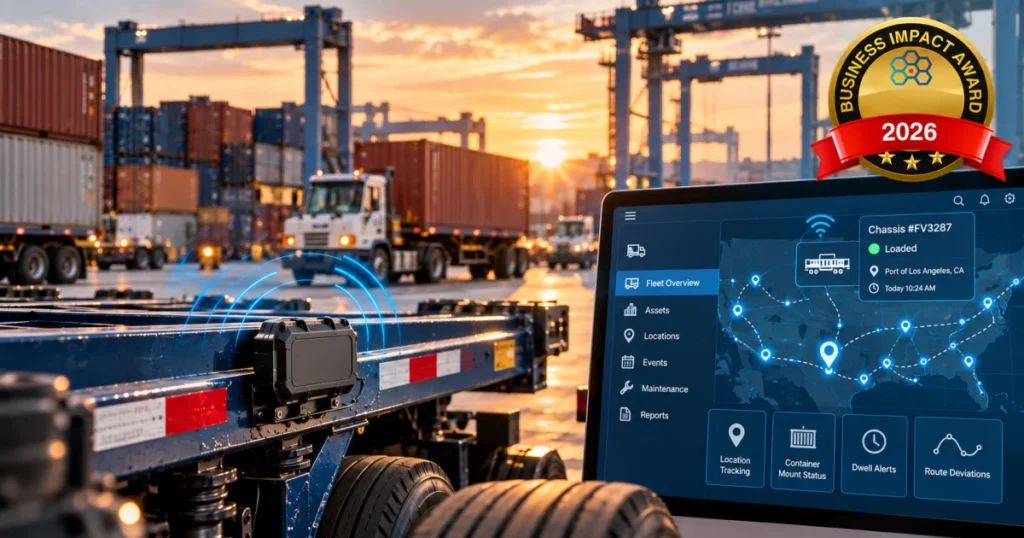
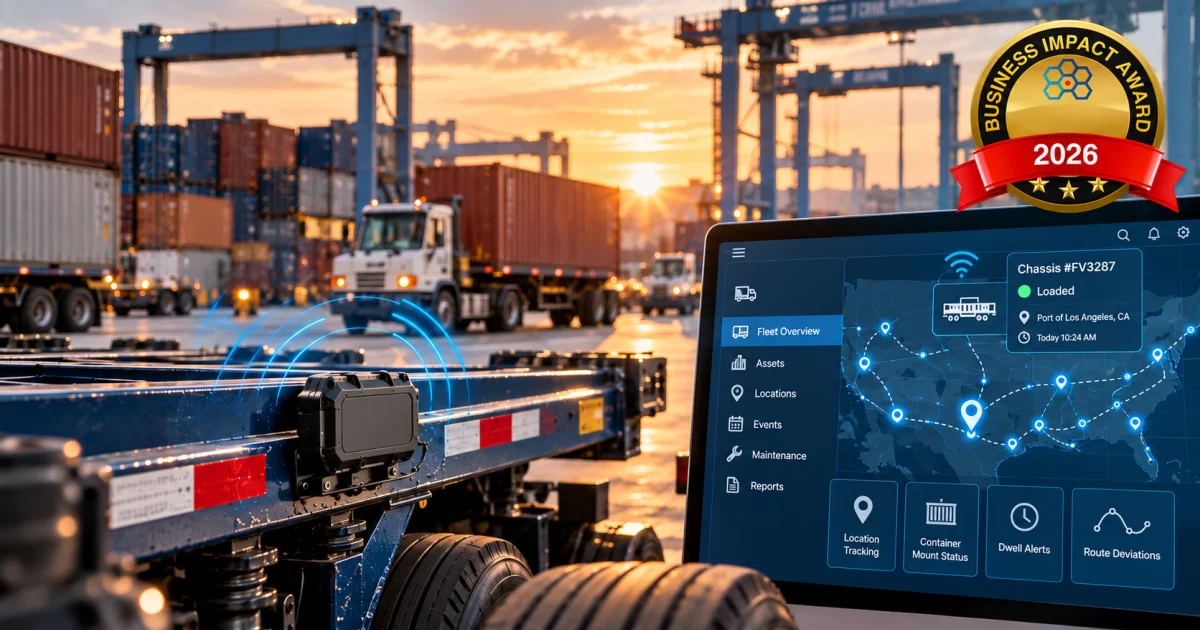
To solve this persistent industry challenge, FlexiVan Leasing, a leading intermodal equipment provider, has executed a large-scale nationwide rollout of advanced Internet of Things (IoT) hardware, selecting Hoopo’s hoopoSense Titan trackers. Integrated directly into FlexiVan’s proprietary AIM360 operations and analytics ecosystem, this deployment breathes digital life into unpowered assets.
The core elements of this technological leap include:
- The Scale of the Network: FlexiVan’s SmartChassis fleet has officially surpassed 75,000 units, operating within an ecosystem that processes more than half a billion chassis and shipment data events annually across nearly 8,000 geofenced intermodal facilities nationwide.
- Edge Intelligence: The hoopoSense Titan is a ruggedized, IP67-rated, battery-operated tracking device boasting a lifespan of up to 10 years. It combines GNSS (Global Navigation Satellite System), Wi-Fi observation, Bluetooth Low Energy (BLE), and cellular communications to ensure uninterrupted connectivity, even in signal-constrained "canyons" and stacked container yards.
- Multi-Modal Sensing: Beyond basic GPS positioning, the device features an integrated radar system capable of accurately determining whether a chassis is bare (empty) or carrying a container.
- Machine Learning Classification: Hoopo’s proprietary rules engine classifies complex operational events—such as gate entries and exits, container mounting and unmounting, cross-border movements, and extended idle periods—achieving greater than 99% accuracy.
- Cross-Departmental Utility: The ingested data does not live in an isolated silo; instead, it directly empowers FlexiVan’s Telematics, Maintenance, Business Intelligence, Commercial, and Loss Prevention teams.
Chronology of the Partnership and Deployment
The journey toward a fully transparent, data-driven intermodal chassis fleet did not happen overnight. It represents the culmination of years of iterative technological development, strategic partnerships, and software integration.
Phase 1: Identifying the Intermodal Visibility Gap (Pre-2023)
Historically, chassis management relied on manual yard checks, driver check-ins, and fragmented legacy tracking systems. As supply chain congestion intensified globally, the limitations of traditional tracking became glaringly apparent. Operators struggled with "ghost inventory"—assets that were technically recorded as being in a specific yard but could not be physically located—alongside unexpected dwell times and unmanaged maintenance issues. FlexiVan recognized that solving these challenges required moving beyond basic GPS dots to capturing contextual operational states.
Phase 2: Embracing GPS-Agnostic Infrastructure and AIM360 Development
Laying the groundwork for advanced telematics, FlexiVan built its AIM360 platform to serve as a centralized nerve center for telematics, maintenance records, billing, and customer-facing analytics. Understanding that a massive fleet cannot rely on a single vendor ecosystem, the company designed AIM360 to be GPS-agnostic. By integrating multiple hardware partners—including BlackBerry Radar alongside emerging innovators like Hoopo—FlexiVan established the capability to ingest, normalize, and act upon millions of incoming spatial and event-driven data streams across thousands of geofenced facilities.
Phase 3: Field-Testing and Selecting the hoopoSense Titan
To address the notoriously difficult radio environments found in stacked container ports and rail yards—where traditional GPS hardware frequently fails due to blocked signals and rapid battery drain—FlexiVan evaluated specialized edge solutions. The hoopoSense Titan was chosen for its unique blend of multi-modal positioning (GNSS, Wi-Fi, BLE) and ultra-low-power consumption architecture. Its one-time, all-in-one installation design minimized ongoing maintenance burdens, making it commercially viable for deployment across tens of thousands of assets.
Phase 4: Full Nationwide Integration and Enterprise-Wide Adoption (Current State)
With the Titan trackers fully deployed across a significant share of FlexiVan’s expansive SmartChassis fleet, the partnership has entered its operational impact phase. Real-time telemetry, advanced mount-status indicators, and machine learning-driven event classifications are now feeding continuously into AIM360. This milestone has earned Hoopo and FlexiVan prominent industry recognition, including Business Impact Award honors, validating the thesis that unpowered asset tracking can achieve high reliability, multi-year battery performance, and deep operational integration.
Supporting Data and Technical Architecture
To fully appreciate the scope of FlexiVan’s deployment, one must examine the underlying architecture that bridges physical hardware constraints with enterprise-grade cloud software.
Overcoming the Power and Signal Dilemmas of Unpowered Assets
The primary technical hurdle in asset tracking has always centered on energy and connectivity. Powered assets—such as semi-trucks or refrigerated reefers—draw continuous electrical current from an engine alternator. Unpowered assets like chassis, however, rely entirely on internal battery cells.
- Intelligent Transmission Policies: The hoopoSense Titan utilizes dynamic firmware protocols that adjust communication intervals based on asset state (moving versus stationary), preserving battery health while ensuring critical updates are transmitted without delay. This enables an operational lifespan reaching up to a decade.
- Multi-Layered Positioning: In dense intermodal yards where towering shipping containers block direct line-of-sight to GNSS satellites, the Titan leverages Wi-Fi fingerprinting and Bluetooth Low Energy (BLE) beacons. This multi-modal redundancy ensures that location data is never completely lost, even deep within concrete-laden or metal-dense port facilities.
Data Processing Scale
The sheer volume of information handled by FlexiVan’s ecosystem highlights the necessity of robust data engineering:
- 75,000+ Units: The size of the active SmartChassis fleet utilizing advanced telematics.
- ~8,000 Geofences: Intermodal yards, rail ramps, ports, and customer facilities meticulously mapped within the AIM360 software.
- 0.5 Billion+ Events: The annual volume of chassis movements, boundary crossings, mount changes, and telemetry data points processed and translated into actionable insights.
Transforming Raw Telemetry into Operational Context
A raw coordinate update stating that Asset A is at Latitude/Longitude X, Y offers limited utility to a dispatcher. The true innovation of the Hoopo-FlexiVan integration lies in machine learning event classification. The Titan’s integrated radar system determines physical load status (bare vs. loaded chassis), while Hoopo’s rules engine interprets complex movement patterns to instantly categorize events:
[Physical Asset: hoopoSense Titan]
       │ (GNSS / Wi-Fi / Radar / BLE)
       ▼
[Edge Intelligence & ML Classification]
       │ (Detects: Mount Status, Gate Crossing, Idle Time)
       ▼
[FlexiVan AIM360 Platform]
       │ (Normalizes across 8,000+ geofences)
       ▼
[Enterprise Actionable Insights]
   ├── Telematics & Routing Optimization
   ├── Automated Maintenance Scheduling
   ├── Billing & Commercial Analytics
   └── Loss Prevention & Dwell Monitoring
This data architecture allows operations teams to stop guessing and start executing based on real-time operational truth.
Official Responses and Industry Perspectives
Industry leaders involved in the deployment emphasize that the true measure of success is not the hardware itself, but the operational intelligence it unlocks.
Don Alfarone, Vice President of Technical Services at FlexiVan, encapsulated the company’s core philosophy during the rollout:
"Our goal is not simply to capture location, but to enable true intelligence. By integrating multi-modal sensing directly into our operational workflows, we can optimize routing, quickly identify stalled or abandoned assets, and proactively schedule field repairs before minor issues cascade into costly operational delays."
Analysts and industry observers note that the collaboration between FlexiVan and Hoopo establishes a new benchmark for the intermodal sector. For decades, supply chain stakeholders accepted the "visibility gap" beneath container logistics as an unavoidable cost of doing business. Unpowered assets were treated as black boxes once they left a terminal gate.
By proving that ruggedized, low-power edge IoT devices can communicate reliably within complex radio environments—and subsequently plug seamlessly into a GPS-agnostic enterprise platform like AIM360—the partnership demonstrates that asset legibility is entirely achievable at a national scale.
Implications for the Future of Intermodal Logistics
The successful integration of the hoopoSense Titan within FlexiVan’s SmartChassis fleet carries profound implications for the broader transportation and supply chain landscape.
1. Shift from Reactive to Proactive Fleet Management
Traditionally, chassis maintenance and asset recovery operated on a reactive basis. Equipment was often serviced only after a driver complained of a mechanical failure at a gate, or searched for days when reported missing. With continuous breadcrumb histories, automated dwell anomaly alerts, and predictive maintenance triggers flowing into AIM360, fleet managers can transition to a proactive maintenance posture. Worn components, abnormal idling, and prolonged bottlenecks at specific customer facilities can be addressed immediately, reducing downtime and lowering total cost of ownership.
2. Enhanced Asset Utilization and Faster Turns
In intermodal logistics, velocity is everything. The faster a chassis completes its cycle—from port to rail ramp, to distribution center, and back—the higher the revenue generation for leasing companies and motor carriers. By eliminating blind spots and providing instant visibility into bare versus loaded chassis states, dispatchers can route nearby equipment precisely where demand is highest, dramatically improving asset turn rates and alleviating port congestion.
3. Blueprint for Interoperability in Industrial IoT
As the IoT landscape matures, organizations increasingly reject proprietary, closed-loop ecosystems that force them to lock into a single hardware vendor. FlexiVan’s GPS-agnostic architecture—capable of ingesting data streams from BlackBerry Radar, Hoopo, and other providers simultaneously—serves as a blueprint for enterprise IoT integration. It demonstrates that the future belongs to platforms that can ingest diverse edge intelligence, normalize it, and distribute it across multi-departmental business workflows (from billing to loss prevention).
Conclusion
The collaboration between FlexiVan and Hoopo is much more than a routine hardware upgrade; it is a masterclass in modern systems engineering. By bridging the physical constraints of unpowered assets with advanced multi-modal sensing, machine learning event classification, and enterprise-wide software integration, they have transformed the humble intermodal chassis from an invisible logistics variable into a fully legible, intelligent participant in the national supply chain. As supply chains face mounting pressures for speed, efficiency, and resilience, making assets transparent to both people and systems marks a monumental leap forward for the industry.