Giving Voice to the Past: The "Perfect Paul ][ Brings Iconic DECtalk Speech Synthesis to the Apple ][ via Modern RP2040 Engineering
By Technology & Retrocomputing Desk
Published: September 2026
Main Facts
Retrocomputing enthusiasts and speech-synthesis historians have reason to celebrate a remarkable bridge across the decades. Maker and developer Michael Wessel has introduced the Perfect Paul ][, a drop-in DECtalk emulator card designed specifically for the legendary Apple ][ computer. This clever peripheral brings the distinct, high-level text-to-speech capabilities of the Digital Equipment Corporation (DEC) DECtalk—a system historically reserved for industrial, institutional, or high-budget applications—straight into the chassis of a classic 8-bit personal computer.
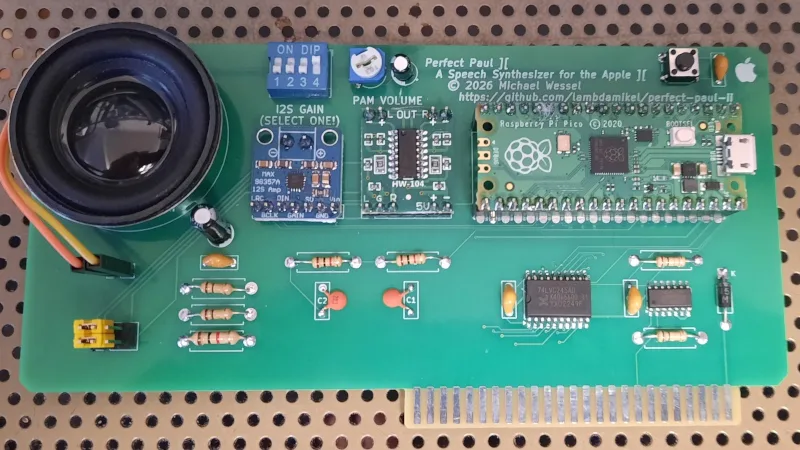
At its technical core, the Perfect Paul ][ relies on modern, low-cost silicon. Rather than attempting to source rare, vintage proprietary chips or bulky hardware units, Wessel’s design centers around an RP2040 microcontroller setup acting as a bridge. Surrounding this processing core is an I2S Digital-to-Analog Converter (DAC), an onboard audio amplifier, and dedicated bus interface logic that allows the card to speak directly to the Apple ][ backplane.
Operationally, the system is designed for maximum simplicity and compatibility. Users do not need to rewrite, patch, or recompile legacy software to enjoy speech output. Instead, the Apple ][ interacts with the card via memory-mapped I/O. By executing simple POKE commands to designated memory addresses, software writes DECtalk command strings directly to the peripheral. The hardware handles the rest, translating text commands into the instantly recognizable, emotive, and heavily synthesized vocal output that defined early digital speech.
The audio chain is entirely self-contained. Once the Apple ][ places a command on its internal bus, the interface logic routes it to the RP2040. The microcontroller renders the audio stream, which is then converted by the I2S DAC, amplified, and projected through an attached 2-watt, 8-ohm speaker. Because the audio processing and generation happen locally on the card, the host Apple ][ experiences virtually no computational drag, leaving its 6502 processor free to run applications, games, or utilities uninterrupted.
Chronology
To understand the significance of the Perfect Paul ][, it is helpful to trace the timeline of speech synthesis, the rise of the DECtalk, and the gradual evolution of Wessel’s retrocomputing project.
- 1984 – The Birth of the DECtalk: Digital Equipment Corporation officially releases the DECtalk, a standalone hardware text-to-speech device engineered by a team led by Dennis Klatt at MIT. Its iconic, distinctively human-yet-robotic voices—most famously "Perfect Paul," "Huge Harry," and "Kit the Kid"—become a cultural touchstone, later famously used by physicist Stephen Hawking.
- The 1980s and 1990s – The Apple ][ Voice Era: While the Apple ][ sees various speech peripherals over its commercial lifetime—such as the Apple Speech Chip and various Echo speech synthesizers by Street Electronics—high-end, formant-based synthesis like the DECtalk remains largely out of reach for the average home consumer due to its prohibitive cost and bulky external enclosure requirements.
- The Modern Microcontroller Revolution (Late 2010s – Early 2020s): The release of low-cost, high-performance microcontrollers like the Raspberry Pi RP2040 changes the landscape of DIY electronics. Makers begin emulating vintage sound chips, synthesizers, and entire computer systems using compact, inexpensive surface-mount boards.
- Development Phase: Michael Wessel conceptualizes a hardware-accurate, drop-in DECtalk software emulation layer tailored specifically for vintage 8-bit bus architectures. By targeting the Apple ][ expansion slot standard, Wessel focuses on creating a seamless memory-mapped interface.
- September 2026 – Public Release: Wessel publishes the complete documentation, schematics, and software repository for the Perfect Paul ][ on GitHub (
lambdamikel/perfect-paul-ii), accompanied by live demonstration videos showing vintage Apple ][ software effortlessly speaking via the new hardware card.
Supporting Data
The hardware specifications and engineering parameters of the Perfect Paul ][ illustrate a careful balance between modern acoustic performance and vintage form-factor constraints.
Hardware Specifications
- Host Compatibility: Apple ][, Apple ][+, Apple //e, and compatible systems utilizing standard 50-pin peripheral slots.
- Processing Core: Raspberry Pi RP2040-based module handling the emulation routines and DECtalk text-to-speech translation engine.
- Audio Subsystem:
- High-fidelity I2S digital-to-analog conversion.
- Integrated audio amplification stage.
- Standard speaker pairing: 2-watt, 8-ohm speaker (approximately 66 mm in diameter) yielding an acoustic sensitivity of 86 dB.
- Frequency response range: Optimized for the 400 Hz to 4,500 Hz speech band, ensuring optimal clarity and intelligibility for synthesized vocal formants.
- Bus Interfacing: Custom logic mapping the card directly into the Apple ][ memory space, allowing register reads and writes via standard machine-language or BASIC commands.
- Open Source Availability: Complete firmware, layout files, and documentation hosted publicly on GitHub under developer username
lambdamikel.
Cost and Resource Efficiency
While exact manufacturing costs fluctuate depending on component sourcing, the reliance on mass-produced RP2040 boards and standard I2S audio amplifiers keeps the Bill of Materials (BOM) exponentially lower than acquiring an original, vintage standalone DECtalk unit on the secondary collector’s market. Furthermore, because the RP2040 manages all heavy lifting regarding phoneme generation and digital signal processing (DSP), the Apple ][ requires zero hardware upgrades to its motherboard or main system RAM.
Official Responses
While the Perfect Paul ][ is an independent open-source hardware project rather than a commercial product launched by a major corporation, the reaction from the retrocomputing community, digital preservationists, and maker forums has been overwhelmingly enthusiastic.
In release notes and documentation accompanying the official GitHub repository, designer Michael Wessel emphasized the modular philosophy of the project:
"The card presents itself to the bus as just another peripheral. Existing software needs to know nothing about the card; it just has to address the commands in the right place… The same chain can be adapted: it would be easy to port the card to other 8-bit machines as well, changing only the bus interface part."
Early testers and community members on retrocomputing message boards have praised the plug-and-play nature of the memory-mapped architecture. Unlike software-only speech synthesizers that consume valuable 6502 cycles and occupy scarce RAM, the Perfect Paul ][ acts as an autonomous coprocessor. Community feedback highlights the eerie accuracy of the DECtalk formant emulation, noting that hearing classic "Perfect Paul" utterances emerge from an Apple //e chassis evokes an authentic mid-1980s high-tech atmosphere that was previously impossible to achieve without cumbersome serial cable hookups to external hardware boxes.
Implications
The introduction of the Perfect Paul ][ carries significant implications for several distinct communities, ranging from vintage computer preservationists to modern embedded systems developers.
1. Breathing New Life into Legacy Software
For decades, text-to-speech on 8-bit computers was constrained by the limitations of primitive phoneme-based chips (such as the General Instrument SP0256 or early Votrax chips). These chips offered robotic, often barely intelligible output. By successfully marrying an RP2040-class DECtalk emulator to the Apple ][ expansion bus, Wessel has elevated the audio capabilities of an 8-bit machine to industrial standards of the 1980s.
Crucially, because the card operates via memory-mapped POKE commands, historical programs, educational software, and text adventures written decades ago can immediately take advantage of advanced speech synthesis without requiring a single line of source code to be rewritten. Educational titles that originally featured silent text prompts can now speak aloud, offering a richer, more immersive historical experience for museum curators, educators, and hobbyists.
2. A Blueprint for Cross-Platform Retro-Peripherals
One of the most profound takeaways from the Perfect Paul ][ architecture is its modularity. As Wessel noted in project documentation, the core audio chain—consisting of the RP2040, I2S DAC, amplifier, and speaker—is entirely decoupled from the bus interface logic.
This design choice establishes a powerful architectural template for future retrocomputing hardware. Developers working on other classic platforms—such as the Commodore 64, Atari 8-bit family, Sinclair ZX Spectrum, or MSX—need only redesign the bus interface and address-decoding logic to port the entire DECtalk emulation stack to their favorite machines. This decoupling minimizes redundant software development and encourages collaborative hardware hacking across different machine ecosystems.
3. The Democratization of Vintage Technologies
Original DECtalk hardware units have long been regarded as holy grails for sound designers, hackers, and speech-synthesis collectors, often commanding exorbitant prices on auction sites due to their rarity and specialized application history. By synthesizing the core behavior of the DECtalk through modern microcontrollers, projects like the Perfect Paul ][ democratize access to historical audio tech. Enthusiasts no longer need deep pockets to experience the golden age of formant-based speech synthesis; they can fabricate, solder, and program their own units using widely available, inexpensive modern components.
Ultimately, the Perfect Paul ][ stands as a stellar example of modern maker culture honoring computing history. By seamlessly fusing a 1980s 8-bit expansion slot with a 2020s microcontroller, Michael Wessel has ensured that the iconic voice of the digital past will continue to speak, clearly and distinctly, for decades to come.