Building with Purpose: How an AI-Generated Mobile Game Sparked a New Wave of Accessible Coding and Charitable Giving
Amid an endless news cycle saturated with debates over artificial intelligence—ranging from job displacement concerns and academic shortcuts to dystopian warnings about the degradation of the digital ecosystem—it is easy to forget the foundational spark that drew most developers into computing in the first place: simple, unadulterated creativity.
Proof of this joy arrived quietly with the launch of Maker Lab, a frantic, time-management puzzle game designed for iOS devices. Available as a free download on the Apple App Store, the game was built entirely from scratch in just 12 days during a developer’s staycation. Notably, the creator did not write a single line of code by hand. Instead, they acted as an opinionated producer, engaging in an iterative feedback loop with an advanced AI coding agent: describing an idea, testing the output, and detailing corrections until the product met their vision.
The project highlights a broader paradigm shift. While high-end proprietary models drive major commercial workflows, lightweight, local hardware—most notably affordable single-board computers like the Raspberry Pi—is democratizing AI-assisted development. Furthermore, Maker Lab transcends a technical exercise, transforming into a deeply personal vehicle for charitable fundraising and cognitive awareness.
Main Facts: The Anatomy of Maker Lab
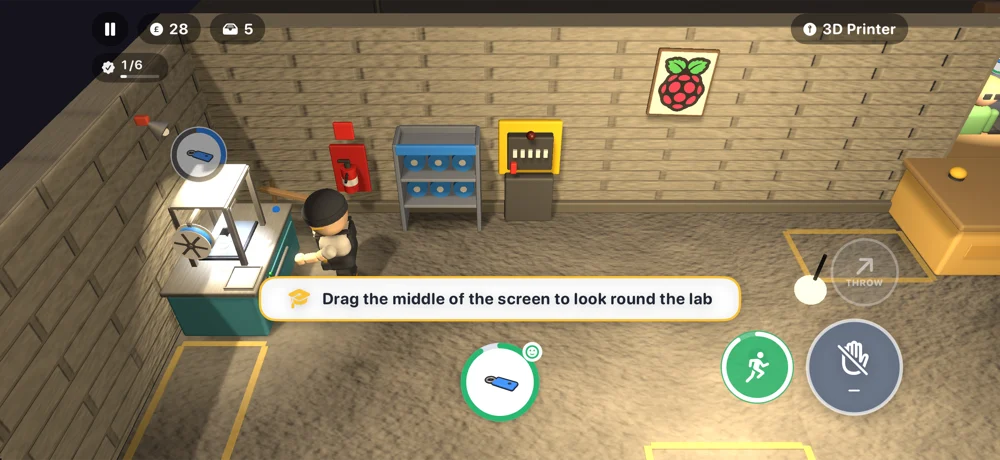
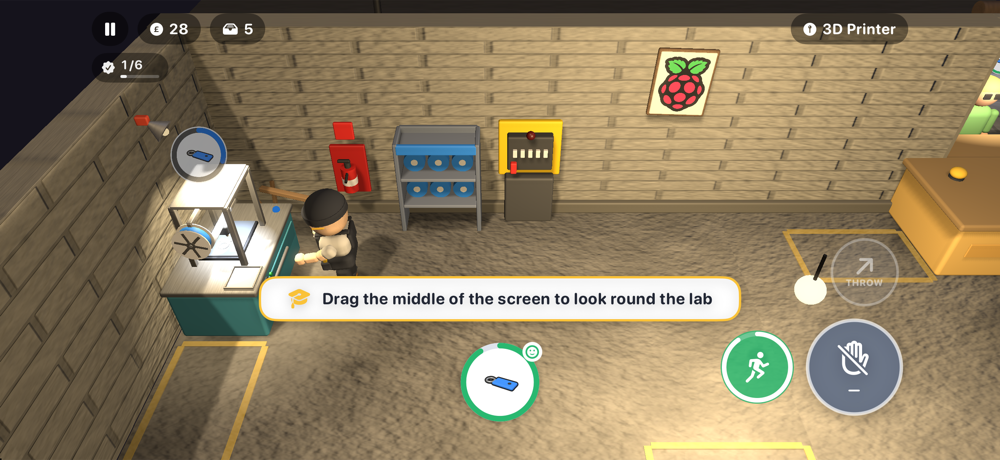
At its core, Maker Lab borrows the frantic, high-stress cooperative mechanics of hits like Overcooked, but pivots the setting from a commercial restaurant kitchen to a high-tech community makerspace.
Players are confronted with impatient customers arriving at a service hatch demanding bespoke manufactured goods, ranging from custom 3D-printed keyrings and laser-engraved coasters to intricate carbon-fiber drone frames. The player must manage a chaotic workshop equipped with 3D printers, laser cutters, CNC mills, and traditional hand benches—all while operating with a single pair of hands. Success requires a meticulous juggling act: fetching raw stock, loading machines, multitasking across the room, retrieving finished parts, and beating customer patience timers.
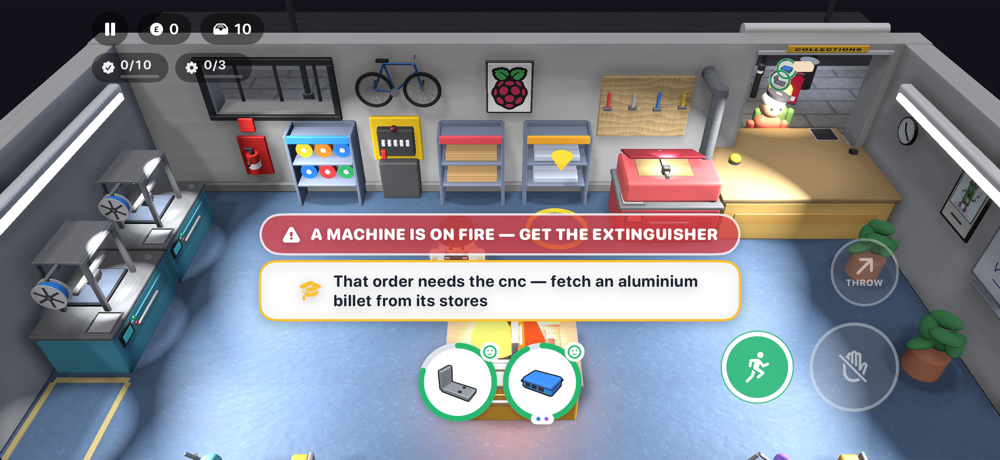
Progression in the game is visually and mechanically rewarding. Players begin their journey in a grimy, uninsulated lock-up garage featuring bare-bulb lighting, breeze-block walls, oil stains, and a rusty bicycle propped against the corner. As players clear successive levels, the workspace undergoes a dramatic physical transformation. Clutter is cleared, robust shelving units are installed, and the once-rusty bicycle is meticulously restored to become a brightly lit centrepiece of the studio.
However, the game’s difficulty scales sharply as players advance:
- Levels 1–4: An introduction to basic resource management, single-machine setups, and core workshop mechanics.
- Level 5 Onward: Industrial hazards are introduced. Machines begin to malfunction and jam. If neglected, jammed equipment catches fire, forcing the player to drop everything, fetch a fire extinguisher, and save the workshop.
- Level 9 Onward: Electrical infrastructure begins to fail. Power trips intermittently, requiring the player to sprint across the map to reset breakers located in distant corners, though manual hand benches remain unaffected by power outages.
- Level 10 Completion: Clearing the final tier unlocks a mysterious, yet-to-be-spoiled reward on the character customization screen.
Chronology: From Blank Directory to App Store Launch
The rapid development of Maker Lab over a 12-day window demonstrates the accelerating speed of modern software prototyping tools.
Days 1–3: Conceptualization and Core Loop
The project began as an empty folder on a local machine. Utilizing a top-tier LLM integrated into a specialized coding environment (such as Claude Code), the developer established the base mechanics. Because the AI agent had direct access to the project directory, it was capable of building the application, executing automated test suites, launching the software inside the iOS Simulator, and visually parsing screenshots of its own graphical output.
Days 4–7: Mechanics, Audio, and Escalation
With the core movement and item-handling loops established, the creator expanded the game environment to feature distinct machinery. Uniquely, the game’s rich auditory landscape—every distinct click, interface beep, and mechanical motor hum—was generated entirely through custom Python scripts synthesising audio on the fly rather than relying on pre-recorded sample libraries.
Days 8–10: Environmental Evolution and Stress Testing
The narrative progression of the garage transforming into a pristine makerspace was coded during this window, alongside the integration of late-game hazard mechanics like machine fires and electrical breaker trips.
Days 11–12: Polish, Compliance, and Deployment
The final days were spent refining gameplay balance, eliminating bugs identified through automated test frameworks, and navigating Apple’s App Store submission guidelines to ensure a frictionless release for end users.
Supporting Data: Democratizing AI Development via Raspberry Pi
While Maker Lab was brought to life using heavy-duty cloud-hosted LLMs, the underlying philosophy of conversational programming is no longer locked behind enterprise paywalls or high-end workstations.
Developers, educators, and hobbyists can replicate this exact "describe, test, and correct" workflow locally using accessible hardware. A Raspberry Pi 5 equipped with 8GB or 16GB of RAM is fully capable of running small, open-weight language models locally via frameworks like Ollama or llama.cpp.
Advantages of Local AI Deployment
- Zero Cost: No ongoing subscriptions, account registrations, or per-token API charges.
- Complete Privacy: Local execution ensures all prompt data and code remain strictly on the local device.
- Offline Functionality: Development workflows continue seamlessly even with network Wi-Fi disabled, making local AI ideal for classrooms, remote maker clubs, and kitchen-table programming sessions.
Expanding Capabilities with Raspberry Pi AI Hardware
For users looking to push local inference further, Raspberry Pi’s hardware ecosystem provides dedicated acceleration modules:
- AI HAT+: Handles intensive computer vision tasks, such as real-time object and person detection via camera feeds.
- AI HAT+ 2: Features a Hailo-10H neural network accelerator capable of delivering up to 40 TOPS (Trillion Operations Per Second) of inferencing performance. Armed with its own 8GB of dedicated memory, the AI HAT+ 2 can effortlessly run compact coding models like
Qwen2.5-Coder, offloading computational overhead entirely from the host Raspberry Pi board.
Implications: Cognitive Health, Personal History, and Philanthropy
Despite being structured as a lighthearted arcade puzzle game, Maker Lab carries a profound personal and social mission. The application features zero advertisements, tracking scripts, or in-app purchases. Instead, a solitary, unobtrusive button in the settings menu directs users to an official JustGiving page supporting the Alzheimer’s Society.
The Intersection of Gaming and Cognitive Function
The fast-paced mechanics of Maker Lab demand significant cognitive overhead. Players must simultaneously hold multiple customer orders in their working memory, plot spatial navigation routes across a crowded workshop floor, manage time-sensitive machinery, and maintain peripheral awareness for sudden equipment failures.
These tasks rely heavily on working memory, executive planning, and sustained attention—precisely the cognitive faculties that neurodegenerative conditions like dementia systematically erode. While the developer is careful to note that a mobile puzzle game is not a therapeutic medical treatment, the thematic connection is deliberate. The cognitive load required to master the game serves as a poignant reminder of the mental agility that dementia strips away from patients and their loved ones.
A Personal Connection
The project is rooted in the creator’s personal history. The visual progression of the game—evolving from a cluttered, solitary garage workspace into a refined, community-oriented laboratory—mirrors the developer’s own professional trajectory, moving from grassroots tinkering to leading maker initiatives. Coupled with the reality of watching a family member battle Alzheimer’s disease, the integration of the charity donation link transforms the app from a simple coding experiment into a deeply meaningful philanthropic vehicle.
Conclusion
Maker Lab stands as a rebuttal to modern anxieties surrounding artificial intelligence. Rather than replacing human creativity or degrading digital culture, AI was harnessed here to compress a monumental software engineering task into a manageable, joyful two-week sprint.
By demonstrating that complex applications can be conceptualized through plain-language dialogue—and that these methods scale down to affordable, credit-card-sized computers like the Raspberry Pi—the project reclaims the playful spirit that originally drove generations of programmers to the keyboard.
Maker Lab is available now as a free download on the iOS App Store. For those inspired by the project, the path forward is simple: have fun, build something new, and give something back.