The Ghost in the Machine: How Gregory Kurtzer Used AI to Build an OS Kernel in 11 Days
In the annals of open-source history, few names carry as much weight as Gregory Kurtzer. As the visionary behind the CentOS project and the subsequent founder of Rocky Linux and CIQ, Kurtzer has spent decades navigating the complex, often contentious waters of Linux enterprise development. However, his latest endeavor, "Ginux," represents a departure from traditional open-source methodology. It is not a fork, not a distribution, and not a community-driven iteration of existing code. It is an entirely new, Rust-first, x86-64 operating system kernel—written, architected, and debugged almost exclusively by an artificial intelligence agent.
This project, which recently made waves across the developer community, marks a potential inflection point in how complex systems software will be constructed in the coming decade. By leveraging a methodology Kurtzer terms "Human-Directed Agentic Engineering" (HDAE), he has demonstrated that the barrier to entry for building fundamental infrastructure has been lowered from "large, funded teams over several years" to "a single expert and an AI agent over eleven days."
The Genesis of Ginux: Beyond the Linux Fork
At its core, Ginux is a paradox. It is an independent operating system kernel, yet it is fully Linux-compatible. While the industry is accustomed to seeing new "distros" that swap out desktop environments or package managers, Ginux is a complete ground-up rewrite of the underlying engine. It features its own bespoke memory management, scheduler, process model, file system, and device support.
The "G" in Ginux, according to Kurtzer, is a playful nod to "GPT." While one might assume the name implies a connection to the GNU project or the Linux kernel, Kurtzer has clarified that it is a tribute to the AI model that did the heavy lifting: GPT-5.6 Sol. By implementing the Linux Application Binary Interface (ABI), Ginux allows existing Linux binaries to execute without modification. It treats "Linux" not as a kernel to be installed, but as a personality or an interface layer that Ginux exposes to user-space applications.
Technical Architecture
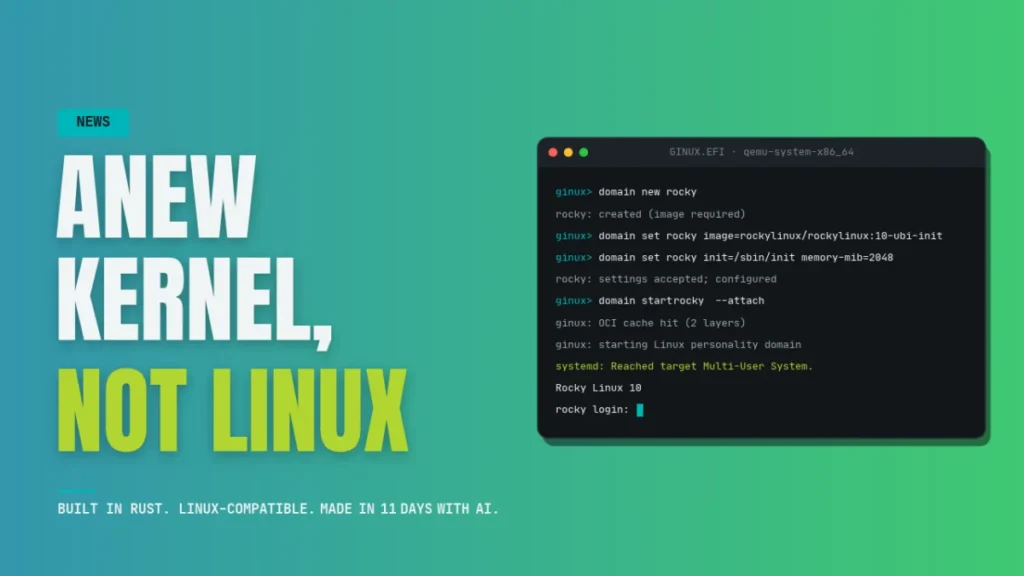
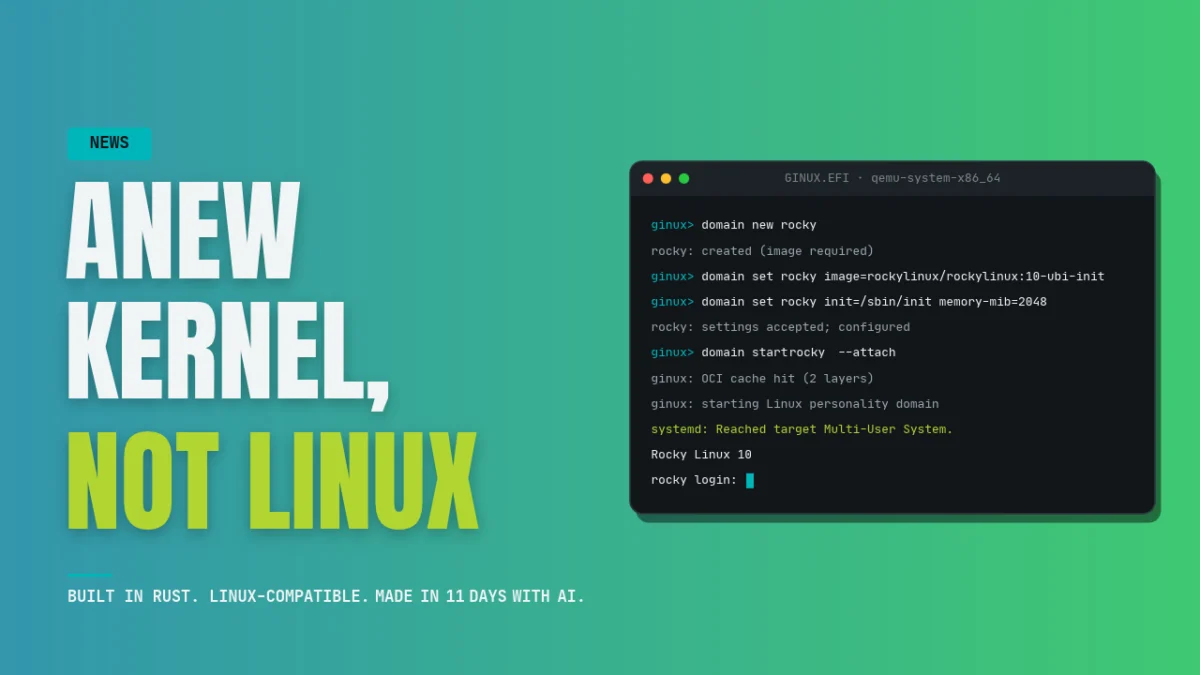
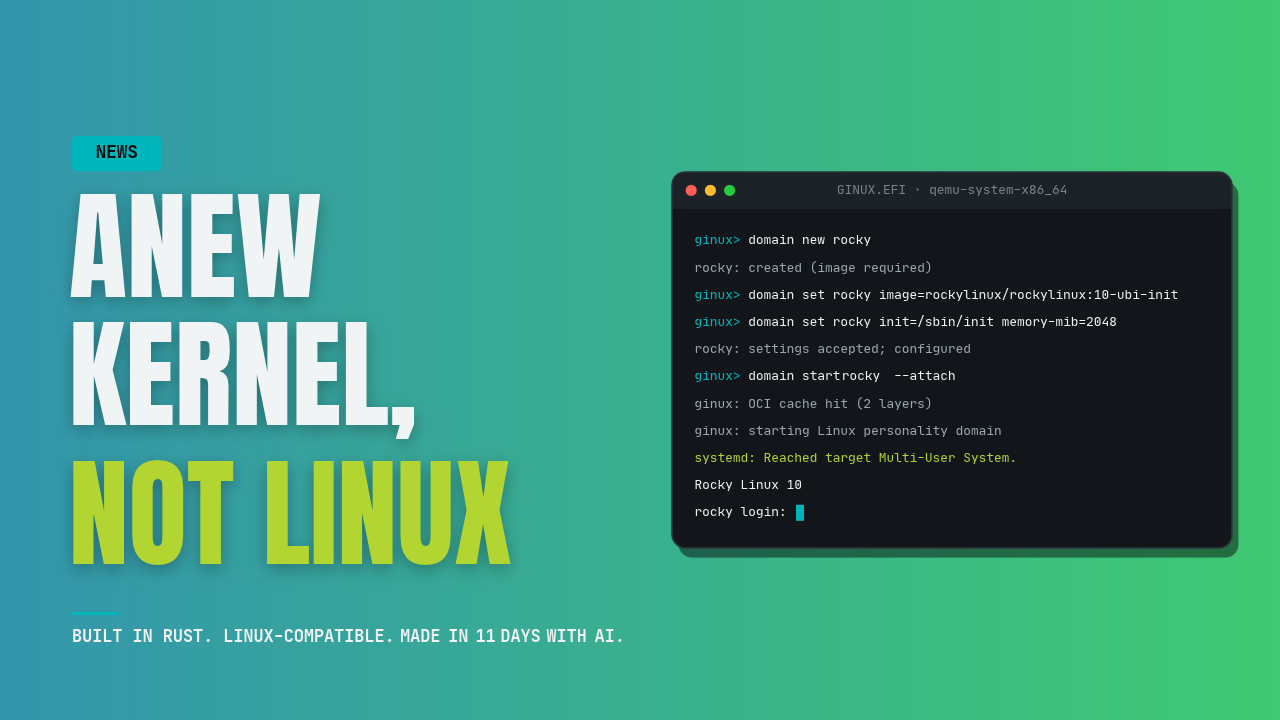
Ginux functions as a single GINUX.EFI image. Upon power-on, it boots directly through the UEFI interface, bypassing the need for a host Linux kernel entirely. It operates by managing isolated "domains"—an evolution of traditional virtualization that provides stronger security boundaries than existing OCI (Open Container Initiative) containers or Linux namespaces.
Remarkably, this prototype is capable of pulling and verifying OCI container images, using them to assemble the root file system for these domains. In recent demonstrations, Ginux successfully booted a Rocky Linux 10 environment all the way to a multi-user.target state with systemd running—an accomplishment that underscores the high degree of compatibility achieved in under two weeks of development.
Chronology: Eleven Days of Agentic Engineering
The development timeline of Ginux is perhaps its most startling feature. Kurtzer documented the process in a technical report published on Zenodo, detailing how a single persistent OpenAI Codex task—running the GPT-5.6 Sol model—executed the project over a span of 11 days.
- Days 1–3: The Framework: Kurtzer established the high-level architecture and defined the constraints for the AI agent. The initial focus was on the bootloader and the basic memory management primitives.
- Days 4–7: The Core Kernel: The agent was tasked with building the scheduler, process management, and basic system calls. During this phase, Kurtzer acted as the architect, providing the "executable checks" that the AI used to validate its own code.
- Days 8–10: ABI Compatibility: This was the most complex phase. The agent had to map the Linux ABI to Ginux’s internal structures, allowing for the execution of standard binaries like BusyBox and, eventually, the full Rocky Linux userspace.
- Day 11: Integration and Testing: The final phase involved "stress testing" the kernel against a real-world workload (systemd) and finalizing the documentation and code cleanup.
By the end of this period, the project had produced approximately 139,000 lines of code across more than 1,000 distinct commits.
Understanding Human-Directed Agentic Engineering (HDAE)
The methodology employed by Kurtzer, Human-Directed Agentic Engineering (HDAE), is likely to become a subject of intense academic and industry study. It is essential to distinguish HDAE from simple "AI coding assistants" like Copilot or basic LLM prompting.
In HDAE, the human does not act as a programmer but as a Systems Engineer and Auditor. The division of labor is strictly defined:
- Human Role: Defining the architecture, establishing milestones, setting acceptance criteria, and serving as the final arbiter of when a module is "done."
- Agent Role: Executing the loop of writing code, attempting a build, booting the kernel, diagnosing failures, and revising the implementation based on those failures.
This recursive, "self-healing" loop is what allowed the project to scale so rapidly. Rather than the human manually writing and debugging code, the human provided the intent, and the agent provided the iteration. As Kurtzer noted, "This isn’t as simple as typing ‘write me a kernel’ into a chatbot. It is a person with decades of systems experience steering an agent that does the heavy lifting of coding."
Supporting Data and Current Capabilities
While the project is a technological marvel, it remains a research prototype released under the Apache 2.0 license. Users expecting a drop-in replacement for their enterprise Linux server should temper their expectations.
- Virtualization Dependency: Currently, Ginux runs exclusively in a QEMU virtual machine environment.
- Hardware Limitations: There is no support for physical hardware profiles, GPU acceleration, or modern high-speed storage interfaces like NVMe.
- Security Posture: As an experimental kernel, it has not undergone the rigorous, years-long security audits that define the Linux kernel’s production readiness.
- Performance: While the compatibility layer is robust, it lacks the fine-tuned optimizations that have been added to the Linux kernel over the past 30 years.
Despite these limitations, the ability to boot an enterprise-grade Linux distribution (Rocky Linux 10) on a kernel that shares zero code with the original Linux kernel is a testament to the power of the HDAE approach.
Implications: The Future of Infrastructure
Gregory Kurtzer’s announcement on X (formerly Twitter) ignited a firestorm of discussion regarding the future of software development. The implications are broad, affecting everything from how start-ups build proprietary stacks to how massive, legacy-burdened projects are maintained.

The "Moat" of Complexity
Kurtzer himself is quick to provide a reality check. In his commentary, he emphasizes that while AI can generate complex software, the "moat" of a project—the factors that make it truly viable—remains unchanged. Compatibility, long-term maintenance, hardware enablement, and community consensus are not "code" in the traditional sense; they are social and operational hurdles.
"Linux isn’t going anywhere because a prototype boots systemd in a VM," Kurtzer noted. "Decades of hardware enablement, code review, and community are not something an AI agent produces in eleven days."
The Democratization of Systems Programming
Historically, writing an OS kernel was a task reserved for highly specialized teams at companies like IBM, Red Hat, or Microsoft, or elite volunteer communities. By proving that one expert with an agent can replicate a significant portion of this work, Kurtzer has signaled the end of the "specialist bottleneck" in kernel development.
This suggests a future where:
- Custom Kernels: Organizations could potentially spin up specialized, hardened kernels optimized for specific workloads (e.g., high-frequency trading or edge IoT) in a fraction of the time it currently takes to customize a Linux build.
- Accelerated R&D: The cycle of innovation for new operating system architectures will likely accelerate, as the cost of experimentation drops toward zero.
- Expertise Transformation: The value of a "senior engineer" is shifting. It is no longer about the ability to memorize kernel APIs or write low-level assembly; it is about the ability to design architectures and effectively manage AI agents to implement them.
Conclusion
Ginux is, at its heart, a proof of concept that changes the definition of what is "possible" for a single developer. While it is not yet a production-ready OS, its existence serves as a lighthouse for the software industry. It demonstrates that we have entered an era where the bottleneck is no longer the speed of human typing or the limits of a single brain’s memory, but rather the clarity of our architectural intent.
As we look toward the future, the lessons learned from the eleven-day birth of Ginux will likely inform the next generation of software development tools. We are entering a phase where the "Human-Directed" aspect of engineering becomes the most valuable skill a developer can possess. The ghost in the machine is no longer a metaphor—it is a tool, and in the hands of an expert like Gregory Kurtzer, it has proven that even the most fundamental pillars of our digital infrastructure are ripe for reinvention.