A New Era for Rust: The Next-Generation Trait Solver Enters Nightly
After nearly four years of intensive, behind-the-scenes engineering, the Rust programming language is on the cusp of its most significant architectural transition since its initial release. The Rust compiler team has officially enabled the "next-generation trait solver" by default in the nightly channel, marking the final stretch toward full stabilization in the coming months. This overhaul represents a fundamental shift in how the compiler processes code, promising to resolve long-standing technical debt, enable advanced language features, and unlock new performance frontiers.
The Core of the Change: What is the Trait Solver?
To understand the magnitude of this update, one must first understand the role of the trait solver. In Rust, traits define shared behavior. The trait solver is the "brain" of the compiler that verifies these behaviors, proves where clauses, normalizes associated types, and handles complex type inference.
The legacy solver, while foundational to Rust’s success, was built in an era where the language’s type system was significantly less complex. Over time, as Rust evolved, the old solver began to struggle with edge cases, leading to inconsistent behavior and "unsoundness"—situations where the compiler might incorrectly allow code that should have been rejected, or conversely, reject code that is logically sound.
The new implementation is a complete, top-to-bottom replacement. It discards the legacy heuristics in favor of a more robust, logic-based approach to type checking. By enabling this on nightly, the team aims to stress-test the system against the vast ecosystem of crates, ensuring that the transition is as seamless as possible before the stable release.
A Four-Year Chronology of Innovation
The journey to this point has been a marathon of incremental progress.
- 2021–2022: Conceptualization and Prototyping. The project began as a research effort to address the limitations of the existing
chalkimplementation and the older legacy solver. The goal was to build a system that could handle higher-ranked trait bounds and associated types more reliably. - 2023: Integration and Benchmarking. As the new solver reached a functional state, the focus shifted to integration. Developers began testing it behind a feature flag, uncovering hundreds of bugs in the process. This phase served as a crucial feedback loop, where the compiler team identified that the new solver was capable of solving problems the old one simply couldn’t handle.
- 2024: The Performance Pivot. Mid-2024 marked a realization that while the new solver was more correct, its performance in certain edge cases was unacceptable. A concerted effort—led by engineers like Nick Nethercote, Jana, Rémy Rakic, and Mira—began to optimize the solver’s execution path, moving from exponential complexity to linear performance for the vast majority of real-world code.
- 2025: The Final Push. The last twelve months have been dedicated to stability and diagnostic refinement. By "dogfooding" the solver within the Rust compiler itself, the team ensured that the new engine could handle the most complex trait-heavy codebases in the ecosystem.
Supporting Data: Why This Matters
The impact of this change is quantifiable. According to the Rust compiler team, the new solver is not just a cleaner implementation; it is a more powerful one.
Overcoming Complexity
The project has already addressed more than 200 open GitHub issues—many of which were considered "unfixable" under the constraints of the old architecture. These range from subtle type-inference failures to complex issues with impl Trait handling.
Compile-Time Performance
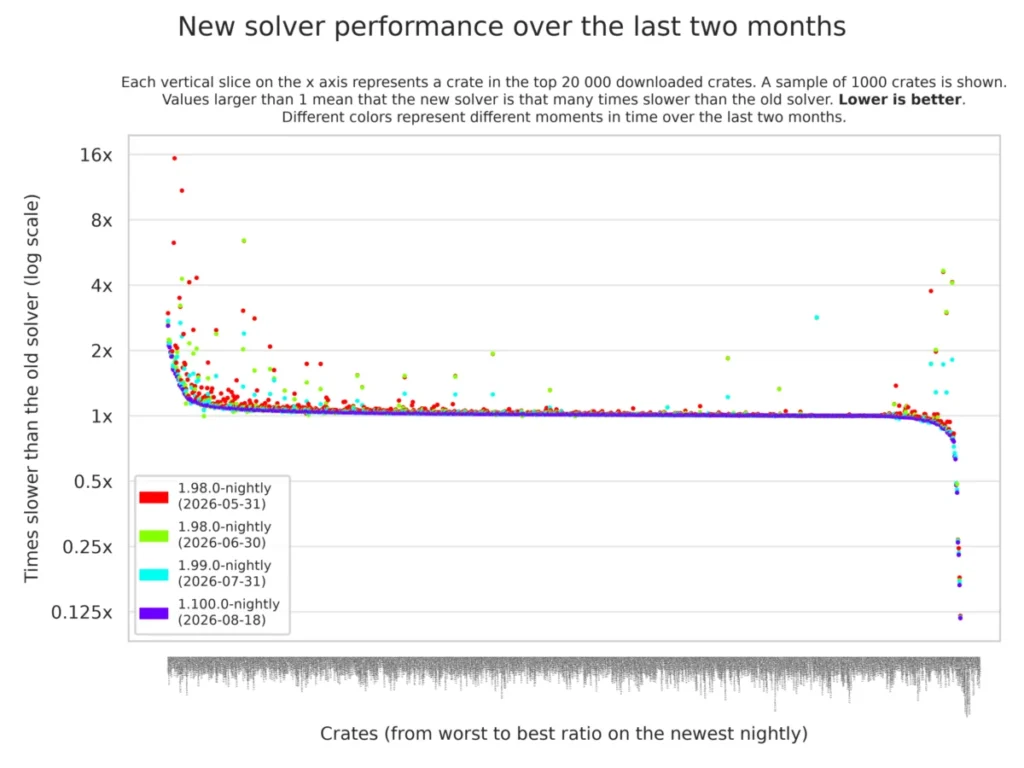
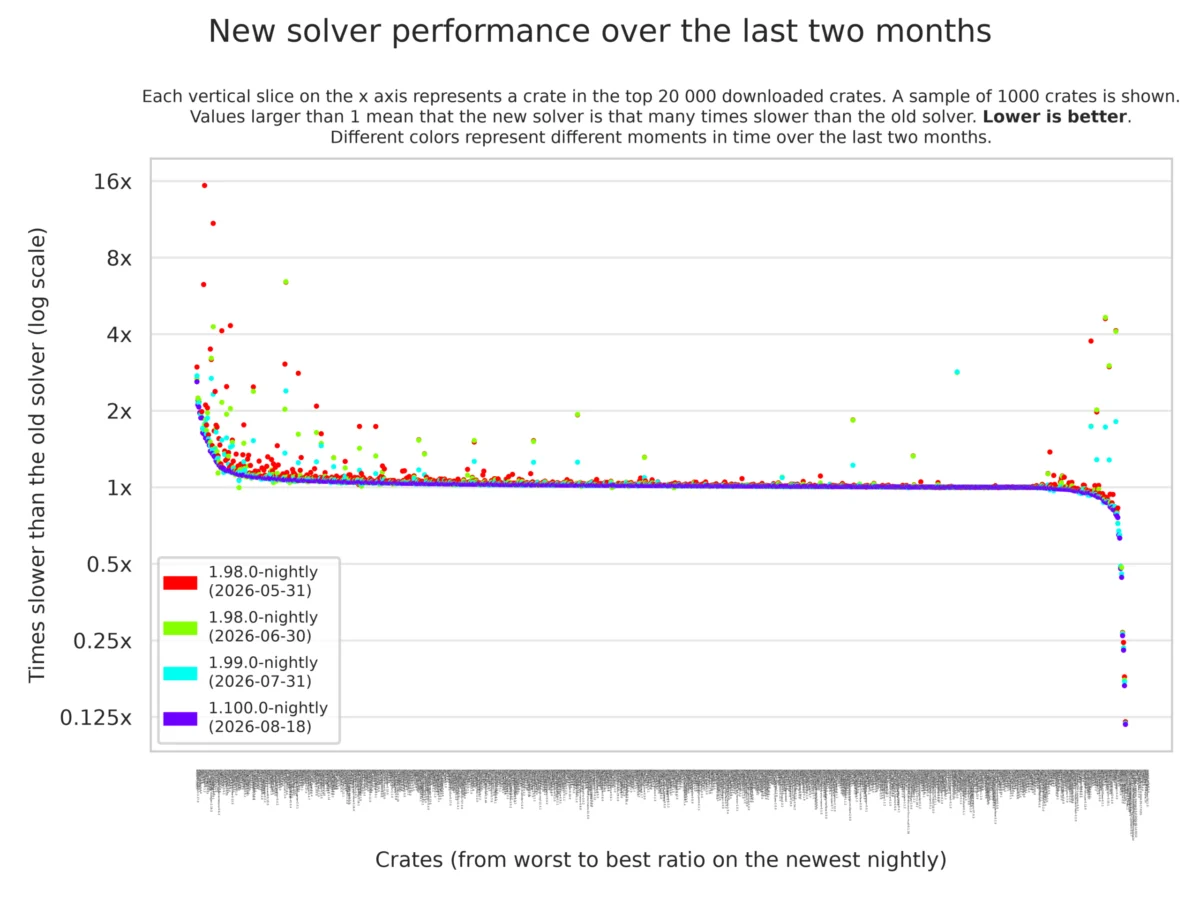
Performance metrics are often a double-edged sword when introducing new compiler infrastructure. Initially, the new solver suffered from regressions, showing exponential slowdowns in specific trait-heavy scenarios. However, the recent optimization sprint has yielded remarkable results.
A recent analysis of the top 20,000 crates on crates.io reveals that for the overwhelming majority of projects, the compile-time impact is negligible. In select, highly specialized cases—such as the datafusion crate—the new solver has actually yielded speed improvements of up to 8x. Furthermore, extreme use cases, such as a chess engine implemented entirely within Rust’s type system, have shifted from hanging indefinitely to completing in under a minute.
Official Responses and Strategic Implications
The Rust compiler team has been transparent about the "non-trivial amount of breakage" that this transition will inevitably cause. Because the new solver is more correct, it is also more strict. Code that previously relied on accidental or "lucky" behavior that the old solver ignored may now trigger a compiler error.

"This is the largest single change to the Rust compiler since its initial release," the team noted in their latest project update. They have emphasized that while the short-term friction of fixing broken code is real, the long-term benefits are essential for the survival of the language’s type system.
Unlocking Future Language Features
Perhaps the most compelling argument for this transition is the roadmap it clears. The legacy solver was a bottleneck preventing the stabilization of several highly anticipated features:
- Type Alias Impl Trait (TAIT): Allowing developers to define opaque types in aliases, greatly simplifying complex library APIs.
- Return Type Notation (RTN): Enabling cleaner ways to specify trait bounds on functions that return asynchronous types.
- New Implicit Default Trait Bounds: Features like
MoveandForgetwill allow for better control over memory safety and ownership semantics, which were previously impossible to express safely.
What Developers Need to Do
The transition is currently in the "opt-in" testing phase. All developers maintaining crates are encouraged to test their projects using the latest nightly build.
How to Test Your Project
To test, run the following command in your terminal:
rustup update nightly
If you encounter issues, the team asks that you first check the official tracking issue on GitHub. If your specific breakage is not listed, opening a new issue with a minimal reproduction case is the most valuable contribution you can make.
How to Opt-Out (Temporarily)
If you are working on a project that requires immediate stability and cannot currently accommodate the new solver, you can revert to the legacy behavior by setting the RUSTFLAGS environment variable or modifying your .cargo/config.toml:
[build]
rustflags = ["-Znext-solver=coherence"]
Looking Ahead: A More Predictable Future
The shift to the next-generation trait solver is a testament to the Rust community’s commitment to long-term sustainability over short-term convenience. By replacing a brittle, legacy component with a modernized, logic-based system, the Rust team is ensuring that the language remains performant, sound, and extensible.
While the coming months will involve a rigorous process of bug-fixing and diagnostic improvements, the end goal is clear: a compiler that is not only faster and more reliable but one that provides a more consistent experience for every developer. As the ecosystem adjusts to this new standard, the "next-gen" solver will likely be remembered as the moment Rust transitioned from a language of clever hacks to a language of robust, mathematical precision.
The team remains committed to refining the error messages provided by the new solver, acknowledging that for many, the quality of diagnostics is just as important as the speed of compilation. With the help of the community’s testing and feedback, the path to full stabilization is clear, and the future of the Rust compiler has never looked more promising.