Accelerating the Cloud: AWS Launches CloudFormation Express Mode to Revolutionize Infrastructure Deployment
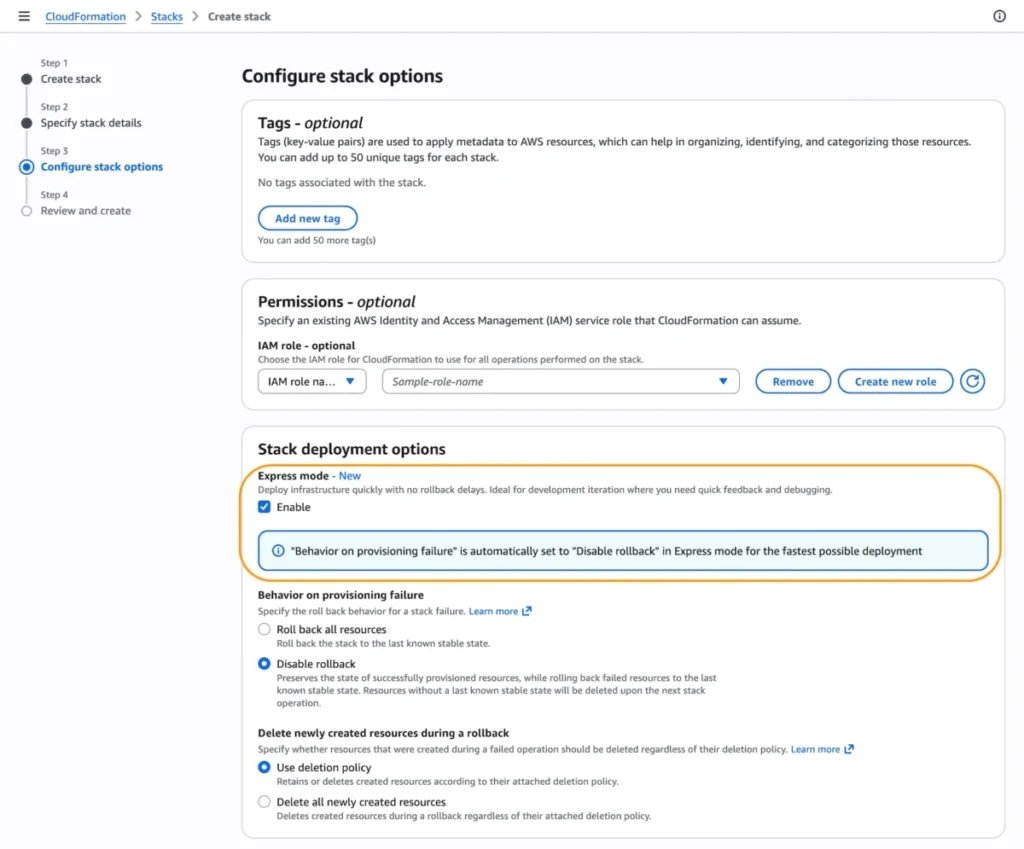
In a move set to redefine the velocity of cloud infrastructure management, Amazon Web Services (AWS) has officially announced the launch of AWS CloudFormation Express mode. This significant enhancement to the company’s flagship Infrastructure-as-Code (IaC) service is designed to strip away the latency inherent in traditional deployment cycles. By fundamentally altering how the service handles resource stabilization, Express mode promises to cut deployment times by up to four times, offering a transformative advantage for developers, DevOps engineers, and AI-driven infrastructure agents.
The Core Innovation: Redefining Deployment Completion
For over a decade, AWS CloudFormation has been the bedrock of consistent, repeatable cloud architecture. Traditionally, a CloudFormation deployment cycle includes a mandatory "stabilization" phase. During this period, the service waits for every resource—be it an S3 bucket, an RDS database, or a Lambda function—to reach a fully operational state before reporting the stack as "CREATE_COMPLETE" or "UPDATE_COMPLETE." While this approach ensures high reliability and verified readiness, it often creates a bottleneck for iterative development.
AWS CloudFormation Express mode pivots from this "wait-and-verify" model to an "apply-and-proceed" model. In Express mode, the deployment process completes the moment the resource configuration is successfully submitted and acknowledged by the AWS control plane. The underlying infrastructure continues to provision and stabilize in the background without holding up the developer’s workflow.
This change does not impact the actual provisioning of resources; the infrastructure is still created with the same robust security and configuration parameters. Instead, it changes the reporting of the deployment status, effectively decoupling the completion of the orchestration task from the physical readiness of the target resources.
A Chronology of Infrastructure Evolution
The introduction of Express mode arrives at a critical juncture in the evolution of cloud engineering. To understand its significance, one must look at the progression of AWS deployment strategies:
- The Manual Era: Early cloud adoption relied heavily on console-based manual configuration, which was prone to human error and difficult to audit.
- The IaC Revolution: The emergence of AWS CloudFormation allowed teams to define infrastructure as code, bringing version control and repeatability to the cloud. However, as stacks grew in complexity, the "wait time" for stacks to stabilize became a friction point for rapid prototyping.
- The Era of Automation and AI: With the rise of AI-assisted coding tools, developers are iterating on infrastructure at a pace previously unseen. These agents and human developers now expect sub-minute feedback loops.
- The Express Shift (2026): By removing the mandatory wait for stabilization, AWS has addressed the specific needs of modern, high-velocity CI/CD pipelines. This release signals a transition from "safe-but-slow" to "optimized-for-iteration."
Quantifying the Impact: Supporting Data
The efficiency gains provided by Express mode are not merely theoretical; they are substantial. AWS internal benchmarks highlight the drastic reduction in wait times for common infrastructure tasks:
- SQS Queue Management: Creating an Amazon Simple Queue Service (SQS) queue alongside a dead-letter queue (DLQ) typically takes 64 seconds in Standard mode. In Express mode, this process is completed in just 10 seconds—a 6.4x improvement in speed.
- Lambda Network Attachments: Perhaps more striking is the management of AWS Lambda functions that require network interface attachments. In traditional deployments, the stabilization wait can last 20 to 30 minutes. Express mode slashes this to roughly 10 seconds, enabling developers to iterate on complex serverless architectures almost instantaneously.
These figures illustrate a shift in the "developer experience" (DevEx). By reducing wait times from minutes to seconds, AWS is effectively enabling a "flow state" for engineers who are testing individual components or debugging infrastructure-as-code templates.
The Official AWS Perspective: Why Now?
According to the leadership at AWS, the decision to introduce Express mode was driven by the changing nature of how software is built. "Many workflows do not require full stabilization to proceed," an AWS spokesperson noted. "Whether you are testing a single component or using AI to rapidly generate infrastructure, the waiting period for resource stabilization is often unnecessary overhead."
AWS has emphasized that Express mode is not a replacement for traditional deployment but a surgical tool for specific use cases. By providing the flexibility to toggle between Standard and Express modes, AWS empowers organizations to choose the right balance between speed and validation. The inclusion of built-in resilience—where CloudFormation automatically retries dependent resources that encounter transient failures—ensures that the "speed-first" approach does not come at the cost of stability.
Strategic Implications for Modern Enterprises
The implications of this update extend across the entire software development lifecycle. For organizations striving to implement "Platform Engineering" models, Express mode offers several key advantages:
1. Accelerating AI-Assisted Infrastructure Development
AI agents like Kiro and other generative models can now iterate on infrastructure configurations with near-instant feedback. This loop allows AI to "learn" from its configuration attempts significantly faster, accelerating the time-to-market for complex cloud-native applications.
2. Enhanced CI/CD Efficiency
In a typical CI/CD pipeline, every second counts. If a team is running hundreds of integration tests that require temporary infrastructure, the cumulative time saved by Express mode can result in hours of reclaimed productivity per week. This enables more frequent deployments and, consequently, more frequent testing.
3. A New Paradigm for Production Scenarios
While Express mode is ideal for development, it also has applications in production where engineers are comfortable with "eventual stabilization." For example, when updating a non-critical microservice, teams can deploy in Express mode and monitor the health of the resources via external observability tools rather than waiting for CloudFormation’s internal status checks.
4. Simplified Tooling Integration
AWS has ensured that Express mode is accessible via the CLI, SDKs, and the AWS Cloud Development Kit (CDK). By simply using the --deployment-config '"mode": "EXPRESS"' parameter, developers can integrate this functionality into their existing workflows without needing to rewrite their underlying templates.

Best Practices and Security Considerations
While the speed of Express mode is highly attractive, AWS cautions users to use it judiciously.
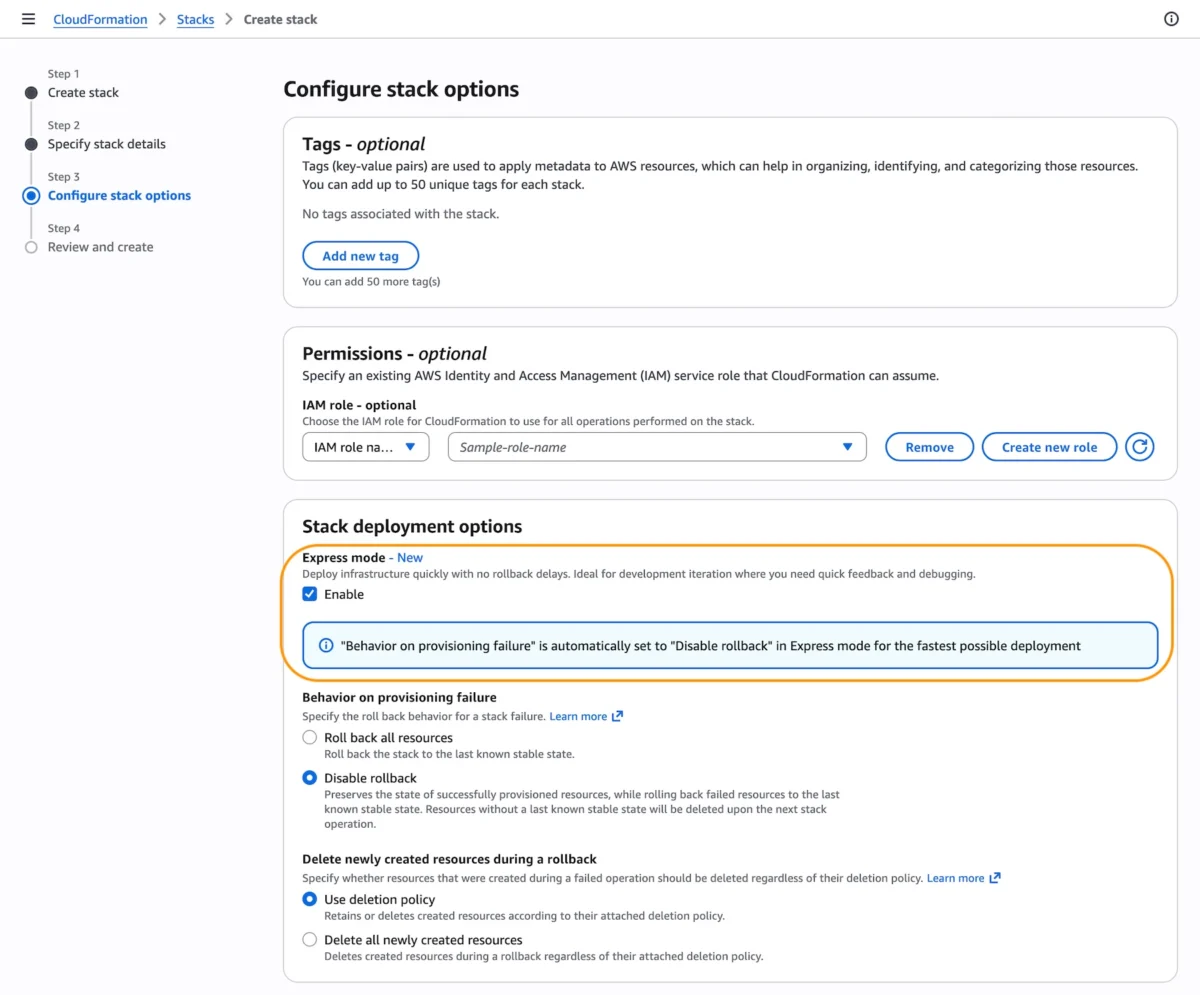
- Default Behavior: Express mode disables rollback by default. This is intended to prevent the stack from rolling back during the critical, high-velocity iteration phase.
- Production Safety: For mission-critical production environments, AWS recommends setting
disableRollbacktofalse. This ensures that if a deployment encounters a permanent failure, the system retains the safety net of returning to the last known good state. - Least Privilege: As always, the principle of least privilege remains paramount. Regardless of how fast the deployment is, the IAM roles associated with the CloudFormation execution must remain strictly scoped to prevent unauthorized access.
A Future-Proofed Infrastructure Strategy
The launch of CloudFormation Express mode represents a maturation of the cloud ecosystem. As infrastructure becomes more complex, the tools used to manage it must evolve to prioritize the developer’s time and cognitive load.
By removing the friction of stabilization, AWS has effectively turned infrastructure deployment into an asynchronous process that respects the pace of modern software development. As the industry continues to move toward AI-driven engineering and rapid deployment cycles, tools like Express mode will be viewed as the standard, rather than the exception.
For teams currently using AWS, the call to action is clear: review your existing CI/CD pipelines. Identify the stages where deployment latency is acting as a bottleneck. By adopting the Express mode, you are not just saving seconds—you are reclaiming the ability to innovate at the speed of thought.
For further technical documentation, regional availability, and guidance on how to integrate Express mode into your specific tech stack, developers are encouraged to visit the official AWS CloudFormation documentation and participate in the AWS re:Post community. The future of infrastructure is fast, and with Express mode, it is finally ready for the next generation of cloud builders.