AWS Revolutionizes Container Performance: Introducing High-Resolution Auto Scaling for Amazon ECS
In an era where digital latency is synonymous with lost revenue and diminished user experience, Amazon Web Services (AWS) has taken a significant leap forward in cloud infrastructure management. The company has officially announced the launch of high-resolution, 20-second interval metrics for Amazon Elastic Container Service (Amazon ECS) service auto scaling. This enhancement marks a paradigm shift in how containerized applications respond to sudden, volatile traffic spikes, effectively slashing reaction times by more than 70%.
For developers, DevOps engineers, and system architects, this update addresses one of the most persistent challenges in cloud computing: the "reaction gap"—the time elapsed between a sudden surge in demand and the moment the infrastructure successfully scales to meet it.
Main Facts: The Power of 20-Second Precision
Amazon ECS service auto scaling has long been a staple for enterprises seeking to balance cost-efficiency with performance. Historically, the service relied on 60-second metric resolution, which, while adequate for steady-state traffic, often left a window of vulnerability during sudden, high-intensity bursts.
The new update introduces 20-second high-resolution metrics, effectively tripling the frequency at which Amazon ECS polls for resource utilization data. By integrating these high-resolution metrics into the target tracking scaling policies, Amazon ECS can now make informed, real-time decisions at a significantly faster cadence.
This feature is universally applicable across all ECS compute options, including:

- AWS Fargate: The serverless compute engine for containers.
- ECS Managed Instances: Simplified management for EC2-based clusters.
- Amazon EC2: For those who prefer granular control over their underlying infrastructure.
By decoupling the standard 60-second polling cycle from the new 20-second resolution, AWS is providing a tiered approach to monitoring, allowing teams to choose the granularity that matches their specific workload requirements.
The Chronology: From Standard Polling to Rapid Response
To understand the magnitude of this advancement, one must look at the evolution of auto scaling within the AWS ecosystem.
The Legacy Model
For years, the standard for CloudWatch metrics and subsequent auto-scaling triggers was anchored at 60-second intervals. While this was sufficient for most applications, high-frequency trading platforms, viral social media applications, and gaming backends often found themselves "chasing" the traffic. By the time a scaling event was triggered and new containers were provisioned, the initial spike had already impacted the user experience.
The Developmental Phase
Recognizing the limitations of the 60-second cycle, AWS engineering teams focused on optimizing the data pipeline between CloudWatch and the Application Auto Scaling service. The goal was twofold: reduce the latency in metric ingestion and accelerate the provisioning logic within the ECS scheduler.
The Breakthrough
In recent benchmarks conducted by AWS, the results were transformative. The time to trigger a scale-out event plummeted from 363 seconds to a mere 86 seconds—a 76% improvement (4.2x faster). Furthermore, the total end-to-end time—from the onset of a traffic surge to the full availability of new tasks—improved from 386 seconds to 109 seconds (a 72% improvement, or 3.5x faster).

Supporting Data: Quantifying the Performance Gain
The implications of these numbers are profound for organizations operating at scale. The following table summarizes the performance gains observed in internal AWS benchmarking:
| Metric | Previous Performance (60s) | New Performance (20s) | Improvement |
|---|---|---|---|
| Time to Trigger Scale-out | 363 Seconds | 86 Seconds | 4.2x Faster |
| Total Provisioning Time | 386 Seconds | 109 Seconds | 3.5x Faster |
These statistics underscore a critical reality: in the world of high-traffic applications, every second of latency is a potential bottleneck. The ability to provision capacity nearly 4x faster allows applications to remain performant even when faced with "flash crowd" phenomena, where demand increases exponentially in a matter of seconds.
Official Responses and Strategic Implications
The introduction of high-resolution scaling is part of a broader AWS strategy to make infrastructure "invisible" and fully responsive. Industry experts and AWS leadership suggest that this move is a direct response to the increasing complexity of microservices architectures.
The Role of CloudWatch
While the service auto scaling feature itself incurs no additional cost, AWS has been transparent about the pricing dimensions of this update. Because the feature relies on high-resolution CloudWatch metrics, users will incur costs associated with the increased frequency of data ingestion. This is a deliberate design choice, ensuring that customers only pay for the extra monitoring granularity when their business-critical applications actually require it.
Enabling High-Resolution Scaling
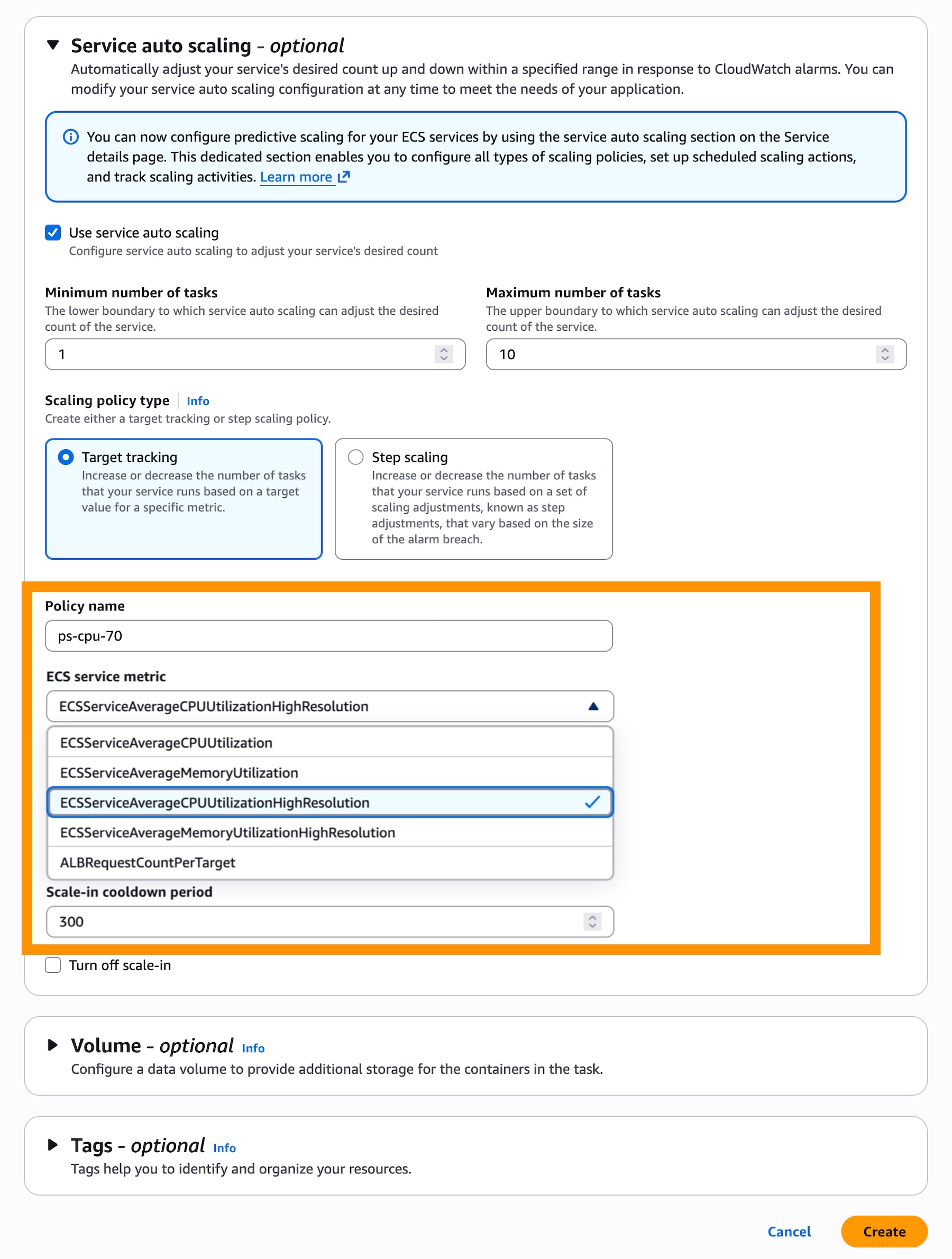
The implementation process is designed to be seamless for existing ECS users. The workflow involves:
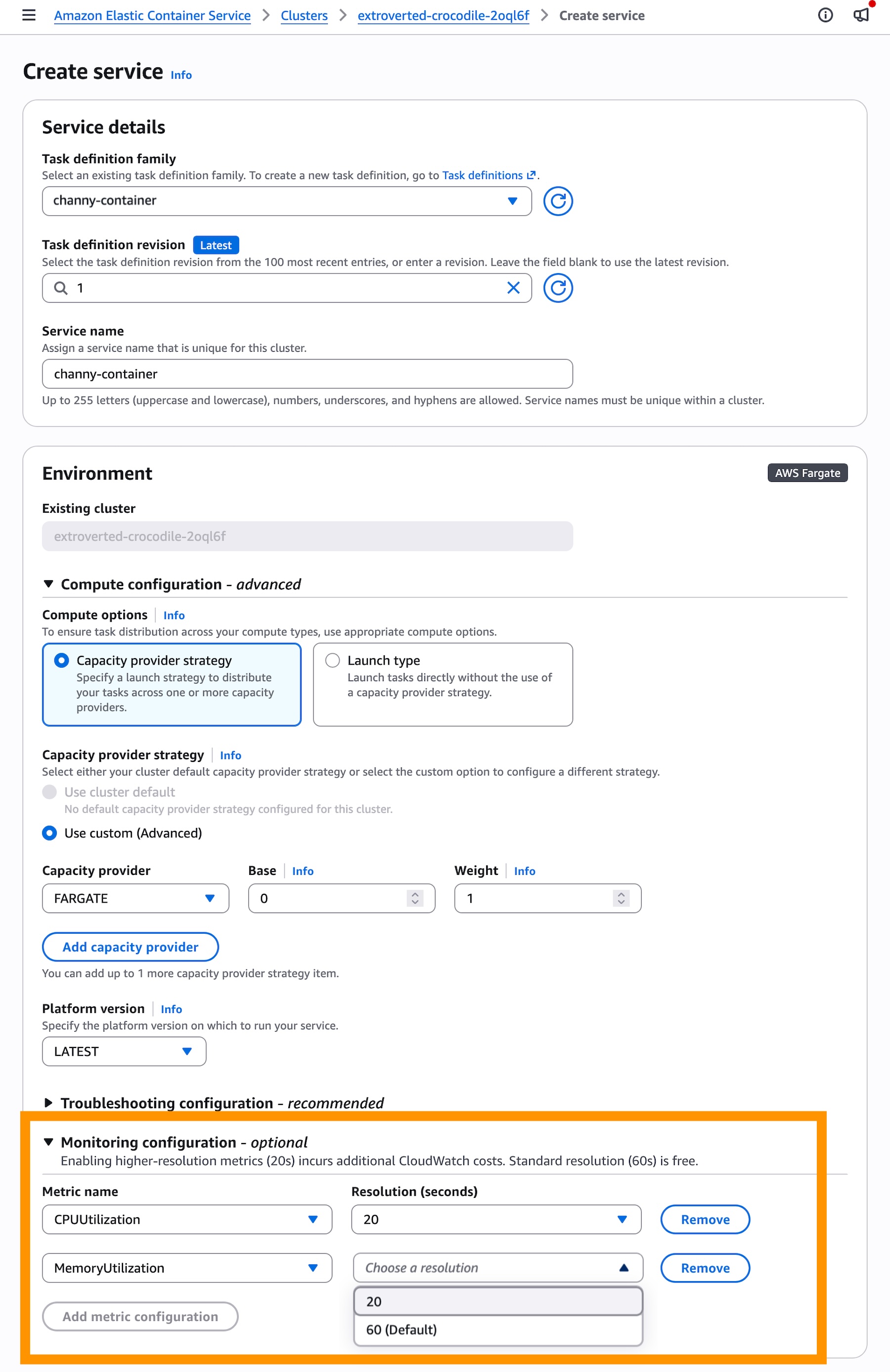
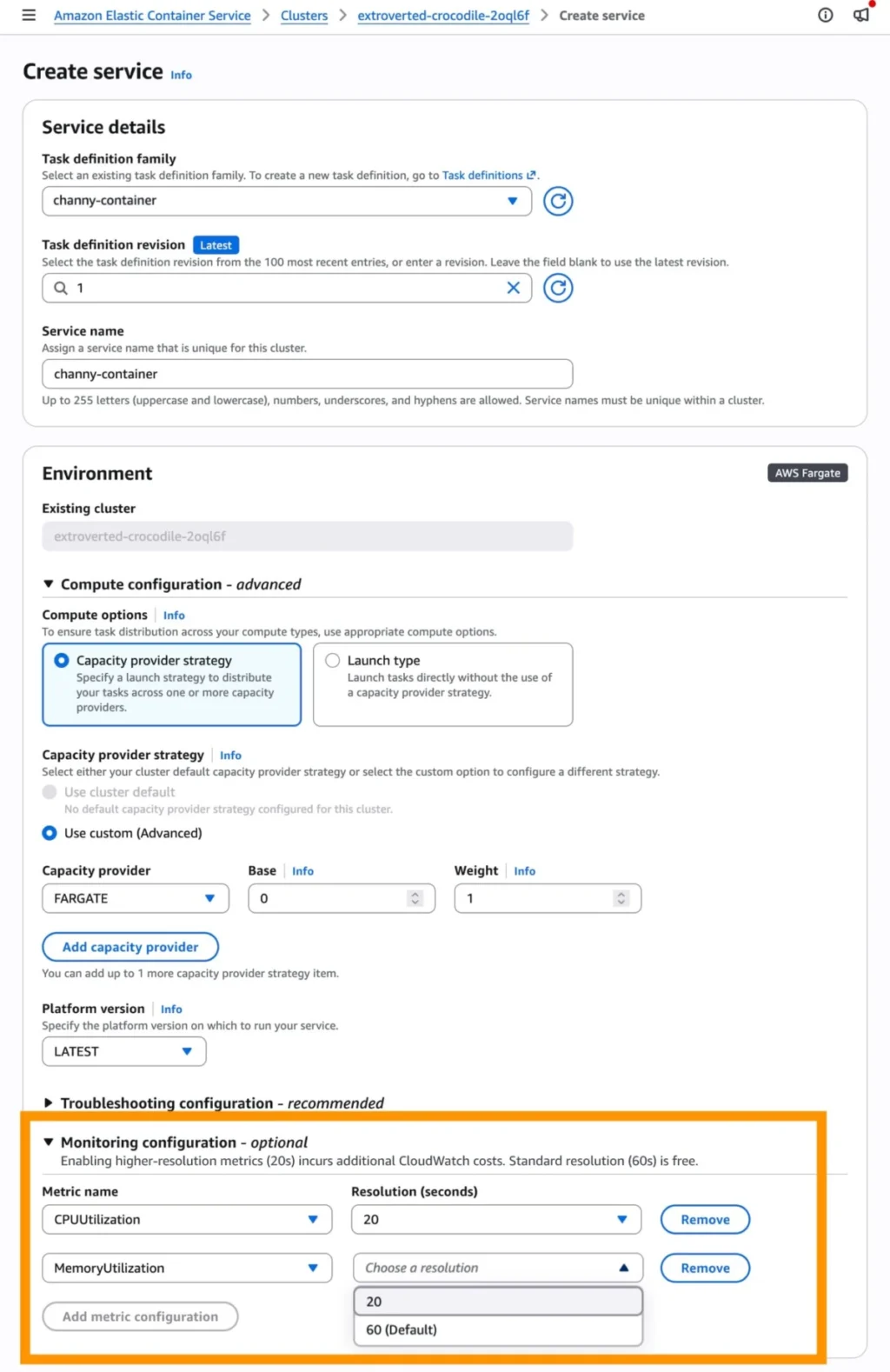
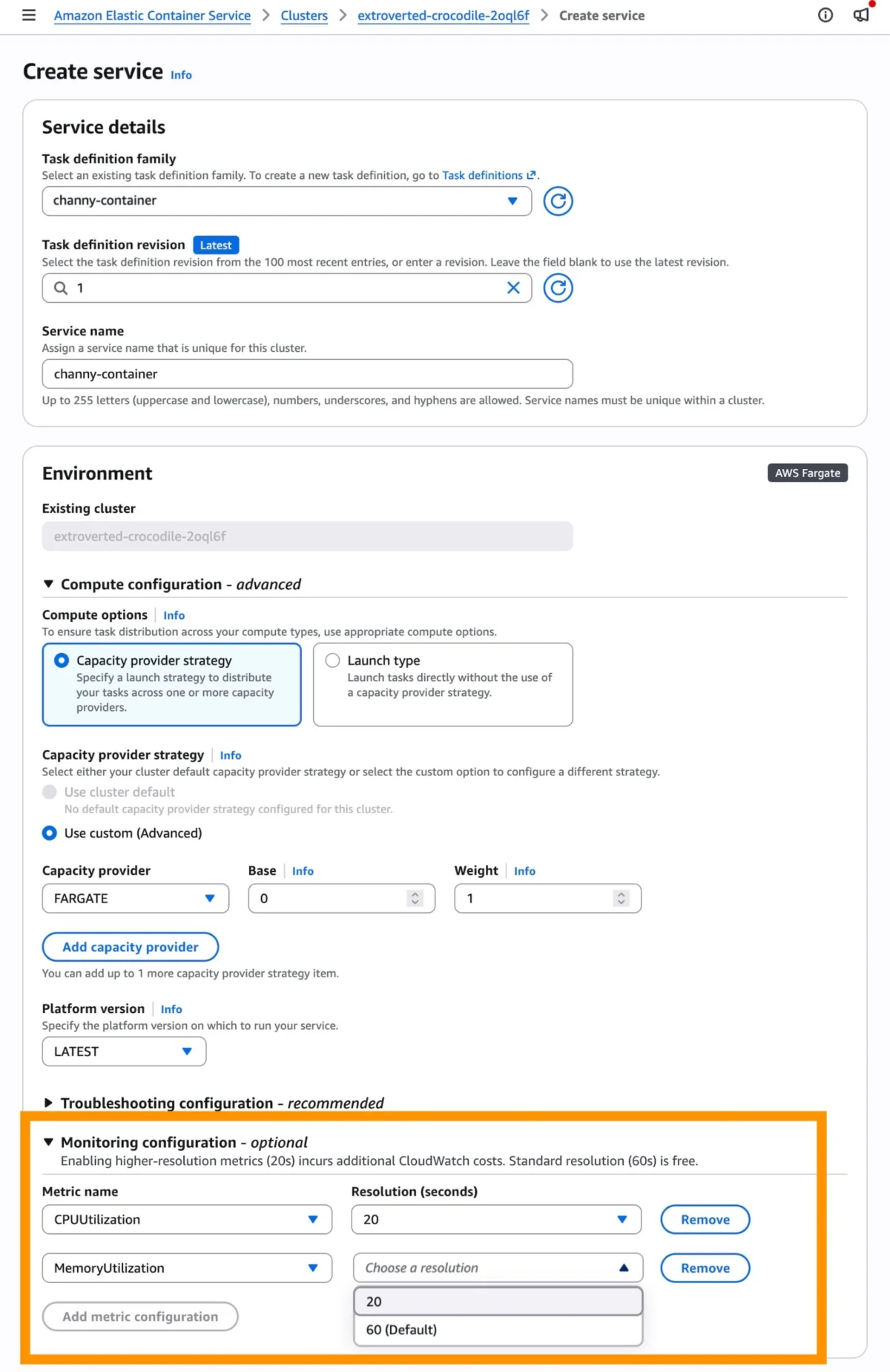
- Configuration: Enabling high-resolution metrics within the "Monitoring configuration" section of the ECS console.
- Policy Selection: Opting for
ECSServiceAverageCPUUtilizationHighResolutionorECSServiceAverageMemoryUtilizationHighResolutionwhen defining target tracking policies. - Deployment: Utilizing the AWS CLI, SDKs, or CloudFormation to automate the rollout across global clusters.
Implications: Why This Changes the Game
The move to 20-second scaling intervals carries several downstream benefits for the modern enterprise.
1. Enhanced User Experience
By reducing the time to scale, applications avoid the "performance dip" that occurs when existing containers become saturated while waiting for new ones to come online. Users experience a consistent response time, even during the most volatile traffic spikes.
2. Cost Optimization Through Precision
Ironically, faster scaling can lead to better cost efficiency. By scaling up faster, you avoid over-provisioning for long periods. Conversely, by scaling down more accurately based on higher-resolution data, you can prune excess capacity as soon as the demand subsides, rather than waiting for the next 60-second heartbeat to confirm the load has dropped.
3. Resilience in Microservices
In a distributed microservices environment, one service lagging can create a cascading failure across the entire system. Faster scaling ensures that the "blast radius" of a traffic spike is contained, as the individual service layer can react and adapt before the pressure impacts the rest of the ecosystem.
4. Operational Simplification
The integration of these metrics directly into the ECS console and CLI means that developers do not need to build complex, custom "sidecar" scaling scripts. By using native AWS tools, teams maintain a smaller operational footprint, reducing the risk of errors associated with custom-built auto-scaling solutions.
A Call to Action for Architects
For teams currently managing ECS services, the recommendation is clear: audit your current traffic patterns. If your applications frequently experience rapid, unpredictable spikes—such as during marketing campaigns, batch processing starts, or sudden viral events—the transition to 20-second resolution metrics is a high-impact optimization.
As Channy, a representative for AWS, noted, the tools are available today. The integration is designed to be non-disruptive, allowing teams to toggle the resolution on existing services without requiring a full refactor of their container architecture.
Conclusion
The launch of high-resolution auto scaling for Amazon ECS is a testament to the ongoing maturity of cloud-native infrastructure. By reducing the scaling reaction time by over 70%, AWS has effectively removed a major barrier to high-performance, resilient computing.
As businesses continue to migrate mission-critical workloads to the cloud, the expectation for infrastructure that is not just scalable, but agile, will only grow. With this update, AWS has provided the tools necessary to meet that demand, ensuring that the infrastructure of the future is capable of keeping pace with the rapid, unpredictable nature of the modern digital economy. Whether you are running a small startup or a global enterprise, the shift to 20-second metrics is a vital step in ensuring your services are ready for whatever the next surge in demand brings.