Bridging the Gap: How ‘Prop For That’ is Revolutionizing CSS-JavaScript Interoperability
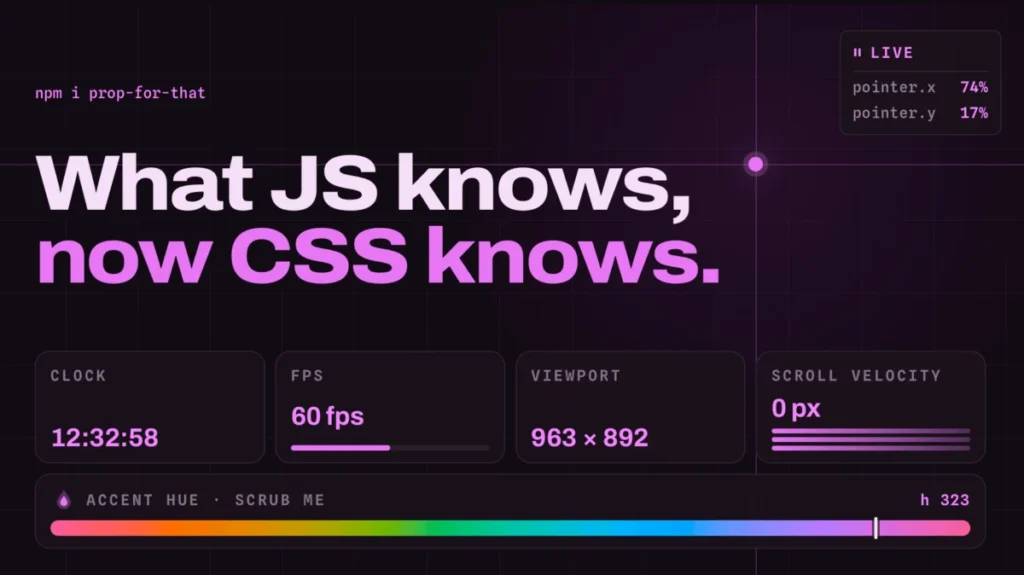
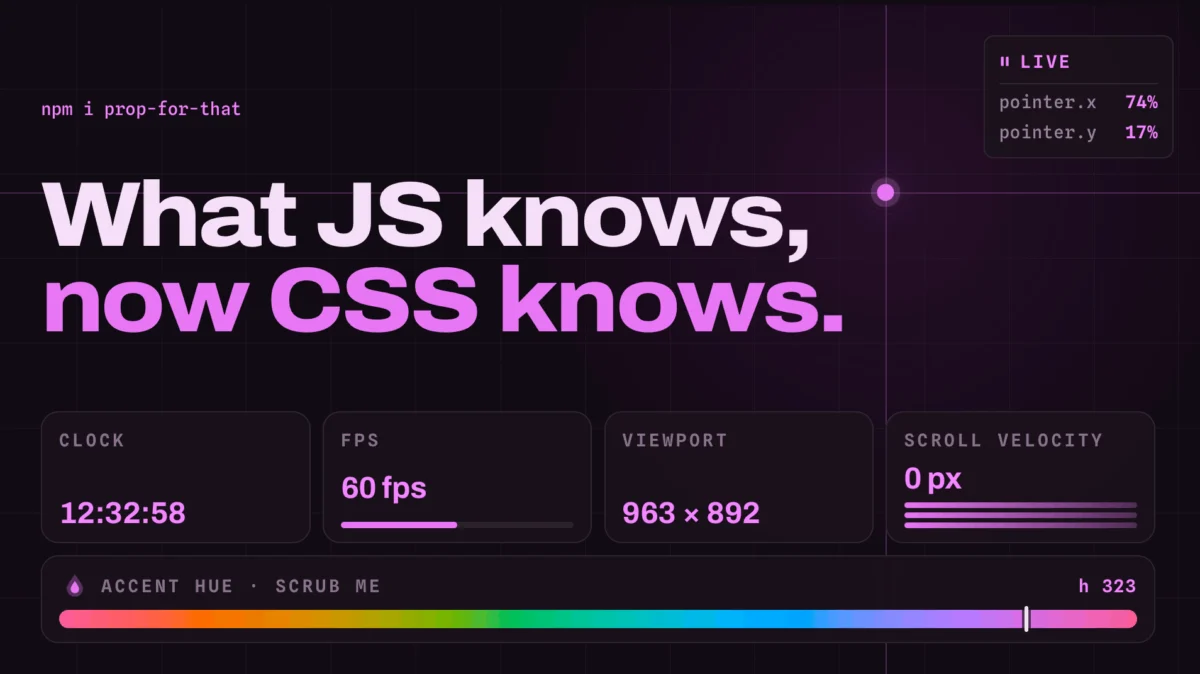
The web development landscape has long been defined by a clear demarcation between the declarative nature of CSS and the imperative power of JavaScript. For decades, developers have wrestled with the "bridge" between these two worlds—often relying on bloated event listeners and manual DOM manipulation just to pass a simple coordinate or state change from the browser engine into a stylesheet.
Adam Argyle, a prominent figure in the CSS community and the architect behind the widely adopted Open Props, has unveiled his latest project: Prop For That. This library promises to dissolve the friction between browser state and visual presentation, allowing developers to leverage "live" CSS variables that react to real-time data without writing a single line of custom JavaScript logic.
The Core Concept: Bridging the Reactive Divide
At its heart, Prop For That is a utility library designed to expose browser-level data—things CSS traditionally cannot "see"—as native CSS custom properties. While Open Props provided a foundational design system of preconfigured variables for typography, spacing, and color, Prop For That moves into the realm of dynamic behavior.
The library acts as a bridge, listening to browser APIs (such as pointer coordinates, scroll velocity, time, and form states) and automatically synchronizing that data into the CSS variable namespace. For developers, this means the end of "boilerplate fatigue." No longer must you attach mousemove listeners to update a style property on a container; you simply declare the interest in the data via an HTML attribute, and the library handles the synchronization layer in the background.
A Chronology of CSS-JS Evolution
To understand the significance of this development, one must look at the historical trajectory of CSS-JavaScript interaction:
- The Early Days (The "Inline Style" Era): In the mid-2000s, developers updated styles by directly modifying the
styleobject of DOM elements via JavaScript. This was computationally expensive and messy, often leading to performance bottlenecks during high-frequency updates like animations or scroll events. - The CSS Variables Revolution (2016–2018): With the introduction of Custom Properties (CSS variables), the game changed. We could finally set a value once and update it globally. However, the bottleneck remained the "bridge": JavaScript still had to manually calculate values and call
element.style.setProperty('--var', value). - The "Glue" Era (2019–2023): Developers began creating bespoke libraries to handle these property updates. Many used
requestAnimationFrameloops to keep CSS in sync with user interactions, a process that was often redundant and difficult to maintain. - The ‘Prop For That’ Era (2024): By abstracting the "glue" into a declarative attribute-based system, Adam Argyle has moved the industry toward a standard where the DOM elements themselves describe their data requirements.
Technical Architecture: How it Works
The genius of Prop For That lies in its simplicity and reliance on modern browser standards. The library utilizes a plugin-based architecture, where specific browser APIs are mapped to CSS variables.
The Implementation Workflow
- Import: The developer imports the library into the document head.
- Declare: Using the
data-props-forattribute, the developer flags an element to track specific metrics. - Style: The library automatically injects values into the element’s style context, which can then be consumed by standard CSS
var()functions.
Consider the tracking of a mouse cursor. Historically, this required a script that calculated the clientX and clientY coordinates and injected them into the DOM. With Prop For That, the markup is reduced to:
<div class="tracker" data-props-for="pointer"></div>The resulting CSS is equally elegant, allowing for direct integration into complex animations:
.tracker
  transform: translate(calc(var(--live-pointer-x) * 1px), calc(var(--live-pointer-y) * 1px));
This decoupling of the logic (the JS that reads the pointer) from the presentation (the CSS that moves the element) represents a fundamental shift in how we build interactive web components.
Supporting Data: Why This Matters for Performance
Performance is the primary driver behind the adoption of such tools. When JavaScript manually updates properties, it often triggers unnecessary style recalculations or layout reflows if not handled correctly.
Prop For That is built with performance in mind. By centralizing the event listeners, the library minimizes the impact on the main thread. Because the library uses a single, optimized loop for various data types, it avoids the "event listener explosion" that often occurs in complex single-page applications where hundreds of elements might need to track a single scroll position or time value.
Furthermore, because these values are injected as CSS variables, they are highly optimized by modern browser rendering engines. Browsers are already designed to handle dynamic variable changes efficiently, meaning the visual output is smoother and more responsive than previous manual-injection methods.
Official Responses and Industry Reception
The web development community, particularly those following Adam Argyle’s work on CSS-Tricks and his advocacy for modern CSS, has responded with significant enthusiasm.
"The beauty of this approach is that it makes the DOM feel alive," says one lead front-end engineer in the community. "We spend so much time fighting the browser to get it to react to the user. This library makes the browser feel like it was designed to react this way from the start."
Critics, however, raise valid questions regarding dependency management. In an era where "vanilla" JS is making a comeback, some developers are wary of adding another library to their stack. However, the prevailing sentiment is that if a library simplifies 50 lines of complex, error-prone event-tracking code into a single HTML attribute, it earns its place in the project’s package.json.
Implications for Future Web Design
The implications of Prop For That extend beyond mere convenience. We are witnessing the maturation of the web as an application platform.
1. The Death of Boilerplate
As developers, we are moving away from writing code that manages state and toward code that declares state. This shift is essential as web applications become more complex. By offloading the "plumbing" of data to libraries like this, developers can focus on the user experience rather than the overhead of browser event APIs.
2. A New Era of Interactive Aesthetics
Expect to see a surge in websites that use scroll-driven effects, time-based themes, and pointer-aware animations. When these effects become trivial to implement, they move from being "expensive, bespoke features" to "standard design elements." We are likely to see a shift in UI design where the layout itself feels more fluid and integrated with the user’s physical actions.
3. Standards Convergence
There is a growing hope that the success of Prop For That might eventually influence the W3C standards. If a library can successfully standardize the way we expose browser state to CSS, it provides a compelling case for browsers to eventually implement these features natively. Imagine a future where data-props-for="pointer" is not a library feature, but a standard browser capability.
Conclusion: The Road Ahead
Prop For That is more than just a convenient tool; it is a signal of the changing philosophy of web development. It acknowledges that while JavaScript is necessary, it shouldn’t be the constant intermediary between the user and the visual interface.
By leveraging the power of CSS custom properties and standardizing the way we feed them data, Adam Argyle has provided a glimpse into a more reactive, efficient, and expressive future. For developers looking to push the boundaries of what is possible in the browser, the time to experiment with these live properties is now. As the demos on the project’s site clearly show, the only limit remaining is the developer’s imagination.
The bridge is built. Now, it is up to the community to see how far we can cross it.