Democratizing Hardware and Software Validation: A Deep Dive into the New AlmaLinux Certification Ecosystem


In an era where enterprise-grade Linux distributions are increasingly scrutinized for stability, compatibility, and security, AlmaLinux has taken a decisive step toward community-driven transparency. The AlmaLinux OS Foundation has officially overhauled its certification ecosystem, introducing a robust, community-accessible framework for validating both software and hardware. By eliminating the traditional barriers to entry—namely, prohibitive costs and complex, time-consuming testing protocols—AlmaLinux is attempting to crowdsource the reliability of its platform on a global scale.
This initiative marks a significant departure from the siloed, vendor-locked certification processes typical of proprietary operating systems. Instead, AlmaLinux is positioning its platform as an open, verifiable, and highly modular environment where the community acts as the primary validator.
The Evolution of Certification: A New Era for AlmaLinux
For years, the "certification" of software and hardware on enterprise Linux distributions has been the exclusive domain of large vendors and specialized testing labs. For the average developer or enterprise IT manager, this meant that verifying whether a specific software stack or hardware component would perform optimally under load was often a guessing game or a costly consulting engagement.
The newly unveiled certification suite changes this paradigm entirely. It is comprised of two distinct but integrated pillars: software certification, which is being introduced for the first time, and a completely rewritten hardware certification suite. Both paths funnel their results into a centralized, public-facing catalog, creating a single source of truth for the AlmaLinux ecosystem.
The Mechanics of Software Certification
Software certification, in the context of the new AlmaLinux portal, is designed as a collaborative, evidence-based verification system. Rather than requiring formal audits, the system relies on a "listing and confirmation" model.

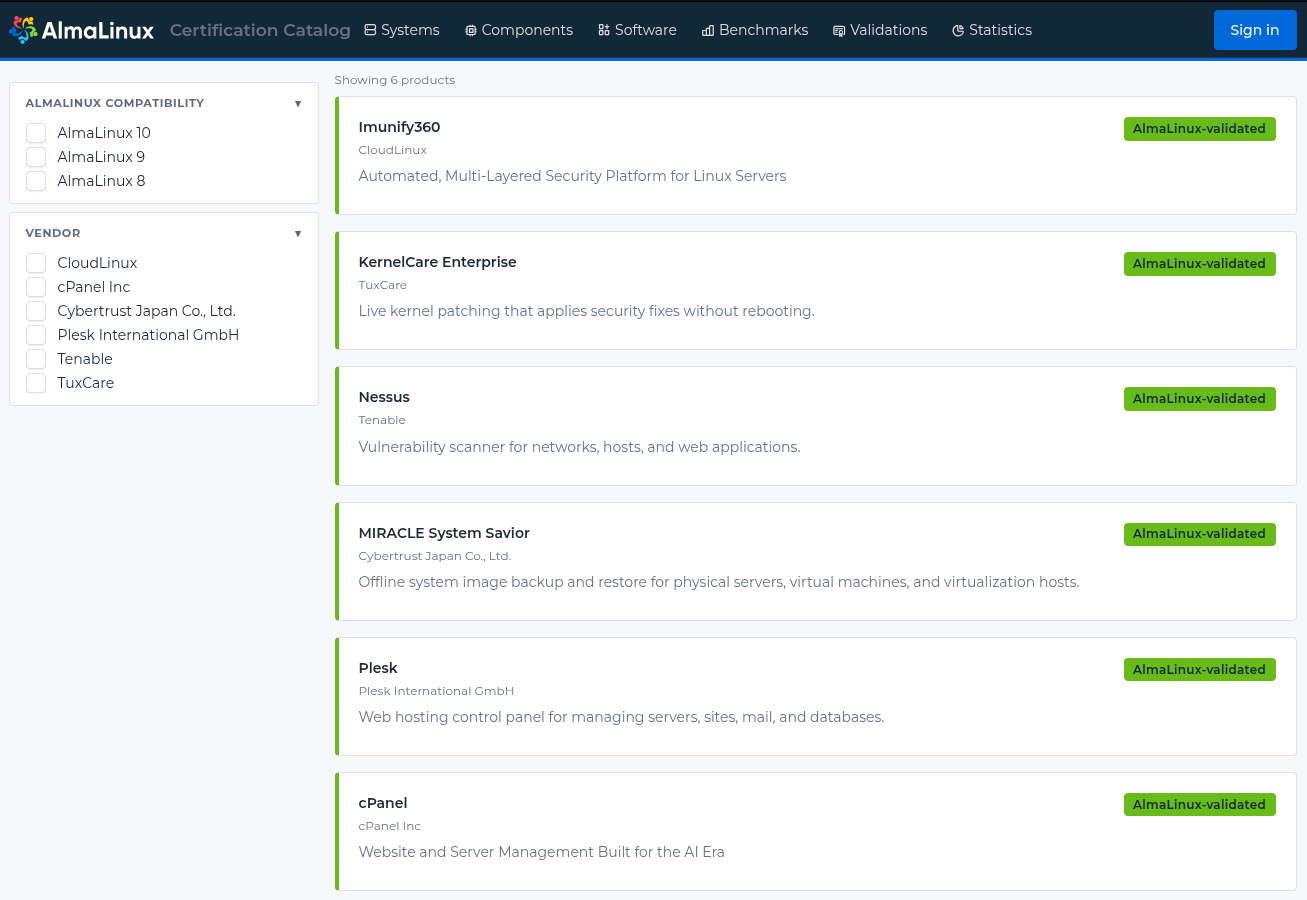
Publishers can register their applications and identify the major versions of AlmaLinux for which their software is compatible. However, the true value of the system lies in the community-driven validation process. Users running the software on their own production or testing hardware can confirm that the application functions as expected across various environments. This distributed testing model ensures that a piece of software isn’t just "certified on paper," but verified in the real-world conditions where users actually deploy it. To ensure data integrity, users are required to register for an account before submitting their findings, adding a layer of accountability to the crowd-sourced data.
Rewriting the Hardware Suite: The alma-certify Tool
On the hardware front, the AlmaLinux team has focused on efficiency and accessibility. The core of this improvement is the complete rewrite of the alma-certify tool. Historically, hardware certification often required a dedicated, clean installation of the operating system, which is a significant deterrent for organizations with pre-existing, production-ready machines.
The new alma-certify tool eliminates this requirement. It is capable of running on live media or within an existing installation, drastically reducing the friction involved in testing. Furthermore, the tool has been optimized for speed; the developers claim that most hardware configurations can now complete a full certification run in under 10 minutes. The process is further streamlined by a new machine registration flow that utilizes QR codes, simplifying the transition from physical testing to digital reporting.
Technical Depth: What Does "Certified" Actually Mean?
The alma-certify tool is not merely a "pass/fail" script; it is a comprehensive diagnostic utility that probes the deep architecture of a system. When a machine is submitted for certification, the tool performs a granular audit of the system’s components, including:
- Drivers and Firmware: Identifying the specific hardware abstraction layers and microcode versions to ensure compatibility with the AlmaLinux kernel.
- Computational and Memory Integrity: Running targeted tests to detect potential hardware-level faults that could lead to kernel panics or data corruption.
- Storage Health: Verifying I/O throughput and consistency, particularly for NVMe and RAID-backed systems.
- Networking and Connectivity: Ensuring that network interface cards (NICs) and their associated drivers perform reliably under standard and high-load conditions.
- Virtualization and GPU: Validating hypervisor support and peripheral interactions, which are critical for users deploying AlmaLinux in cloud or containerized environments.
- Kernel State: Checking for optimal configurations to ensure that the system is not just running, but running in a state that adheres to the best practices of the AlmaLinux project.
The Central Catalog: Transparency as a Metric
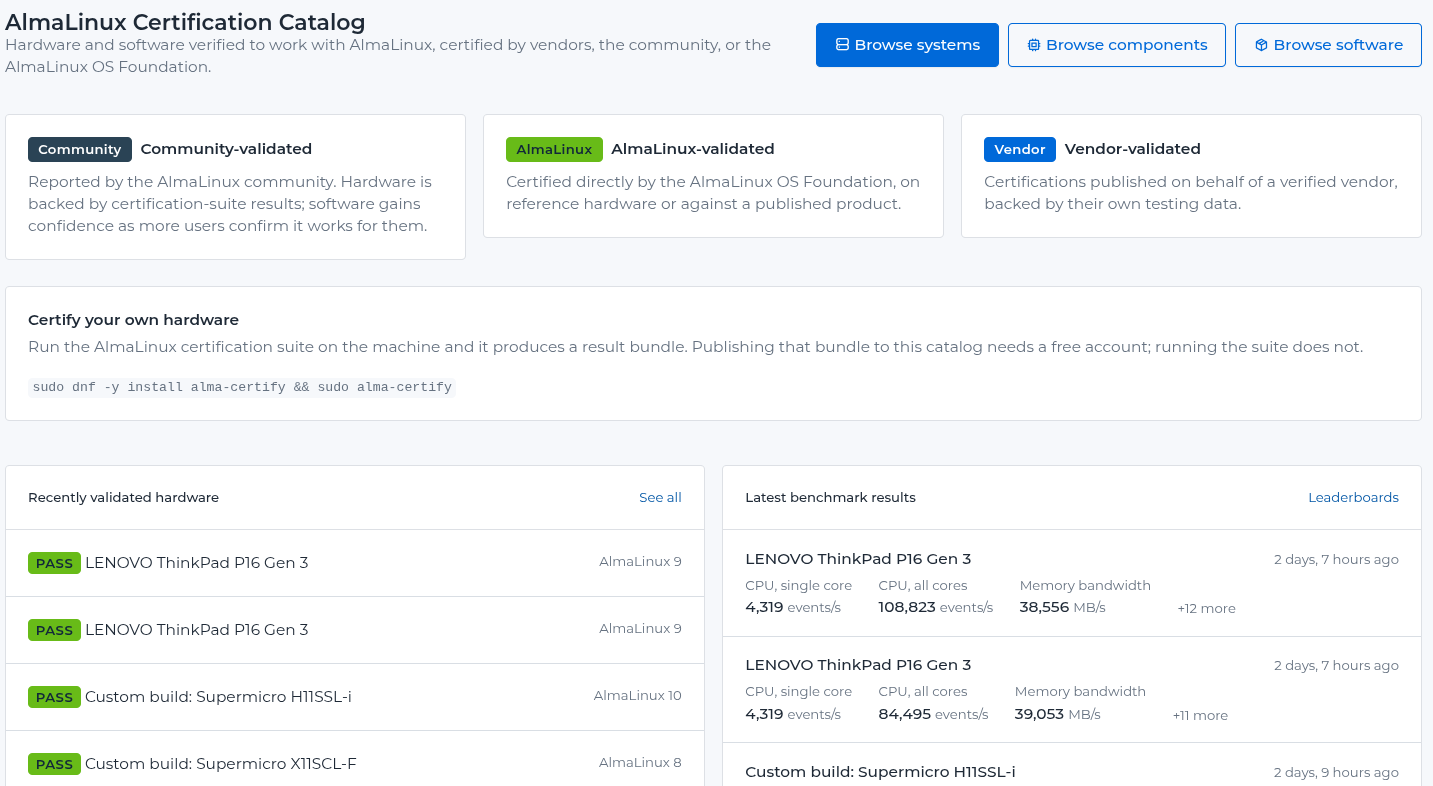
The culmination of these tests is the AlmaLinux Certification Catalog. This public repository acts as a searchable, living database of every validated system and software package.

Key Features of the Catalog:
- Versioned Tracking: Every major release of AlmaLinux is tracked individually, allowing users to verify if a piece of hardware or software is compatible with their specific version (e.g., AlmaLinux 9.x vs. 10.x).
- Benchmark Transparency: Beyond simple compatibility, the catalog includes benchmark data from test runs. This allows IT managers to compare performance metrics across different hardware setups.
- API Accessibility: To encourage further integration, the project offers a free, read-only API. This allows developers to scrape the catalog data for their own internal tooling, such as automated provisioning scripts that check for hardware compatibility before deploying an OS.
Official Perspectives: The Value of Community Validation
Jonathan Wright, the Infrastructure Lead for AlmaLinux, has been a vocal proponent of this shift toward community-led certification. In his official statement, he highlighted two primary motivations for this development: proving viability and lowering the barrier for vendors.
"Two things would make all of this worth it," Wright noted. "A lot of people and organizations want proof that AlmaLinux runs on the hardware they already own before they’ll give it a try, and now they can get that proof themselves. Every result that gets submitted makes the case to hardware and software vendors that supporting AlmaLinux officially is a low-effort thing to do."
This statement hits upon a critical "chicken and egg" problem in the Linux world. Hardware vendors are often hesitant to provide official support for a distribution unless there is sufficient market demand, but users are hesitant to adopt the distribution if the hardware isn’t explicitly supported. By empowering the community to provide the proof of compatibility, AlmaLinux is essentially creating the market demand required to force the hands of hardware manufacturers.
Broader Implications for the Enterprise Linux Market
The implications of this move for the enterprise Linux market are profound.
1. Disrupting the "Big Tech" Certification Monopoly
For years, certifications have been used by dominant Linux vendors to create a competitive moat. By turning certification into a public, community-led utility, AlmaLinux is challenging the notion that "certified" must mean "expensive." This democratizes the enterprise-readiness of the operating system, allowing smaller organizations and boutique hardware vendors to compete on a level playing field with massive corporations.
2. Enhancing Security through Visibility
The alma-certify tool’s ability to map firmware and driver versions creates a massive, crowdsourced security database. If a specific firmware version is found to be vulnerable to a new exploit, the AlmaLinux community will be able to quickly query the catalog to identify which systems and users might be at risk. This level of visibility is unprecedented in the open-source server space.
3. Sustainability and Longevity
By allowing users to test their own hardware, AlmaLinux is extending the lifecycle of server components. Instead of upgrading to "officially supported" hardware, sysadmins can verify that their existing, perfectly functional equipment is fully compatible with the latest AlmaLinux kernel, thereby reducing electronic waste and capital expenditure.
The Path Forward: The Role of the Community
The success of this initiative rests entirely on the participation of the community. A catalog with one entry is a curiosity; a catalog with ten thousand entries is a powerhouse of data.
The AlmaLinux team is explicitly calling for users to step up. Whether you are an individual developer with a home lab or a system administrator managing a cluster of servers, the act of running alma-certify and posting the results is a direct contribution to the project’s health. As Wright noted, "Validations stack, so adding yours to something already listed helps just as much as being the first."
Conclusion
The launch of the new AlmaLinux certification framework is more than just a software update; it is a strategic maneuver to redefine how enterprise software is validated. By stripping away the bureaucracy and cost, and replacing them with a fast, transparent, and community-driven toolset, AlmaLinux is reinforcing its commitment to openness.
For the IT professional, this means faster deployments, better visibility into hardware compatibility, and the ability to make data-driven decisions about their infrastructure. For the open-source community, it is a testament to the power of distributed verification. As the catalog grows, it will inevitably become a standard resource for anyone evaluating the suitability of AlmaLinux for their production environments, proving that in the world of enterprise technology, the most reliable certifications are the ones we build together.