Engineering at Scale: AWS Unveils "Continuous Modernization" to Eradicate Technical Debt
In an era where software velocity is the primary currency of enterprise success, the accumulation of technical debt has become a silent, compounding tax on innovation. Engineering organizations, which often consume up to 30% of total IT budgets, have long struggled with the friction of maintaining legacy codebases while simultaneously pushing for new feature development. Today, Amazon Web Services (AWS) announced a significant evolution in its strategy to address this systemic challenge: the preview launch of AWS Transform – Continuous Modernization.
This new capability, integrated into the existing AWS Transform suite, aims to move organizations away from reactive, manual "firefighting" toward a model of autonomous, continuous code remediation. By shifting the burden of mundane software maintenance—such as upgrading Java versions, swapping deprecated frameworks, and patching security vulnerabilities—to an intelligent, automated system, AWS intends to reclaim millions of engineering hours currently lost to undifferentiated heavy lifting.
The Core Challenge: Why Tech Debt is Scaling Out of Control
For most large-scale enterprises, managing technical debt has been a fragmented, manual process. Engineering leaders typically rely on a patchwork of disconnected point tools: one for dependency scanning, another for vulnerability detection, and a third for static code analysis. This "Frankenstein" approach to tooling creates a lack of visibility, forcing leadership to rely on self-reported status updates that are often outdated or optimistic.
The situation has reached a critical inflection point due to the rapid adoption of AI-assisted development. While generative AI coding agents have successfully accelerated the speed of feature creation, they have also dramatically increased the pace at which code—and associated technical debt—is generated. Without a systematic way to track and remediate this code, organizations are finding their repositories drifting further from modern security and performance standards at an unprecedented rate.
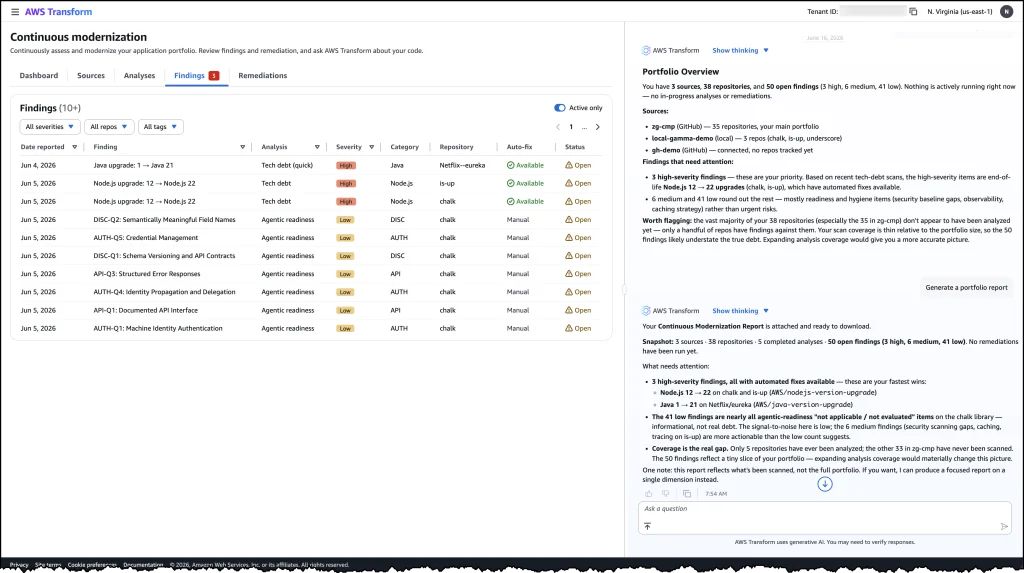
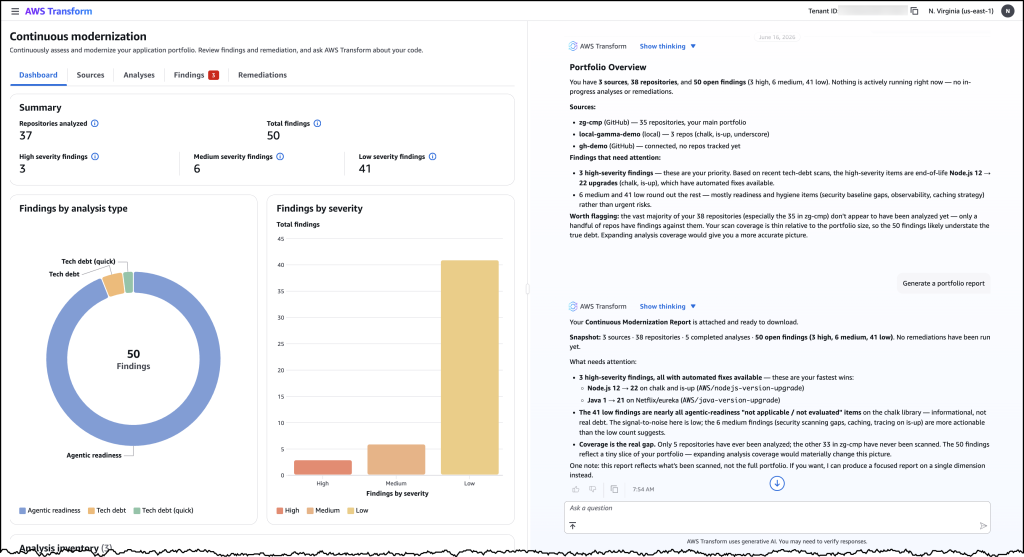
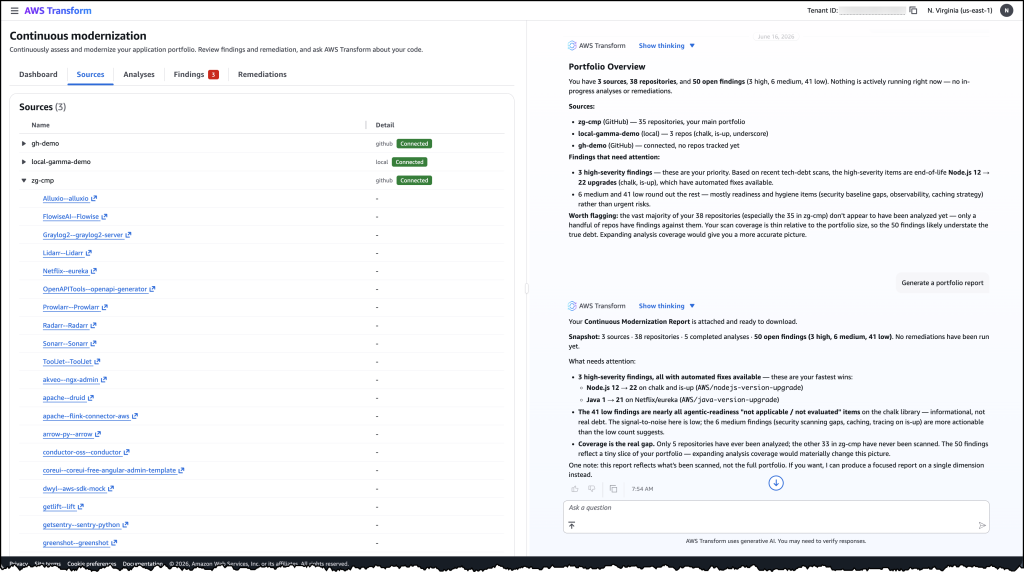
AWS Transform – Continuous Modernization is designed to be the "ground truth" platform for these organizations, providing a centralized dashboard that scans thousands of repositories, identifies out-of-compliance code, and—crucially—proposes the actual code changes required to fix them.
Chronology: The Evolution Toward Autonomous Remediation
The release of this preview capability represents the latest milestone in AWS’s multi-year investment in modernization tooling.
- Phase 1: Migrations and Mainframes: Initially, AWS Transform focused on the "heavy lifting" of cloud migration—moving data centers to the cloud and refactoring monolithic mainframe or Windows-based applications.
- Phase 2: The Maintenance Burden: Recognizing that the work doesn’t stop once an application is in the cloud, AWS began building out capabilities for routine maintenance, including automating runtime upgrades for AWS Lambda and handling deprecated framework transitions.
- Phase 3: Continuous Modernization (Current): The launch of the Continuous Modernization preview marks the transition from periodic, project-based refactoring to a persistent, automated background process. This capability treats technical debt not as an occasional "clean-up project," but as a continuous operational requirement, much like security patching or log management.
Supporting Data: The Anatomy of the New Capability
The architecture of the new AWS Transform capability is built on three pillars: continuous analysis, autonomous remediation, and integration-ready security workflows.
1. Continuous Analysis
The platform automatically scans source code repositories against user-defined baselines. By integrating directly with source control systems, the tool can identify "drift" in real-time. If an organization mandates a specific Java version or prohibits a deprecated logging library, AWS Transform monitors every repository for compliance. The system operates on a "policy-as-code" philosophy, allowing platform teams to codify their organization’s internal standards and automatically enforce them across thousands of projects.

2. Autonomous Remediation at Scale
Detection is only half the battle. The defining feature of this new capability is its ability to generate pull requests (PRs) autonomously. When a repository is identified as being behind a baseline, the system automatically creates a PR that contains the necessary code changes. This transforms the developer’s role from "investigator and patcher" to "reviewer and approver." By providing the code fix alongside the detection report, AWS significantly reduces the time-to-remediation from weeks to minutes.
3. Security-First Integration
Through a tight integration with the AWS Security Agent, the platform ensures that security vulnerabilities are treated with the same urgency as standard technical debt. Findings flow into a unified, prioritized list, ensuring that developers are not context-switching between a security dashboard and a technical debt dashboard.
Implications for Engineering Leadership
The introduction of this capability signals a fundamental shift in how engineering organizations will be managed in the coming decade.
Reducing the "Innovation Tax"
By automating the remediation of dependencies and frameworks, organizations can shift their engineering spend away from maintenance and toward product differentiation. If an enterprise can reclaim even 10% of the 30% of budget currently spent on "undifferentiated work," that represents a massive windfall in capacity for new feature development.
Solving the "Status" Problem
For platform teams, the ability to see a real-time "tech debt landscape" across the entire enterprise is revolutionary. Gone are the days of quarterly spreadsheets or manual status check-ins. Leaders now have a transparent view of which teams are compliant and which are drifting, allowing for data-driven decisions on resource allocation.
Supporting Two Modes of Modernization
AWS has wisely bifurcated the platform’s utility into two distinct operational modes:
- Continuous Mode: Designed for the "always-on" maintenance of dependencies, security patches, and coding standards. This is the background noise of software development, handled autonomously.
- Campaign Mode: Designed for large-scale, high-impact transformations, such as migrating entire product lines to new architectures or upgrading major, breaking runtime versions.
Official Perspectives: A New Standard for Infrastructure
In early demonstrations of the platform, the workflow is notably streamlined. A user connects their source control, selects the desired baseline policies, and receives a comprehensive report within hours. The ability to track the lifecycle of a PR—from creation to merge—provides a level of accountability that has been absent in traditional software maintenance.
"We aren’t just identifying the problems," a lead AWS engineer noted during the preview briefing. "We are providing the remediation path. The goal is to make the right way to build software the easiest way to build software."
By providing these primitives, AWS is positioning itself as the infrastructure layer for the entire software development lifecycle (SDLC). By embedding these capabilities directly into the toolchain, AWS is making it increasingly difficult for organizations to justify the manual overhead of traditional, human-led maintenance.
Looking Forward: The Future of Autonomous Codebases
The preview of AWS Transform – Continuous Modernization is available today, with support for integration via the AWS Transform web application, the Kiro Power tool, and various Model Context Protocol (MCP) integrations for AI-based coding assistants.
As coding agents become more sophisticated, the volume of code being produced will only increase. We are entering an era where "writing code" is the easy part, and "maintaining the integrity of a million-line codebase" is the primary challenge. AWS’s move to automate this maintenance cycle suggests that the future of enterprise software will be defined by autonomous, self-healing repositories. For CTOs and engineering managers, the message is clear: the era of manual technical debt tracking is ending, and the era of autonomous, continuous modernization has officially begun.
Whether this tool will fully replace human architectural oversight remains to be seen, but for the day-to-day grind of dependency management and compliance, it represents the most significant leap forward in years. Organizations that adopt these practices early will likely find themselves operating at a velocity that their legacy-bound competitors will struggle to match.