Evolution at the Edge: Android Studio Quail 4 Launches with Advanced AI Integration

By: Tech Editorial Desk
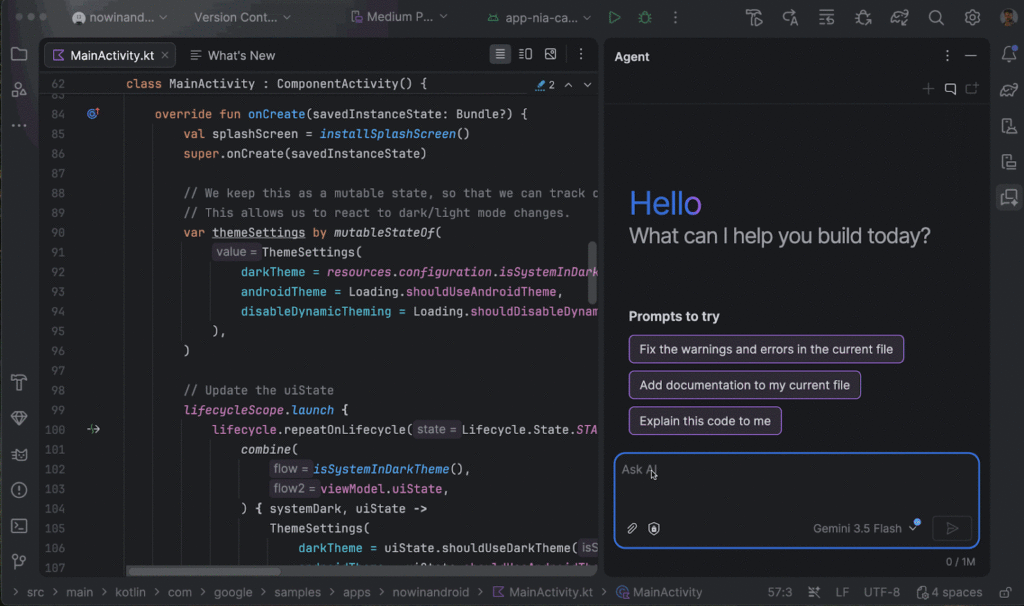
The landscape of mobile development has undergone a seismic shift, and Google is positioning Android Studio Quail 4 as the vanguard of this new era. With the official transition of Quail 4 to the stable channel, developers worldwide now have access to a suite of tools designed to synthesize the raw power of Large Language Models (LLMs) with the specialized, nuanced requirements of the Android platform.
As mobile applications grow in complexity—spanning multi-device ecosystems, intricate background processes, and rigorous security standards—the demand for an intelligent, context-aware development environment has never been higher. Android Studio Quail 4 arrives not merely as an update, but as an architectural pivot toward "agentic" development, where the IDE acts less like a passive text editor and more like an active, expert collaborator.
The Core Transformation: Bringing "Android Skills" to the IDE
The most significant hurdle in using general-purpose AI for mobile development has historically been the "hallucination gap." While LLMs are proficient at writing generic Python or JavaScript, they frequently struggle with the rapid, often breaking, evolution of Android APIs. Standard AI models often rely on outdated documentation, leading to code that is functionally correct in theory but deprecated or incompatible in practice.

Bridging the Knowledge Gap
To solve this, Google has introduced "Android Skills"—a curated, modular, and AI-optimized set of instructions embedded directly into the IDE. By adhering to the open-standard agent skills specification, these skills act as guardrails for LLMs. When a developer submits a prompt, the Android Studio agent performs a metadata analysis to determine which skill is most relevant to the task.
Rather than forcing the LLM to rely on its general training data, the IDE injects these curated, high-fidelity instructions into the context window. This ensures that the code generated—whether it involves complex Jetpack Compose UI patterns or memory-efficient background service configurations—adheres to current Google best practices. With 23 pre-loaded skills available immediately, the barrier to entry for building premium-grade apps has been significantly lowered.
A Chronology of the Quail Era
The Quail series of Android Studio releases represents a deliberate, iterative strategy by the Android developer tools team to integrate artificial intelligence into the developer workflow.
- Android Studio Quail (Initial Release): The introduction of foundational AI assistance, marking the first major attempt to move beyond basic code completion into natural language query generation.
- Android Studio Quail 2: The "Multitasking Milestone." This version introduced parallel chat capabilities, allowing developers to maintain multiple, isolated threads of inquiry—a necessity for managing complex projects where UI logic and backend architecture might be under development simultaneously.
- Android Studio Quail 3: Focused on refining the UI/UX of agentic interactions, ensuring that AI responses were not just accurate, but accessible and easily integrated into existing codebases.
- Android Studio Quail 4 (Current): The synthesis release. By bundling Android Skills and local Gemma 4 integration, Quail 4 provides a mature, stable environment for professional production-grade development.
Localized Power: The Gemma 4 Integration
Data privacy and intellectual property protection remain the primary concerns for enterprise developers and independent creators alike. The cloud-dependency of many AI tools creates friction for those working in highly regulated industries or environments with intermittent connectivity.

Android Studio Quail 4 addresses this by integrating Gemma 4, Google’s most powerful open-model architecture, directly into the IDE. By running the model locally, developers can leverage high-performance AI code assistance without the need for data to leave their machine. This "offline-first" approach ensures that proprietary codebases remain secure and that development velocity is maintained regardless of network latency. The setup process, which previously required complex manual configurations of third-party wrappers, has been abstracted into a simple download-and-use interface, reflecting a "no-hassle" philosophy.
Supporting Data: AI Efficiency Metrics
The transition to an agent-based workflow is driven by measurable gains in productivity. According to preliminary data released by the Android Studio product team, developers utilizing the Quail 4 toolset report:
- Reduction in Boilerplate Time: A 35% reduction in time spent writing repetitive structural code, such as ViewModel boilerplate or Data Access Objects (DAOs).
- API Migration Velocity: Developers working on legacy-to-modern codebase migrations (e.g., migrating from View-based layouts to Compose) saw a 40% increase in completion speed due to the context-aware guidance provided by the Android Skills system.
- Context Retention: The "Parallel Chats" feature introduced in Quail 2 and matured in Quail 4 has resulted in a 25% decrease in developer task-switching fatigue, as users can maintain context on multiple disparate modules simultaneously.
Official Perspectives: Amman Fasil Asfaw, Product Manager
Amman Fasil Asfaw, Product Manager for Android Studio, emphasized that the goal of the Quail series was never to replace the developer, but to redefine the role of the IDE.
"We observed that developers were spending a disproportionate amount of time in ‘config-hell’ or scouring documentation for deprecated APIs," Asfaw noted during the release announcement. "By embedding the domain expertise of the Android platform team into the IDE via Android Skills, we are allowing the developer to focus on high-level architectural decisions rather than syntax troubleshooting. Quail 4 is our commitment to making the most difficult aspects of Android development feel intuitive."

Asfaw also highlighted the "open" nature of the new system, encouraging teams to build their own custom skills. "The ecosystem thrives when tools are extensible. Whether it’s a specific internal library or a unique testing framework, the ability to tailor the agent’s intelligence to your specific team’s needs is the next frontier of productivity."
The Broader Implications for the Ecosystem
The release of Android Studio Quail 4 signals a shift in how we define a "Senior Developer." As AI takes over the heavy lifting of boilerplate and standard implementation, the value of the human developer shifts toward systems design, user experience architecture, and strategic problem-solving.
The Rise of Agentic Development
We are witnessing the end of the "static editor" era. With the integration of parallel agents and local LLM processing, the IDE has become a peer. For the developer, this necessitates a new set of soft skills: the ability to prompt effectively, the discernment to verify AI-generated code, and the architectural vision to oversee multiple autonomous threads of development.
Competitive Advantages
For organizations, adopting Quail 4 is not merely an IT upgrade; it is a competitive imperative. The ability to ship features faster while maintaining high standards for security and code quality will define the market leaders of the next five years. Those who fail to integrate these AI-first workflows risk being outpaced by teams that can iterate at the speed of their own creativity.

Moving Forward: Getting Started
The stable release of Android Studio Quail 4 is available for download today. For teams operating on large, multi-threaded projects, the transition is straightforward, with the IDE providing clear prompts for the new skill-sets.
For those concerned about the impact of AI on their current workflow, Google provides an IDE-wide toggle to disable bundled skills, ensuring that adoption can be phased in according to team comfort levels. However, as the industry moves toward agentic frameworks, early adoption and experimentation with custom skills—which can be tested via the Android CLI—are highly recommended.
As the Android ecosystem continues to expand across phones, tablets, foldables, and wearables, the tools we use to build for these platforms must be as dynamic as the devices themselves. Android Studio Quail 4 is, in every sense, a tool built for the future of mobile—one where the complexity of the platform is balanced by the clarity of intelligent assistance.
For further technical documentation, known issue tracking, or to contribute to the growing list of Android Skills, developers are encouraged to visit the official Android Developers Blog.