From Sweat to System: How IoT Automation Transformed YogaSol’s Extreme Climate Challenge

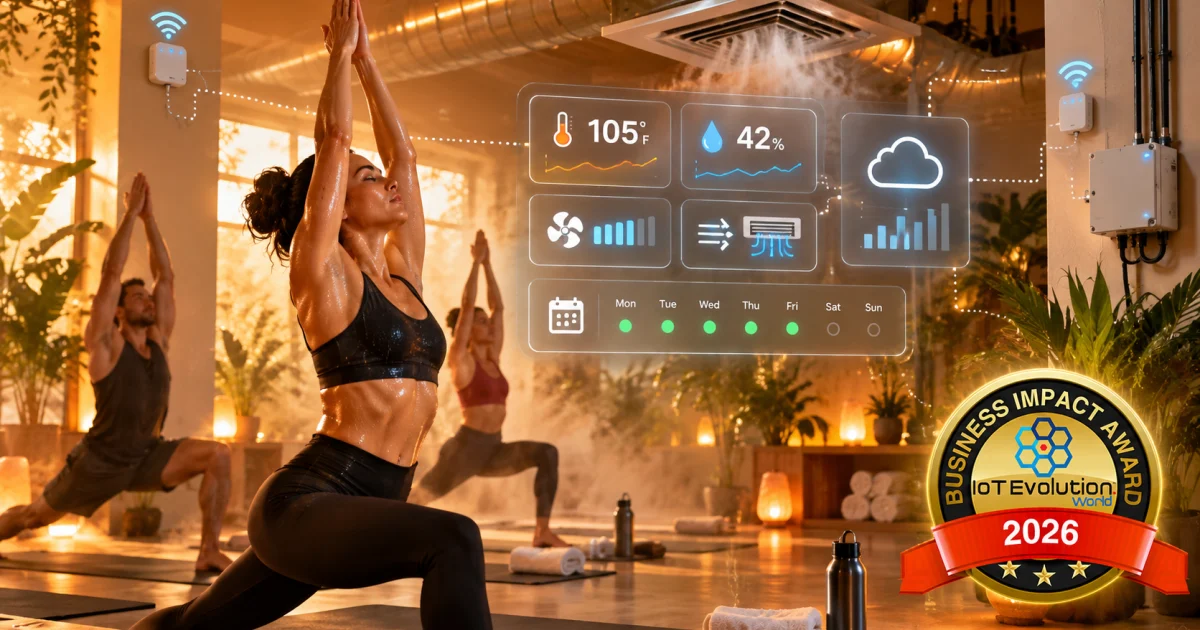
Norwalk, Connecticut — Running a specialized fitness studio is rarely just about instruction and community; it is an exercise in complex facility management. For Dan Markowitz, founder of YogaSol in Norwalk, Connecticut, the daily operations resemble the mechanical demands of an industrial plant rather than a traditional neighborhood gym. Operating 16 hours a day, seven days a week, YogaSol specializes in hot yoga and Hot HIIT Pilates. These high-intensity disciplines require rigorous environmental conditions: indoor temperatures soaring between 90 and 110 degrees Fahrenheit, paired with a relative humidity level hovering around 50 percent.
Maintaining this hyper-specific climate is only half the battle. Between back-to-back classes, the studio faces a demanding environmental transition. The air must be rapidly cleared, the suffocating heat and humidity knocked down, and fresh conditions restored just in time for the next session of practitioners.
Historically, orchestrating this high-turnover cycle required continuous manual intervention. Staff members had to remain on site long after classes ended to manage dampers, verify exhaust fans, and monitor heating equipment. For an independent business, this meant heavy labor costs and severe operational friction.
Enter AIMNET Smart Building Systems, a trusted Monnit partner based in Orange, Connecticut. By deploying an ingenious Internet of Things (IoT) architecture utilizing Monnit’s Indoor Environmental Monitoring and Control technology, AIMNET automated YogaSol’s entire climate workflow. The resulting system has not only slashed weekly labor expenditures by more than 60 hours but also earned Monnit’s prestigious Business Impact Award—proving that advanced, enterprise-grade building automation can be scaled down effectively and affordably for independent small businesses.
Main Facts: The Anatomy of a Small-Facility Problem
At its core, YogaSol faced a massive building-scale control challenge within a relatively compact footprint. The physical realities of hosting high-heat, high-humidity classes in a commercial retail space created a cascade of operational pain points:
- Extreme Climate Demands: The studio spaces must be maintained at punishing temperatures (90°F to 110°F) while holding a steady relative humidity of roughly 50 percent to ensure safety and comfort.
- Rapid Turnaround Windows: Between sessions, the facility requires rapid environmental remediation—venting out stale, humid air and cooling the space before the next wave of students arrives.
- Complex Stakeholder Needs: Instructors needed a frictionless way to trigger fresh air cycles without disrupting classes. Management required strict climate logs for compliance, real-time visibility into HVAC health, and immediate leak detection around steam humidifiers. Furthermore, the owners needed robust remote-override capabilities to manage unexpected schedule modifications without being physically tethered to the facility.
- The Technological Solution: Designed by AIMNET, the deployed system bridges wireless sensors, cloud scheduling, and physical relay controls into a single, cohesive loop. Utilizing Monnit ALTA wireless technology, the setup connects environmental measurements directly to physical actions, entirely eliminating the need for constant human supervision.
Chronology: From Concept to Closed-Loop Automation
The journey toward total studio automation began with a fundamental question posed by Markowitz and managing partner Jeanne Tang: How could an independent small business obtain the behavioral sophistication of a multi-million-dollar Building Management System (BMS) without the crushing capital expenditure and maintenance overhead?
Phase 1: Architectural Design and Discovery
Recognizing that off-the-shelf residential thermostats were wholly inadequate for commercial hot yoga operations, the leadership team turned to AIMNET Smart Building Systems. Project engineer David Dickson and his team evaluated various options, ultimately selecting Monnit’s wireless ecosystem due to its robust reliability, ease of retrofit, and extreme cost-effectiveness—coming in at roughly 25 percent of the installation cost of competing enterprise solutions.
Phase 2: Hardware Deployment and Wireless Integration
The physical installation relied on a multi-layered deployment of Monnit ALTA hardware:
- Sensing the Environment: Wireless temperature and humidity sensors were strategically distributed throughout the studio spaces to capture hyper-local environmental data continuously.
- Guarding the Equipment: Water detection discs were installed around the critical steam humidifiers to catch potential leaks and equipment failures before they could cause costly structural damage.
- Empowering the Instructors: Portable, button-press wireless sensors were handed to instructors, granting them the power to initiate pre-programmed fresh air and exhaust cycles with a single touch.
- Bridging Data to Action: Wireless gateways aggregated all sensor data, piping it securely into the cloud-based iMonnit platform. Crucially, two ALTA 10 Amp Wireless Control units were deployed as relay switches, directly connecting the digital data streams to the physical actuators governing the studio’s fresh air dampers and exhaust fans.
Phase 3: Cloud Synchronization and Calendar Integration
To elevate the deployment from simple remote monitoring to true automation, AIMNET integrated the iMonnit platform with Google Calendar. By synchronizing the studio’s live class timetable with the automation logic, the building itself began responding to operational intent without human intervention.
When a class ends according to the digital calendar, the system automatically triggers ventilation cycles, dampens heating output, and resets baseline conditions. If a class is canceled or rescheduled, authorized users can immediately adjust parameters via an AIMNET-built web portal optimized for PCs and mobile smart devices.
Supporting Data: Efficiency, Economics, and Impact
The measurable outcomes of the AIMNET and Monnit deployment at YogaSol underscore the transformative power of purposeful IoT implementation. For an independent fitness studio operating on tight margins, the numbers tell a compelling story of operational optimization:
- Labor Savings: By automating the facility’s daily environmental resets and remote oversight, YogaSol eliminated the need for a non-instructor employee to remain on site during off-hours. This single change saved the business more than 60 hours of labor cost every single week.
- Capital Efficiency: According to AIMNET project engineer David Dickson, the Monnit-based wireless retrofit cost roughly 75 percent less to install than alternative enterprise building management options considered during the planning phase.
- System Longevity: Demonstrating the industrial-grade reliability of the hardware, the system has now been running continuously and reliably in a punishing, high-moisture environment for more than four years.
- Risk Mitigation: The deployment of water detection discs and instantaneous alert protocols (dispatched via email, text message, or voice call) effectively eliminated catastrophic humidifier leak risks, preserving thousands of dollars in potential property damage.
Official Responses: Perspectives on the Transformation
The success of the YogaSol installation lies as much in its human impact as its technical elegance. For the studio’s leadership and its integration partners, the project represents a watershed moment in work-life balance and small-business scalability.
Jeanne Tang, managing partner at YogaSol, captured the emotional and personal dimension of the automation project with striking candor:
"Automation lets the owners manage the studio when they are not physically present and makes it possible to run the business while retaining some semblance of family life."
For small business owners in the wellness and fitness sectors, the invisible labor of facility management often eats into personal time, leading to burnout. By handing the reigns of climate control over to a dependable, automated loop, Tang and Markowitz reclaimed their evenings and weekends.
From the integrator’s perspective, the project serves as a textbook example of how modern wireless IoT should be applied in the wild. David Dickson, project engineer at AIMNET, highlighted the democratization of building automation:
"The approach cost about 75 percent less to install than other options we reviewed, yet it delivers the robust, closed-loop reliability required to manage extreme indoor conditions day in and day out."
Monnit’s recognition of the project with its Business Impact Award validates the core thesis of the deployment: technology is only as valuable as the human outcomes it enables. By bridging the gap between raw environmental visibility and physical control, the system transformed a persistent operational headache into a seamless, background process.
Implications: The Future of Smart Small Businesses
The YogaSol case study carries profound implications for the broader commercial real estate and small-business landscapes. For decades, sophisticated building automation systems (BMS) were economically out of reach for independent operators. Restaurants, retail boutiques, yoga studios, and local clinics were forced to choose between manual management—relying on human memory, physical keychains, and constant on-site checks—or installing prohibitively expensive, proprietary commercial systems designed for high-rise corporate offices.
The collaboration between AIMNET and Monnit demonstrates that the era of the accessible, wireless "smart building" has arrived. By leveraging off-the-shelf wireless sensors, cloud flexibility, and simple relay switches, local integrators can solve hyper-specific environmental challenges without custom-coding enterprise infrastructure.
Furthermore, YogaSol illustrates the vital distinction between monitoring and automation. Many businesses invest in sensor suites that merely inform staff when conditions drift outside acceptable parameters. While visibility is useful, it still requires a human to react, travel to the site, and manually correct the issue. Closed-loop automation—where the sensor talks to the cloud, consults the digital schedule, and triggers a physical relay—completes the cycle. It allows a business to respond, recover, and prepare proactively.
As IoT components continue to drop in price and rise in durability, deployments like YogaSol’s will transition from innovative outliers to industry standards. For small-business operators looking to scale their capacity without inflating their payroll, the message from Norwalk is clear: the future belongs to automation that gives time back to the human being.