Mastering PostgreSQL Role-Based Access Control (RBAC): A Comprehensive Enterprise Implementation Guide
Database security remains a critical cornerstone of modern enterprise architecture. As applications scale and microservices proliferate, managing user permissions through ad-hoc commands creates substantial compliance risks and operational overhead.
To help database administrators transition from basic privilege granting to robust security patterns, this guide breaks down how to architect, implement, and audit a production-grade Role-Based Access Control (RBAC) framework within PostgreSQL.
Using a realistic credit-card processing application environment, we explore the mechanical distinctions between user authentication, role hierarchies, schema separation, object ownership, and effective permission auditing.
Main Facts: The Architecture of PostgreSQL Security
Unlike relational database management systems that treat users and groups as fundamentally distinct entities, PostgreSQL implements a unified concept: the Role. Everything that interacts with a PostgreSQL database—whether it is a human operator, a connection pooling service, or an automated reporting daemon—is represented as a role.
The distinction between a "user" and a "group" in PostgreSQL is determined solely by configuration attributes assigned during role creation:
LOGINRoles: These identities can authenticate and establish sessions against the database cluster, provided they supply valid credentials and possess the necessary network and database connection permissions.NOLOGINRoles: These identities cannot authenticate directly. Instead, they serve as logical containers for privileges, object ownership, and authorization hierarchies. They can be granted to other roles to establish clean inheritance chains.
By separating authentication (LOGIN) from authorization (NOLOGIN), database administrators can enforce the principle of least privilege. Rather than managing privileges per individual user, permissions are assigned to reusable functional roles, and users inherit those privileges via membership mappings.
Chronology: Step-by-Step Lab Implementation
To observe PostgreSQL RBAC in action, we can construct a production-inspired credit-card application environment (carddb) from scratch.
Step 1: Establishing the Role Hierarchy
We begin by connecting to our PostgreSQL cluster as an administrative user and creating three NOLOGIN roles to manage ownership and permissions, alongside two LOGIN roles for application and reporting traffic.
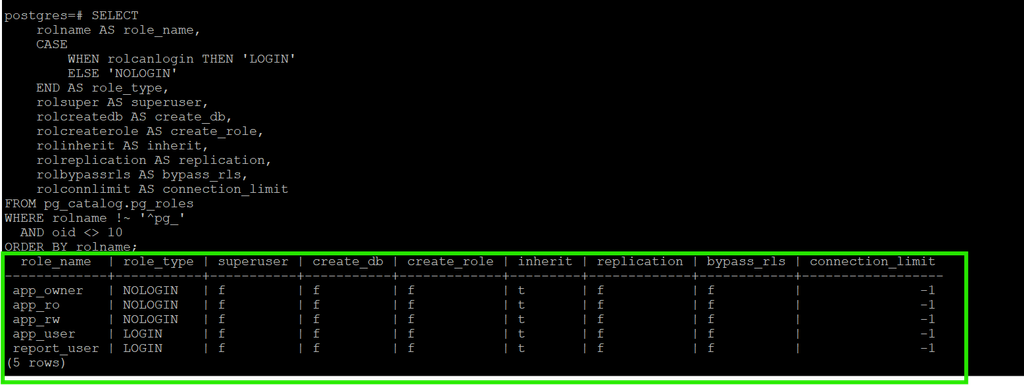
-- Create NOLOGIN structural roles
CREATE ROLE app_owner NOLOGIN;
CREATE ROLE app_ro NOLOGIN;
CREATE ROLE app_rw NOLOGIN;

-- Create LOGIN application and reporting roles
CREATE ROLE app_user LOGIN PASSWORD 'AppLab123!';
CREATE ROLE report_user LOGIN PASSWORD 'ReportLab123!';
Step 2: Provisioning the Application Database and Schema
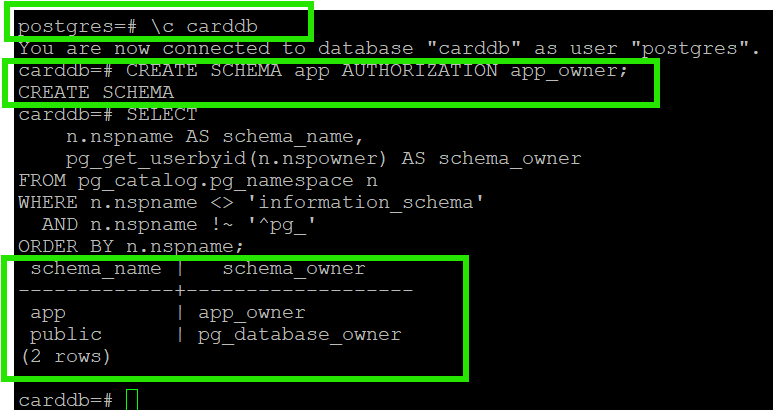
In a secure production topology, application objects should not reside in the default public schema. We create a dedicated database owned by our structural app_owner role, followed by a dedicated schema.
-- Create the application database
CREATE DATABASE carddb OWNER app_owner;

-- Connect to the new database and create the schema
c carddb
CREATE SCHEMA app AUTHORIZATION app_owner;
Step 3: Constructing Application Tables and Data
Next, we instantiate our data model within the app schema. Because our session runs under administrative credentials initially, we temporarily assume the identity of our structural owner using SET ROLE to ensure proper object ownership.
SET ROLE app_owner;

CREATE TABLE app.customers (
    customer_id integer PRIMARY KEY,
    customer_name varchar(100) NOT NULL,
    email varchar(150),
    status varchar(20) DEFAULT 'ACTIVE'
);

CREATE TABLE app.accounts (
    account_id integer PRIMARY KEY,
    customer_id integer REFERENCES app.customers(customer_id),
    account_number varchar(20) NOT NULL,
    credit_limit numeric(12,2),
    balance numeric(12,2) DEFAULT 0
);

-- Seed sample data
INSERT INTO app.customers (customer_id, customer_name, email)
VALUES (1, 'Alice Johnson', '[email protected]'),
       (2, 'Bob Smith', '[email protected]');

INSERT INTO app.accounts (account_id, customer_id, account_number, credit_limit, balance)
VALUES (101, 1, 'CC-10001', 5000, 1200),
       (102, 2, 'CC-10002', 8000, 2500);

RESET ROLE;
Step 4: Configuring Membership Hierarchies and Privileges
PostgreSQL requires explicit permission grants at multiple layers: database connection, schema usage, and table-level data manipulation. We restrict default access to the database and configure our RBAC inheritance tree.
-- Revoke default open access from the PUBLIC group
REVOKE CONNECT, TEMPORARY ON DATABASE carddb FROM PUBLIC;

-- Establish role inheritance hierarchy
GRANT app_ro TO app_rw;
GRANT app_rw TO app_user;
GRANT app_ro TO report_user;

-- Grant database connection and schema usage
GRANT CONNECT ON DATABASE carddb TO app_ro, app_rw;
GRANT USAGE ON SCHEMA app TO app_ro, app_rw;

-- Grant table-level data manipulation rights
GRANT SELECT ON ALL TABLES IN SCHEMA app TO app_ro;
GRANT INSERT, UPDATE, DELETE ON ALL TABLES IN SCHEMA app TO app_rw;
Supporting Data: System Catalogs and Privilege Verification
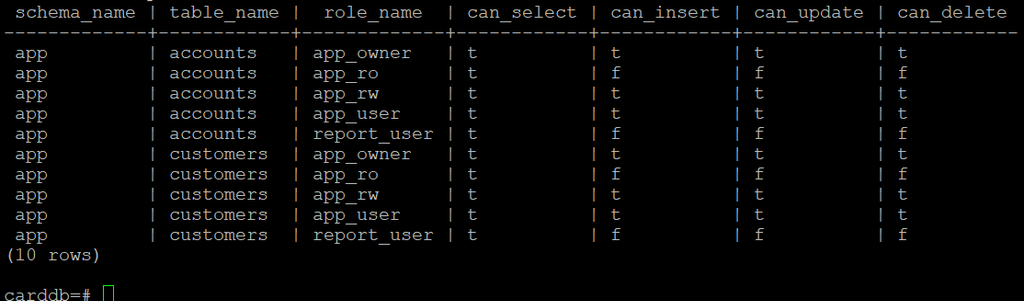
Relying on assumptions in database security is dangerous. DBAs must use PostgreSQL’s system catalogs and metadata functions to verify effective privileges.
Auditing Effective Table Access
Using the has_table_privilege function, we can programmatically confirm what actions a given role can execute, accounting for inherited permissions and explicit grants alike.
SELECT
    n.nspname AS schema_name,
    c.relname AS table_name,
    r.rolname AS role_name,
    has_table_privilege(r.oid, c.oid, 'SELECT') AS can_select,
    has_table_privilege(r.oid, c.oid, 'UPDATE') AS can_update
FROM pg_catalog.pg_class c
JOIN pg_catalog.pg_namespace n ON n.oid = c.relnamespace
CROSS JOIN pg_catalog.pg_roles r
WHERE c.relkind IN ('r', 'p')
  AND n.nspname = 'app'
  AND r.rolname IN ('app_user', 'report_user');
Expected Verification Output:
report_user:can_select=true,can_update=falseapp_user:can_select=true,can_update=true
Official Responses: Navigating Architectural Gotchas
Administrators migrating from other enterprise relational systems—most notably Oracle Database—frequently encounter structural surprises when implementing PostgreSQL RBAC.
- Schemas vs. Users: In Oracle, a schema is tightly bound to a database user account. In PostgreSQL, schemas are entirely independent namespaces. A
NOLOGINrole can own multiple schemas and tables without ever logging in. - Cluster-Level Roles: PostgreSQL roles are cluster-wide objects, not database-local objects. Creating a role once makes it visible across all databases within the cluster instance.
- The Myth of
GRANT ALL: Granting all privileges on a table to a user does not transfer object ownership. Operational DDL commands—such as altering table columns or dropping constraints—can only be executed by the true table owner (app_owner), a superuser, or a role possessing explicit ownership authority. Even aGRANT ALL PRIVILEGESstatement will fail to authorize schema-level structural modifications.
Implications: Production Best Practices and Security Auditing
Implementing a structured RBAC framework dramatically reduces the surface area for privilege escalation and human error. However, maintaining this posture requires continuous validation.
Automated Default Privileges
To prevent security gaps when application deployments introduce new database objects, DBAs must configure default privileges for future creations:
ALTER DEFAULT PRIVILEGES FOR ROLE app_owner IN SCHEMA app
GRANT SELECT ON TABLES TO app_ro;

ALTER DEFAULT PRIVILEGES FOR ROLE app_owner IN SCHEMA app
GRANT INSERT, UPDATE, DELETE ON TABLES TO app_rw;
Periodic Compliance Auditing
Security teams should regularly execute automated queries against pg_catalog.pg_auth_members and pg_catalog.pg_default_acl to ensure no drift has occurred from the intended least-privilege architecture.
By enforcing strict role hierarchies, isolating object ownership to non-login identities, and validating permissions through system catalogs, organizations can build resilient, highly secure PostgreSQL environments capable of meeting rigorous enterprise compliance standards.