Mastering Time: How Temporian and TensorFlow Decision Forests Are Revolutionizing Temporal Data Engineering

In the rapidly evolving landscape of machine learning, the ability to interpret and act upon temporal data—information that fluctuates, evolves, or holds significance only within a specific timeframe—has become a cornerstone of competitive intelligence. Whether it is predicting fluctuating market prices, analyzing the rhythmic patterns of heartbeats, or detecting subtle anomalies in network traffic, temporal data is the lifeblood of modern predictive analytics.
Despite its importance, processing this data has traditionally been a bottleneck for data scientists. Enter Temporian, a groundbreaking open-source Python library developed through a strategic collaboration between Google and the machine learning experts at Tryolabs. When paired with the robust TensorFlow Decision Forests (TF-DF), Temporian offers a streamlined, efficient pipeline for feature engineering and model training, effectively bridging the gap between raw transactional noise and actionable machine learning signals.

The Core Challenge: Why Temporal Data Matters
Temporal data is omnipresent. Every transaction, sensor reading, or digital interaction carries a timestamp, and that timestamp is often the most "discriminative" feature in a dataset. Consider, for instance, a retail environment. A simple list of sales records is informative, but the rate at which those sales occur, the interval between purchases, and the seasonality of demand are what allow a business to optimize inventory and forecast future revenue.
Historically, preparing this data for machine learning models required laborious, often fragile custom code. Data scientists had to write complex scripts to resample non-uniform data, calculate rolling statistics, and manage synchronization across multiple data sources. This process is not only prone to errors but also creates "training-serving skew," where the preprocessing logic used during model training fails to mirror the logic used in production environments. Temporian was engineered specifically to solve this, providing a unified framework that handles temporal data with the same ease that standard libraries handle static data.

A New Paradigm: The Temporian Advantage
Temporian introduces the concept of the EventSet—a versatile, high-performance container for temporal data. Unlike standard time series, which often assume uniform sampling (e.g., one measurement every hour), EventSet is designed to handle the messy, non-uniform reality of real-world event logs.
Key Capabilities of Temporian:
- Multivariate and Multi-index Support: It seamlessly manages relationships between different signals, such as tracking individual product sales across thousands of unique customer IDs.
- Operator-Driven Engineering: It provides a suite of high-performance operators—such as
moving_sum,moving_count, andcalendar_day_of_week—that allow users to construct complex features with minimal syntax. - Production-Ready: By design, Temporian ensures that the same logic applied to historical data during training can be deployed in production, eliminating the risk of performance degradation.
Chronology of Implementation: From Raw Logs to Forecasting
To demonstrate the power of this stack, consider a typical retail forecasting scenario. The goal: predict the total weekly sales for an online shop based on historical transaction data.

1. Data Ingestion and Visualization
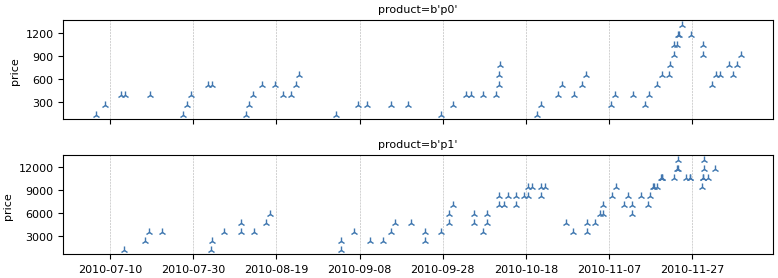
The process begins by loading raw transaction logs. Using tp.from_csv(), the data is converted into an EventSet. Visualization is immediate and intuitive; a single line of code allows developers to inspect price fluctuations across the entire dataset. While a raw plot might appear chaotic due to the density of transactions, Temporian allows for quick refinement.
2. Feature Engineering with Moving Averages
The power of Temporian truly shines when performing window-based operations. Calculating the moving sum of sales over a seven-day period—a task that might require dozens of lines in native Pandas—is reduced to a single method call: sales["price"].moving_sum(tp.duration.days(7)). This creates a smoothed signal that reveals trends hidden beneath the day-to-day volatility.

3. Handling Multi-Index Relationships
In a real-world shop, calculating global sales is insufficient; you need granular insight into individual products. Temporian’s .add_index("product") allows the developer to isolate metrics for every SKU. By applying the moving_sum operator to these indices, the model can now differentiate between the performance of a high-turnover item and a niche product, significantly increasing the model’s predictive power.
4. Aggregation and Sampling
When moving from transaction logs to a machine learning model, data must often be aggregated into uniform time steps (e.g., daily totals). Temporian’s tick() function enables this transition, allowing developers to define a target sampling frequency while maintaining the integrity of the underlying temporal features.

Supporting Data: Training the TensorFlow Model
Once the feature engineering is complete, the EventSet is converted into a format suitable for TensorFlow. This is where TensorFlow Decision Forests (TF-DF) take over. TF-DF is particularly well-suited for tabular data, which is exactly what the processed temporal features represent.
By constructing a dataset that includes multiple windowed moving sums (e.g., 3, 7, 14, and 28-day windows) and calendar information (like the day of the week), the model gains a holistic view of the business cycle. After training a RandomForestModel, developers can inspect the "Variable Importance." In this experiment, the 28-day moving sum proved to be the most critical feature, followed closely by product identity and calendar signals. This empirical evidence validates the engineering strategy: the model is effectively learning that long-term trends and cyclical human behavior are the strongest predictors of future sales.

Official Perspectives: The Collaboration
The development of Temporian represents a significant milestone in the Google/Tryolabs partnership. As noted by the engineering teams involved, the primary goal was to "make the hard parts of temporal data engineering invisible." By shifting the focus from the mechanics of data manipulation to the logic of feature selection, the library empowers data scientists to iterate faster and deploy more robust models. The integration with the broader TensorFlow ecosystem means that developers do not have to leave the comfort of their established workflows to access these advanced temporal tools.
Implications for the Industry
The implications of this technology stack are far-reaching:
- Democratization of Time Series Forecasting: By lowering the technical barrier to entry, smaller teams can now build sophisticated forecasting models that were previously reserved for organizations with large, specialized data engineering departments.
- Reduced Time-to-Market: The reduction in boilerplate code for data preprocessing means that models can be prototyped, tested, and deployed in days rather than weeks.
- Enhanced Model Accuracy: Because Temporian makes it easy to engineer complex features—like multi-window moving averages and time-shifted labels—models are trained on richer, more contextual data, leading to superior performance in real-world scenarios.
- Reliability in Production: The inherent consistency between the Temporian preprocessing pipeline and the production environment addresses one of the most common causes of model failure in industry: data leakage and training-serving mismatch.
Conclusion: The Path Forward
As machine learning matures, the industry is moving away from "black box" models toward systems that prioritize clean, well-engineered features. The combination of Temporian and TensorFlow Decision Forests provides a clear, scalable roadmap for this future.
For practitioners looking to start, the documentation and tutorials provided by the Temporian team offer a comprehensive deep dive into everything from anomaly detection to complex fraud identification. As businesses continue to generate vast amounts of timestamped data, tools like these will not just be helpful—they will be essential for any organization aiming to remain data-driven in a rapidly changing world. The era of manual, error-prone temporal data processing is coming to an end; the era of efficient, intelligent temporal engineering has begun.