In the modern landscape of homeautomation and the Internet of Things (IoT), consumers are often forced into a frustrating compromise. Upgrading legacy electrical systems—such as automated gates, motorized blinds, or traditional domestic boilers—typically requires purchasing expensive proprietary hardware. Worse yet, many commercially available smart devices rely on centralized, opaque cloud architectures situated across the globe, raising significant concerns regarding data privacy, compliance with regulations like the European Union’s GDPR, and overall cybersecurity.
To resolve these challenges, developers and electronics enthusiasts now have access to an open-source, serverless alternative: a remote gate-control and appliance-management ecosystem built around the Ganimede.E12 hardware board and a dedicated cross-platform mobile application. Powered by an ESP-12F microcontroller and programmed via MicroPython, this system utilizes a serverless architecture relying on the free dweet.io cloud service.
By employing robust end-to-end symmetric encryption via the Advanced Encryption Standard (AES) and dynamic timestamp validation to prevent replay attacks, the Ganimede.E12 project delivers enterprise-grade security and absolute user privacy without requiring complex server infrastructure, subscription fees, or proprietary vendor ecosystems.
Chronology
The conceptualization and realization of the Ganimede.E12 remote control project followed a methodical engineering lifecycle designed to ensure seamless integration between embedded hardware, cloud communication protocols, and user-facing software:
Hardware Selection and Prototyping: The foundational Ganimede.E12 board—featuring the ESP-12F microcontroller—was selected for its robust Wi-Fi capabilities and flexible expansion headers. Integrations were established by connecting a 5 Vdc 10 A relay to the Neopixel connector (CN4) for load management and a miniature 0.96-inch OLED display via the I2C bus to the CN7 connector.
Protocol Evaluation and Integration: Developers analyzed standard IoT communication protocols and selected dweet.io for its Humanized Application Programming Interface (HAPI) and HTTP-based GET/POST methodology, striking a balance between ease of implementation and zero-cost operation.
Cybersecurity Hardening: Recognizing the vulnerabilities inherent in the free version of dweet.io—specifically its lack of native authentication and the public visibility of network endpoints—engineers implemented an AES symmetric encryption wrapper. To mitigate replay attacks, dynamic application-side timestamps were embedded into the encrypted message payloads and cross-referenced against the board’s Network Time Protocol (NTP)-synchronized Real-Time Clock (RTC).
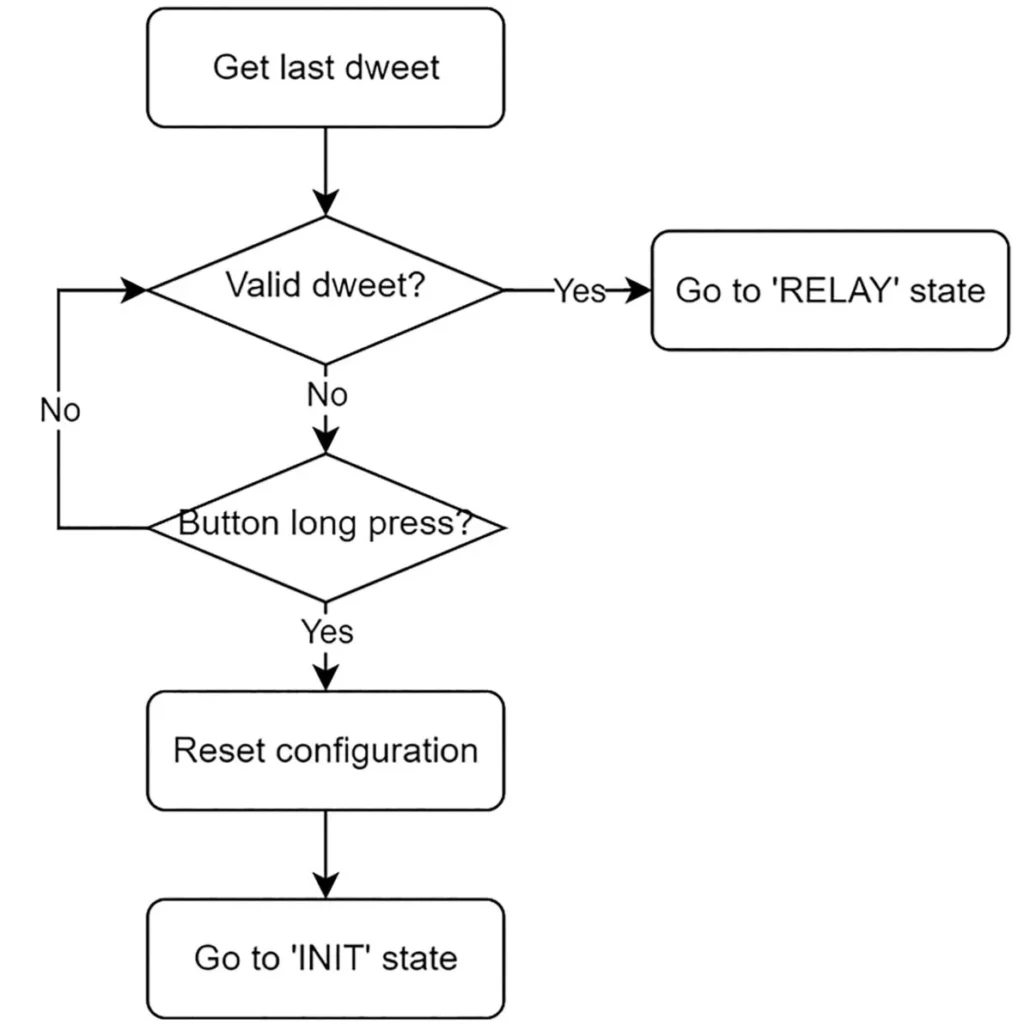
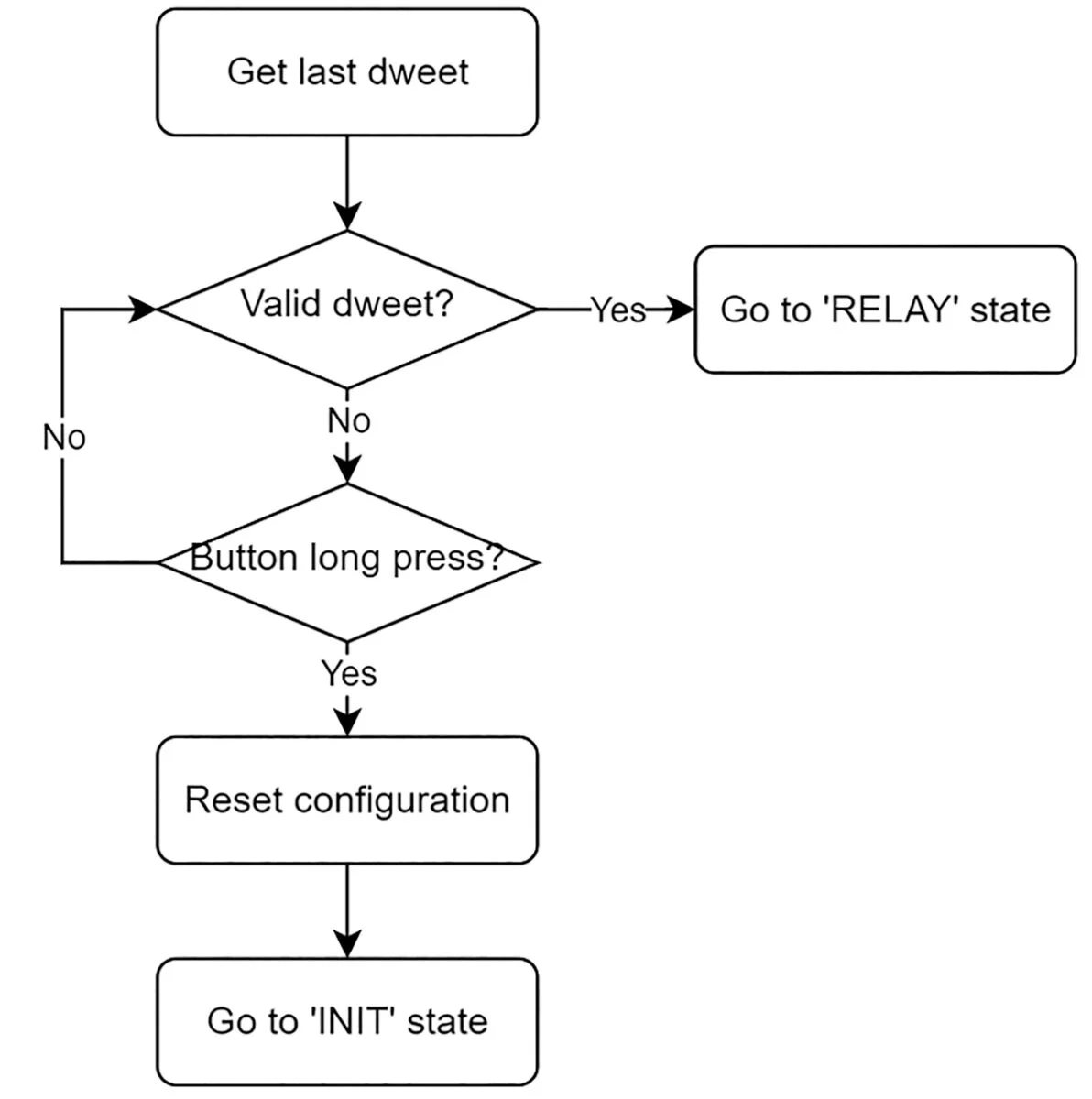
Firmware Architecture Development: Utilizing MicroPython and an Object-Oriented Programming (OOP) paradigm, developers wrote a clean, scalable Finite State Machine (FSM) mapped across multiple logical classes (AccessPoint, Configuration, WifiStation, Dweet, Button, Relay, and a singleton Display class).
Mobile Application Deployment: Using the Ionic framework combined with React and Material UI, a cross-platform mobile application was developed for Android and iOS. This app streamlines initial device provisioning via a temporary local Wi-Fi Access Point and formats secure, encrypted POST requests to the dweet.io endpoint.
Community Physical Enclosure Design: In collaboration with community enthusiast Bruno Luziatelli, a custom 3D-printable case featuring mounting brackets and wire-routing ports was engineered to house the Ganimede board, relay module, and OLED display for protected installations.
Supporting Data
The technical specifications and operational metrics of the Ganimede.E12 system underscore its efficiency as a lightweight, high-performance IoT solution:
Microcontroller: ESP-12F module integrated onto the Ganimede.E12 board, providing reliable Wi-Fi connectivity and general-purpose input/output (GPIO) management.
Control Interfaces:
5 Vdc, 10 A relay connected to the CN4 header for high-load device activation (such as gate motors or heaters).
0.96-inch OLED display linked via I2C (CN7 connector) for real-time local status updates.
Cloud Architecture: Serverless design utilizing dweet.io, operating on HTTP GET and POST requests structured around HAPI (Humanized Application Programming Interface) standards.
Data Transmission Limits: Free-tier dweet.io operations restrict polling frequency to a maximum of 1 Hz, which is more than adequate for human-initiated commands like gate opening, though unsuitable for high-frequency industrial automation requiring sub-millisecond response times.
Encryption Standard: Advanced Encryption Standard (AES) symmetric key encryption, utilizing a user-defined password shared between the mobile application and the embedded device during initial setup.
Replay Attack Mitigation: Timestamp comparison mechanism requiring incoming decrypted commands to match board-side time (synchronized via NTP) within a strict one-second threshold.
Software Environment: MicroPython interpreter executing an infinite loop Finite State Machine (main.py), utilizing modular class files adhering to SOLID design principles.
Mobile Framework: Ionic framework paired with React and Material UI, ensuring native-like performance across both Android and iOS platforms.
Official Responses and Developer Insights
The design philosophy behind the Ganimede.E12 project addresses core frustrations voiced by the open-source electronics community regarding modern smart home appliances. According to project architects, the primary objective was to decouple home automation from intrusive corporate cloud servers while lowering the technical barrier to entry for secure embedded programming.
"Many commercial IoT devices force users to route private data through foreign servers where privacy regulations are poorly enforced," project developers noted during system evaluations. "By leveraging a serverless model where communication occurs strictly between the user’s mobile app and the local device via a lightweight message broker—secured entirely by onboard AES encryption—we return data sovereignty to the end user."
Furthermore, engineers emphasized that choosing MicroPython over traditional low-level languages like C was a deliberate strategy to maximize code readability and maintainability without sacrificing performance in home automation contexts:
"While procedural C code remains the gold standard for micro-optimizing memory in industrial microcontrollers, it introduces high error rates and steep development curves. MicroPython allows us to implement clean, object-oriented architectures that respect SOLID principles, drastically reducing development time while retaining complete command over the underlying hardware peripherals."
Implications
The deployment of the Ganimede.E12 gate control and IoT ecosystem carries significant implications for the future of DIY electronics, consumer privacy, and sustainable technology:
1. Reclaiming Consumer Data Privacy
By eliminating intermediary servers and processing all sensitive decryption locally on the ESP-12F microcontroller, the system ensures that user interactions—such as opening a home gate or activating a heating boiler—remain entirely private. Because the mobile app transmits zero personal data and relies exclusively on encrypted payloads, third-party entities monitoring public message brokers like dweet.io see only incomprehensible ciphertext.
2. Economic and Environmental Sustainability
Traditional IoT setups often require dedicated local servers, always-on Raspberry Pi bridges, or paid cloud subscriptions. The serverless, zero-infrastructure model demonstrated by Ganimede.E12 reduces hardware clutter, lowers electrical power consumption, and avoids recurring subscription costs, presenting a truly sustainable model for smart home upgrades.
3. Democratizing Advanced Firmware Engineering
By combining the accessibility of Python with structured object-oriented programming, modular class mapping, and a singleton display pattern, the project serves as an educational blueprint. It bridges the gap between basic hobbyist scripting and professional-grade embedded software engineering, empowering makers to build secure, scalable IoT devices for diverse residential and commercial applications.