
Stripping Away the Abstraction Layers: Inside ForgeZero and the Gloria Systems Language
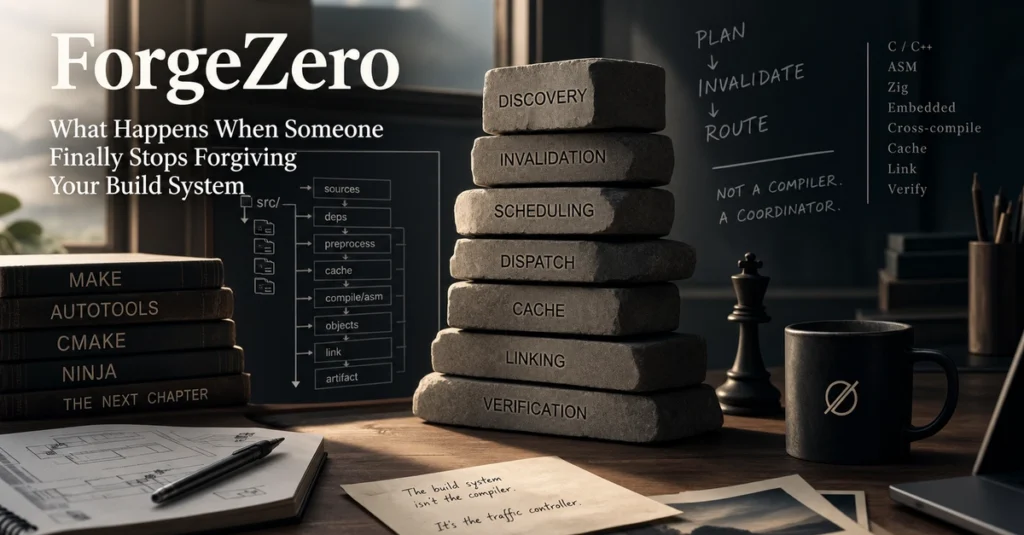
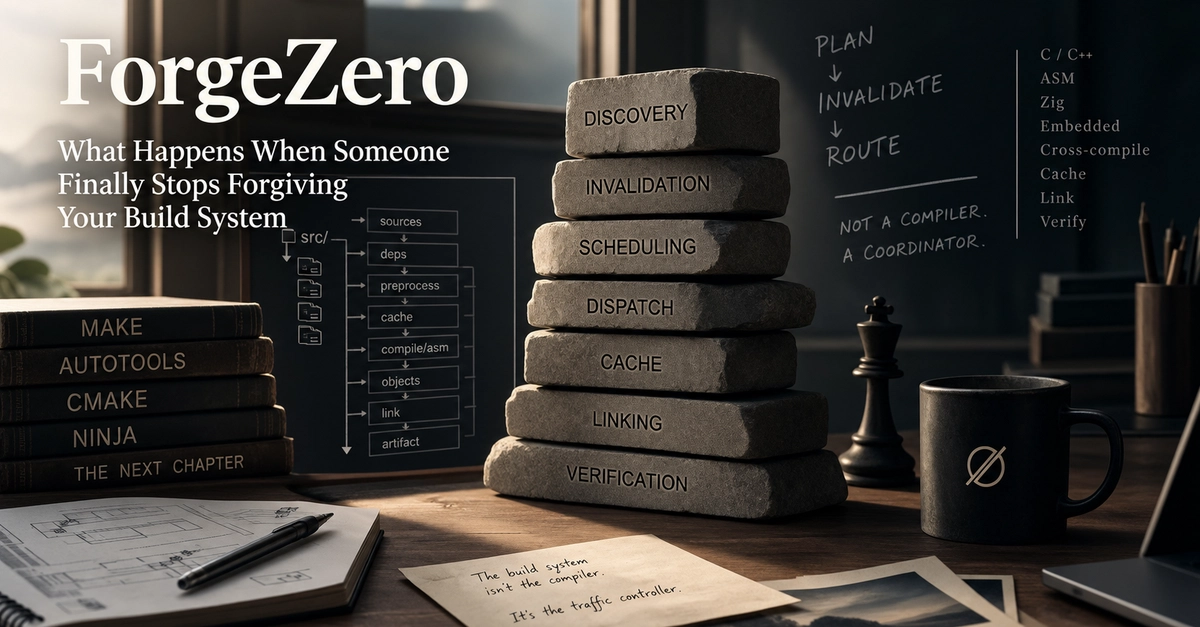
In an era defined by software abstractions, automated garbage collection, and multi-layered build systems that obscure the underlying hardware, systems engineer Alex Voste is swimming resolutely against the current. Tired of toolchains that demand blind faith while hiding the mechanics of execution, Voste has introduced ForgeZero—a transparent, high-throughput build system—and Gloria, an experimental systems programming language designed to strip away the fat of modern software development.
Rather than offering a standard marketing mission statement, Voste’s project stems from a deeply pragmatic frustration: the pervasive dread of build systems that fail with opaque error messages, and compilers that generate code without offering developers a clear window into their inner workings. By revisiting the bare-metal ethos of systems engineering, ForgeZero and Gloria represent a radical return to transparency, speed, and absolute developer control.
Main Facts: The Architecture of ForgeZero and Gloria
At its core, the ForgeZero project is divided into two distinct components: a high-performance build orchestration system and a zero-runtime experimental programming language.
ForgeZero is designed specifically to handle the demands of assembly-heavy codebases, hundreds of small C translation units, and mixed-language repositories. The guiding philosophy is simple yet revolutionary in modern software engineering: A build system should handle planning, invalidation, and routing. It should not try to reinvent the compiler. ForgeZero avoids swallowing the toolchain; instead, it acts as a thin, highly optimized coordination layer that determines what needs to be built, when, and whether it needs to be rebuilt at all.
Gloria, on the other hand, occupies a narrow and deliberate niche. It is a minimal, zero-allocation language that compiles directly into native AMD64 machine code without relying on a libc runtime, a garbage collector, or an external linker for small raw binaries. By bypassing standard runtime initialization, Gloria allows developers to interact directly with the operating system via raw system calls, establishing absolute control over memory management from the very first line of code.
Chronology: The Evolution from Historical Frustration to Modern Execution
The conceptual lineage of ForgeZero traces back nearly half a century, but its recent realization is the result of exhaustive, bottom-up engineering:
- 1976: Bell Labs engineer Stuart Feldman develops
maketo solve a fundamental developer annoyance: editing a source file and forgetting to rebuild dependent binaries. - Decades of Accumulation: Over the next 50 years, tools like Autotools, CMake, and Ninja attempt to manage the growing complexity of software builds. However, they introduce layers of generators, configuration scripts, and timestamp-based checks that often complicate debugging rather than simplifying it.
- The ForgeZero Conception: Alex Voste identifies a critical gap in existing build tooling. Modern systems—particularly those involving bare-metal targets and mixed-language environments—suffer from bloated invalidation checks and poor cache-identity models. Voste begins developing ForgeZero to attack the denominator of build throughput: discovery, dispatch, repeated work, and invalidation cost.
- The Development of Gloria: Alongside the build system, Voste engineers Gloria as an experimental language capable of writing coroutines in pure assembly, featuring register-level context switching, open-addressing hash tables, and zero-allocation primitives.
- Present Day: ForgeZero and Gloria are developed transparently in public, inviting systems engineers, low-level programmers, and critics to inspect, test, and debate the project’s architecture via GitHub and Telegram.
Supporting Data: Benchmarks, Hashing, and Kernel-Level Optimization
To understand why ForgeZero performs the way it does, one must examine its underlying data structures and systems-level engineering choices. Most homegrown build caches rely solely on source-byte hashes. ForgeZero recognizes that identical source files can produce entirely different binaries depending on the compiler, version, target triple, sysroot, and optimization flags. Consequently, ForgeZero’s cache identity integrates sorted inputs, their digests, action names, and the complete toolchain context.
The Dual-Hash Strategy: BoomBoom Hash and BB64
ForgeZero implements a strict dual-hash boundary to balance cryptographic integrity with raw performance:
- BoomBoom Hash: Built over keyed BLAKE3, this engine handles incremental invalidation. It utilizes a flat Merkle tree where source files are split into logical chunks. Modifying a single chunk triggers an $O(log n)$ recomputation of its path to the root rather than a full re-aggregation.
- BB64: Recognizing that cryptographic primitives are unnecessary for certain internal cache-key generations, Voste developed BB64—a purpose-built, non-cryptographic 64-bit hash featuring a hand-written AVX2 hot path. Tested on a Ryzen 7 PRO 4750U, BB64 clocked approximately 16.87 GB/s at zero allocations per operation, running roughly 40 times faster than FNV-1a and nearly 10 times faster than BLAKE3. Crucially, BB64 is strictly segregated from security-sensitive surfaces, ensuring cryptographic integrity checks always default to keyed BLAKE3.
Bypassing the Go Standard Library
Operating at the system level on Linux, ForgeZero bypasses standard abstractions like filepath.WalkDir in favor of raw getdents64 calls via unix.Getdents, combined with openat and O_NOFOLLOW flags to prevent silent symlink traversal. Manual directory entry parsing reduced Linux discovery allocations on a 1,024-file benchmark from ~3,182 down to 2,088 per operation—slashing allocations by a third on the most frequently executed code path.
Furthermore, worker and scheduler queue counters are explicitly positioned on separate 64-byte cache lines to eliminate false sharing—a hidden concurrency bottleneck where unrelated atomic operations fight over CPU cache coherence traffic.
Real-World Performance Metrics
When tested against complex codebases like Redis, ForgeZero demonstrates its parallel execution capabilities. Compiling Redis along with its dependency closure (fpconv, hdr_histogram, hiredis, libxxhash, linenoise, lua, and tre) yielded the following benchmark figures on a configured test environment:
fz -p performance -dir redis/src -mode c -out redis-server -j 16

user       27.66 s
system     11.68 s
CPU        1155%
elapsed     3.404 s
An 1155% CPU utilization metric indicates that the build workload genuinely saturated multiple hardware threads rather than bottlenecking on a single-threaded path. Achieving an elapsed time of 3.4 seconds against nearly 40 seconds of cumulative CPU time underscores the efficacy of parallel compile-and-link orchestration.
Official Stances and Philosophy: Restraint and Radical Transparency
What distinguishes the ForgeZero project from standard open-source releases is its explicit adherence to technical restraint. Voste has been vocal about what the project deliberately chose not to build:
- No Forced Compilers: ForgeZero refuses to become a compiler (GCC, Clang, Zig, NASM, etc.). It coordinates them; it does not replace them.
- No Kernel Over-Engineering: During development, the io_uring integration evaluated
IORING_OP_GETDENTS. Because the target kernel ABI lacked a robust, reliable opcode implementation, the feature was consciously omitted rather than faking completeness with a fragile workaround. Directory listings remained on standard syscall paths where execution is provably stable. - Skeptical AI Integration: While Voste utilizes neural networks as a brainstorming partner for syntax design and documentation drafting, generated code receives zero unsupervised trust. In systems programming where an error corrupts machine binaries rather than generating grammatical awkwardness, human oversight remains absolute.
Implications: What ForgeZero and Gloria Mean for the Future of Systems Programming
The release of ForgeZero and Gloria challenges the broader software engineering community to re-examine its reliance on bloated toolchains and heavy abstractions.
For enterprise and embedded systems developers, ForgeZero offers a blueprint for how build systems should function: transparently, predictably, and with zero hidden costs. By aggressively optimizing cache identity and removing redundant syscall overhead, it proves that modern hardware can achieve phenomenal build speeds when the software stack gets out of the way.
Meanwhile, Gloria serves as an intellectual playground and a practical tool for developers who wish to understand every single byte executed by the CPU. Its path toward self-hosting—where the Gloria compiler will eventually be written entirely in Gloria—represents the ultimate test of its architectural integrity.
In an industry increasingly comfortable with layers of obscurity, ForgeZero and Gloria send a clear, uncompromising message: true engineering confidence comes from understanding your tools down to the bare metal, and refusing to use software that lies to you about what it is doing.







