The Passwordless Revolution: How WhatsApp Scaled Passkeys to Billions
In the rapidly evolving landscape of digital security, the tension between ironclad protection and user convenience has long been the primary obstacle for global applications. For WhatsApp, the world’s most pervasive messaging platform, this challenge was magnified by its scale: how do you secure billions of accounts without introducing friction that alienates users with varying levels of digital literacy?
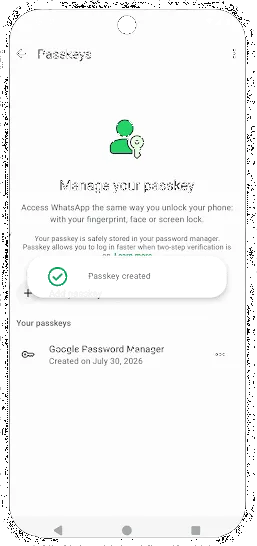
The answer arrived in the form of passkeys—a cryptographic solution that replaces traditional, phishable credentials with the simplicity of a biometric touch or a screen lock gesture. By becoming one of the first major consumer applications to integrate this technology in 2023, WhatsApp has provided a blueprint for how to deploy advanced security at a global scale.
The Genesis of the Shift: Why Passkeys?
The traditional authentication model, reliant on SMS-based One-Time Passwords (OTPs), has become increasingly fragile. Beyond the inherent risk of SIM-swapping and interception, SMS delivery is notoriously unreliable in many of the developing regions where WhatsApp holds its largest market share. Network congestion, carrier delays, and regional infrastructure gaps often left users locked out of their accounts.

"What excites me most is the sheer scale of WhatsApp’s impact. Even a small improvement to WhatsApp touches billions of users worldwide," says Mayank Manuja, an Android Engineer on the WhatsApp Registration and Access team.
The decision to adopt passkeys was driven by two core pillars:
- Phishing Resistance: By leveraging public-private key cryptography, passkeys ensure that the "secret" never leaves the user’s device. Even if an attacker compromises a server, they cannot replicate the biometric signature required for authentication.
- User Friction Reduction: Replacing manual codes with a single tap creates a "happy path" for login, significantly reducing the drop-off rates associated with authentication failures.
A Chronology of Implementation
The journey to a passwordless WhatsApp began in early 2023, a period when passkeys were still largely an emerging technology without established UX patterns.

- Early 2023: WhatsApp initiated the integration process, treating it as a high-priority architectural overhaul. The teams at Google and WhatsApp began deep collaboration to navigate the complexities of the Android ecosystem.
- Mid-2023: The engineering teams focused on "The Happy Path." Using the Credential Manager API, they mapped out the basic flow of registration and retrieval.
- Late 2023: The rollout phase began, which immediately exposed the realities of global fragmentation. WhatsApp had to account for diverse OEMs, varying Android versions (from 13 to 14+), and a wide range of hardware capabilities, including devices lacking biometric sensors.
- 2024: Following initial adoption, the focus shifted to refining the UX. Through extensive A/B testing, the team moved away from intrusive prompts, instead adopting a contextual framework that presented the passkey option only when it was most relevant to the user journey.
Supporting Data and Technical Architecture
At the heart of the system lies a sophisticated server-side architecture. WhatsApp opted for a robust implementation of WebAuthn/FIDO2 standards. The backend, written in Erlang, interacts with the Rust webauthn-rs library to handle signature verification and credential parsing.
The server orchestrates the experience through four distinct phases:
- Begin Registration: The server issues creation options, including an
excludeCredentialsparameter to prevent redundant enrollment, and stores a short-TTL challenge. - Finish Registration: The server verifies the attestation, maps the credential ID to the user’s account, and decides between single or multi-passkey storage modes.
- Begin Authentication: The system retrieves valid credentials for the user and initiates the challenge.
- Finish Authentication: The server verifies the assertion and, if necessary, triggers a refresh of the stored credential, ensuring the security lifecycle remains evergreen.
By enabling a "multi-passkey" infrastructure, WhatsApp allowed for a more flexible user experience, enabling individuals to register multiple devices without overwriting existing credentials.

Official Responses and Collaborative Challenges
The collaboration between Google and WhatsApp was not without its hurdles. Integrating the Credential Manager API meant abstracting the complexities of different credential providers while maintaining a unified interface.
"Navigating a diverse user base across OEMs surfaced unprecedented edge cases," the team noted. These included unexpected exception types from older device firmware, inconsistent behavior from various credential providers, and users who had not configured a secure screen lock.
To address these, the Google and WhatsApp teams adopted a "deep-collaboration" model, effectively stress-testing the Android OS flows. As the OS matured, WhatsApp simplified its own UI to avoid redundant, confusing prompts, demonstrating that for security to be effective, it must be invisible.

Implications for Global Security
The implications of WhatsApp’s move extend far beyond its own app. By proving that passkeys can be deployed to billions of users across vastly different network and hardware environments, WhatsApp has set a new industry standard.
1. The Death of the "Fragile" Transport Layer
WhatsApp consciously bypassed the standard WebAuthn cross-device flow, which often relies on Bluetooth-based QR code scanning. Recognizing that this created a dependency that was frequently confused with "WhatsApp Web" linking, they pivoted to a native, multi-platform approach. Users now simply generate a fresh passkey when migrating to a new device, utilizing the native syncing capabilities of Google Password Manager or iCloud Keychain. This removes the need for unreliable cross-device transport.
2. The Future of In-App Authentication
The success of the initial rollout has paved the way for broader utility. WhatsApp is currently exploring the use of passkeys for sensitive in-app actions, such as securing end-to-end encrypted backups. This signals a shift where passkeys are no longer just an "entry key" but a foundational layer for identity verification throughout the entire app experience.

3. Scaling Recommendations for Developers
For other organizations looking to follow in these footsteps, the WhatsApp and Google engineering teams offer several key recommendations:
- Prioritize Context: Don’t prompt for passkeys at every opportunity. Use data-driven A/B testing to identify the moments where users are most likely to benefit from the speed of biometric login.
- Assume Fragmentation: Build for the "worst-case" device configuration. If a user doesn’t have a biometric sensor, the system must gracefully fall back to a PIN or pattern, rather than breaking the authentication flow.
- Leverage Existing APIs: Do not reinvent the wheel. The Credential Manager API is designed to abstract the heavy lifting; using it allows teams to focus on product rules—eligibility, rate-limiting, and lifecycle management—rather than the underlying cryptographic ceremonies.
- Monitor the Lifecycle: A passkey is not a "set and forget" item. Implement robust logic to handle credential revocation, updates, and synchronization across devices to ensure users are never permanently locked out.
Looking Ahead: A Passwordless Future
The adoption of passkeys at this scale serves as a definitive turning point. For years, the industry has debated the viability of a "passwordless" future, often citing the complexity of global user habits as an insurmountable wall. WhatsApp has effectively dismantled that argument.
As biometric capabilities become more ubiquitous in entry-level smartphones, the barriers to entry will naturally diminish. The work done by the WhatsApp team in 2023 and 2024 has not only secured billions of accounts against the rising tide of credential theft and phishing, but it has also proven that, when executed with a focus on simplicity, the most secure path can also be the most convenient.

As the industry moves forward, the focus will likely transition from "convincing users to adopt passkeys" to "optimizing the seamless transition between devices." The era of memorizing, managing, and resetting passwords is nearing its end. In its place, the biometric signature—a unique, unforgeable, and effortless key—is becoming the new standard for the global digital economy. WhatsApp’s journey serves as both a case study for engineers and a roadmap for the future of the internet.