The $3,000 Gamble: Anatomy of a Total Hardware Failure
In the world of professional networking, Juniper Networks occupies the upper echelons of reliability and enterprise-grade performance. A brand-new Juniper EX4100-F-12P switch—a powerhouse of high-density, multi-gigabit connectivity—typically commands a price tag well north of $3,000. It is a piece of infrastructure designed for data centers and high-traffic corporate environments, built to operate with "five-nines" availability.
So, when a listing appears on the secondary market offering one of these units in "untested" condition for less than 10% of its original retail value, it presents an irresistible siren song to the hardware enthusiast. It is the classic "high-risk, high-reward" scenario that defines the hobbyist repair community. Recently, the YouTube channel This Does Not Compute decided to test the limits of this gamble, documenting a cautionary tale that serves as a masterclass in the risks of buying "as-is" enterprise hardware.
The Allure of the "Cheap" Enterprise Switch
The temptation of discounted enterprise hardware is a well-documented phenomenon. For IT professionals and home lab enthusiasts, the prospect of acquiring a managed switch with advanced features like PoE++ (Power over Ethernet), sophisticated VLAN tagging, and robust Layer 3 routing capabilities for the price of a budget consumer-grade device is intoxicating.
When This Does Not Compute encountered the listing for the Juniper EX4100-F-12P, the logic seemed sound: if the unit functioned, the savings would be astronomical. If it required a minor repair, the investment would still be pennies on the dollar compared to a new unit. However, the term "untested" in the world of online auctions is frequently a euphemism for "we know it is broken, but we don’t want to admit it."
Chronology of a Failed Recovery
The journey from purchase to post-mortem provides a clear timeline of how a sophisticated piece of hardware succumbs to environmental and electrical disaster.
1. The Initial Assessment
Upon receiving the unit, the first hurdle was the lack of a proprietary 48VDC power supply brick. Enterprise switches of this caliber often utilize external power supplies to save space and reduce heat within the chassis. After sourcing a compatible power input and attempting to probe the rails, the user discovered an immediate red flag: a dead short across the power input. A short circuit at the primary power intake is the "death knell" for most electronics, as it indicates a failure in the power regulation stage that protects the delicate silicon downstream.
2. Disassembly and Internal Inspection
The EX4100-F-12P is an engineering marvel, featuring a massive aluminum heatsink integrated directly into the chassis lid, augmented by heat pipes to manage the thermal output of the 280-watt power requirement. Upon opening the case, the first visual clue appeared: a distinct, ominous black "skid mark" near the power input. This is a tell-tale sign of arcing—a catastrophic electrical event where current jumps across a gap, superheating the air and melting the surrounding components.
3. The Evidence of Neglect
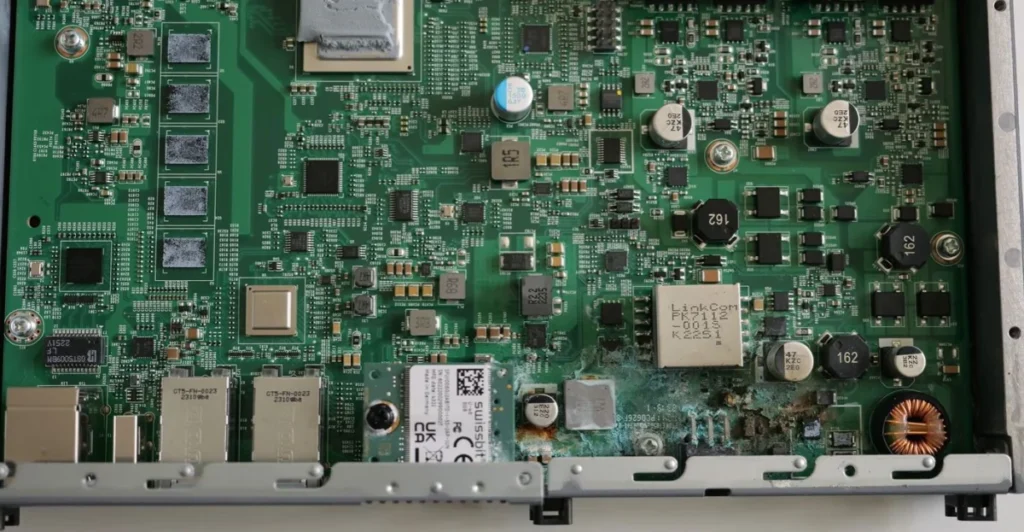
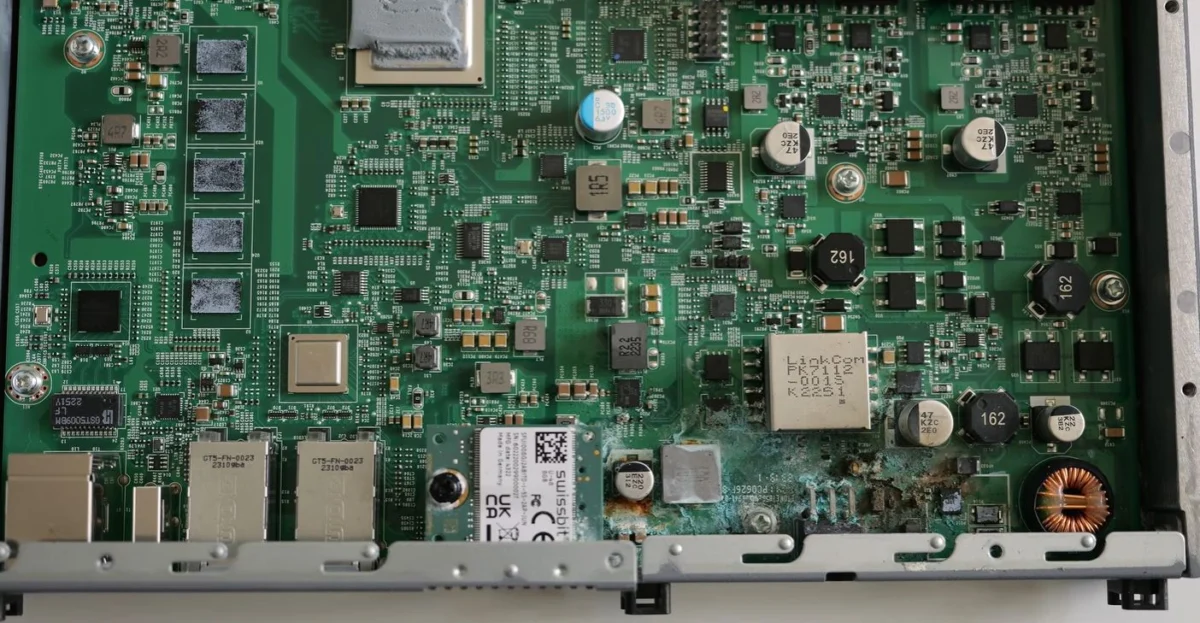
As the investigation moved deeper into the PCB (Printed Circuit Board), the condition of the unit shifted from "repairable" to "total loss." The board showed undeniable signs of water ingression. Rust, mineral deposits, and heavy corrosion were visible across several sections of the board. This suggests that the switch was likely subjected to poor storage conditions, a flood, or a major spill. When a circuit board already compromised by conductive, corrosive liquid is supplied with 48V of power, the result is almost always a violent, localized explosion of components.
4. The Final Verdict
Post-cleaning, the extent of the damage became undeniable. The corrosion had eaten through the protective solder mask and into the substrate of the PCB. Furthermore, the short circuit had caused components to rupture, effectively "blasting" holes through the multilayer board. With the inner layers of the PCB destroyed, the copper traces required for communication and power distribution were severed beyond any hope of manual repair.
Supporting Data: Why Enterprise Gear Fails
The failure of the Juniper EX4100-F-12P is not an indictment of Juniper’s manufacturing standards, but rather a reflection of the fragility of modern, high-density PCBs.

The Multi-Layer PCB Challenge
Modern enterprise switches use multi-layer PCBs, often consisting of 8 to 12 layers of copper traces separated by fiberglass-reinforced epoxy (FR-4). When a high-current short occurs, the heat generated is localized and intense. Unlike a simple single-layer board, where a burnt trace can be "jumped" with a wire, a short in a multi-layer board often destroys the connections buried inside the board’s core. Once these internal layers are damaged, the board is essentially a piece of structural plastic.
Environmental Degradation
Electronics are designed to operate in controlled environments—typically between 20% and 80% non-condensing humidity. When a device is exposed to moisture, the combination of electricity and salt or mineral-laden water creates an electrolytic process. This eats away at copper traces, creates "whisker" growth that causes short circuits, and permanently ruins the dielectric properties of the board material.
The Silence of the Manufacturer
In cases of catastrophic hardware failure, users often wonder if the original equipment manufacturer (OEM) can assist. However, Juniper Networks, like many enterprise vendors, operates on a strict warranty and support model.
- Warranty Exclusions: Official manufacturer warranties are almost exclusively limited to the original purchaser and are voided by any evidence of liquid damage or unauthorized physical modification.
- Availability of Schematics: Juniper, like Cisco and Arista, considers their PCB schematics to be proprietary trade secrets. They do not publish board-level repair documentation.
- Component Obsolescence: Even if the schematics were available, enterprise switches often use highly customized ASICs (Application-Specific Integrated Circuits). If these proprietary chips are damaged, they cannot be sourced from standard electronic suppliers like Digi-Key or Mouser, making repair impossible for anyone outside of the factory.
Implications for the Secondary Market
The "This Does Not Compute" experience serves as a stark reminder for anyone participating in the secondary hardware market.
Caveat Emptor (Let the Buyer Beware)
When purchasing "untested" equipment, the buyer must assume that the device is not merely non-functional, but potentially hazardous or physically destroyed. The price of such items should be weighed against the value of the scrap metal and the effort required to diagnose the failure.
The True Cost of "Cheap"
While the initial cost of this switch was low, the hidden costs include:
- Time: The hours spent on disassembly, cleaning, and diagnostic probing.
- Ancillary Costs: The cost of the power brick and diagnostic equipment.
- Opportunity Cost: The time that could have been spent on a project with a higher probability of success.
When to Walk Away
The experience suggests that if a listing mentions "untested" and shows signs of potential liquid damage—such as discoloration, odd smells, or unusual residue—it is almost certainly a "parts-only" unit. In the world of networking, where stability is the highest priority, there is no substitute for tested, warrantied, and properly maintained equipment.
Conclusion: Lessons from the Ashes
The charred remains of the Juniper EX4100-F-12P are a sobering reminder of the physical limitations of electronics. While we may dream of "rescuing" enterprise gear from the scrapyard, physics has the final say. When a PCB is subjected to water damage followed by high-voltage abuse, it ceases to be a computer and becomes a piece of geological waste.
For the home lab community, this video acts as a valuable educational tool. It demystifies the "black box" of enterprise hardware, showing exactly what happens when power meets neglect. While the outcome was not the triumphant repair many hoped for, the autopsy provides more value in cautionary knowledge than the switch ever could have provided in network throughput. In the future, when a deal looks too good to be true, it is best to remember: someone else has likely already tried to fix it, and failed.