The AI Paradox: How Generative Tools Are Reshaping the Open Source Landscape

The open source ecosystem, the bedrock of modern software infrastructure, stands at a precarious crossroads. For decades, the collaborative model of Linux and its peers has relied on human-centric code review, community trust, and organic contribution patterns. However, the rise of generative artificial intelligence (GenAI) has introduced a double-edged sword: the promise of accelerated development versus the reality of a massive influx of low-quality, automated code.
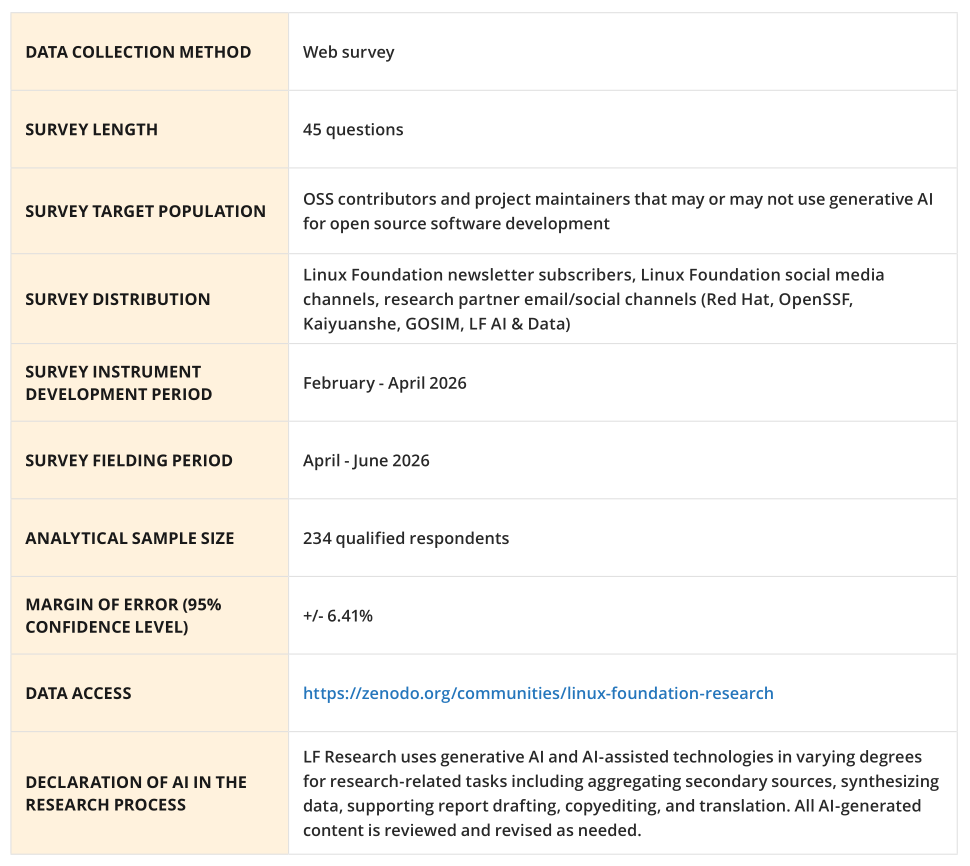
A groundbreaking report from LF Research, the research arm of the Linux Foundation, titled “Navigating Open Source Software Development in the Generative AI Era,” provides a sobering look at how these tools are fundamentally altering the way software is built, maintained, and secured. With input from 234 contributors and maintainers, the study highlights a growing tension between the efficiency of AI and the sustainability of human-led projects.

The Core Conflict: Productivity vs. "AI Slop"
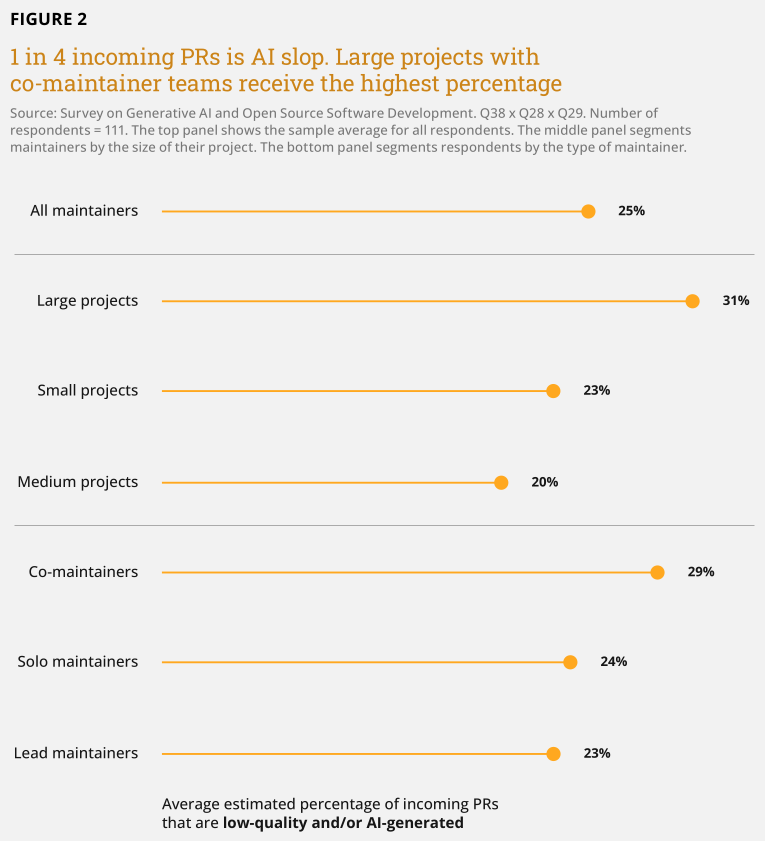
At the heart of the debate is the sheer volume of incoming contributions. The report estimates that approximately 25% of all incoming pull requests (PRs) now consist of what maintainers colloquially call "AI slop"—code generated by AI tools with little to no human oversight, verification, or refinement. For larger, more established projects—those boasting 50 or more active contributors—this figure climbs to a staggering 31%.
This phenomenon represents a paradigm shift. In the past, a PR was typically the result of a developer identifying a specific need, writing code to address it, and engaging in a dialogue with maintainers. Today, the ease of generating boilerplate code has lowered the barrier to entry so significantly that maintainers are being inundated with automated submissions that often prioritize quantity over coherence.

Chronology: The Rapid Ascent of AI in Development
The integration of AI into the software development lifecycle (SDLC) has been nothing short of meteoric.
- 2021-2022 (The Prototyping Phase): The Linux Foundation established LF Research to formalize the study of how open source evolves. During this period, AI coding assistants were largely experimental tools used by early adopters to autocomplete basic syntax.
- 2023 (The Mainstream Shift): With the explosion of Large Language Models (LLMs), AI assistants like GitHub Copilot and similar tools moved from niche utilities to standard developer equipment. The volume of AI-assisted PRs began to tick upward.
- 2024-2025 (The Saturation Point): As GenAI became ubiquitous, the "low-effort" submission trend accelerated. Projects began reporting increased fatigue as maintainers struggled to differentiate between helpful AI-assisted contributions and automated noise.
- 2026 (The Current Crisis): The LF Research report marks a turning point where the industry is moving from "experimentation" to "governance." The focus has shifted from how to use AI to how to regulate AI within the context of community-driven development.
Supporting Data: A Landscape Under Pressure
The data paints a clear picture of the strain placed on maintainers. The LF Research survey, sponsored by Red Hat with contributions from OpenSSF, LF AI & Data, and Futurewei, reveals several critical metrics:
The "Large Project" Burden
Large projects are disproportionately affected by the AI boom. While 59% of all maintainers reported an increase in incoming contributions, that number jumps to 69% for large-scale projects. Perhaps most alarmingly, 64% of these maintainers noted that the review process now takes significantly longer.
The Human Cost: Burnout
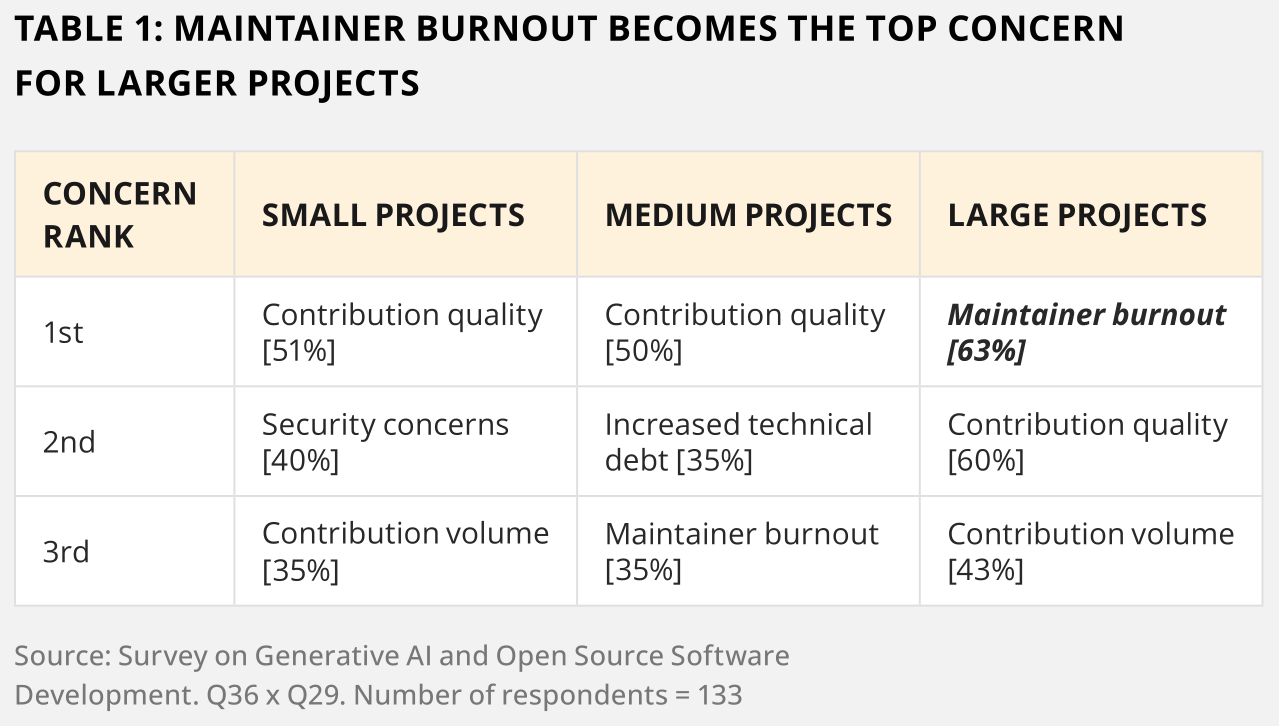
Burnout has emerged as the primary concern for the open source community, cited by 63% of respondents in large projects. This narrowly edges out "contribution quality" (60%) as the most significant threat. The implication is clear: the influx of automated code is not just a technical challenge; it is a human resources crisis that threatens the longevity of critical software projects.
The Efficiency Paradox
The report also highlights the duality of AI. While 52% of developers estimate that AI reduces code authoring time, 21% of respondents noted that, for complex tasks, the work actually took longer when utilizing AI. This suggests that while AI excels at boilerplate, it often fails at context-aware architectural challenges, forcing developers to spend more time debugging AI-generated hallucinations than they would have spent writing the code from scratch.
Policy and Governance: The Regulatory Gap
Perhaps the most startling revelation of the study is the lack of institutional readiness. Policies governing the use of AI in open source are in their infancy, and for many, they do not exist at all.
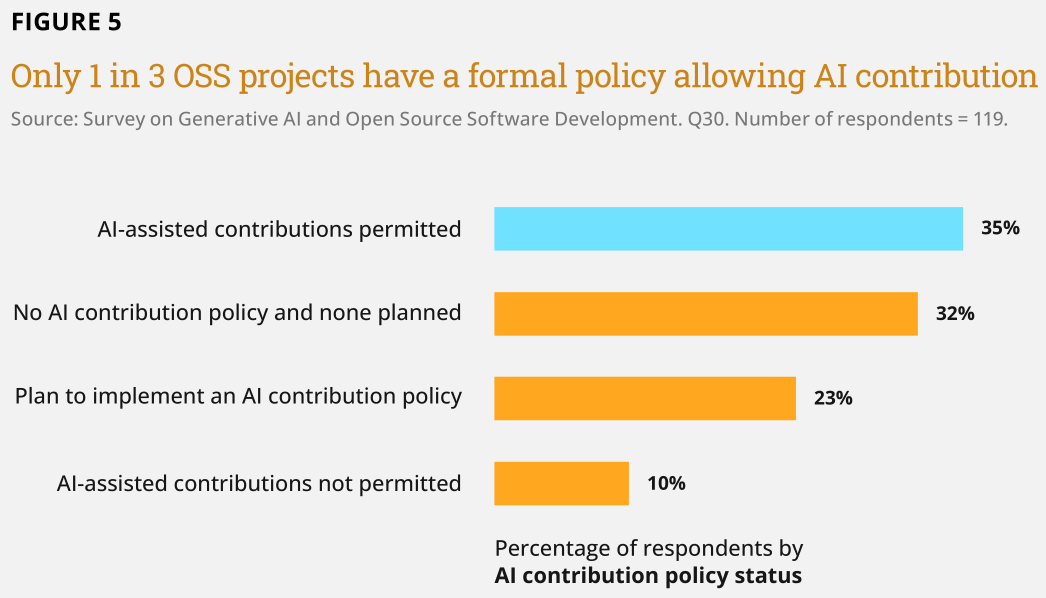
Of the 119 respondents who addressed policy, only 35% indicated that their project has a formal policy permitting AI use. A concerning 32% have no policy and no intention of creating one, while 23% are in the planning stages. Only 10% of projects have taken the hard line of banning AI-generated contributions entirely.
Projects like LLVM have paved the way by setting clear, conditional rules for AI usage, but they remain the exception rather than the rule. Furthermore, 26% of projects surveyed have absolutely no mechanism to verify whether a contribution is AI-assisted. This creates a "blind spot" in the supply chain, as malicious or vulnerable code could be injected via AI without the maintainer ever realizing the origin of the code.
Official Responses and Strategic Implications
The Linux Foundation, through this report, is issuing a call to action. The recommendations center on three pillars: transparency, policy, and testing.
- Disclosure: Contributors should be required to disclose when AI tools are used to generate code, allowing maintainers to calibrate their review process accordingly.
- Written Policies: Every project, regardless of size, should explicitly define its stance on AI. Ambiguity is the enemy of community health.
- Enhanced Verification: Projects need to invest in automated tooling that can detect, scan, and audit AI-generated code for security vulnerabilities.
The Trust Deficit
The social fabric of open source is also fraying. Only 13% of respondents believe that AI has improved community trust, while 53% explicitly stated that it has not. This decline in trust is perhaps the most dangerous side effect of the AI era. Open source thrives on the idea that "given enough eyeballs, all bugs are shallow." If the "eyeballs" are overwhelmed by synthetic code, the collaborative trust that allows for rapid, secure innovation begins to erode.

Conclusion: A New Era for Human Collaboration
The LF Research report concludes that while generative AI is an inevitable evolution of the software development lifecycle, it is currently "unmanaged" within the open source ecosystem. The findings serve as a stark warning: without a renewed focus on human-centric governance, the efficiency gains promised by AI may come at the cost of the very projects that drive the global digital economy.
As we move toward 2027 and beyond, the success of open source will likely be defined by the ability of maintainers to establish boundaries. The "slop" that currently clogs the pipelines of major projects is not just a nuisance—it is a signal that the community needs to adapt its standards to a world where code can be generated faster than it can be understood.

For contributors, the message is equally clear: if you intend to use AI, do so responsibly, document your process, and ensure that your contribution adds genuine value. For maintainers, the path forward involves rigorous gatekeeping and the implementation of clear, enforceable policies. The future of open source depends not on the speed of the machine, but on the wisdom of the human developers who choose which code is worthy of the repository.