The Rise of Chatto: A New Contender in the Open-Source Team Communication Landscape
In the modern digital workplace, communication is the lifeblood of productivity. For over a decade, Slack has reigned supreme as the gold standard for team collaboration, setting the bar for features, integration capabilities, and user experience. Yet, for organizations prioritizing data sovereignty, privacy, and the ethos of free and open-source software (FOSS), the reliance on proprietary, cloud-locked platforms like Slack, Microsoft Teams, or Discord has become a point of increasing friction.
The landscape of open-source alternatives is already populated by robust platforms like Rocket.Chat, Mattermost, Zulip, and the decentralized Matrix-based ecosystem. However, the search for the "perfect" balance between ease of use and administrative power continues. Enter Chatto, a burgeoning project by developer Hendrik Mans that aims to provide a lightweight, self-hostable communication hub for teams seeking an escape from the walled gardens of Big Tech.
Main Facts: What is Chatto?
At its core, Chatto is designed to be a streamlined, efficient alternative to enterprise chat applications. Developed by Hendrik Mans, the project seeks to solve the "bloat" often associated with legacy communication tools. Unlike massive enterprise suites that require complex infrastructure and dedicated DevOps teams to manage, Chatto is built with simplicity in mind.
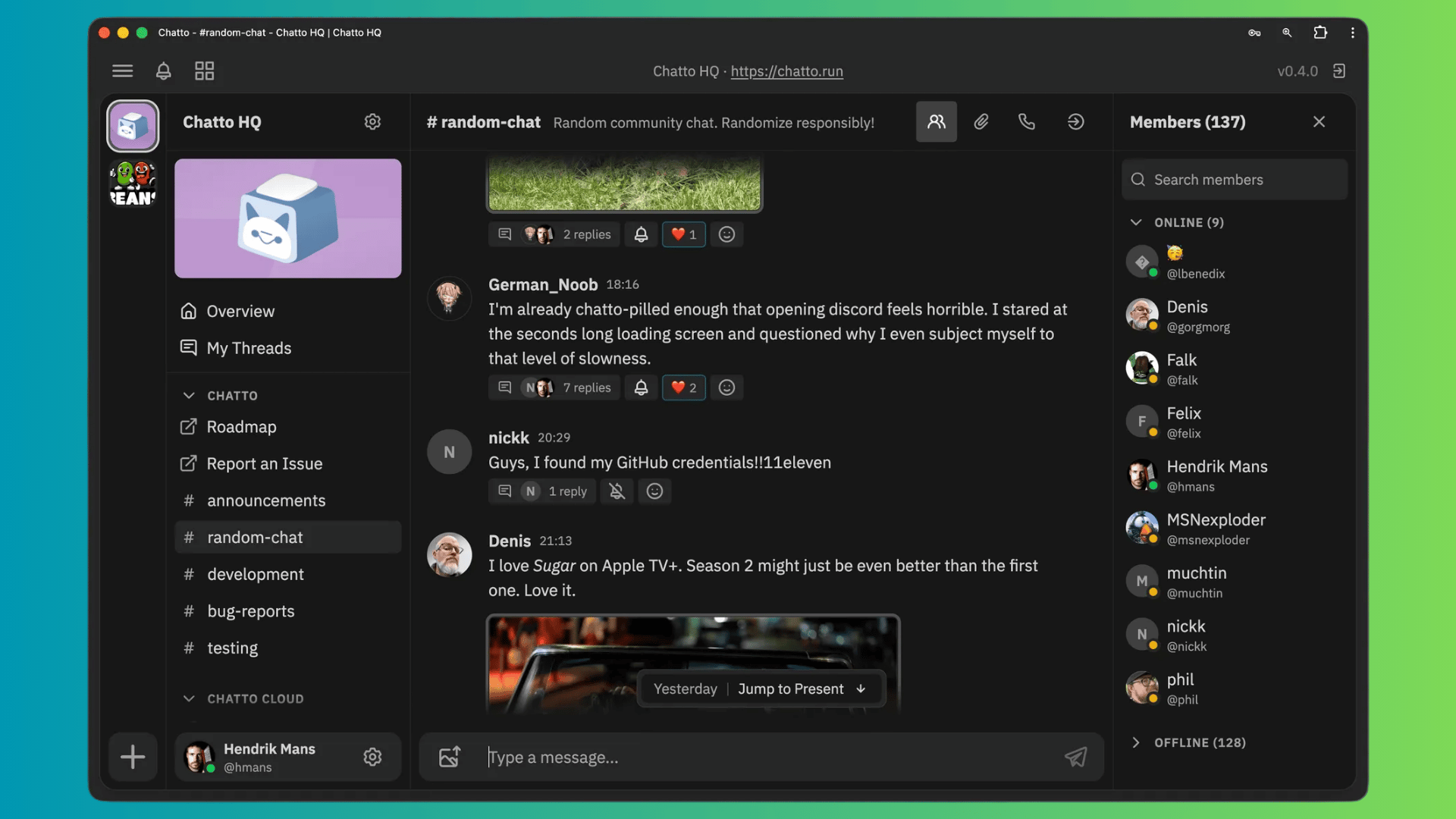
The primary value proposition of Chatto is its accessibility for administrators. The goal is to provide a single, executable file that can be deployed with minimal configuration, allowing teams to get their communication infrastructure up and running in minutes rather than days. Despite its lean architecture, the platform packs the essential feature set that modern teams demand:
- Communication Channels: Organized spaces for team discussions and project-specific threads.
- Multimedia Integration: Native support for file sharing and video embeds.
- Granular Access Control: A robust roles and permissions system that allows administrators to define exactly what each user can see and do within the workspace.
- Collaborative Tools: Built-in screen sharing capabilities.
- Security: End-to-end encryption (E2EE) for all voice and video calls, ensuring that sensitive discussions remain private.
Chatto is released under the AGPL-3.0+ license, with specific components utilizing the Apache-2.0 license, signaling a strong commitment to the open-source community.
Chronology: From Conception to Public Beta
The trajectory of Chatto is still in its infancy, reflecting the "early days" phase of its development cycle.
- Development Phase: Over the past several months, Hendrik Mans has been working in relative solitude, focusing on the architectural foundation of the server-side infrastructure.
- Open Source Announcement: Recently, Mans transitioned the project into the public sphere, inviting developers and early adopters to review the source code and contribute to its evolution.
- Roadmap Establishment: With the project now public, the focus has shifted toward formalizing the feature list. Current development is centered on server-wide user management, bot API integration, and the "Chatto Hub."
- Upcoming Milestones: The team is currently in the discovery phase for dedicated desktop and mobile clients. Simultaneously, a managed cloud version—Chatto Cloud—is nearing its public beta launch, targeting organizations that want the benefits of Chatto without the overhead of managing their own servers.
Supporting Data: Why the Shift Toward Self-Hosting?
The demand for platforms like Chatto is backed by a growing trend in IT: the "re-decentralization" of the workplace. According to industry reports on data privacy, nearly 60% of technical teams are concerned about the long-term implications of storing proprietary corporate data on third-party, multi-tenant cloud servers.
Resource Efficiency
Most open-source competitors are powerful but heavy. Mattermost and Zulip, for instance, offer massive feature sets but require significant RAM and CPU resources to maintain, especially as user counts grow. Chatto’s design philosophy prioritizes a "lightweight" footprint. By minimizing dependencies and streamlining the codebase, Chatto aims to run efficiently on modest hardware—even on a VPS with limited resources.

The "Cloud-vs-Self-Hosted" Dilemma
While self-hosting is the ultimate goal for many, Chatto recognizes the barrier to entry. The upcoming Chatto Cloud offering is designed to bridge this gap. By utilizing European-owned infrastructure for the cloud version, Chatto ensures that even its hosted solution adheres to high data privacy standards, such as GDPR compliance, while offering features like automatic scaling and nightly automated backups.
Official Stances and Development Roadmap
Hendrik Mans has been transparent about the limitations of the current build. By admitting that dedicated clients are currently in the "discovery phase," the project demonstrates a refreshing level of honesty. Instead of rushing to ship an inferior mobile app, the development team is focusing on the stability of the server and the core API, which will eventually serve as the backbone for any future client applications.
The roadmap is aggressive, reflecting a high-velocity development cycle. Planned features include:
- Migration Tools: A dedicated Slack-to-Chatto importer to lower the switching cost for teams currently trapped in the Slack ecosystem.
- Advanced Governance: Emergency lockdown modes for administrators, thread locking, and message deletion capabilities.
- Safety Features: In-app message reporting, slow mode (to manage high-volume channels), and sophisticated server invite systems.
- Extensibility: Bot accounts with dedicated API tokens, allowing teams to integrate Chatto with their own internal DevOps pipelines.
Implications for the Open-Source Ecosystem
The emergence of Chatto serves as a litmus test for the current state of open-source collaboration software. Can a new, lightweight entrant compete with established giants like Matrix or Rocket.Chat?
Breaking the Vendor Lock-in
One of the most critical aspects of Chatto’s mission is the explicit promise to avoid vendor lock-in. Whether you are self-hosting or using the cloud version, Chatto is committed to making data export and import accessible. This is a direct challenge to the proprietary models of Slack and Microsoft, which often make it intentionally difficult to migrate historical message data.
Impact on Competition
The presence of another viable alternative increases pressure on existing open-source players to refine their user experiences. While platforms like Element (Matrix) are powerful, they are often criticized for their steep learning curve. If Chatto succeeds in creating a "Slack-like" feel with the privacy benefits of self-hosting, it could potentially capture a significant segment of the market—specifically small-to-medium-sized businesses (SMBs) that want the UI of Slack but the control of a private server.
The Sustainability of FOSS Projects
The model of offering a free, self-hosted version alongside a paid, managed cloud service is a proven path for projects like GitLab and Mattermost. By adopting this dual-track strategy early, Chatto is positioning itself for long-term sustainability. It ensures that the project can remain open-source while generating the revenue necessary to hire developers, pay for infrastructure, and provide support.
Conclusion: A Project to Watch
Chatto is not yet a replacement for a mature, feature-complete platform like Slack. It lacks the extensive app directory, the years of polish, and the dedicated native applications that power the daily workflows of millions. However, it represents the vital "next generation" of open-source communication.

For teams that are tired of the privacy trade-offs and the rising costs of subscription-based communication tools, Chatto offers a glimpse into a future where team collaboration is decentralized, secure, and under the control of the users themselves. As the project moves from its current beta stages toward a stable 1.0 release, it will be fascinating to see if it can maintain its lightweight philosophy while scaling to meet the complex needs of modern enterprises.
For now, developers and privacy-conscious team leads should keep a close eye on the Chatto GitHub repository. In a world where data is the new currency, a platform that puts the keys to that data back in the hands of the user is not just a luxury—it is a necessity.
For those interested in exploring the current state of the market, our guide to Best Open Source Slack Alternatives provides a comprehensive look at the established players while you wait for Chatto’s maturation.