
The Shrinking Spectrum: Exploring the Frontiers of Ultra-Compact Internet Radio Design
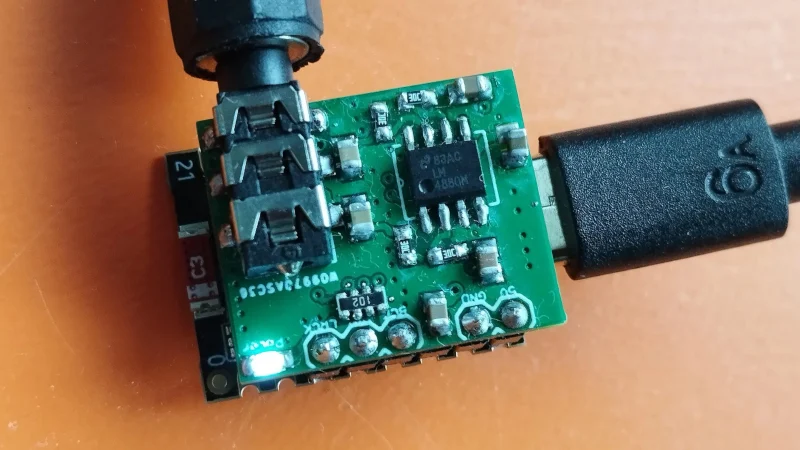
For over a quarter of a century, the concept of the "internet radio"—a device capable of streaming audio directly from global servers—has evolved from bulky, PC-dependent setups to elegant, standalone consumer appliances. As the democratization of networked microcontrollers has accelerated, the barrier to entry for hobbyists and engineers alike has plummeted. However, a new frontier has emerged in the maker community: the race for extreme miniaturization.
In a recent project detailed on Instructables, a developer known as [Milen] has pushed the boundaries of what is physically possible, unveiling an internet radio so diminutive that its external connectors appear disproportionately large. This feat of engineering serves as a case study in how far the integration of modern silicon can be pushed when the primary goal is the minimization of footprint.
Main Facts: The Anatomy of a Micro-Radio
At its core, the project follows a classic, streamlined architectural philosophy: ingest digital data, decode the stream, and output an analog signal. The device is built around the ESP32-C3, a RISC-V based microcontroller known for its balance of power efficiency and integrated Wi-Fi connectivity.
The hardware stack is deceptively simple. The ESP32-C3 dev board acts as the brain, processing the incoming stream of internet audio. To bridge the gap between digital data and audible sound, Milen integrated a PCM5102A I2S DAC (Digital-to-Analog Converter). This component is a staple in the DIY audio community due to its high-fidelity output and ease of implementation. Paired with a compact amplifier, the entire assembly occupies a surface area roughly equivalent to a postage stamp.
The project challenges the traditional definition of a "radio." By moving away from local FM/AM tuning circuits and relying entirely on the packet-switched network, the device effectively turns a Wi-Fi connection into an infinite antenna. The result is a device that fits in the palm of a hand, or arguably, on the tip of a finger.
Chronology: The Evolution of the Connected Receiver
To understand the significance of Milen’s work, one must look at the timeline of the internet radio’s development over the last twenty-five years.
The Desktop Era (1999–2005)
Initially, internet radio was a software-only pursuit. Users required a desktop computer, a sound card, and early streaming software like RealPlayer or Winamp. The concept of "hardware" was limited to speakers tethered to a tower PC.
The Appliance Era (2006–2015)
As Wi-Fi became ubiquitous in the home, companies like Squeezebox and Sonos popularized dedicated network audio players. These devices were generally the size of traditional kitchen radios, featuring proprietary interfaces and dedicated processors designed solely for streaming audio.
The Maker Revolution (2016–2023)
The introduction of the ESP8266 and subsequently the ESP32 changed the landscape entirely. Suddenly, a $5 chip could handle the heavy lifting of TCP/IP stacks and audio decoding. Projects began to focus on aesthetics, such as the widely praised cassette-shaped internet radio, which married retro form factors with modern connectivity.
The Era of Hyper-Miniaturization (2024–Present)
We have now entered a phase where the focus is no longer on "can we build it?" but "how small can we make it?" Milen’s current project represents the latest milestone in this timeline, shifting the focus from functional casing to pure circuit density.
Supporting Data: Engineering Constraints and Opportunities
The miniaturization of an internet radio is governed by several critical technical factors, most notably the trade-off between power, thermal management, and audio fidelity.
The Role of the DAC
The choice of the PCM5102A is significant. Unlike internal DACs found on microcontrollers, which are often noisy and limited to 8-bit or 10-bit resolution, the PCM5102A provides a 32-bit, 384kHz interface. This ensures that the small size of the device does not necessarily equate to "lo-fi" sound.
Power Management
Powering such a small device requires a delicate balance. The ESP32-C3 draws significant current during Wi-Fi transmission. Designers must use high-density, low-dropout regulators (LDOs) to ensure the voltage remains stable without requiring large capacitors that would add bulk to the PCB.
Connectivity Limitations
The project highlights an interesting paradox: as the board shrinks, the physical size of standard USB-C or JST connectors becomes the primary limiting factor. In many modern designs, the connector occupies 30% to 50% of the total board real estate. This raises the question of whether "wireless" devices should dispense with physical data ports entirely in favor of inductive charging and over-the-air (OTA) updates.
Official Responses and Industry Perspectives
While the DIY community has lauded the project, industry experts point to the broader implications of these miniaturization efforts.
"What Milen has accomplished is a masterclass in PCB layout," notes one embedded systems engineer. "However, the next hurdle isn’t the PCB—it’s the ecosystem. We have the capability to make the electronics the size of a grain of rice, but we are still limited by the physics of speakers and antennas."
From a commercial standpoint, manufacturers are watching these DIY projects closely. The ability to hide an entire streaming audio engine within the casing of a pair of headphones or even inside a piece of jewelry represents a significant potential shift in consumer electronics design. While Milen’s radio is a proof-of-concept, the modularity of the design—the separation of the microcontroller from the DAC—suggests a path toward future "System-on-Chip" (SoC) integration where the radio and amplifier are combined into a single, microscopic package.
Implications: The Future of Connected Audio
The implications of extreme miniaturization in radio technology are twofold: it democratizes the "Internet of Things" (IoT) for audio enthusiasts, and it challenges the traditional form factor of personal communication devices.
The Death of the "Box"
For a century, a radio was defined by its enclosure. It had a dial, a speaker grille, and a chassis. By reducing the electronics to a size smaller than a postage stamp, we are entering an era where the radio ceases to be a distinct "object" and instead becomes a "function" embedded into other objects. One could imagine a future where the furniture in a home or the clothing one wears acts as an ambient streaming interface, entirely devoid of the traditional "box" form factor.
The Trade-off: Quality vs. Convenience
The project also invites a debate regarding the internal DAC of the ESP32. While the current build uses an external high-quality DAC, the suggestion to use the internal, lower-quality DAC is a reminder of the compromises inherent in miniaturization. As we shrink devices, we often sacrifice audio fidelity for physical aesthetics. The engineering community remains divided: is a radio that is the size of a coin worth the loss of sonic clarity?
A Call for Innovation
The author of the project has explicitly invited the community to propose ways to make the device even smaller. This open-source approach to hardware design is accelerating innovation at a pace that traditional R&D departments struggle to match. Ideas such as utilizing flexible PCBs (fPCBs) or embedding components directly into the structure of the casing are now moving from the realm of science fiction into viable prototyping methods.
Conclusion: Beyond the Horizon
Milen’s internet radio is more than just a novelty; it is a signal of the times. It represents a convergence of affordable, powerful microcontrollers and a growing desire to challenge the physical constraints of our devices.
As we look toward the future, the lessons learned from this project will likely inform the next generation of wearable technology, smart home integration, and embedded audio. Whether it serves as a practical tool for daily listening or a stepping stone toward even smaller, more integrated systems, the project succeeds in its primary mission: it forces us to rethink what a radio is, and how small it can possibly be before it disappears into the ether entirely.
If you are a tinkerer, a designer, or simply an enthusiast of audio technology, the invitation remains open: if you have a way to make it smaller, the community is listening. The race to the bottom—in terms of size, not quality—is only just beginning.







