Revolutionizing Time-Series Engineering: Google and Tryolabs Unveil Temporian to Simplify Temporal Data Processing with TensorFlow

In the fast-evolving landscape of applied machine learning, handling time-dependent information has long been one of the most resource-intensive bottlenecks for data scientists. Whether analyzing high-frequency financial market fluctuations, tracking minute-by-minute vital signs in healthcare, or parsing complex network security logs for cyber intrusions, temporal data is ubiquitous. Yet, preparing, cleaning, and engineering features from non-synchronized event streams often requires writing custom, error-prone code.
To solve this persistent industry challenge, Google—in close collaboration with artificial intelligence research and development firm Tryolabs—has introduced Temporian, a powerful open-source Python library designed specifically for the preprocessing and feature engineering of temporal data.
When paired with TensorFlow Decision Forests (TFDF), Temporian provides a seamless, end-to-end pipeline that transforms raw transactional records into high-performance forecasting models in a fraction of the traditional development time. This technological leap promises to democratize predictive modeling across industries where data changes dynamically over time.

The Chronology of a Breakthrough: From Raw Transactions to Predictive AI
To understand the impact of Temporian, one must examine the workflow data scientists typically face when building predictive models from real-world event data. Historically, this journey has been fraught with complex data manipulation tasks.
1. Ingestion and Multi-Source Aggregation
In a typical machine learning scenario, data does not arrive neatly pre-packaged. Consider a standard e-commerce platform where user interactions, inventory updates, and sales transactions occur asynchronously. Each event carries a timestamp, client identifier, product SKU, and transaction value.
timestamp,client,product,price
2010-10-05 11:09:56,c64,p35,405.35
2010-09-27 15:00:49,c87,p29,605.35
2010-09-09 12:58:33,c97,p10,108.99
Previously, aggregating these disparate streams into a unified format required extensive use of low-level data manipulation libraries, often leading to performance bottlenecks. With Temporian, data engineers can ingest raw CSV files directly into an EventSet—a versatile, general-purpose container capable of representing multivariate time series, time sequences, and multi-indexed data structures.

2. Feature Engineering via Moving Windows
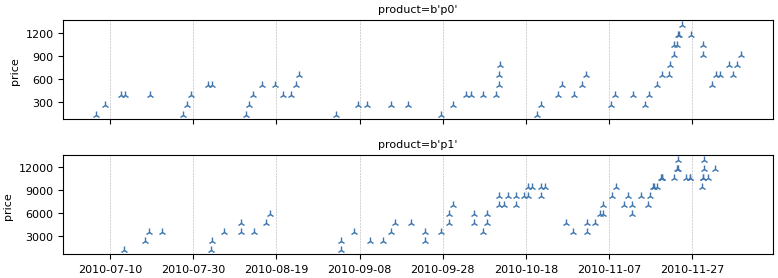
Once loaded, the next chronological step in model building is extracting meaningful signals. In time-series analysis, calculating rolling or moving metrics—such as sales totals over the past week—is essential. Temporian simplifies this by offering built-in operators like moving_sum.
By applying these operators across specific time horizons (e.g., 3, 7, 14, and 28 days), data scientists can generate robust historical contexts for every transaction. Furthermore, indexing capabilities allow these operations to run independently across distinct categories, such as individual product lines or client IDs, without writing complex looping logic.
3. Transitioning to Tabular Formats for Machine Learning
While time-series representations are useful for visualization, tabular machine learning models require structured datasets where each row represents an instance at a specific sampling frequency (e.g., daily samplings). Temporian bridges this gap by allowing developers to "tick" datasets into regular intervals and seamlessly export them into Pandas DataFrames or directly convert them into TensorFlow-compatible datasets (tf.data.Dataset).

4. Model Training and Evaluation with TensorFlow Decision Forests
With the feature-engineered dataset prepared, the final phase involves training the predictive model. TensorFlow Decision Forests—known for their exceptional ability to handle tabular and temporal features natively—take over the pipeline. By training a Random Forest regressor on the Temporian-processed data, developers can predict future sales metrics, detect anomalies, or forecast inventory demands with high accuracy.
Supporting Data and Technical Architecture
The technical elegance of the Temporian and TensorFlow integration lies in its ability to handle complex mathematical transformations natively on event-based data structures.
Event Sets vs. Traditional Time Series
Traditional time series rely on uniformly sampled values over fixed intervals. While effective for aggregate signals, they often fail to capture the irregular, bursty nature of real-world events, such as user login times or credit card swipes. Temporian leverages multivariate multi-index time sequences (referred to as event sets), which preserve the exact irregular intervals of incoming data while allowing flexible resampling when necessary.

Feature Importance and Model Explainability
In benchmark tests forecasting weekly sales from individual transaction logs, models trained using TFDF and Temporian yielded deep insights into feature relevance. Upon examining the model’s variable importance metrics (INV_MEAN_MIN_DEPTH), data scientists discovered clear hierarchies in predictive power:
moving_sum_28(Score: ~0.342): Demonstrated the highest predictive utility, proving that long-term historical sales baselines heavily influence near-term forecasts.product(Score: ~0.294): Highlighted the critical importance of category-specific indexing.calendar_day_of_week(Score: ~0.254): Captured weekly human behavioral patterns effectively.- Shorter Windows (
moving_sum_14,7,3): Provided granular, short-term momentum indicators.
This transparency allows engineers to iteratively prune useless features and focus computational resources where they matter most.
Official Perspectives from the Development Team
The release of Temporian is the result of a strategic partnership between Google’s machine learning engineering teams and Tryolabs, an elite AI consultancy known for cutting-edge predictive systems.

Core contributors Mathieu Guillame-Bert, Richard Stotz, Robert Crowe, and Luiz Gustavo Martins (Gus) from Google, alongside Tryolabs engineers Ian Spektor, Braulio Rios, Guillermo Etchebarne, and their peers, emphasized that the library was born out of a shared frustration with existing tooling.
"Temporal data is omnipresent, yet the tooling required to bridge raw event streams with modern machine learning frameworks has historically been fragmented," the development team noted in introductory technical documentation. "With Temporian, our goal was to abstract away the boilerplate code of temporal data engineering. By combining Temporian’s agile event processing with TensorFlow Decision Forests, developers can focus on solving business problems rather than wrestling with data pipelines."
Industry analysts have similarly praised the initiative, noting that lowering the barrier to entry for temporal feature engineering will accelerate AI adoption in sectors like retail supply chain management, fintech risk assessment, and predictive maintenance.

Implications for Applied Machine Learning and Future Outlook
The introduction of Temporian and its integration with TensorFlow marks a significant maturation in how organizations handle time-sensitive data. The implications of this release span across multiple operational dimensions:
1. Accelerated Time-to-Market for Predictive Models
Data scientists frequently report spending up to 80% of their time on data cleaning and feature engineering. By standardizing temporal transformations into declarative, high-performance Python operations, Temporian drastically cuts down development cycles. Prototypes that once required weeks of custom data-wrangling scripts can now be constructed, visualized, and trained in hours.
2. Enhanced Model Accuracy Through Richer Features
Because Temporian retains the granularity of event-level data while enabling seamless windowing and resampling, models no longer have to sacrifice precision for structural convenience. Machine learning models fed with multi-window historical aggregates and synchronized calendar features consistently outperform those built on naive, uniformly sampled time series.
3. Broadening Accessibility Beyond Time-Series Experts
Historically, advanced time-series forecasting required specialized domain expertise in econometrics or complex signal processing. By wrapping these capabilities in intuitive Python APIs that integrate natively with the broader TensorFlow ecosystem, Google and Tryolabs are making sophisticated temporal modeling accessible to a much broader community of software engineers and generalist machine learning practitioners.
Next Steps for Practitioners
Developers interested in exploring this workflow can install Temporian via open-source repositories and access comprehensive tutorials covering various data domains—ranging from financial fraud detection to predictive maintenance. Coupled with the extensive documentation available for TensorFlow Decision Forests, engineering teams now possess a robust, enterprise-grade toolkit for taming the complexities of time.