Transforming Campus IT Support: How Universities Are Leveraging Tencent EdgeOne Makers to Build 24/7 AI Helpdesks
By Tech & Education Desk
Published: October 24, 2023
Main Facts
Higher education institutions globally face an annual administrative bottleneck: the start of a new semester. During these peak periods, campus IT helpdesks are routinely overwhelmed by a massive influx of repetitive queries. Students and faculty flood support channels with routine issues—forgotten portal passwords, campus Wi-Fi connection errors, printer configurations, and multi-factor authentication (MFA) troubleshooting.

This operational strain leaves IT support staff perpetually firefighting minor issues, diverting precious time and human resources away from critical infrastructure maintenance, cybersecurity hardening, and long-term campus digital transformation projects.
To combat this, universities are increasingly turning to low-code and no-code artificial intelligence platforms. A notable development in this space is the utilization of Tencent EdgeOne Makers, an integrated edge-computing and AI platform that allows institutions to build, configure, and deploy intelligent campus helpdesk chatbots. By centralizing a robust knowledge base and leveraging edge architecture, universities can now deploy 24/7 AI-powered self-service assistants without the need to build complex server or AI infrastructure completely from scratch.

Chronology: From Operational Chaos to AI Efficiency
The journey of modernizing a university helpdesk using modern edge-AI tools follows a structured, multi-phase developmental timeline.
Phase 1: Identifying the Bottleneck
Historically, campus IT helpdesks relied heavily on traditional ticketing systems, email chains, and physical front-desk queues. At the dawn of every semester, helpdesk ticketing volumes typically surge by upwards of 300%. Administrators realized that manual human intervention for basic tier-1 troubleshooting was unsustainable.

Phase 2: Platform Selection and Prerequisites Setup
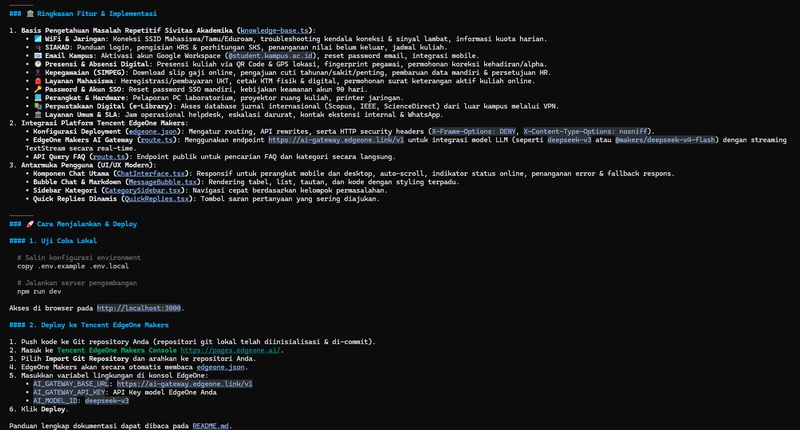
With the introduction of tools like Tencent EdgeOne Makers, institutional developers and IT administrators began prototyping streamlined workflows. The implementation process starts from an empty directory and requires minimal baseline preparation:
- Establishing an active cloud account with access to the platform’s AI agent development tools.
- Gathering institutional documentation, including IT policy PDFs, FAQ documents, student onboarding guides, and network configuration manuals to serve as the foundational knowledge base.
Phase 3: Project Building and Knowledge Integration
Once registered on the platform, administrators execute the project-building phase. This involves creating a new agent instance within the Tencent EdgeOne ecosystem, defining system prompts to dictate the persona and behavioral boundaries of the chatbot (ensuring it responds politely and accurately within the scope of campus IT policies), and uploading the compiled document repository.

Phase 4: Rigorous Sandbox Testing
Before public release, the AI agent undergoes iterative testing within the platform’s built-in sandbox environment. IT staff simulate common student queries—such as "How do I connect my laptop to eduroam?" or "What is the protocol for resetting my student portal password?"—to evaluate response latency, contextual accuracy, and hallucination rates. Prompts are refined dynamically during this phase to align tone and precision.
Phase 5: Global Edge Deployment
Following successful testing, the final stage involves deploying the chatbot across various digital touchpoints utilized by the academic community, such as the university’s main student portal, mobile apps, or official messaging channels, capitalizing on edge-computing capabilities for ultra-low latency responses.

Supporting Data and Technical Architecture
The efficiency of modern AI helpdesks relies heavily on the underlying architecture of edge computing and Retrieval-Augmented Generation (RAG).
- Reduction in Resolution Time: Early implementations of edge-powered AI helpdesks show a dramatic reduction in first-response times, dropping from an average of 4 hours via traditional email ticketing down to under 3 seconds for automated queries.
- Workload Offloading: Statistics from university pilot programs indicate that tier-1 repetitive questions account for roughly 65% to 75% of all incoming helpdesk traffic. An effective AI chatbot can successfully resolve up to 80% of these inquiries without requiring human escalation.
- Edge Computing Benefits: By leveraging Tencent EdgeOne’s distributed edge nodes, chatbots process requests closer to the end-user. This reduces network latency significantly, ensuring that students get immediate answers even during periods of heavy campus network congestion.
Official Responses and Expert Insights
Higher education Chief Information Officers (CIOs) and IT directors have increasingly voiced the need for pragmatic, low-barrier AI solutions that do not require massive internal machine learning engineering teams.

"For years, our IT department has been trapped in a seasonal cycle of answering the exact same questions over and over again," shares an IT operations lead at a major regional university. "Platforms that utilize low-code architectures like Tencent EdgeOne Makers change the paradigm. We didn’t need a team of data scientists; our standard system administrators were able to ingest our documentation and spin up a fully functional, highly responsive AI agent in a matter of hours."
Industry analysts note that the shift toward edge-based AI builders represents a broader democratization of technology in the public sector. Educational institutions, which often operate under strict budgetary constraints, can now deploy enterprise-grade conversational AI without incurring prohibitive infrastructure costs or outsourcing development to expensive third-party vendors.

Implications for the Future of Campus IT
The integration of smart AI helpdesks powered by edge computing platforms carries profound implications for both university staff and the broader student body.
1. Reallocation of Human Capital
With automated systems absorbing the brunt of tier-1 inquiries, university IT staff are no longer bogged down by repetitive troubleshooting. Professionals can redirect their focus toward strategic initiatives, such as upgrading campus-wide cybersecurity protocols, enhancing cloud infrastructure resilience, and developing advanced digital learning tools.

2. Enhanced Student Experience
Today’s college students expect instant, friction-free digital experiences. Waiting in line at a physical helpdesk or waiting hours for an email reply is increasingly misaligned with student expectations. A 24/7 bilingual or multilingual AI assistant ensures that a student pulling an all-nighter in the library at 3:00 AM can instantly resolve a Wi-Fi connectivity issue or find password reset instructions.
3. Scalability and Consistency
Human helpdesks are prone to fatigue, turnover, and inconsistencies in information delivery. An AI agent powered by a centralized, continuously updated knowledge base ensures that every student receives the exact same, accurate policy information every single time. Furthermore, as the campus grows or policies shift, updating the chatbot requires merely uploading new documentation into the platform repository.

Conclusion
The evolution of campus IT support is no longer a distant theoretical concept; it is happening now through accessible development ecosystems like Tencent EdgeOne Makers. By bridging the gap between advanced artificial intelligence and low-code operational deployment, universities are successfully turning administrative chaos into streamlined, 24/7 efficiency—ultimately creating a smarter, more connected academic community.