The Next Frontier: OpenAI’s GPT-5.5 and Codex Arrive on Amazon Bedrock
In a landmark development for the generative AI ecosystem, Amazon Web Services (AWS) has officially announced the integration of OpenAI’s most advanced models—GPT-5.5 and GPT-5.4—alongside the powerful Codex coding agent into the Amazon Bedrock platform. This strategic expansion, first teased during the What’s Next with AWS 2026 event, marks a significant shift in how enterprises can access frontier-level intelligence while maintaining the security, compliance, and architectural rigor associated with the AWS cloud environment.
By routing these models through Bedrock’s next-generation inference engine, AWS is providing developers and architects with a robust toolkit designed to handle everything from high-stakes professional reasoning to large-scale, automated software development lifecycles.
Main Facts: A New Tier of Generative Capability
The integration of GPT-5.5 and GPT-5.4 into Amazon Bedrock is not merely an API addition; it is a fundamental shift in how OpenAI’s flagship models interact with enterprise infrastructure.
GPT-5.5: The Performance Powerhouse
GPT-5.5 is engineered for the most demanding enterprise workloads. It is positioned as the primary choice for complex reasoning, multi-step agentic workflows, and high-level professional tasks that require a deep understanding of nuance and long-horizon planning.
GPT-5.4: Efficiency at Scale
Recognizing that not every task requires the maximum parameter weight, OpenAI has introduced GPT-5.4. This model is optimized for superior price-performance ratios, making it an ideal candidate for high-throughput, routine tasks where efficiency is as critical as accuracy.
Codex: The Developer’s New Co-Pilot
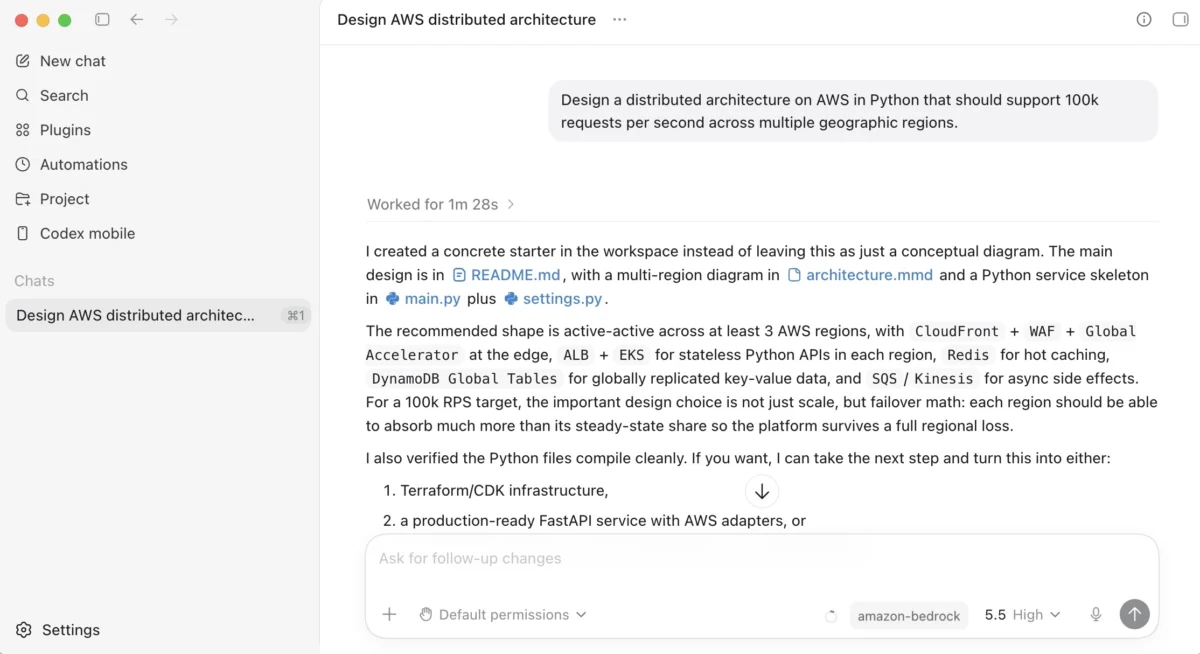
Perhaps the most transformative addition is Codex, OpenAI’s dedicated coding agent. With over 4 million weekly active users, Codex has become a standard in modern development environments. By leveraging GPT-5.5 for inference, the Codex integration on Bedrock introduces a new level of intelligence, specifically optimized for complex, long-horizon software development workflows. Whether refactoring massive legacy codebases, debugging distributed systems, or writing novel features, Codex is now natively accessible through Bedrock’s managed ecosystem.
Chronology: The Evolution of the Integration
The rollout of these models has been rapid and iterative, reflecting the agile nature of modern AI deployment.
- May 24, 2026: Initial announcement during What’s Next with AWS 2026, confirming the upcoming availability of GPT-5.5, GPT-5.4, and Codex on Bedrock.
- June 1, 2026: Official launch of the models via the
ResponsesAPI. This release emphasized programmatic access, with initial console support pending. - June 3, 2026: Expansion of GPT-5.4 availability to the AWS GovCloud (US-West) Region, signaling that the models meet the stringent security requirements of regulated government entities.
- June 7, 2026: Launch of the updated Amazon Bedrock console, providing a unified UI experience for developers to manage and test OpenAI-compatible API workflows.
Supporting Data: Infrastructure and Accessibility
The integration is built on the Responses API, a specialized interface designed for high-performance, reliability, and security. Unlike standard request-response cycles, the Responses API is built to handle:
- Model-managed multi-turn state: Essential for complex, conversational, or iterative workflows.
- Hosted tools and function orchestration: Allowing the models to trigger external APIs and perform background computations.
- Long-running tasks: Facilitating deep-thinking or intensive code-generation processes that exceed standard timeouts.
Economic and Operational Model
AWS has maintained its commitment to transparency in pricing. Customers pay strictly per token, with no requirement for seat licenses or long-term developer commitments. This pay-as-you-go model ensures that organizations of all sizes—from startups to Fortune 500 companies—can experiment with these frontier models without prohibitive upfront costs.
Security and Residency
Data residency remains a cornerstone of the Bedrock value proposition. All processing stays within the user-selected Bedrock region. This is particularly vital for organizations operating under strict data sovereignty laws (such as GDPR or CCPA), as it ensures that sensitive proprietary code and customer data do not cross regional boundaries during inference.

Official Responses and Implementation Guidance
The deployment process is designed to be seamless for developers familiar with the OpenAI SDK.
Programmatic Access
To begin, developers install the updated OpenAI SDK (pip install -U openai) and configure their environment variables to route requests to the bedrock-mantle endpoints.
import os
from openai import OpenAI

# Configuring the client to hit the Bedrock-Mantle endpoint
client = OpenAI(
    base_url=os.environ["OPENAI_BASE_URL"],
    api_key=os.environ["OPENAI_API_KEY"],
)

# Executing a request
response = client.responses.create(
    model="openai.gpt-5.5",
    input=["role": "developer", "content": "You are a cloud architect expert."],
    reasoning="effort": "medium"
)
Codex Configuration
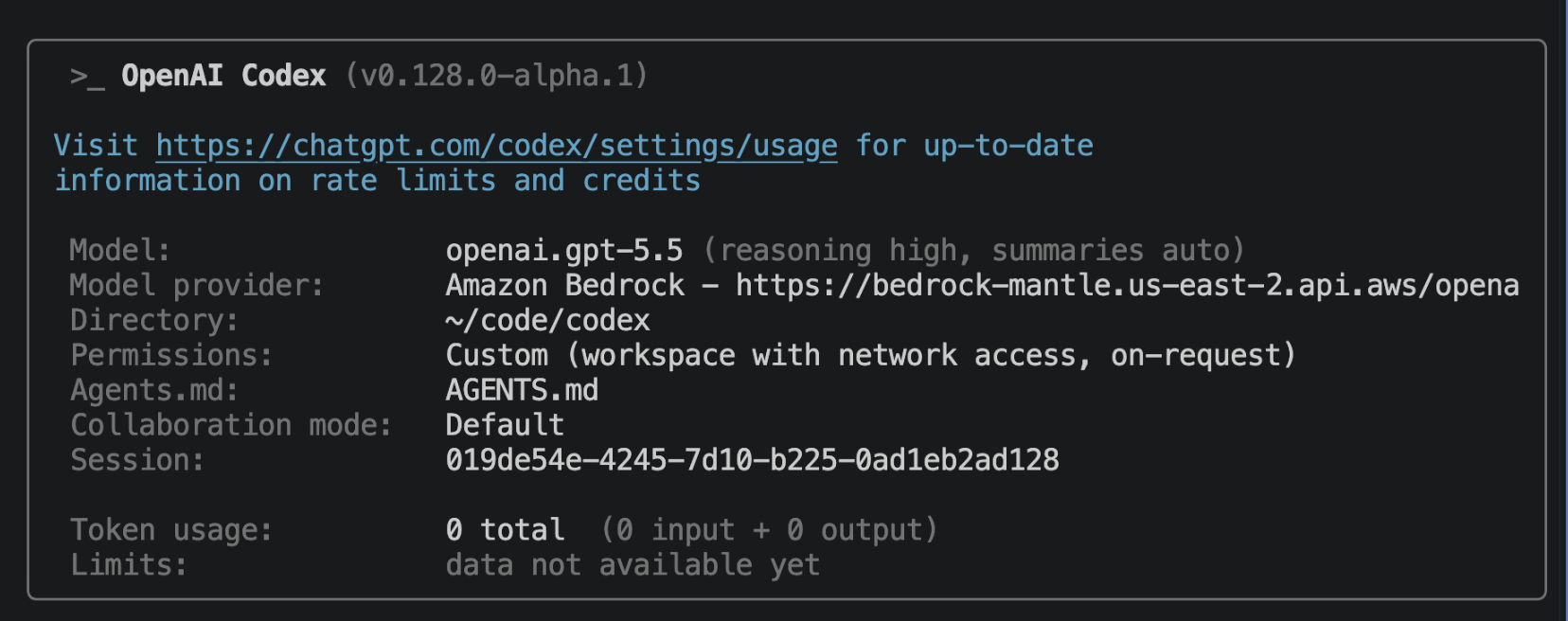
For software developers, the integration extends into the IDE. By updating the ~/.codex/config.toml file, developers can point their local Codex instance to the Bedrock provider. This configuration enables seamless authentication through either AWS SDK credential chains or direct Bedrock API keys, effectively bridging the gap between local development environments and the power of cloud-based inference.
Implications: The Future of AI-Driven Development
The implications of bringing OpenAI’s frontier models to Amazon Bedrock are profound, touching on several key industry shifts.
1. Democratization of High-End AI
By removing the barrier of complex infrastructure management, AWS and OpenAI have effectively commoditized access to top-tier reasoning capabilities. Organizations that previously struggled to build their own RAG (Retrieval-Augmented Generation) or agentic systems can now leverage the Responses API to build robust, state-aware applications with minimal overhead.
2. The Rise of "Agentic" Software Engineering
The introduction of Codex on Bedrock suggests a future where software development is no longer just about writing lines of code, but about orchestrating autonomous agents. With GPT-5.5 powering the inference, these agents can handle long-horizon tasks—such as updating an entire microservices architecture to a new language version—with a level of context retention previously impossible in static models.
3. Enterprise Adoption at Scale
Perhaps most importantly, the availability of these models in AWS GovCloud and the integration with the standard AWS security fabric signals that "frontier" AI is officially ready for the enterprise. The ability to use these models while adhering to strict internal compliance protocols will likely trigger a new wave of adoption among highly regulated sectors, including finance, healthcare, and government defense.
4. Competitive Dynamics
This partnership represents a formidable alliance between the world’s leading cloud provider and the pioneer of modern generative AI. By aligning their incentives, AWS and OpenAI have created a platform that is difficult for competitors to replicate in terms of sheer scale, regional availability, and developer ecosystem penetration.
Conclusion
The arrival of GPT-5.5, GPT-5.4, and Codex on Amazon Bedrock is a turning point for the generative AI era. It moves the conversation away from "can we run these models?" to "what can we build with them?" As developers continue to integrate these tools into their daily workflows, the velocity of innovation in cloud architecture and software engineering is set to accelerate.
For those looking to get started, the path is clear: leverage the Responses API for complex orchestration, utilize the Bedrock console for monitoring, and begin experimenting with Codex to redefine the boundaries of your development lifecycle. The tools are now in place; the next phase of the AI revolution is underway.