Simplifying the Frontier: How GNOME Test Center Aims to Revolutionize Experimental Software on Linux
Testing experimental software has long been the "Wild West" of the Linux ecosystem. For developers and power users alike, the choice has historically been binary: wait patiently for a stable, polished release, or venture into the volatile world of nightly builds—a landscape often fraught with system instability, broken dependencies, and the nagging fear that an update might render one’s machine unbootable.
This friction is significantly magnified on modern, immutable, image-based operating systems like GNOME OS. Because these systems utilize a read-only base image to ensure integrity and security, the traditional "swap a package and pray" approach is physically impossible. To bridge this gap between bleeding-edge innovation and system stability, the GNOME community is prototyping an ambitious new tool tentatively titled Test Center.
The Problem: The Perils of Testing on Immutable Infrastructure
In traditional Linux distributions (like Debian or Arch), the package manager allows users to pull down experimental versions of software, often replacing stable binaries with newer, buggier iterations. While this is how testing happens, it is also how systems break. Once an experimental package is installed, it often creates a "dependency hell," making it difficult to revert to a stable state without manual intervention or, in worst-case scenarios, a complete reinstallation.
The "Modal Collective," a development group heavily involved in GNOME OS tooling, notes that on conventional distributions, developers often rely on unofficial repositories—such as Fedora’s COPR or Debian’s PPAs—to distribute test builds. The fatal flaw here is that these packages don’t sit "alongside" stable ones; they often overwrite them. Once the user updates their system, they are locked into the experimental branch, and the responsibility for fixing any resulting breakage falls entirely on the user.
Image-based systems, such as GNOME OS or Silverblue-based distributions, aim to solve the fragility of traditional Linux by making the core operating system read-only. However, this architectural integrity creates a new hurdle: it makes it incredibly difficult for developers to deploy and test experimental features, such as new system services or early-stage UI components, without rebuilding the entire system image.
Enter Test Center: A Unified Sandbox for Innovation
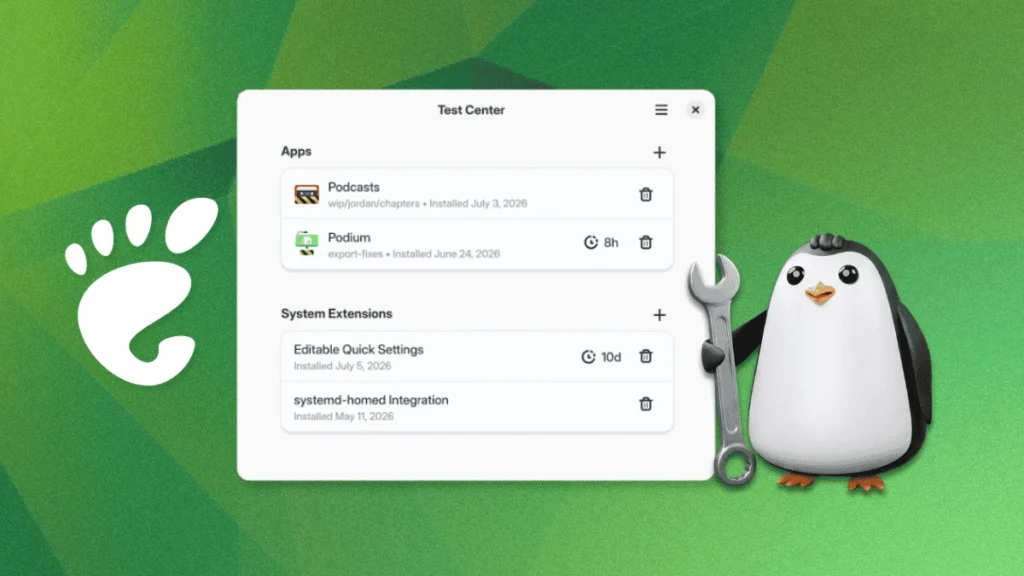
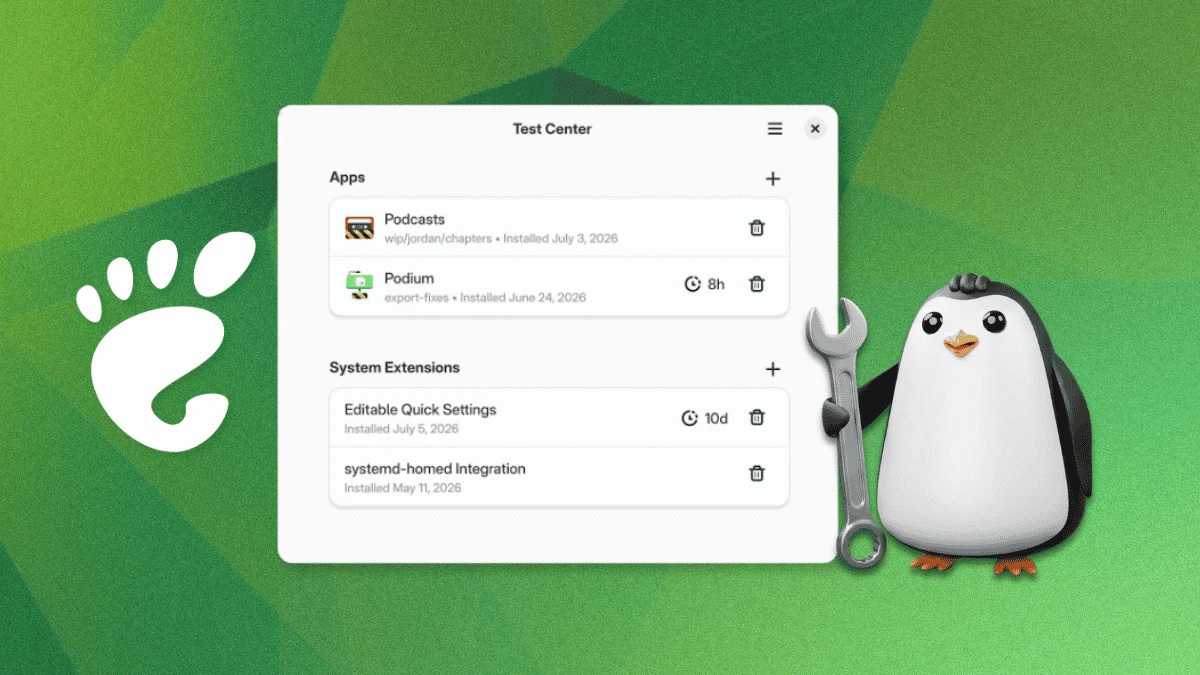
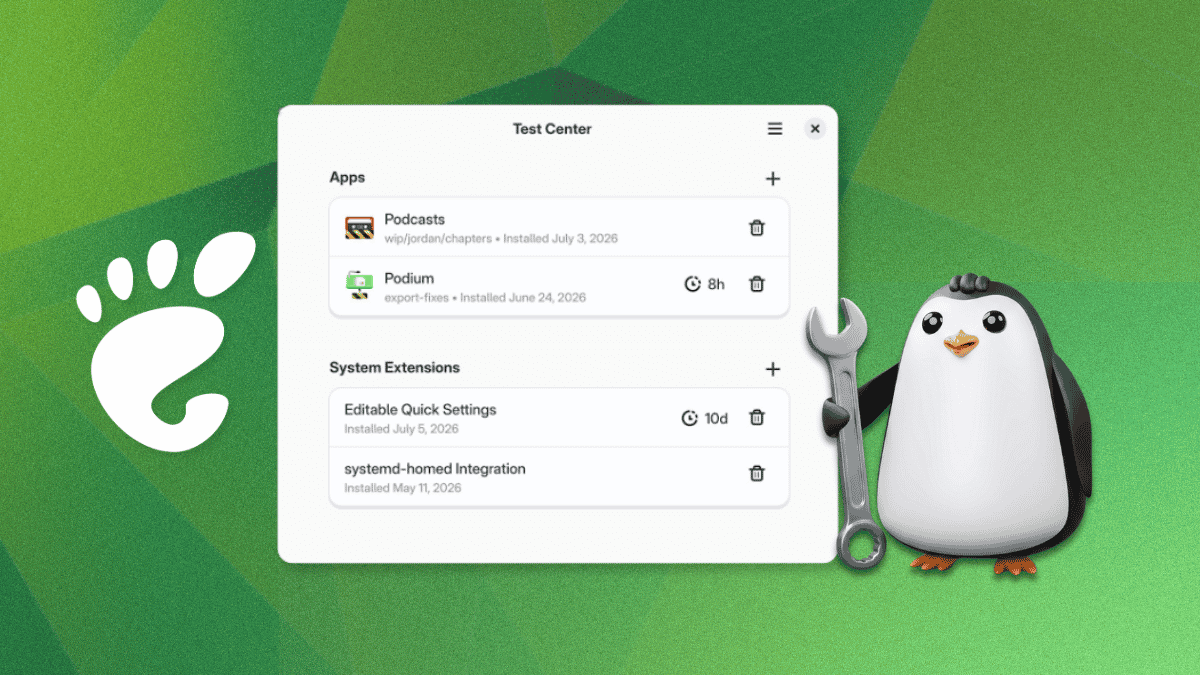
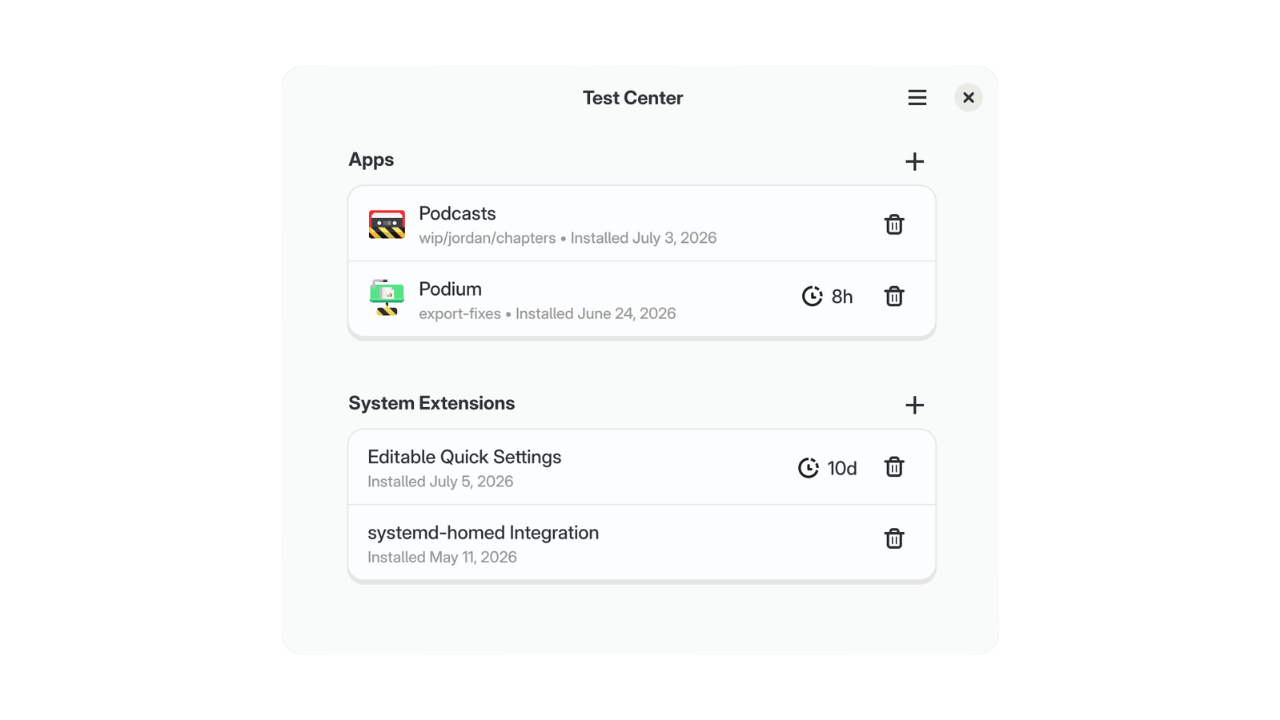
The proposed GNOME Test Center is designed to be the ultimate "one-stop shop" for managing the experimental lifecycle. Instead of requiring users to hunt down CI (Continuous Integration) artifacts, manually compile code, or manage complex Flatpak bundles, Test Center aims to streamline the process into a single, intuitive interface.
How It Works
The functionality of Test Center is divided into two distinct categories: application-level testing and system-level experimentation.
- For Applications: Developers can provide a simple link to a build. A user clicks that link, and the Test Center pulls down the experimental build. The application is tagged as "experimental" within the system, and crucially, it is configured to expire automatically. This prevents the "forgotten experimental build" syndrome, where a user unknowingly runs an outdated test version of an app for months.
- For System Components: This is where the magic of
sysext(system extensions) comes into play. Unlike Flatpaks, which are isolated from the host system,sysextimages allow developers to overlay functionality onto the read-only base image. If a developer is working on a new feature—such as a revamped parental control panel—a user can pull the correspondingsysextimage via Test Center. The system treats this as an "overlay" rather than a replacement.
The primary benefit here is reversibility. Because the base image remains untouched, removing an experimental component through Test Center is as simple as removing an overlay. The system returns to its exact previous state, ensuring that the integrity of the host OS is never compromised.
Chronology: The Path to Modern Development Tools
The development of Test Center is not an isolated experiment; it is part of a broader, long-term strategic initiative known as the GNOME OS Developer Tool Suite.
- June 2026: The project receives a vital boost in funding from Germany’s Prototype Fund, an organization dedicated to supporting open-source innovation. This funding provides the financial runway for key contributors like Tobias Bernard and Jonas Dreßler, working under the umbrella of the Modal Collective, to dedicate full-time resources to the project.
- Late 2026: Initial architectural discussions regarding the limitations of image-based systems on GNOME OS begin to coalesce. The team identifies that the lack of an efficient distribution channel for "non-stable" code is the single biggest bottleneck for contributor growth.
- Present Day: The project moves into the prototyping phase. The mockups released by the team suggest a clean, GNOME-native interface that prioritizes simplicity and user safety, distancing itself from the technical complexity that usually accompanies experimental testing.
Supporting Data: Why Image-Based Systems are the Future
The move toward image-based systems is driven by a desire to make Linux more robust and secure. By keeping the core system immutable, developers can guarantee that the environment in which an app runs is identical across all installations. This eliminates the "it works on my machine" phenomenon.
According to data presented by the GNOME OS team, the overhead of managing experimental software in a traditional environment is the primary reason many users avoid participating in the testing phase of software development. By using sysext, the team is essentially leveraging the same technology that allows modern systems to perform atomic updates. It provides a surgical way to inject code into the system without performing open-heart surgery on the root partition.
Official Responses and Collaborative Spirit
The team behind the GNOME OS Developer Tool Suite, including the Modal Collective, has emphasized that they are building this for the community, not just for themselves.

"We want to hear from you," is the recurring message from the contributors. The team is actively soliciting feedback from developers who feel the sting of current, inefficient workflows. They have established a presence on the Matrix protocol (specifically the #gnome-os room) to engage with the community in real-time. Furthermore, the project has been a central theme at the recent GNOME OS Birds of a Feather (BoF) sessions at GUADEC, where developers met in person to discuss the architectural nuances of the Test Center implementation.
Broader Implications: A Catalyst for Linux Desktop Adoption
The implications of the Test Center extend far beyond the convenience of a few developers. If successful, this tool could fundamentally change how the Linux desktop ecosystem handles innovation.
1. Accelerating the Feedback Loop
Currently, the time it takes for a feature to go from a Merge Request (MR) to a user’s machine is hindered by the friction of build distribution. If Test Center becomes a standard feature, a developer could post a link to a feature branch, and testers could install it in seconds. This significantly reduces the time required for bug reports, which in turn leads to higher-quality stable releases.
2. Lowering the Barrier to Entry
Open source development often requires a high level of technical expertise to even begin testing. By abstracting the complexities of sysext and build management behind a clean UI, Test Center democratizes the testing process. It allows non-engineers—designers, translators, and power users—to participate in the testing cycle, which is essential for a well-rounded desktop experience.
3. Strengthening the GNOME Ecosystem
By creating a cohesive, professional suite of developer tools, GNOME is positioning itself as the most developer-friendly desktop environment on Linux. In an era where competing platforms are becoming increasingly closed, the ability to rapidly iterate on experimental features while maintaining a rock-solid, immutable foundation could become a key differentiator for GNOME OS.
Looking Ahead: The Road to Distribution
While the Test Center focuses on graphical applications and system extensions, the Modal Collective has hinted at a second, equally important pillar: an easier way to distribute command-line developer tools.
The team has promised that more details on this will be revealed in a forthcoming post. This suggests that the GNOME OS Developer Tool Suite is not merely a collection of utilities, but a comprehensive rethink of the entire software development lifecycle on the GNOME desktop.
As the Linux community moves toward a future where stability is guaranteed by architecture, tools like Test Center will be the gatekeepers of innovation. They represent a shift toward a more modular, safe, and collaborative development model—one where the thrill of testing new features no longer comes at the expense of a functional operating system.
For those eager to get involved, the best path forward is to join the ongoing discussions on Matrix or follow the progress of the GNOME OS Developer Tool Suite through the official Prototype Fund documentation. As the project matures, it promises to turn the "pit of nightly builds" into a well-tended garden, where experimentation is not just possible, but encouraged.