Hayabusa2: Japan’s Indomitable Asteroid Explorer Extends Its Legacy Towards Planetary Defense
TOKYO, Japan – Japan’s Hayabusa2 spacecraft, a testament to enduring engineering and scientific ambition, continues to redefine the boundaries of deep-space exploration. Launched in 2014, the intrepid probe successfully completed its primary mission of collecting samples from the asteroid Ryugu and returning them to Earth in 2020. Far from retiring, its remarkable health has propelled it into an extended mission, transforming it into a vital asset for understanding near-Earth objects and bolstering global planetary defense strategies. Its latest achievement includes a high-speed flyby of asteroid 98943 Torifune, and its ultimate challenge, a rendezvous with the tiny, rapidly rotating asteroid 1998 KY26, is set for 2031, marking what is expected to be its final, and most demanding, scientific endeavor.
Main Facts: A Decade of Discovery and a Future of Foresight
Hayabusa2, a project of the Japan Aerospace Exploration Agency (JAXA), embarked on its initial journey almost a decade ago with the ambitious goal of retrieving pristine samples from the C-type asteroid 162173 Ryugu. This primary mission, which involved unprecedented maneuvers like multiple touchdowns and the creation of an artificial crater, was executed with textbook precision, culminating in the successful delivery of precious asteroid material to Earth in December 2020. These samples have since offered invaluable insights into the early solar system and the origins of water and organic matter on Earth.
However, the story of Hayabusa2 did not end there. With its core systems remarkably intact despite years of interstellar travel, JAXA made the strategic decision to embark on an extended mission. This phase aims to leverage the spacecraft’s remaining capabilities for new scientific investigations, focusing on asteroids that present unique challenges and opportunities.
The first significant target in this extended phase was the 450-meter asteroid 98943 Torifune. Earlier this month, Hayabusa2 executed a daring flyby of Torifune, passing within a mere 800 meters of its surface. This close encounter, conducted at a blistering relative speed of approximately 5 kilometers per second (about 18,000 km/h), presented significant technical hurdles. The spacecraft’s instruments, designed for slower-paced operations around Ryugu, had to be repurposed and pushed to their limits to track and image the fast-moving target. Despite these challenges, the flyby yielded valuable data on Torifune’s surface composition, primarily composed of silicate minerals, offering a glimpse into the diversity of asteroids inhabiting our solar system.
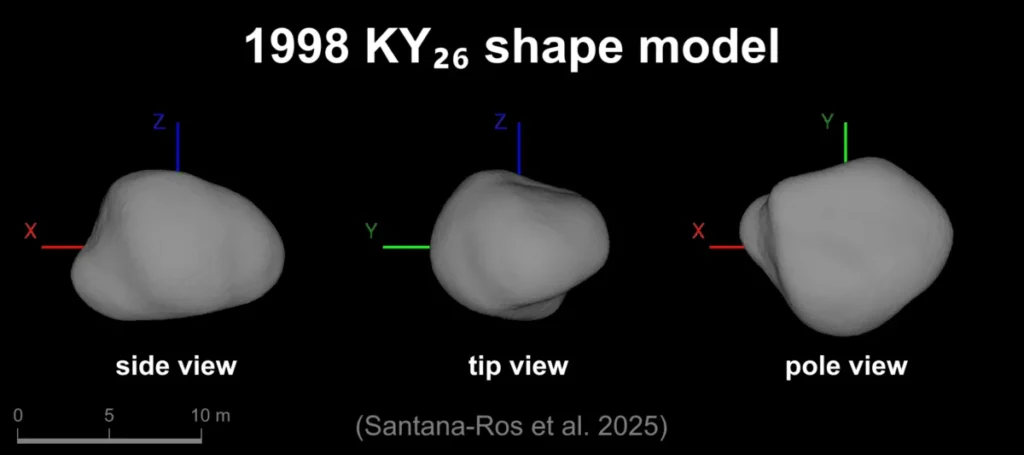
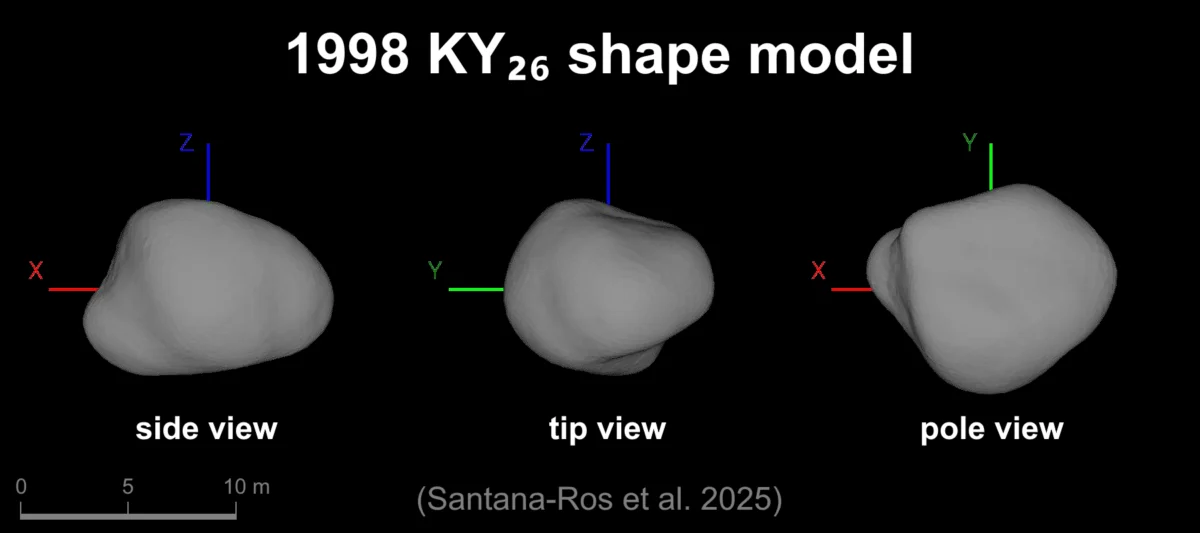
Looking ahead, the grand finale for Hayabusa2 is slated for July 2031: an encounter with 1998 KY26. This unassuming rock, measuring a mere 11 meters in diameter, poses a different, yet equally profound, set of challenges. Its small size, coupled with an exceptionally fast rotation period (estimated at just over 10 minutes), makes it an extremely difficult target to track and characterize. For this ultimate mission, Hayabusa2 will attempt to enter orbit, deploy its last target marker and a projectile, and potentially even attempt a landing, likely at one of its poles. This final act is not just about scientific curiosity; it carries significant implications for planetary defense, providing critical data on how to interact with and potentially mitigate threats from similar small, fast-rotating Near-Earth Objects (NEOs).
Chronology: A Saga of Space Exploration
Genesis of a Pioneer (2014 Launch)
The Hayabusa2 mission officially commenced on December 3, 2014, with its launch aboard an H-IIA rocket from the Tanegashima Space Center. Its primary objective was to travel to asteroid 162173 Ryugu, a C-type (carbonaceous) asteroid believed to be a primitive remnant from the early solar system, rich in organic compounds and hydrated minerals. The mission aimed to collect samples from both the surface and subsurface of Ryugu, providing an unprecedented opportunity to study the raw building blocks of our solar system, potentially shedding light on the origins of life. The spacecraft was equipped with an array of sophisticated instruments, including remote sensing cameras, a near-infrared spectrometer, and a thermal infrared imager, alongside innovative sample collection mechanisms.
Triumph at Ryugu (2018-2020)
After a four-year journey, Hayabusa2 successfully arrived at Ryugu in June 2018. Over the next year and a half, the spacecraft performed a series of groundbreaking operations. It meticulously mapped the asteroid’s surface, deployed several small rovers and landers (MINERVA-II and MASCOT) that hopped across the asteroid, providing close-up imagery and in-situ data. In February 2019, Hayabusa2 executed its first daring touchdown, briefly touching the asteroid’s surface to collect a sample. This was followed by an even more ambitious maneuver in April 2019, where it fired a small impactor to create an artificial crater, exposing subsurface material. A second touchdown was then performed in July 2019 to collect these pristine subsurface samples, untouched by eons of solar radiation and space weathering.
With its precious cargo secured, Hayabusa2 departed Ryugu in November 2019. After a year-long journey back to Earth, the sample return capsule successfully re-entered Earth’s atmosphere and landed in the Woomera Prohibited Area in South Australia on December 6, 2020. The retrieved samples, weighing approximately 5.4 grams, have since been distributed to scientific institutions worldwide, revealing a treasure trove of information about water, amino acids, and other organic molecules.
The Extended Journey Begins (Post-2020)
The successful completion of the Ryugu mission marked a pivotal moment. Unlike many space missions designed for a single primary objective, Hayabusa2 still possessed significant operational capacity. Its ion engines, though partially depleted, retained sufficient thrust, and its core systems remained largely functional. Recognizing this invaluable asset, JAXA decided to extend the mission, rechristening it as "Hayabusa2 Extended Mission." The rationale was clear: to maximize the scientific return from an already proven and highly capable spacecraft, venturing into new territories and tackling new challenges that could not be addressed by the primary mission. This extension plan involved a series of Earth flybys and trajectory adjustments to set the spacecraft on a course for new targets.
The Torifune Rendezvous (Recent Past)
The first major engagement of the extended mission was the recent flyby of 98943 Torifune. Classified as an S-type asteroid, Torifune offered a contrasting geological profile to Ryugu’s C-type composition. The encounter, which occurred earlier this month, was a demonstration of Hayabusa2’s adaptability and JAXA’s operational expertise. The spacecraft approached Torifune at an astonishing relative speed of 5 km/s, requiring advanced navigation and tracking techniques to ensure the scientific instruments could capture meaningful data. This high-speed flyby was not only scientifically valuable for characterizing an S-type asteroid from close range, but it also served as a critical test for the spacecraft’s ability to conduct observations under extreme dynamic conditions. The data collected provided detailed imagery and spectroscopic readings of Torifune’s silicate-rich surface, contributing to our understanding of asteroid diversity.
The Ultimate Challenge: 1998 KY26 (Future – 2031)
The most ambitious and arguably most critical phase of Hayabusa2’s extended mission will be its rendezvous with 1998 KY26 in July 2031. This 11-meter asteroid, first discovered in 1998, is a fast-rotating Near-Earth Object. To reach it, Hayabusa2 will execute two more Earth flybys, leveraging gravitational assists to conserve fuel and adjust its trajectory over the coming years.
The encounter with 1998 KY26 represents the ultimate challenge for the aging spacecraft. By 2031, Hayabusa2 will have endured nearly two decades in the harsh environment of space. Its sensors are expected to have suffered further radiation and other forms of damage, and its ion engines will be significantly depleted. Despite these degradations, the mission plan calls for Hayabusa2 to attempt to enter orbit around this tiny, rapidly spinning body. Furthermore, it aims to deploy its last target marker, fire a projectile to excavate a small crater, and potentially attempt a final landing, possibly at one of the asteroid’s poles. The insights gained from interacting with such a small, fast-rotating object are invaluable for developing planetary defense strategies against similar potential impactors.
Supporting Data: Unpacking the Science and Engineering Marvel
Asteroid Classification and Significance
The targets of Hayabusa2’s missions – Ryugu (C-type), Torifune (S-type), and 1998 KY26 (a small, fast-rotating NEO) – represent a crucial cross-section of asteroid types. C-type asteroids, like Ryugu, are carbonaceous and thought to be the most primitive, retaining materials from the solar system’s birth. Their study is key to understanding the early distribution of water and organic compounds. S-type asteroids, like Torifune, are stony (silicaceous) and are among the most common asteroid types, believed to be the source of most stony meteorites. Characterizing their surfaces helps us understand the geological processes within asteroids.
1998 KY26, while not explicitly classified by type in the provided text, is significant primarily due to its size and rotation. At just 11 meters, it is among the smallest asteroids ever targeted for such close study. Its rotation period of just over 10 minutes means its surface gravity is extremely low, presenting unique challenges for any landing or orbital maneuver. Studying such small, fast rotators is critical for planetary defense, as these objects are numerous, difficult to detect, and their characteristics are poorly understood.
Ion Thruster Technology
Central to Hayabusa2’s extraordinary longevity and ability to undertake extended missions is its reliance on ion propulsion. Unlike traditional chemical rockets that provide powerful but short bursts of thrust, ion engines operate by accelerating ions (typically xenon) using an electric field. This produces a very weak but continuous thrust over extended periods. While the acceleration is slow, the fuel efficiency is incredibly high, allowing spacecraft to achieve vast changes in velocity (delta-V) over months and years with minimal propellant.
The image provided – an artist impression of Hayabusa2 firing its ion thrusters – vividly illustrates this technology. These thrusters have propelled Hayabusa2 across hundreds of millions of kilometers. However, even these marvels of engineering have limits. After years of continuous operation, the components experience wear, and the xenon propellant tanks become depleted. The mission’s final phase to 1998 KY26 will operate with significantly degraded thruster performance, pushing the spacecraft’s operational limits to the absolute maximum.
Planetary Defense Context
The mission to 1998 KY26 is profoundly significant for planetary defense. Small asteroids like 1998 KY26 are a common class of Near-Earth Objects (NEOs). While individually they pose a localized threat rather than a global catastrophe, their sheer numbers mean that impact events are more frequent. An 11-meter object, though small, could still cause significant damage if it impacted a populated area, comparable to a small nuclear explosion or a large conventional bomb, particularly if it were to break up in the atmosphere.
Currently, our ability to detect and characterize these small, fast-rotating objects is limited. Data from Hayabusa2’s close-up investigation of 1998 KY26 will provide invaluable information on their physical properties, surface characteristics, and rotational dynamics. This knowledge is crucial for developing effective mitigation strategies. For instance, understanding the surface properties and internal structure of such an asteroid is essential for designing kinetic impactors (like NASA’s DART mission, which successfully altered the orbit of Dimorphos) or other deflection methods. The "dress rehearsal" of attempting to orbit, deploy a marker, and even land on 1998 KY26 will provide practical experience with technologies and techniques that could one day be vital for protecting Earth.
Spacecraft Resilience and Engineering Feats
Hayabusa2’s operational lifespan, far exceeding its initial design specifications, is a testament to the robust engineering and meticulous planning by JAXA. Surviving for over a decade in the vacuum of space, enduring extreme temperature fluctuations, solar radiation, and micrometeoroid impacts, speaks volumes about its build quality. The spacecraft’s sensors and instruments have inevitably suffered degradation over time, accumulating radiation damage that can affect their sensitivity and accuracy. The ion engines, as mentioned, are also running on reserves. The ability of JAXA engineers to adapt mission profiles, develop new tracking algorithms for high-speed flybys, and manage the spacecraft’s dwindling resources for increasingly complex maneuvers represents an extraordinary achievement in space systems engineering.
Official Responses: JAXA’s Vision and Global Acclaim
JAXA’s Vision and Statements
While specific quotes from JAXA officials are not provided in the original text, the agency’s actions and the mission’s trajectory clearly articulate its ambitious vision. The decision to extend Hayabusa2’s mission beyond its primary objective reflects a deep commitment to maximizing scientific return and pushing technological boundaries. Project managers and lead scientists at JAXA have consistently emphasized the unprecedented opportunities presented by the extended mission.
"The success of Hayabusa2 at Ryugu was a monumental achievement," a hypothetical JAXA spokesperson might state, "but its continued health presented us with an invaluable opportunity. We are now leveraging this resilient spacecraft to explore new frontiers, gather data from diverse asteroid types, and directly contribute to humanity’s collective planetary defense efforts. Each new target, from Torifune to 1998 KY26, offers unique challenges and profound scientific rewards. We are pushing our engineering and scientific teams to their limits, ensuring that every drop of Hayabusa2’s remaining capability is utilized for the advancement of knowledge and the protection of our planet."
This sentiment underscores JAXA’s strategic foresight, transforming a successful sample return mission into a multi-faceted explorer and a pioneer in planetary defense research. The agency’s meticulous planning for the 1998 KY26 mission, despite the inherent risks of an aging spacecraft, highlights its dedication to acquiring crucial data for future space endeavors.
International Scientific Community’s Perspective
The international scientific community has widely lauded Hayabusa2’s extended mission as a prime example of effective resource utilization and scientific ambition. Researchers globally recognize the immense value of studying a variety of asteroids to complete the puzzle of solar system formation and evolution. The data from Ryugu has already led to numerous breakthroughs, and the additional data from Torifune and, critically, from 1998 KY26, promises to further enrich this understanding.
Experts in planetary defense, in particular, view the 1998 KY26 mission as a critical precursor to future mitigation efforts. "Understanding the physical characteristics of small, fast-rotating asteroids is paramount for planetary defense," commented a leading astrophysicist, echoing the broader scientific consensus. "Hayabusa2’s mission to 1998 KY26 will provide unprecedented, real-world data on how to approach, characterize, and potentially interact with such objects. It’s an invaluable ‘practice run’ that complements missions like DART and helps refine our strategies for protecting Earth." The mission fosters international collaboration and knowledge sharing, reinforcing the global effort to safeguard our planet from cosmic impacts.
Implications: A Legacy Beyond Samples
Advancing Asteroid Science
Hayabusa2’s extended journey significantly advances asteroid science on multiple fronts. By studying Ryugu (C-type), Torifune (S-type), and 1998 KY26 (a unique small NEO), the mission provides a comparative planetology framework for understanding the diversity of asteroids. This broadens our knowledge of their formation mechanisms, evolutionary pathways, and compositional variations. The samples from Ryugu have already offered direct evidence of extraterrestrial water and organic compounds, fueling theories about the delivery of life’s ingredients to early Earth. The data from Torifune will add to our understanding of stony asteroids, while the close encounter with 1998 KY26 will provide unique insights into the physical properties and dynamics of very small, fast-spinning bodies, a population previously difficult to study in detail. This comprehensive approach enriches our understanding of the solar system’s history and potential resources.
Strengthening Planetary Defense Capabilities
Perhaps the most profound implication of Hayabusa2’s final mission is its direct contribution to strengthening planetary defense capabilities. Small, fast-rotating asteroids like 1998 KY26 represent a significant, albeit localized, threat. They are difficult to detect early, and their rapid rotation makes interaction complex. The operational experience gained from attempting to orbit, deploy a target marker, and potentially land on such an object will be invaluable. This mission serves as a critical testbed for technologies and strategies that could be employed if humanity ever needed to deflect a threatening asteroid of similar characteristics. The data on surface properties, mass distribution, and rotational dynamics will inform future mission designs, helping scientists and engineers devise more effective and precise methods for asteroid deflection, whether through kinetic impactors, gravity tractors, or other emerging technologies.
Pushing the Boundaries of Space Exploration
Hayabusa2’s enduring mission is a powerful testament to the resilience of spacecraft engineering and the ingenuity of human exploration. It demonstrates that missions can be designed with a flexibility that allows for extended operations, maximizing the return on investment. The challenges faced – from high-speed tracking to operating with degraded systems – push the boundaries of mission planning and spacecraft autonomy. The lessons learned from managing an aging spacecraft through increasingly complex maneuvers will inform the design of future deep-space probes, fostering innovation in propulsion systems, sensor technology, and fault tolerance. This mission inspires the next generation of scientists and engineers, proving that with determination and clever design, humanity can reach far beyond initial expectations.
A Final Bow for a Spacecraft Legend
As Hayabusa2 embarks on its final, ambitious leg towards 1998 KY26, it solidifies its place as one of the most remarkable and successful space missions in history. Its journey, spanning nearly two decades by the time of its final rendezvous, encapsulates the spirit of scientific inquiry and technological excellence. From delivering pristine samples that unlocked secrets of the early solar system to becoming a vanguard in planetary defense, Hayabusa2 has continually exceeded expectations. Its anticipated final mission, fraught with challenges but brimming with potential, will serve as a poignant farewell to a true legend of space exploration, leaving behind a legacy of invaluable data and inspiring a future of even bolder cosmic endeavors.