Demystifying the Silicon Bridge: How Code Translates into Physical Hardware Action
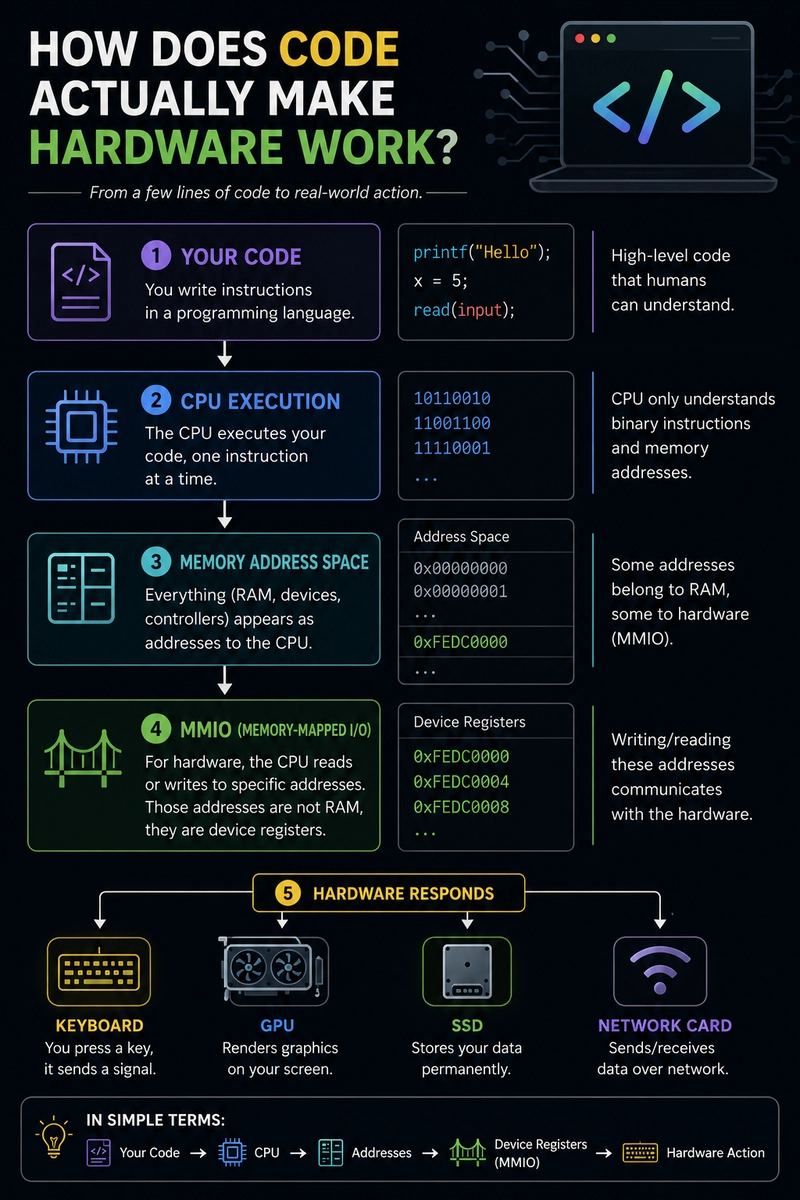
In an era dominated by high-level cloud computing, artificial intelligence, and low-code frameworks, the physical reality of computing has largely been abstracted away. Developers write code in Python, JavaScript, or Rust, deploy it to a virtualized cloud instance, and observe the output on a screen. Yet, beneath these layers of abstraction lies a profound engineering puzzle: How does an abstract line of code translate into the physical movement of electrons, the storage of data on silicon, or the rendering of millions of pixels on a GPU?
This fundamental question—recently highlighted by systems researcher and developer Vedant in an ongoing inquiry into computer architecture—serves as the gateway to systems programming, firmware development, and hardware-software co-design. To understand how code makes hardware work, one must peer beneath the operating system kernel and explore the complex, highly coordinated dance between the Central Processing Unit (CPU), system buses, and peripheral controllers.
Main Facts: The Mechanics of the Hardware-Software Interface
At its core, a CPU is an extraordinarily fast, highly specialized calculator. It does not innately understand what a keyboard, a solid-state drive (SSD), or a graphics processing unit (GPU) is. The CPU operates purely on machine instructions (such as ADD, SUB, LOAD, and STORE) and memory addresses.
To bridge the gap between abstract mathematical execution and physical hardware interaction, computer architects rely on four primary mechanisms: Memory-Mapped I/O (MMIO), Port-Mapped I/O (PMIO), Interrupts, and Direct Memory Access (DMA).
+-------------------------------------------------------------+
|                         User Space                          |
|             (Applications, Web Browsers, Games)             |
+-------------------------------------------------------------+
                              | System Calls
+-------------------------------------------------------------+
|                        Kernel Space                         |
|            (Operating System, Device Drivers)               |
+-------------------------------------------------------------+
                              | MMIO / PMIO / Interrupts
+-------------------------------------------------------------+
|                      Hardware Interface                     |
|          (PCIe Bus, Memory Controller, DMA Engine)          |
+-------------------------------------------------------------+
                              | Physical Signals
+-------------------------------------------------------------+
|                      Physical Hardware                      |
|                 (GPU, SSD, Keyboard, NIC)                   |
+-------------------------------------------------------------+
Memory-Mapped I/O (MMIO) and Port-Mapped I/O (PMIO)
How does a CPU send a command to a specific device if it only understands memory addresses? The primary solution is Memory-Mapped I/O.
Under MMIO, a portion of the CPU’s physical address space is reserved not for system RAM, but for peripheral devices. Each device is assigned a specific range of addresses. When the CPU writes a byte to an address within that range, the system’s memory controller routes the signal over a system bus (such as PCIe) to the target hardware controller instead of the RAM.
- For example, writing a specific hex value to address
0xFE000000might instruct a network interface card (NIC) to transmit a packet. - Conversely, Port-Mapped I/O (PMIO) uses a completely separate address space and specialized CPU instructions (such as
INandOUTin x86 architectures) to communicate with peripheral control registers.
Interrupts: The Hardware’s Doorbell
A CPU cannot afford to waste clock cycles constantly polling peripherals to check if they have new data. Instead, hardware devices use a mechanism called an Interrupt Request (IRQ).
When you press a key on a keyboard, the keyboard controller asserts a physical line on the interrupt controller. This signals the CPU to temporarily halt its current execution thread, save its state, and execute a specialized piece of software called an Interrupt Service Routine (ISR) or interrupt handler. Once the keypress is processed and registered in system memory, the CPU resumes its previous task.
Direct Memory Access (DMA): Bypassing the CPU
For high-bandwidth devices like SSDs and GPUs, relying on the CPU to move every byte of data from the device to system RAM would create an intolerable bottleneck.
Direct Memory Access (DMA) solves this by allowing peripheral controllers to read and write directly to system memory without CPU intervention. The CPU merely sends a command to the DMA controller specifying the source address, destination address, and transfer size, and then goes back to executing other tasks. Once the transfer is complete, the DMA controller triggers an interrupt to notify the CPU.

The Role of Device Drivers and Firmware
Device drivers act as the translators of the operating system. Written in low-level languages like C or Rust, drivers convert high-level OS commands (such as "write this file to disk") into the specific sequence of MMIO writes, PMIO commands, and DMA configurations required by a specific hardware model.
On the hardware side, many peripherals run their own internal software, known as firmware. Firmware runs on microcontrollers embedded within the device itself (e.g., the controller inside an SSD or the firmware on a Wi-Fi card), translating the registers manipulated by the host device driver into physical operations like flashing NAND cells or modulating radio waves.
Chronology: The Evolution of CPU-Peripheral Communication
The methods by which software controls physical electronics have evolved dramatically over the last eight decades, shifting from manual, hardwired configurations to highly parallelized, high-speed serial networks.
  1940s-1950s            1970s-1980s            1990s-2000s            2010s-Present
+--------------+       +--------------+       +--------------+       +--------------+
| Manual Patch |       | Parallel     |       | High-Speed   |       | Heterogeneous|
| Cables &     | ----> | Shared Buses | ----> | Point-to-    | ----> | Unified SoC  |
| Relays       |       | (ISA, early  |       | Point Buses  |       | Architecture |
|              |       | x86 PMIO)    |       | (PCIe, USB)  |       | (Apple M-    |
|              |       |              |       |              |       | Series, CXL) |
+--------------+       +--------------+       +--------------+       +--------------+
The Pioneer Era (1940s–1950s)
In the earliest days of computing (e.g., the ENIAC), there was no separation between hardware and software. "Programming" meant physically moving patch cables, toggling switches, and configuring relays. Communication with hardware was direct and manual; the machine was the program.
The Rise of Parallel Shared Buses (1970s–1980s)
With the advent of microprocessors like the Intel 8080 and the MOS 6502, computers began utilizing shared parallel buses. Devices were connected to a common set of wires representing data and address lines.
- Industry Standard Architecture (ISA): Introduced with the IBM PC in 1981, the ISA bus allowed expansion cards to be slotted directly into the system bus. Communication relied heavily on fixed PMIO ports and manual jumper configurations on the cards themselves to prevent address conflicts.
The Standardization and Serial Revolution (1990s–2000s)
As CPU clock speeds skyrocketed, parallel buses became bottlenecked by physical limitations like propagation delay and electromagnetic interference (cross-talk).
- Peripheral Component Interconnect (PCI): Introduced by Intel in 1992, PCI standardized slot auto-configuration (Plug and Play), eliminating the need for manual jumper settings.
- PCI Express (PCIe) and USB: Released in the early 2000s, PCIe replaced shared parallel buses with point-to-point serial links called "lanes." USB did the same for external peripherals, standardizing how low-speed and high-speed devices negotiated communication with the host operating system.
The Modern Era of Heterogeneous Integration (2010s–Present)
Today, the line between CPU, GPU, and memory is blurring. System-on-Chip (SoC) architectures, such as Apple’s M-series, place the CPU, GPU, Neural Engine, and Unified Memory on a single silicon die. Rather than traversing long motherboard traces, communication occurs over ultra-fast, on-die interconnects, reducing latency to near-zero and radically altering how software coordinates workloads across different compute engines.
Supporting Data: Latency, Throughput, and the Cost of Abstraction
To appreciate why low-level systems programming remains a critical field of study, one must analyze the stark differences in performance, latency, and throughput across different layers of the hardware-software stack.
| Operation / Interface | Typical Latency | Throughput (Bandwidth) | Controller / Protocol |
|---|---|---|---|
| CPU L1 Cache Access | ~0.5 – 1 ns | ~1–3 TB/s | On-die Cache Controller |
| System RAM Access | ~50 – 100 ns | ~50–100 GB/s | Integrated Memory Controller (IMC) |
| PCIe 5.0 (x16 slot) | ~100 – 250 ns | ~128 GB/s | PCIe Root Complex |
| NVMe SSD (PCIe Gen 4) | ~10 – 50 µs | ~7 GB/s | NVMe Controller / Flash Translation Layer |
| SATA SSD (Legacy) | ~50 – 150 µs | ~550 MB/s | AHCI Controller |
| Gigabit Ethernet (NIC) | ~100 – 500 µs | ~125 MB/s (1 Gbps) | Network Interface Controller (MAC/PHY) |
| USB Keyboard Input | ~10 – 20 ms | < 10 KB/s | USB Host Controller (XHCI) |
The Cost of Abstraction
When a developer writes a high-level command to write a file to disk in a language like Python, the request must pass through multiple software boundaries:
- Application Layer: Python runtime interprets the command.
- Standard Library: Translates it to a C-standard library system call (
write()). - OS Kernel: The Virtual File System (VFS) determines which file system (e.g., ext4, NTFS) handles the path.
- File System Driver: Translates logical file offsets into physical block addresses.
- Block Layer: Queues and optimizes the I/O requests.
- Device Driver: Translates the request into NVMe commands and writes them to the MMIO registers of the PCIe controller.
- Physical Hardware: The SSD’s onboard controller receives the command, coordinates the flash memory cells, and executes the physical write.
This multi-tiered journey highlights why systems-level optimization is crucial. A single inefficient abstraction in this chain can introduce latency that dwarfs the physical limits of the silicon.

Industry Standards and Expert Perspectives
The relationship between code and hardware is currently undergoing its most significant shift in decades, driven by physical limitations in silicon scaling and the explosive demands of artificial intelligence.
The Post-Moore’s Law Paradigm
For decades, Dennard scaling and Moore’s Law guaranteed that CPUs would get faster and more energy-efficient every year. Now that physical limits are halting this progression, computer architects John Hennessy and David Patterson (winners of the ACM Turing Award) argue that we have entered a "New Golden Age for Computer Architecture."
In their seminal papers, they emphasize that future performance gains will not come from faster general-purpose CPUs, but from hardware-software co-design—designing domain-specific accelerators (like Google’s TPU or Apple’s Neural Engine) alongside highly specialized, low-level software stacks tailored to exploit their exact physical layouts.
The Security Frontier
The interface between hardware and software is also the most critical battleground in modern cybersecurity. In recent years, researchers have exposed fundamental flaws in how CPUs abstract physical memory and instruction execution.
- Spectre and Meltdown (2018): These vulnerabilities revealed that "speculative execution"—a hardware optimization where the CPU guesses which instructions it will execute next—leaves measurable traces in the physical CPU cache. Software can exploit these side channels to read privileged kernel memory.
- Rowhammer: A physical vulnerability where repeatedly accessing ("hammering") a specific row of transistors in DRAM can cause electrical charge leakage, flipping bits in adjacent, unauthorized rows of memory. This bypasses all software-level security boundaries.
These discoveries have forced the industry to realize that software security cannot exist without a deep, rigorous understanding of physical hardware behavior.
Implications: Why Low-Level Systems Knowledge is More Critical Than Ever
The journey from silicon to software is not merely an academic exercise. As computing paradigms shift, understanding how code interacts with hardware has profound practical implications for the future of technology.
The Rise of Heterogeneous Computing
The dominance of single-CPU systems is over. Modern applications—particularly in machine learning, autonomous driving, and real-time graphics—rely on heterogeneous computing architectures where tasks are distributed across CPUs, GPUs, DSPs, and FPGAs. Developers who understand the underlying memory architectures, DMA transfers, and bus topologies of these systems are the ones capable of unlocking their true performance potential.
The Systems Programming Renaissance
For years, systems programming was viewed as a niche domain reserved for operating system developers and embedded systems engineers. Today, there is a massive renaissance in low-level programming.
- The rise of Rust as a safe, modern alternative to C and C++ has democratized systems programming, allowing web and application developers to write bare-metal code without sacrificing memory safety.
- Major technology companies are rewriting core infrastructure—ranging from databases and web servers to operating system kernels and virtualization layers—in systems-level languages to reduce energy consumption, lower latency, and cut cloud hosting costs.
Securing the Root of Trust
As IoT devices proliferate and infrastructure becomes increasingly digitized, securing the hardware-software boundary is paramount. Firmware-level attacks, bootloader exploits, and supply-chain vulnerabilities can compromise systems at a level invisible to traditional antivirus software. Developing secure systems requires engineers who can audit code not just for logical bugs, but for physical side-channels and hardware-level vulnerabilities.
Ultimately, the magic of computing disappears when we understand the bridge between software and silicon. By demystifying how a CPU orchestrates physical electronics through memory maps, interrupts, and direct memory access, developers transition from mere consumers of computing platforms to architects of the digital physical world.