
The Open Source Schism: How Siemens’ Abrupt Deletion of OpenRadioss Sparked a Community Resurrection
In an era where major industrial conglomerates increasingly leverage the collaborative power of open-source software to accelerate innovation, the sudden, unexplained erasure of a significant project serves as a stark reminder of the fragility of corporate-backed open initiatives. Earlier this month, the engineering giant Siemens, following its recent acquisition of Altair Engineering, abruptly deleted the repository for OpenRadioss, a high-performance finite element solver.
The move caught the global research and engineering community by surprise, effectively "nuking" a project that had become a cornerstone for crash testing, blast response, and complex structural analysis since its open-source debut in September 2022. While Siemens remains within its legal rights to manage its intellectual property, the manner of the deletion—denying the community a formal archive or transition period—has sent shockwaves through the industry. However, true to the spirit of the free software movement, the project has already been resurrected as OpenCourant, a community-led fork that ensures the continuity of this critical scientific tool.
The Rise and Fall of OpenRadioss: A Chronology
To understand the severity of this development, one must look at the trajectory of Radioss. Originally developed by Altair Engineering, Radioss has long been an industry standard for simulation-heavy sectors, including automotive safety, aerospace, and defense. In September 2022, Altair made a bold strategic move by releasing the core solver under the GNU AGPLv3 license as "OpenRadioss."
A Timeline of Events:
- September 2022: Altair releases OpenRadioss, inviting researchers and developers to contribute to the finite element analysis (FEA) solver. The move is praised as a "watershed moment" for computational engineering.
- 2025: Siemens acquires Altair Engineering, promising a "complete, AI-powered portfolio of industrial software."
- Early October 2026: Without public announcement or prior notice to the community, the OpenRadioss GitHub repository is deleted. The project’s landing page is redirected to a proprietary landing page for Simcenter Radioss.
- Mid-October 2026: Within days of the deletion, Brian Clemens (co-founder of Rocky Linux) and a coalition of community members announce the creation of "OpenCourant," a fork containing the full commit history of OpenRadioss.
The transition from a thriving, open ecosystem to a silent vacuum illustrates the inherent tension between proprietary corporate interests and the collaborative nature of open-source development. By removing the repository entirely rather than setting it to "read-only" (an industry-standard practice for archiving), Siemens effectively severed the community’s immediate access to version control history and documentation.
Technical Significance: Why OpenRadioss Mattered
The finite element analysis (FEA) market is notoriously expensive, often gated behind restrictive licensing fees that prevent smaller academic labs and startups from performing rigorous structural testing. OpenRadioss changed that calculus. By providing a high-performance, industry-proven solver, it allowed for the democratization of simulation data.
The software is essential for:
- Non-linear structural analysis: Modeling materials under extreme stress.
- Impact and Crash Testing: Simulating vehicle safety standards.
- Blast Response: Evaluating how critical infrastructure holds up under explosive loads.
The project relied on the Courant-Friedrichs-Lewy (CFL) condition, a mathematical stability criterion necessary for numerical solutions of hyperbolic partial differential equations. This technical foundation is exactly why the community’s new project was christened OpenCourant—a nod to the underlying mathematics that keep these simulations from spiraling into instability.
The "License as Shield": How OpenCourant Survived
While the deletion was abrupt, the developers of OpenCourant were protected by the very license Siemens had originally chosen: the GNU AGPLv3.
The AGPL (Affero General Public License) is specifically designed to prevent "license laundering" in network-based services, ensuring that the software remains free and open even when deployed over a network. More importantly, it grants any user the perpetual right to fork, modify, and redistribute the code.
"Siemens was legally within its rights to stop maintaining the project," explains one industry analyst. "But the AGPL ensured that the work done by the community over the last four years could not be locked away in a digital vault."
By exercising their rights under the license, the OpenCourant team essentially performed a "data rescue" mission. They retrieved the full commit history—every line of code written by thousands of researchers—and migrated it to an independent infrastructure. This serves as a vital lesson for open-source project leads: if your project is hosted on a single corporate account, it is not truly decentralized.
Challenges of the Resurrection: The Binary Problem
Re-establishing an engineering project of this magnitude is not as simple as clicking "restore" on a repository. A significant hurdle in the OpenCourant transition was the loss of the proprietary hm_reader input-reader binary.

This component was never committed to the public Git history, meaning it vanished entirely when the OpenRadioss repository was purged. In the world of complex engineering software, missing a binary reader is akin to losing the keys to the library; without it, the solver cannot ingest the files required to run simulations.
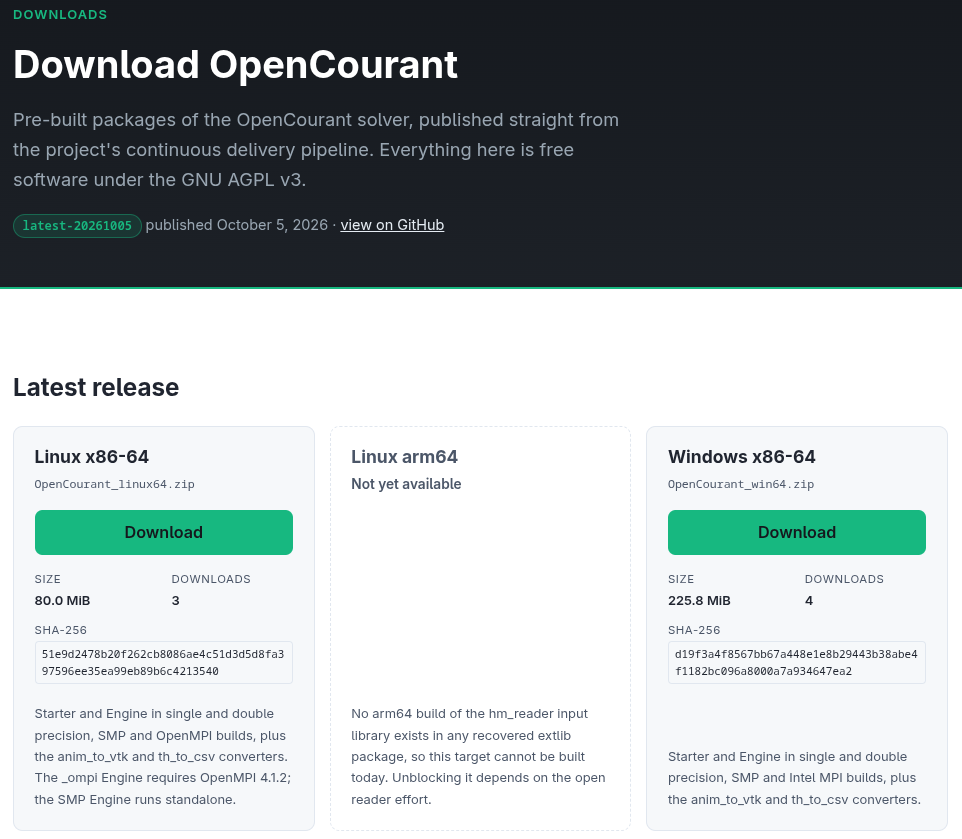
In an act of community heroism, an unnamed contributor provided a cached copy of the binary. The OpenCourant team successfully verified the integrity of the file and restored it to the new build pipeline. Despite this victory, the project still faces significant technical debt:
- ARM64 Support: The current build relies heavily on legacy x86_64 architectures. Expanding to modern ARM64 platforms remains a primary goal.
- Infrastructure Rebuild: The original build pipeline relied on proprietary Siemens servers. The OpenCourant team has had to rebuild these from scratch using open-source CI/CD tools.
- Documentation Updates: While the code is functional, much of the
INSTALL.mdand auxiliary documentation still references the now-defunct OpenRadioss branding.
Implications for the Future of Industrial Open Source
The "OpenRadioss Incident" has ignited a debate regarding the ethics of corporate-sponsored open source. Critics argue that when a company takes over an open project, they have a moral obligation to the community to facilitate a graceful transition if the project no longer aligns with their business model.
1. The Risk of Corporate Stewardship
Companies often treat open source as a marketing funnel. When the product is "open," it gains adoption and developer mindshare. However, when the company shifts its strategy—as Siemens has done by pivoting toward a more closed-off, AI-integrated Simcenter ecosystem—the community is left to pick up the pieces. This cycle reinforces the need for independent foundations, such as the Linux Foundation or Apache, to host critical industrial software rather than single-entity corporate accounts.
2. The Resurgence of Community Autonomy
The rapid emergence of OpenCourant is a testament to the resilience of the open-source community. Within days of the deletion, the project was already distributing working builds for Linux and Windows. This suggests that the "knowledge base" behind the solver is not concentrated in one company, but distributed among the researchers and developers who have spent years perfecting the code.
3. A Call to Action
The OpenCourant team is now actively seeking contributors to help stabilize the platform. Whether you are an expert in finite element analysis, a developer proficient in C++ and Fortran, or someone who can help with documentation, the project serves as a rallying point for those who believe that high-performance engineering tools should remain accessible to all.
Conclusion: A New Chapter for Scientific Simulation
The deletion of OpenRadioss will likely be remembered as the moment the community realized it had outgrown its corporate parent. While Siemens’ decision to erase the repository was a disruptive blow, it inadvertently catalyzed the formation of a more autonomous, community-driven entity in OpenCourant.
For engineers and researchers, the transition represents a fresh start. By moving to an independent, community-owned repository, OpenCourant is now insulated from the whims of corporate quarterly earnings and acquisition strategies. As the project continues to rebuild its build pipelines and expand its hardware support, it stands as a reminder that in the world of open source, code never truly dies—it only finds a new home.
Those interested in participating in the future of the solver can find the current builds at OpenCourant.org and contribute to the ongoing development efforts on their official GitHub page. As the project matures, it aims to restore all original features of the solver, ensuring that the legacy of the Radioss engine continues to drive innovation in structural mechanics for years to come.








