The Rebellion Against Big Tech: Ikey Doherty Returns to Linux Development with ‘Barney’
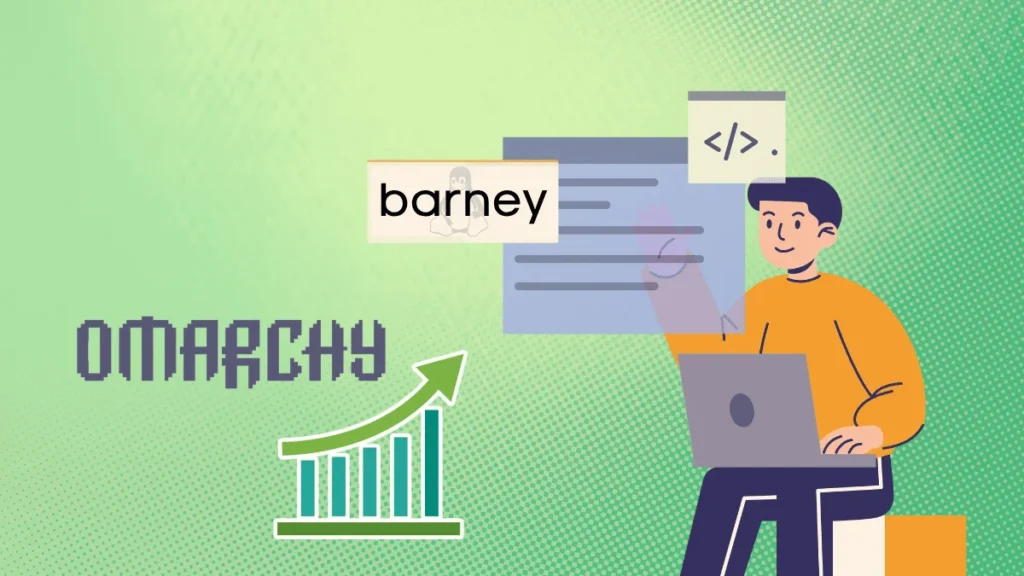
In a landscape where Linux distributions are increasingly becoming the recipients of massive, corporate-backed capital injections, a prominent voice from the open-source community has emerged from retirement to challenge the status quo. Ikey Doherty, the architect behind the Solus project and AerynOS (formerly Serpent OS), has officially returned to the fray. His mission is not to launch a competing product, but to expose the technical and ethical bankruptcy he perceives in the current trend of venture-backed operating systems.
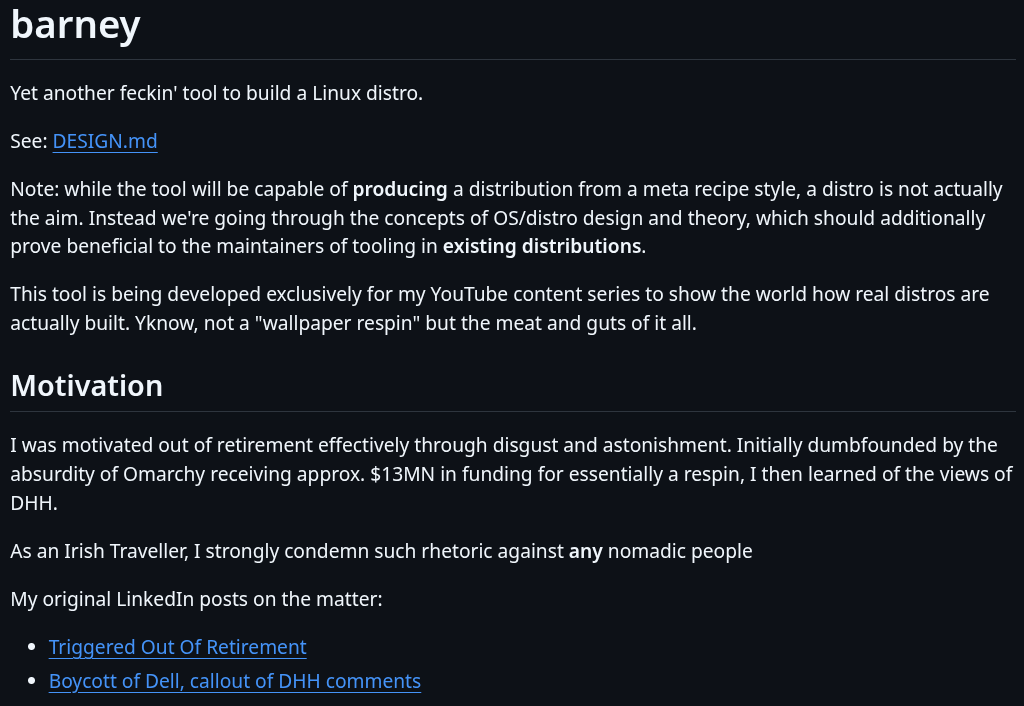
At the center of this firestorm is the Omarchy project and its Omacom Foundation, a venture that has recently secured millions in funding from high-profile tech executives and artificial intelligence firms. Doherty’s response to this influx of capital is "Barney," a minimalist, Rust-based toolset designed to demonstrate how a Linux distribution should be built from the ground up—without the need for an eight-figure bank account.
The Catalyst: A Clash of Ideology and Ethics
The motivation behind Doherty’s return is twofold: technical frustration and moral indignation. The trigger, according to Doherty, was the rhetoric employed by David Heinemeier Hansson (DHH), the creator behind the Omarchy distro project.
DHH recently authored a post drawing controversial parallels between the wolf population in Denmark and the Romani people residing in Copenhagen’s public parks. For Doherty, an Irish Traveller—a group that has historically endured systemic marginalization and discrimination across Europe—these comments were a bridge too far.
Doherty, who had previously been enjoying a quiet retirement from the front lines of Linux development, took to LinkedIn to denounce the comments. He explicitly linked his decision to return to the industry to both the "horrific" nature of the rhetoric and the financial support that prominent figures, including Michael Dell, have provided to the Omarchy initiative. In a scathing critique, Doherty stated, "As an Irish traveller, I strongly condemn his [DHH’s] rhetoric surrounding nomadic people. As a former Linux distro developer, I wouldn’t touch his [expletive] if you paid me."
This moral stance has had immediate, real-world consequences for Doherty’s personal professional habits. He has effectively blacklisted Dell hardware, signaling that the intersection of corporate funding and questionable personal conduct has created a toxic environment for developers who value integrity alongside code quality.
Chronology of the Omacom Foundation’s Rise
The meteoric rise of the Omacom Foundation has been one of the most polarizing stories in the 2026 tech calendar. Since its inception in August, the foundation has managed to aggregate significant financial resources, raising questions about the role of venture capital in the traditionally community-driven Linux ecosystem.
- August 2026: The Omacom Foundation launches, immediately securing $13 million in pledges. The funding round includes $1 million contributions from eight high-profile tech executives, including Michael Dell.
- Early September 2026: Internal friction surfaces at 1Password after the company pledges $300,000 to the foundation. Employees express significant pushback, citing the political and social controversies surrounding the project’s leadership.
- September 6, 2026: The Omacom Foundation announces a further injection of $1.95 million, this time in the form of AI tokens provided by industry titans Meta, Anthropic, OpenAI, and Fireworks.
- September 7, 2026: Ikey Doherty releases a video announcing his return and the development of "Barney," positioning the project as a direct technical and ideological counterweight to the "wallpaper-respin" nature of well-funded distros.
Technical Architecture: The Barney Approach
Unlike the Omarchy project, which Doherty dismisses as a "wallpaper-respin"—a derogatory term for a distribution that simply rebrands existing software without contributing fundamental innovation—Barney is designed to be a transparent educational tool.
Barney is written entirely in Rust and released under the permissive MPL-2.0 license. Its purpose is to demystify the creation of a Linux distribution by forcing a "from-source" build process. The architecture is built on several key principles:
Stateless Layouts and Content-Addressed Storage
Doherty brings years of experience from his tenure at Intel’s Clear Linux team to the Barney project. The build system operates on the principle of statelessness, ensuring that the environment remains predictable and reproducible. Furthermore, the tool uses content-addressed storage; identical files across various software packages are stored only once, drastically reducing redundancy.
Dependency-Aware Rebuilding
A cornerstone of the Barney build process is its sophisticated caching mechanism. Every build artifact is cached against the specific inputs that produced it. If a single dependency is modified, Barney automatically identifies and triggers a rebuild of every component that sits atop that dependency. This creates a rigorous, reliable, and entirely transparent build chain.
Toolchain Sovereignty
Perhaps the most ambitious aspect of the Barney project is its commitment to rebuilding the entire toolchain from scratch. By eschewing pre-built binaries, Doherty aims to prove that the "black box" approach of modern, well-funded distributions is unnecessary, provided one has the expertise to manage a truly native build environment.

Official Responses and Industry Reception
The response to Doherty’s return has been largely supportive among the open-source purist community, who view the professionalization and corporate colonization of Linux as a threat to its foundational ethos. However, the Omacom Foundation has remained largely silent regarding the specific criticisms leveled by Doherty, focusing instead on its mission to integrate AI-driven development workflows into the Linux stack.
The controversy surrounding 1Password’s contribution serves as a microcosm of the broader tension. When a company pledges funds to a foundation led by a polarizing figure, the internal friction that follows highlights the shifting expectations of employees in the modern tech sector. They are no longer willing to separate their corporate contributions from their personal ethics, a sentiment that Doherty is currently leveraging to build momentum for his own project.
Implications for the Linux Ecosystem
The emergence of Barney and the parallel development of projects like Auke Kok’s "The Ur Project" suggest a growing schism in the Linux world. On one side, there is a movement toward massive, corporate-funded entities that seek to leverage AI and venture capital to streamline the user experience. On the other, there is a resurgence of "build-from-source" practitioners who believe that the soul of Linux lies in the transparency and technical rigor of its creation.
The Myth of Capital-Intensive Development
Doherty’s central thesis is that the massive amounts of money flowing into projects like Omarchy are fundamentally unnecessary for building a functional, high-performance operating system. By showing the world exactly how a distro is constructed—using nothing but expertise and a robust toolset—Doherty is attempting to deflate the perceived value of corporate-sponsored Linux projects.
The Risk of Burnout
Critics of Doherty’s approach point to his history of moving on from projects. Solus and AerynOS continue to operate, but they have functioned without his direct involvement for long periods. The question remains: is Barney a sustainable project, or is it a flash-in-the-pan protest movement? Doherty has anticipated this by setting up a Ko-fi page, allowing for direct, decentralized community support that bypasses corporate foundations entirely.
The Potential for Collaboration
There is a faint, optimistic hope among industry observers that the current environment might lead to an alliance between those who have left the "corporate" side of Linux development. If developers like Ikey Doherty and Auke Kok were to combine their efforts, they could provide a viable, high-quality alternative to the "wallpaper-respin" culture, demonstrating that a small team of skilled engineers can outpace a foundation with millions in the bank.
Conclusion: A Philosophical Turning Point
The story of Barney is, at its core, a debate about what Linux is meant to be. Is it a product to be sold, funded, and branded by tech executives? Or is it a craft, defined by the integrity of its code and the transparency of its assembly?
By naming his project after his son, Doherty has signaled that Barney is a personal labor of love—the antithesis of the cold, venture-backed machinery of the Omacom Foundation. Whether or not Barney gains mass adoption is secondary to its intended purpose: to hold a mirror up to the industry and ask, "Is this truly the best way forward, or have we simply forgotten how to build for ourselves?"
As the Linux ecosystem watches, the battle between the "Big Foundation" model and the "Lone Architect" model is set to define the next era of open-source development. For now, Ikey Doherty has planted his flag, and the industry is paying close attention.