Ubuntu’s Defensive Pivot: Canonical Overhauls Kernel Release Strategy to Combat AI-Driven Vulnerabilities


In an era where cybersecurity is increasingly defined by the speed of automated threats, Canonical has announced a radical restructuring of its kernel update strategy. Recognizing that the traditional, bifurcated approach to Stable Release Updates (SRUs) is no longer sufficient to mitigate modern security risks, the company is shifting to a streamlined, high-velocity release cadence. This transition represents one of the most significant changes to the Ubuntu ecosystem in recent years, prioritizing agility in the face of an AI-augmented threat landscape.
The Evolution of the SRU Model: Why Change Now?
For years, Canonical maintained a split kernel SRU cycle. Under this previous paradigm, standard system improvements, bug fixes, and security patches were funneled into separate release tracks. A full update typically rolled out on a four-week schedule, with a dedicated security-focused release occurring at the two-week midpoint. This cadence was designed to balance system stability with the urgent necessity of deploying Common Vulnerabilities and Exposures (CVE) patches.
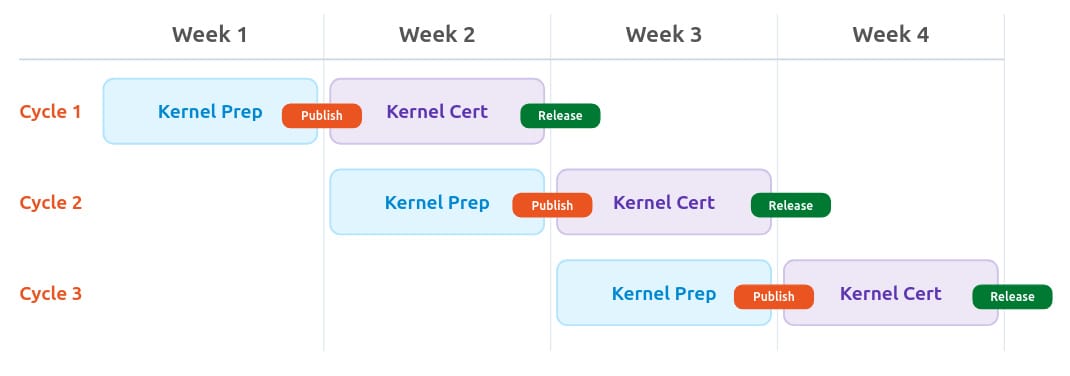
However, the rapid acceleration of AI-powered vulnerability research has rendered this timeline archaic. Canonical’s new strategy consolidates these disparate tracks into a single, cohesive two-week cycle. Because the company is initiating a new cycle every seven days, the net result is that a refined, security-hardened kernel release will now land every single week.
The Mechanics of the New 2-Week Cycle
To understand the shift, it is essential to analyze the granular workflow Canonical has implemented. The process is divided into two distinct phases, overlapping to ensure a continuous delivery stream.
Phase One: Integration and Preparation
The first week of every cycle is dedicated to intensive patch integration. During this period, the Ubuntu kernel engineering team evaluates the current state of upstream kernel development and internal security reports. The team carefully selects the most critical fixes—ranging from minor performance regressions to high-severity security exploits—and integrates them into the kernel build.

Following integration, the build undergoes a series of internal "smoke tests." These automated tests are designed to catch glaring regressions or build failures before the package is promoted. Once these tests pass, the kernel release candidate is pushed to the -proposed pocket of the Ubuntu package archive. This serves as a vital staging ground where stakeholders and early adopters can evaluate the new kernel before it undergoes full certification.
Phase Two: Certification and Quality Assurance
The second week is defined by the Ubuntu Certified hardware testing program. Recognizing that Linux runs on a staggering diversity of hardware—from low-power IoT devices to massive server clusters—Canonical subjects the candidate builds to rigorous, multi-machine testing. This phase ensures that the kernel does not introduce stability issues in real-world, production environments.
By staggering these cycles—starting a new one every week regardless of the current progress—Canonical ensures a "rolling" pipeline. There is always a kernel in the testing phase and always a kernel ready for deployment.
The Catalyst: AI, LLMs, and the Automated Threat Landscape
The impetus for this overhaul was not merely a pursuit of operational efficiency, but a direct response to the "clanker" phenomenon. Recent months have highlighted the alarming rise of AI agents—often referred to in technical circles as "clankers"—that are capable of autonomously scanning open-source repositories for vulnerabilities.
These AI-driven tools are not limited by human fatigue or time zones. They are capable of scraping platforms like git.kernel.org at a scale and speed that makes manual patch development feel like an uphill battle. By automating vulnerability hunting, these entities have drastically shortened the "window of exposure"—the time between a security vulnerability becoming known to researchers and it being exploited by malicious actors.

Canonical’s decision to adopt a weekly release cadence is a strategic defensive maneuver. Their stated goal is to ensure that, in the event of a high-profile CVE, a mitigation or a workaround can be published within 24 to 48 hours. By reducing the time-to-patch, Canonical is effectively raising the cost for attackers, ensuring that even if an AI identifies a flaw, the window for exploitation is closed before the threat can be weaponized at scale.
Implications for Enterprise and DevOps Teams
For system administrators and DevOps engineers, this shift requires a change in operational philosophy. The reliance on a four-week cycle allowed for predictable, albeit slower, maintenance windows. The new weekly cycle mandates a more robust automated testing pipeline.
The Role of the -proposed Pocket
For organizations that cannot afford to wait the full two weeks for a certified release, Canonical is increasingly highlighting the -proposed archive as a "fast path." The strategy here is clear: organizations with high-maturity CI/CD pipelines can pull kernels directly from -proposed and run their own acceptance tests. This allows teams to verify that their specific hardware and software stack remains functional with the latest patches, bypassing the general certification wait-time.
System Hardening and Transparency
Canonical has committed to a policy of radical transparency. If a specific kernel build is deemed unsafe or if it contains a known regression, the company will explicitly signal this. Instead of forced updates, they intend to provide clear guidance and system hardening advice, allowing administrators to decide whether to apply the patch immediately or wait for the subsequent cycle.
A New Benchmark for Linux Security
Canonical’s move sets a new industry benchmark for how Linux distributions should respond to the AI threat. While other distributions may struggle to maintain the engineering velocity required for a weekly kernel cadence, Canonical’s infrastructure—backed by its massive "Ubuntu Certified" program—is uniquely positioned to handle the load.
This transition is not just about shipping code faster; it is about changing the relationship between the maintainer and the user. By providing a faster, more reliable pathway for security updates, Canonical is acknowledging that in the age of AI, security is a fluid, continuous process rather than a static release milestone.
Conclusion: Preparing for the Future of Security
The shift to a weekly kernel cycle is a calculated bet on the future of software maintenance. As AI continues to evolve, the distinction between "vulnerability research" and "automated exploitation" will continue to blur. By compressing their release cycles, Canonical is positioning Ubuntu to remain a secure foundation for everything from personal laptops to hyperscale cloud infrastructure.
For the end-user, the impact will be mostly invisible—a steady stream of updates that keep the system running securely. For the industry at large, however, this represents a significant shift. The days of quarterly or monthly security patching are fading, replaced by a high-velocity environment where the ability to respond to threats at machine speed is no longer a luxury, but a necessity.
As the landscape of open-source security shifts, Canonical’s proactive stance serves as a reminder that stability in the modern era is found in adaptability. Whether this new model will become the standard for other distributions remains to be seen, but one thing is certain: the era of the slow-moving patch cycle is officially at an end.
For those interested in following these developments, Canonical continues to publish updates on their kernel release strategies through their official engineering blog. Organizations are encouraged to review their update policies to align with this new, more frequent release cadence to ensure optimal security posture in their server environments.