Bridging the Visual Divide: How an Inexpensive ESP32-CAM Pendant is Redefining Assistive Technology for the Visually Impaired
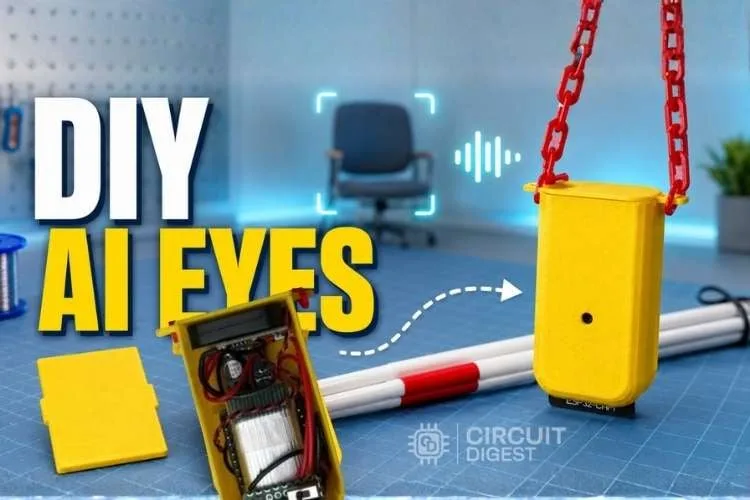
TECHNOLOGY & INNOVATION — For millions of individuals living with visual impairments, navigating the physical world has long relied on centuries-old methodologies. Traditional white canes, while effective at identifying immediate tactile hazards such as curbs, steps, and walls at ground level, suffer from a critical limitation: they are fundamentally blind to the dynamic, multi-dimensional environment unfolding at chest and head height. Low-hanging tree branches, street signs, dynamic crowd movements, and storefront displays remain entirely undetected by proximity-based canes, leaving users vulnerable to unexpected obstacles.
Enter Anand D, an independent developer whose latest open-source creation aims to disrupt the assistive technology market. Anand has engineered a compact, wearable AI vision pendant powered by an ultra-low-cost ESP32-CAM microcontroller. By merging computer vision, cloud-based artificial intelligence, and multilingual text-to-speech (TTS) conversion into a lightweight device that rests comfortably around the neck, this innovation promises to translate the visual world into spoken word—empowering users with rich, real-time contextual awareness of their surroundings at a fraction of the cost of commercial alternatives.
Main Facts: The Anatomy of an AI-Powered Assistive Vision Pendant
At its core, the device functions as an intelligent intermediary between the physical environment and the user’s auditory senses. When the wearer encounters a complex space or wishes to understand what lies ahead, a simple press of a tactile limit switch activates the system.
The operational loop is executed in a matter of seconds:
- Image Capture: The onboard ESP32-CAM module snaps a high-resolution photograph of the immediate environment.
- Cloud-Based Vision Analysis: The image is transmitted via Wi-Fi to the CircuitDigest Cloud, where advanced computer vision algorithms parse the visual data, identifying objects, spatial layouts, and potential hazards. The cloud service returns a detailed textual description packaged in a structured JSON format.
- Speech Synthesis: The descriptive text is then routed to Sarvam AI’s advanced text-to-speech engine (specifically leveraging the Bulbul v3 model), which converts the written words into a natural-sounding audio file encoded in Base64 format.
- Decoding and Audio Playback: The ESP32-CAM downloads the Base64 data stream, decodes it locally, and routes the audio signal through an I2S MAX98357 amplifier connected to a compact speaker.
Crucially, the hardware footprint remains astonishingly lean. Beyond the foundational ESP32-CAM module, the parts list reads like a masterclass in frugal engineering: a MAX98357 audio amplifier, a miniature speaker, an HW-105 5V boost converter to regulate battery output, a limit switch for triggering captures, an operational push button, and a physical toggle switch for power control.
Power management is a vital consideration for any wearable device. The system draws an average of 600 milliamperes (mA)—a significant electrical load driven primarily by the ESP32-CAM’s power spikes during Wi-Fi transmission routines and subsequent audio playback. The HW-105 boost converter ensures a stable, reliable 5V supply from an integrated portable battery pack, keeping the device operational throughout daily use.
Furthermore, the pendant addresses global accessibility by integrating multilingual support. Users can cycle through response languages—including English, Hindi, Tamil, and Malayalam—via an integrated tactile button. By prioritizing linguistic adaptability, the device molds itself to the user’s cultural and geographic context rather than forcing the user to adapt to rigid linguistic defaults.
Chronology: The Engineering Evolution of the Vision Pendant
The development of the ESP32-CAM vision pendant followed an iterative, methodical engineering trajectory typical of modern open-source hardware projects.
Phase One: Concept and Limitations of Legacy Hardware
The project originated from a recognized gap in assistive technology. Traditional electronic travel aids (ETAs) relying on ultrasonic or infrared proximity sensors frequently generate sensory overload through constant beeping, without providing semantic context. Anand recognized that what users truly needed was not just a distance warning, but semantic understanding: "Is there a chair I can sit on?" or "What kind of storefront is to my left?"
Phase Two: Hardware Selection and Prototyping
The decision to center the design on the ESP32-CAM was dictated by a balance of processing power, integrated camera capabilities, and cost. While traditional single-board computers like the Raspberry Pi offer immense processing capacity, they are power-hungry, bulky, and expensive—making them impractical for a lightweight, all-day wearable pendant. The ESP32-CAM offered an ideal compromise: an integrated OV2640 camera sensor coupled with an Xtensa dual-core microcontroller and native Wi-Fi capabilities, all packed into a thumbnail-sized module.
Phase Three: Firmware Integration and API Pipelines
Writing the firmware required stitching together diverse software libraries to bridge hardware-level input/output with high-level cloud APIs. The developer utilized standard Arduino-compatible libraries, including esp_camera.h for image acquisition, WiFi.h for network connectivity, HTTPClient.h for RESTful API communication, driver/i2s.h for digital audio streaming, and mbedtls/base64.h for decoding incoming audio payloads. Parsing the incoming metadata required the integration of the ArduinoJson library.
Phase Four: Testing and Deployment Optimization
Initial tests revealed bottlenecks in audio generation pipelines, particularly regarding character limits imposed by TTS engines. Through trial and error, the developer optimized the audio sampling frequency to 16,000 Hz and set the AUDIO_GAIN_FACTOR to 2.5f, ensuring that audio output remained crisp and adequately amplified even in noisy outdoor environments. The project was subsequently documented and published as an open-source repository on CircuitDigest, inviting global contributions and replication.
Supporting Data: Technical Specifications and Performance Metrics
To fully appreciate the technical achievement of Anand D’s pendant, one must examine the underlying performance metrics and software constraints that govern its operation.
Component Specification Breakdown
- Microcontroller & Camera: ESP32-CAM (incorporating an ESP32-S microcontroller and OV2640 camera sensor).
- Audio Amplification: MAX98357 I2S digital amplifier IC.
- Power Regulation: HW-105 5V step-up (boost) converter.
- Average Power Consumption: ~600 mA (peaking during Wi-Fi upload/download and audio rendering).
- Audio Parameters: 16,000 Hz sampling rate; gain factor scaled to 2.5f for optimal auditory clarity.
Comparative Analysis of TTS API Constraints
Handling cloud-based text-to-speech conversion requires strict adherence to API payload limits. The choice of TTS engine heavily dictates the depth and verbosity of the scene description returned to the user:
| TTS Provider / Model | Maximum Character Limit per Request | Impact on Descriptive Detail |
|---|---|---|
| Wit.ai | 280 characters | Severely restrictive; limits descriptions to brief, fragmented sentences. |
| Sarvam AI (Bulbul v3) | 2,500 characters | Generous capacity; allows rich, highly detailed spatial and contextual breakdowns. |
| Google TTS | 5,000 characters | Maximum narrative depth, though prone to higher network latency. |
As highlighted by the data, Sarvam AI’s Bulbul v3 model strikes an optimal balance. With a 2,500-character ceiling, it comfortably accommodates the comprehensive JSON descriptions generated by the CircuitDigest Cloud vision analysis without running the risk of truncation, while maintaining low operational latency crucial for real-time navigation.
Official Responses and Developer Insights
While commercial manufacturers of assistive technologies have historically favored proprietary, high-margin ecosystems, the open-source community has responded to Anand D’s project with immense enthusiasm.
In technical breakdowns accompanying the release, the developer emphasized that the core philosophy of the project is democratization: "Assistive technology should not be a luxury item reserved for the wealthy. By leveraging ubiquitous microcontroller architectures and cloud intelligence, we can build tools that restore independence without imposing financial hardship."
Accessibility advocates have similarly praised the project’s hardware transparency. Because all schematics, source code, and assembly guides are publicly accessible via the CircuitDigest repository, visually impaired makers, engineering students, and local community tinkerers can fabricate, repair, or modify the pendant independently.
Furthermore, hardware enthusiasts have begun exploring future iterations. For developers seeking to modernize the underlying hardware stack, community discussions have pointed toward the emerging ESP32-C6-Zero development kit. Offering native Wi-Fi 6 support and an even more compact form factor, the C6-Zero hints at a future where wearable assistive nodes consume even less power while offering faster, more reliable cloud synchronization—though transitioning to such boards requires integrating external camera modules.
Implications: The Future of Frugal Assistive AI
The implications of the ESP32-CAM vision pendant extend far beyond a single DIY electronics project; they point toward a broader paradigm shift in how assistive technology is conceptualized, funded, and deployed globally.
1. Breaking Economic Barriers in Assistive Tech
Commercial electronic travel aids and AI-driven smart glasses frequently retail for thousands of dollars, placing them out of reach for disabled individuals in developing economies or low-income households. By utilizing off-the-shelf components whose total material cost amounts to a fraction of commercial devices, this project proves that advanced computer vision can be made universally accessible.
2. The Rise of "Edge-Cloud" Hybrid Architectures
The pendant exemplifies the power of hybrid edge-cloud computing. While microcontrollers lack the raw neural processing power required to run heavy computer vision models locally, offloading the heavy lifting to the cloud via Wi-Fi allows a tiny, low-cost wearable device to punch far above its weight class. As cellular IoT integration and low-power Wi-Fi standards continue to evolve, the latency of these round-trips will shrink even further.
3. Localization and Cultural Inclusion
The inclusion of multilingual support—spanning major Indian regional languages like Tamil, Malayalam, and Hindi alongside English—highlights a historically neglected dimension of technology design: linguistic equity. Too often, assistive AI is developed strictly through an English-centric lens. By integrating regional TTS pipelines, projects like Anand D’s pave the way for hyper-localized assistive tools that honor the linguistic diversity of their users.
Conclusion
Anand D’s ESP32-CAM vision pendant is more than an exercise in microcontroller programming; it is a testament to the liberating potential of open-source innovation. By transforming raw pixels into spoken narratives, the device offers its wearers a renewed sense of confidence, autonomy, and engagement with the world around them. As developers continue to refine its firmware, optimize its power draw, and expand its linguistic capabilities, this humble pendant may well serve as the blueprint for the next generation of accessible, human-centric assistive technology.