Beyond the Algorithm: Why Machine Learning Systems Engineering is AI’s Missing Link
By Jason Jabbour, Kai Kleinbard, and Vijay Janapa Reddi (Harvard University)
Main Facts: The Great Disconnect in Modern Artificial Intelligence
In the fast-paced world of artificial intelligence, a pervasive industry mantra continues to dictate career paths and academic focus: "Everyone wants to do the modeling work, but no one wants to do the engineering."
This catchy aphorism highlights a glaring imbalance in the modern machine learning (ML) landscape. While thousands of data scientists and researchers flock to design complex neural network architectures, fine-tune generative models, and chase state-of-the-art benchmarks, a critical bottleneck looms over the industry. The infrastructure required to make these models run efficiently, reliably, and at scale is dangerously neglected.

Machine learning and systems engineering are inextricably linked. Models—particularly contemporary large language models (LLMs) and resource-heavy generative AI systems—are computationally demanding. They consume vast amounts of memory, energy, and hardware resources. Yet, educational curriculums and professional development tracks have historically over-indexed on model theory while under-delivering on infrastructure.
To help bridge this divide, academic initiatives like MLSysBook.ai—born out of Harvard University’s pioneering coursework—are stepping in to codify the principles of ML systems engineering. By mapping these foundational hardware-software co-design concepts to established frameworks like the TensorFlow ecosystem, educators and practitioners are attempting to build a comprehensive roadmap for the next generation of AI systems.
Chronology: The Evolution of ML Systems Education
The path toward recognizing ML systems engineering as a distinct and vital discipline has evolved rapidly alongside the hardware revolution:

- The Pre-Deep Learning Era: For decades, machine learning algorithms were computationally light enough to run on standard CPUs. Systems engineering was largely decoupled from algorithmic development, treated as a traditional software engineering or database management concern.
- The Deep Learning Boom (Mid-2010s): The resurgence of neural networks shifted reliance toward specialized hardware, primarily GPUs. Frameworks like TensorFlow and PyTorch emerged to bridge the gap between high-level model creation and low-level hardware execution, though formal education remained heavily focused on mathematical theory rather than infrastructure constraints.
- The Harvard CS249r Milestone (2023): Recognizing a severe industry shortage in embedded and efficient AI skills, Harvard University introduced course CS249r: Tiny Machine Learning (TinyML). Spearheaded by educators and researchers, the course curriculum laid the groundwork for open-source educational materials addressing end-to-end ML systems.
- The Birth of MLSysBook.ai: The materials from Harvard’s courses expanded beyond the traditional classroom into a collaborative, open-source digital textbook—MLSysBook.ai. Designed to be a living resource, the platform addresses the entire machine learning lifecycle, from data ingestion to deployment, hardware quantization, and continuous monitoring.
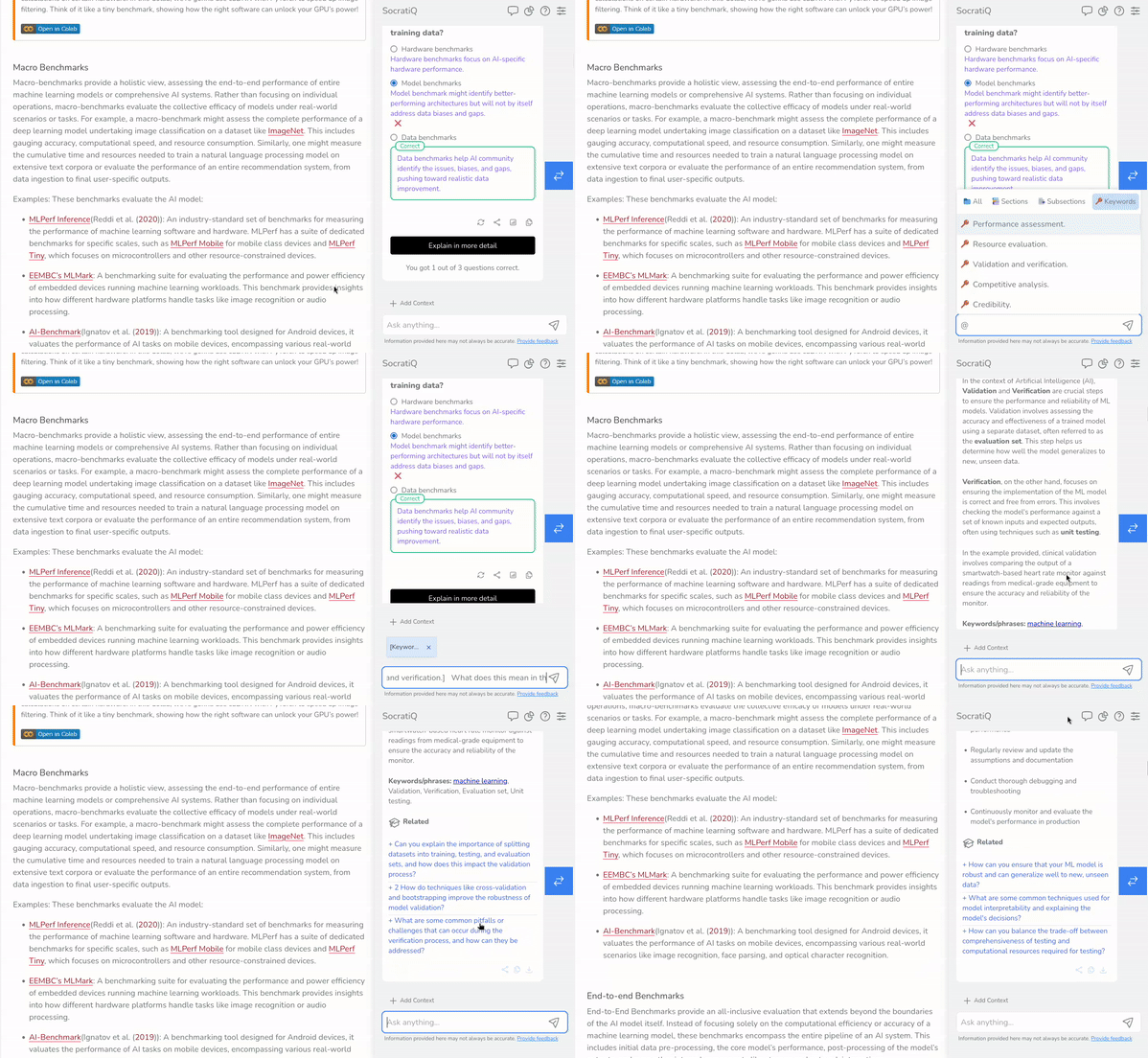
- Integration of AI-Powered Pedagogical Tools (Present): To combat passive reading habits, the creators integrated SocratiQ, a Large Language Model (LLM)-powered generative learning assistant, transforming the static textbook into an interactive, real-time educational environment. Furthermore, AI-generated audio summaries, such as custom podcasts built via Google’s NotebookLM, have expanded accessibility for modern learners.
Supporting Data and Conceptual Frameworks: The Rocket Science of AI
To understand the gravity of the ML systems problem, one must examine the operational pipeline of an artificial intelligence solution. The creators of MLSysBook.ai utilize a powerful analogy: If ML developers are like astronauts exploring new frontiers, ML systems engineers are the rocket scientists designing and building the engines that take them there. Without precision engineering, even the most brilliant algorithmic astronaut remains permanently earthbound.
+-----------------------------------------------------------------+
                       THE ML SYSTEMS LIFECYCLE
+-----------------------------------------------------------------+
  1. Data Engineering    --> Raw data preparation & organization
  2. Model Development   --> Crafting and refining neural networks
  3. System Optimization --> Hardware tuning, quantization, & scaling
  4. Production Deploy   --> Integration into real-world infrastructure
  5. Monitoring & Maint. --> Long-term reliability & adaptation
+-----------------------------------------------------------------+
The End-to-End ML Lifecycle
The core thesis of MLSysBook.ai is that efficiency is required at every stage of the pipeline, regardless of whether the target deployment is a massive cloud-based data center or a tiny embedded microcontroller.
- Data Engineering: Lays the operational groundwork by preparing, cleaning, and organizing raw data streams. Tools like TensorFlow Data streamline this phase, ensuring seamless pipelines that feed models without causing CPU or I/O starvation.
- Model Development: The creative phase where researchers define network architectures and objective functions.
- Optimization: Often the most overlooked phase. Optimization involves techniques like quantization—such as converting 32-bit floating-point numbers (FP32) down to 8-bit integers (INT8) or 16-bit floats (FP16)—to drastically reduce memory footprints and latency without sacrificing predictive accuracy. Whether applied to edge devices (TinyML) or server-grade GPUs, the foundational principles of hardware-software co-design remain identical.
- Production Deployment: Moving code out of Jupyter notebooks and into live environments. This demands robust orchestration, containerization, and compatibility with deployment runtimes like TensorFlow Serving or TensorFlow Lite.
- Monitoring and Maintenance: Ensuring long-term system health. Models degrade over time due to data drift and changing real-world conditions; continuous monitoring closes the feedback loop.
SocratiQ: Reimagining Digital Textbooks
A notable innovation embedded within MLSysBook.ai is SocratiQ, an AI-driven learning assistant. Traditional technical textbooks often suffer from high drop-off rates because static text cannot adapt to a reader’s individual comprehension gaps. SocratiQ addresses this by acting as an unobtrusive, context-aware tutor.

Powered by an LLM backend, SocratiQ enables readers to:
- Engage in real-time conversational queries directly related to the chapter text.
- Take dynamically generated interactive quizzes that test comprehension of complex infrastructure concepts.
- View personalized performance dashboards that track conceptual mastery over time.
By stepping in to offer explanations or assessments and then receding back into the background, SocratiQ preserves the natural reading flow while transforming passive consumption into active, co-created education.
Official Responses and Open-Source Advocacy
The development of MLSysBook.ai has garnered strong support from both academic institutions and industry leaders. Crucial to its public release has been community feedback—including strategic guidance from Google engineers like Josh Gordon, who helped align the book’s theoretical foundations with practical tools used by mainstream practitioners.

To sustain and expand this educational resource, the project relies on a unique crowdsourced funding model tied to its GitHub repository (harvard-edge/cs249r_book). Backed by corporate and philanthropic sponsors, the project leverages public engagement metrics for social good:
- Every Star Counts: Every "star" awarded to the MLSysBook.ai GitHub repository directly translates into corporate-sponsored financial contributions.
- Global Impact: These donations fund research scholarships and educational grants for students and underrepresented minorities worldwide, empowering a diverse new demographic to drive innovation in machine learning systems research.
Project organizers emphasize that community validation via open-source engagement is vital to keeping the textbook up-to-date in an industry that evolves on a weekly basis.
Implications: The Future of AI Careers and Infrastructure
The growing emphasis on ML systems engineering carries profound implications for the technology sector, educational institutions, and individual practitioners:

1. A Shift in Industry Demand
For years, the job market has been flooded with entry-level data scientists fluent in high-level Python libraries but entirely unversed in memory management, latency constraints, or hardware architectures. As companies face the sobering financial realities of running generative AI at scale, the market correction is well underway. Organizations are actively seeking "Full-Stack ML Engineers"—professionals who understand both the gradient descent mathematics of a model and the cluster orchestration required to deploy it cost-effectively.
2. Sustainability and Green AI
With massive language models requiring power grids comparable to small cities, inefficient model engineering is no longer just a financial liability—it is an environmental crisis. Systems-level thinking, such as aggressive quantization, sparse model execution, and hardware-aware pruning, directly reduces the carbon footprint of artificial intelligence. Training models without system constraints is becoming professionally and environmentally unacceptable.
3. Democratization via Edge Computing
By proving that tiny embedded devices and massive cloud servers share the same foundational systems principles, resources like MLSysBook.ai democratize AI development. Engineers working in resource-constrained environments—such as agricultural IoT sensors, medical wearables, or low-power robotics—can leverage the exact same systems methodologies used by hyperscale cloud providers.

Conclusion
The era of treating machine learning models as isolated mathematical artifacts is coming to an end. As artificial intelligence embeds itself deeper into critical infrastructure, the demand for professionals capable of bridging the chasm between algorithms and systems implementation will only accelerate.
Investing time in learning ML systems engineering is no longer an optional niche skill; it is a fundamental career requirement for anyone looking to build AI solutions that actually survive contact with the real world. As the authors of MLSysBook.ai remind us: Even the most brilliant astronauts need skilled engineers to build their rockets.