The Silicon Detective: Deciphering the Mystery of the 1985 "F1-10-5" Integrated Circuit
In the fast-paced world of modern electronics, components are typically documented with exhaustive datasheets, extensive online repositories, and digital footprints that span the globe. However, for those who spend their time salvaging the ghosts of computing history, mystery components are a common, albeit frustrating, hurdle. Recently, a particularly enigmatic integrated circuit (IC) crossed the workbench of legendary hardware sleuth Ken Shirriff, courtesy of fellow electronics historian "CuriousMarc."
What followed was a masterclass in reverse engineering, transforming a nameless, cryptic ceramic chip into a revelation of 1980s analog signal processing. This investigation not only solved the mystery of the "F1-10-5" but also highlighted the ingenious, albeit fading, technology of switched-capacitor filters.
Main Facts: A Mystery in a Ceramic Shell
The object in question was a standard Ceramic Dual In-Line Package (CDIP), an industry-standard format for high-reliability components in the 1980s. When CuriousMarc discovered the chip in a miscellaneous box of vintage components, it presented very little to the naked eye. The markings were sparse: a date code indicating the 47th week of 1985 and a cryptic alphanumeric string—F1-10-5—accompanied by a manufacturer logo that did not appear in any standard commercial IC databases.
Without a datasheet or a clear manufacturer identity, the chip was essentially a "black box." The primary objective for Shirriff was to identify the internal architecture of the device. By performing a surgical de-capping of the ceramic package—a delicate process involving precision tools to avoid damaging the silicon die—Shirriff was able to expose the heart of the device to high-magnification microscopy.
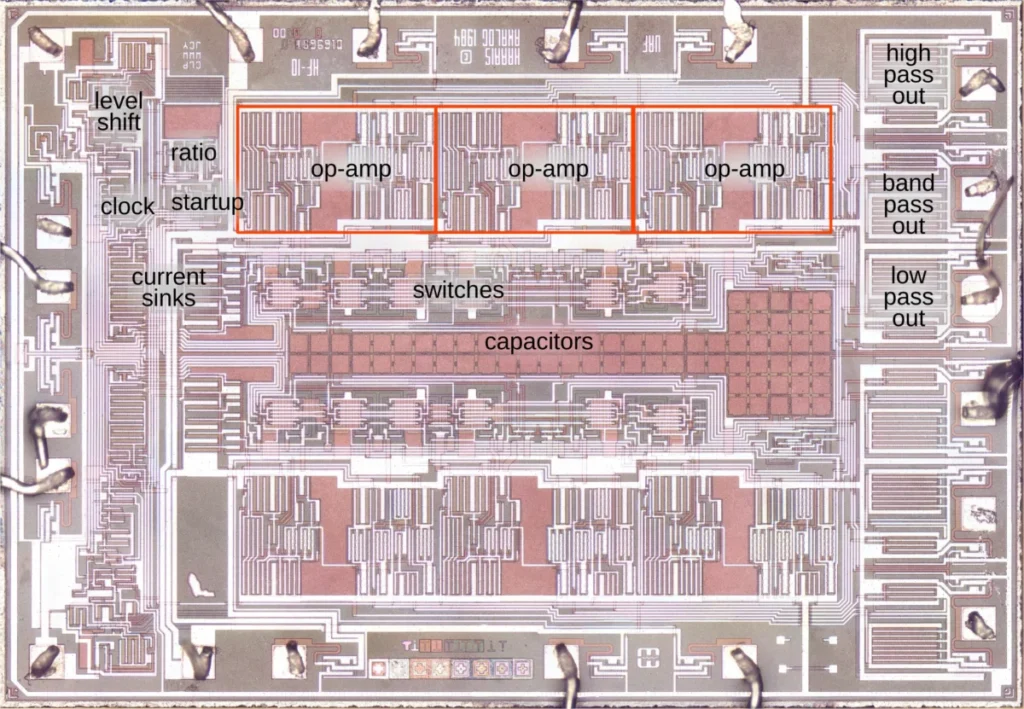
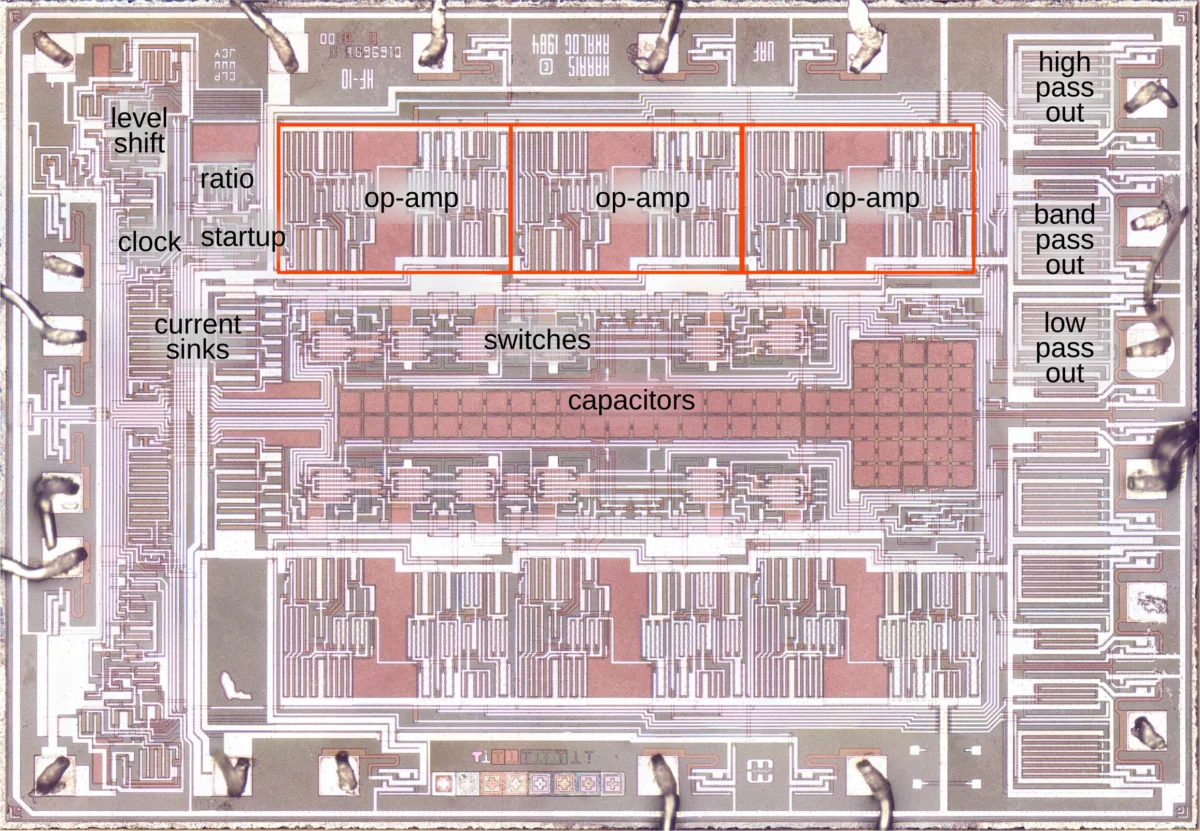
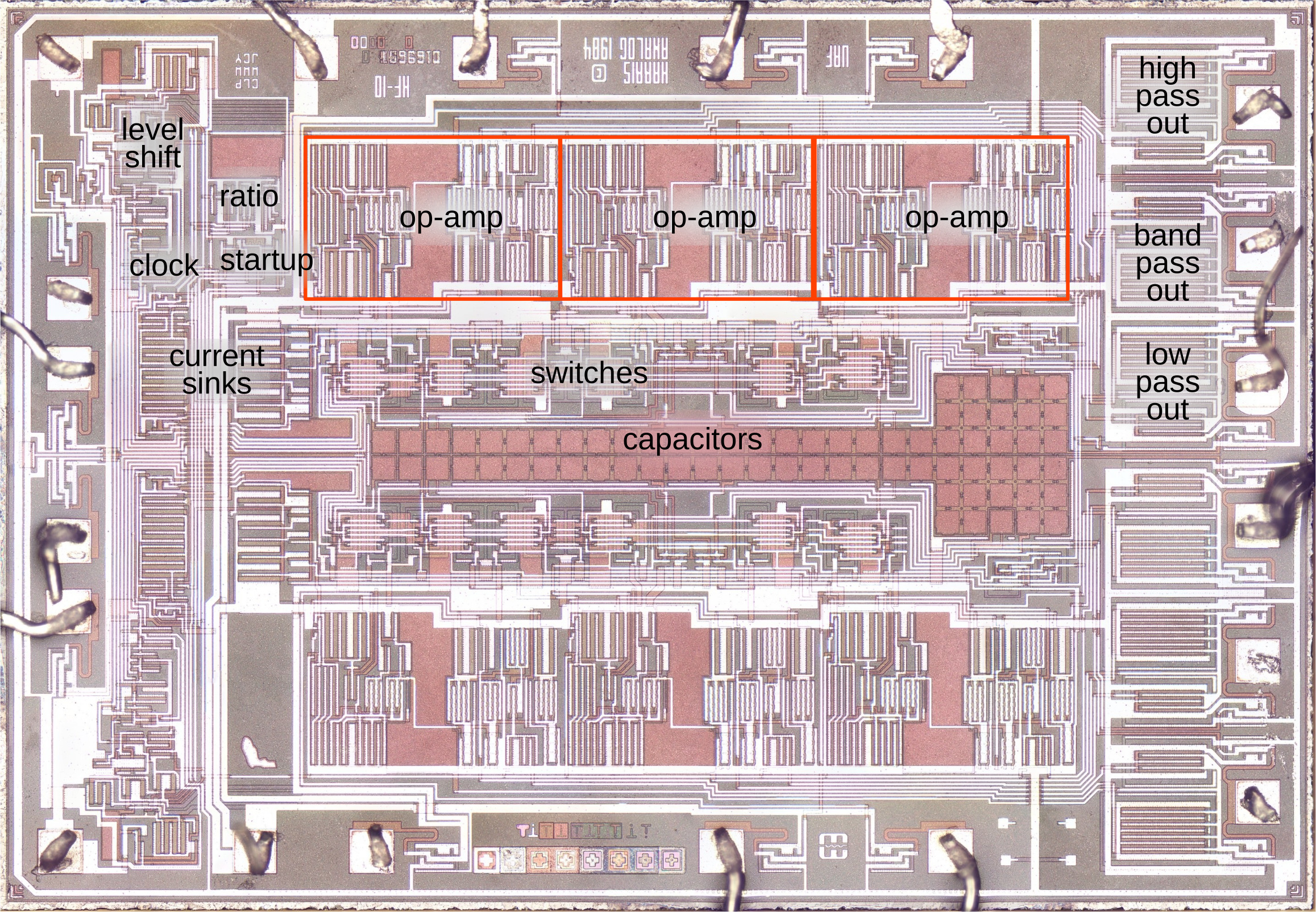
Upon visual inspection of the die, the mystery evaporated. The layout, topography, and specific feature sets were unmistakable. The device was identified as a variant of the legendary National Semiconductor MF10—a dual switched-capacitor filter—manufactured by Harris Semiconductor. This discovery provided a window into the state of analog circuit design in the mid-80s, revealing a piece of silicon that once stood at the forefront of signal conditioning technology.
Chronology: From Salvage to Silicon Forensics
The journey of the F1-10-5 began in the mid-1980s, a golden age for analog-to-digital transitions in audio and telecommunications. Harris, a major player in the semiconductor market at the time, produced this chip as a high-performance alternative to the industry-standard MF10 developed by National Semiconductor.
The Discovery Phase
Fast forward nearly 40 years: CuriousMarc, an avid collector of vintage computing and laboratory equipment, stumbled upon the chip. Recognizing that it defied easy identification, he handed it to Ken Shirriff, a renowned expert in hardware reverse engineering whose blog, Righto, is a repository for the deep-dives into the silicon guts of classic technology.
The Decapping Process
In October 2026, Shirriff began the investigation. The CDIP package was carefully breached, revealing the silicon die. Under the microscope, the arrangement of the transistors and the distinct switched-capacitor arrays confirmed its identity. The "F1-10-5" marking was a shorthand for the Harris HF10, an improved or custom-sourced variant of the ubiquitous MF10.
Analytical Validation
Once the die was identified as a switched-capacitor filter, Shirriff cross-referenced the physical layout with known schematics of the MF10 architecture. The correlation was near-perfect, allowing for a reconstruction of how the chip functioned, even without a factory-provided manual.
Supporting Data: The Mechanics of Switched-Capacitor Filters
To understand why this chip was a "holy grail" of 1980s signal processing, one must understand the problem it solved. In traditional analog electronics, filters (which allow specific frequency ranges to pass while blocking others) require resistors and capacitors. However, resistors are difficult to integrate onto silicon chips because they consume significant surface area and their resistance values can drift due to manufacturing inconsistencies.
The Genius of the Switched Capacitor
The MF10 (and by extension, the Harris HF10) bypasses the need for large, physical resistors entirely. Instead, it uses a clever technique known as "switched capacitors."
- The Principle: By rapidly switching a capacitor between two nodes at a specific clock frequency, the capacitor effectively acts as a resistor.
- Tunability: The "resistance" value is determined by the capacitance of the capacitor and the frequency of the switching clock. By simply changing the external clock frequency, an engineer could change the filter’s characteristics—the cutoff frequency or the bandwidth—without ever picking up a soldering iron to change a physical resistor.
- Versatility: These chips could be configured as low-pass, high-pass, band-pass, or notch filters. This made them indispensable in the burgeoning world of digital synthesizers, modems, and telecommunications equipment, where precise control over audio frequencies was paramount.
The die photography revealed that the chip contained two independent filter stages, allowing for complex signal conditioning on a single piece of silicon. This was a massive space-saver for engineers in 1985, who were constantly battling the limitations of printed circuit board (PCB) real estate.
Official Responses and Industry Context
The legacy of the MF10/HF10 remains significant, though its commercial footprint has shrunk to almost nothing. While Texas Instruments (TI) continues to produce a modern version of the MF10-N, the industry has largely pivoted to Digital Signal Processing (DSP).
In modern applications, filtering is almost exclusively handled by software algorithms running on high-speed processors or FPGAs. These digital filters offer infinite precision, perfect repeatability, and the ability to update behavior via firmware updates—advantages that analog switched-capacitor chips cannot match.
However, industry experts and retro-computing enthusiasts alike note that the MF10-N is becoming increasingly scarce. TI’s current product offerings for the MF10 are limited to PDIP (Plastic Dual In-Line Package) and SOIC (Small Outline Integrated Circuit) formats. The rugged, hermetically sealed CDIP format, which was once the standard for aerospace and industrial environments, is now effectively obsolete.
"The MF10 might not be long for this world," Shirriff noted in his analysis. As supply chains move toward newer technologies, the specific silicon architecture of the 1980s is being phased out, turning these chips from "functional components" into "collector’s items."
Implications: Why We Must Study the Past
The investigation into the F1-10-5 is more than just an exercise in idle curiosity; it is a vital practice for the preservation of technological history.
The Knowledge Gap
As companies go bankrupt or shift their product portfolios, the technical documentation—the "DNA"—of our technological past is often lost. When we encounter "mystery chips" like the one found by CuriousMarc, we are essentially looking at lost knowledge. By reverse engineering these components, researchers like Shirriff ensure that the ingenuity of 1980s engineers is documented for future generations.
Lessons in Efficiency
The switched-capacitor filter serves as a reminder that before we had the luxury of massive processing power, we had pure mathematical elegance. The ability to simulate a resistor using a switch and a capacitor remains a profound example of "doing more with less." In an era where modern AI and software are increasingly abstract and power-hungry, the cleverness of these analog circuits provides a sobering and inspiring lesson in resourcefulness.
The Future of Preservation
The transition from analog to digital is complete, but the hardware that bridged that gap is now reaching the end of its life cycle. As these components fail or are lost, the ability to repair vintage synthesizers, industrial controllers, and telecommunications gear from the 1980s will depend entirely on the documentation created by enthusiasts.
The story of the F1-10-5 is, therefore, a success story. It represents the collaborative effort of a community dedicated to understanding the "black boxes" of the past. Through the lens of a microscope and the patience of a reverse engineer, a nameless piece of ceramic and silicon was restored to its rightful place in the history of electronics. It stands as a testament to a time when every gate and every capacitor had to be justified, and where the mastery of physics was the only path to innovation.