The Sound of Silence: VolAnti and the Open-Source Acoustic Revolution Against Invisible Drones
Main Facts
In an era dominated by electronic countermeasures, radio-frequency (RF) triangulation, and complex radar systems, a quiet technological revolution is taking shape in the open-source hardware community. Developed by engineer Agam Rossen, VolAnti is a low-cost, highly specialized acoustic drone detector designed to solve one of modern aerial security’s most intractable problems: the detection of fiber-optic First-Person View (FPV) drones.
Unlike traditional counter-UAV (C-UAV) systems that rely on intercepting radio control frequencies, Wi-Fi handshakes, or video downlink transmissions, VolAnti is entirely passive. It does not transmit signals, nor does it attempt to jam, hack, or physically intercept targets. Instead, it listens. By focusing exclusively on the distinct acoustic signatures generated by high-RPM carbon-fiber or plastic propellers, VolAnti bypasses the camouflage of modern tethered or fiber-optic drones. These modern tactical variants often spool out hair-thin fiber-optic cables to relay high-definition video and control inputs, rendering them completely invisible to RF scanners and traditional electronic warfare receivers because they emit zero electromagnetic radiation.
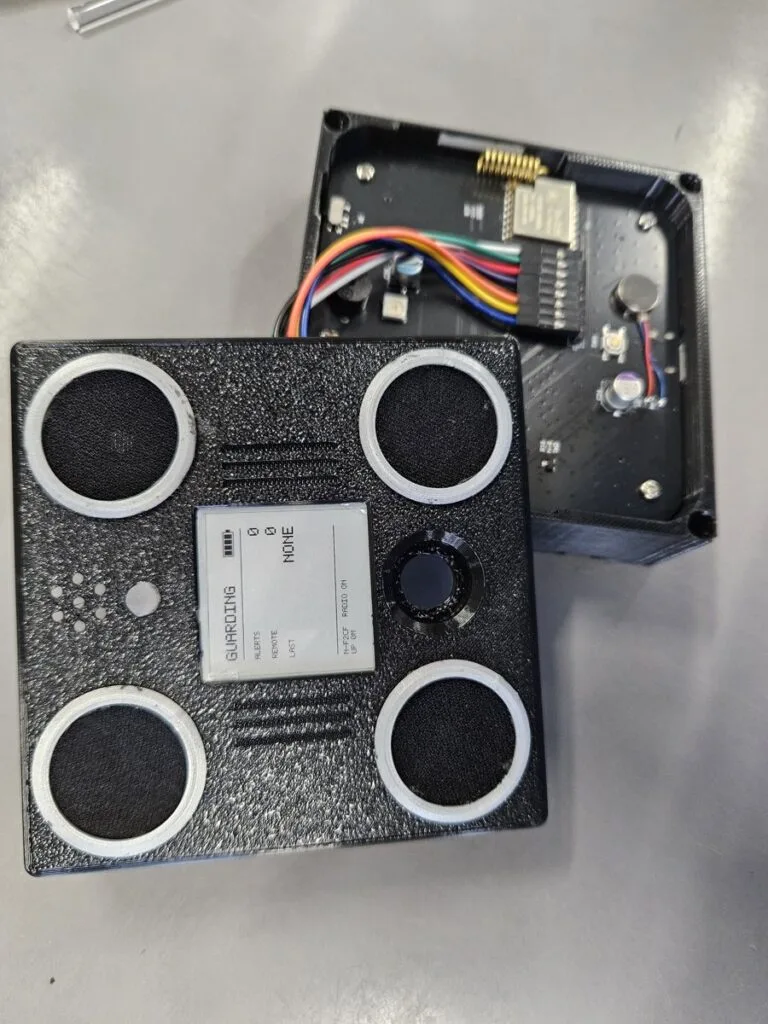
At the core of the VolAnti hardware architecture is an ESP32-S3 microcontroller, a powerful and versatile chip well-suited for edge-computing and digital signal processing (DSP) tasks. Audio acquisition is handled by an array of four ICS-43434 Micro-Electro-Mechanical Systems (MEMS) microphones. These sensors are meticulously arranged in a rigid cross configuration, measuring precisely 79 millimetres from corner to corner, and are synchronized from a single master clock source.
This acoustic array layout is mathematically optimized. At the frequencies generated by drone propellers, a 79-millimetre baseline represents roughly one-tenth of an audio wavelength. Consequently, sound waves arriving from any directional vector naturally sum in-phase, while the inherent thermal and electrical noise of each individual microphone capsule cancels out. This acoustic beamforming effect yields an impressive 6 dB boost in Signal-to-Noise Ratio (SNR) "for free," while maintaining a near-omnidirectional detection response pattern.
Operating entirely independently of proprietary defense contractors, VolAnti is democratizing airspace awareness. Built using off-the-shelf components that cost between £35 and £45 for a breadboard prototype, and up to £80 for a fully enclosed production unit, the project offers an accessible, community-driven alternative to million-dollar military-grade anti-drone hardware.
Chronology of Development and Field Testing
The evolution of VolAnti from a theoretical concept to a field-tested, open-source hardware reality has been marked by rapid iteration, rigorous benchmarking, and transparent public documentation via Agam Rossen’s GitHub repository.
Early Prototyping and Mathematical Foundations
The initial phase of the project focused on solving the fundamental challenge of acoustic filtering: isolating the periodic "harmonic comb" of a drone rotor from complex environmental noise, such as wind, traffic, and human speech. Rossen utilized the ESP32-S3 to compute a 2048-point Fast Fourier Transform (FFT) every 512 audio samples sampled at a 16 kHz rate. This translates to a continuous stream of discrete time windows, capturing a fresh "slice" of acoustic data every 32 milliseconds.
To prevent false alarms caused by transient noises (such as a slamming door or a passing car), the firmware implements a dynamic background noise-subtraction algorithm. The system continuously maintains a running spectral profile of the local acoustic environment. Quiet ambient sounds are learned and filtered out over a baseline window of approximately six seconds, while loud broadband bursts are adapted to and subtracted in under a second.
Summer 2026: Field Trials and Production Readiness
Field testing throughout the late summer of 2026 provided vital empirical data regarding the detector’s real-world operational limits and latency budgets:
- August 21, 2026: Tested in open ground environments under variable wind conditions. The VolAnti prototype successfully detected loaded drone propellers at a distance of 14 meters while registering zero false positives over an entire day of continuous operation.
- August 28, 2026: Benchmarking of the first official production-grade printed circuit board (PCB) revealed exceptional computational efficiency. Over a grueling test sequence of 1,938 consecutive frames, the processor’s worst-case frame processing time was measured at 29.4 milliseconds, comfortably under the strict 32-millisecond real-time budget with zero buffer overruns.
- September 6, 2026: In a milestone field demonstration, "Tier 4" of the multi-tiered detection algorithm successfully triggered an early-warning alarm at a line-of-sight distance of 104.2 meters (114 yards) in calm atmospheric conditions.
Supporting Data and Technical Architecture
The technical elegance of VolAnti lies in its firmware efficiency and hardware integration. Understanding how the device parses auditory data requires a closer look at its mathematical models and power management systems.
The Harmonic Comb and Multi-Tiered Detection
Propellers do not emit random noise; they produce a distinct acoustic signature known mathematically as a harmonic comb. A propeller featuring $B$ blades rotating at $R$ revolutions per second generates acoustic peaks at precise, evenly spaced harmonic frequencies, interspersed with silent spectral valleys.
VolAnti’s firmware scans this frequency landscape across every candidate rotational speed from 70 Hz to 2,000 Hz. For each frequency candidate, the algorithm sums the acoustic energy concentrated on the "teeth" of the harmonic comb, subtracts the energy found in the valleys, normalizes the result, and assigns a confidence score.
To eliminate spurious environmental anomalies, VolAnti requires a candidate rotational speed to sustain a winning score across six consecutive time windows (within a 2% variance margin). Because environmental noise (such as thunder, sirens, or wind gusts) does not exhibit stable rotational harmonics over consecutive temporal frames, this verification step effectively neutralizes false positives.
Four independent detector algorithms run concurrently on the same spectral data stream. The system triggers an immediate alert the moment any single detector achieves verification certainty. Because latency varies slightly across algorithms, the fastest reliable tier dictates the warning time.

Power Management, Form Factor, and Telemetry
Designed for field deployment in remote or austere environments, VolAnti balances high-performance digital signal processing with strict power thriftiness:
- Power Subsystem: The device is powered by a standard single-cell (1S) 2500 mAh Lithium-Polymer (LiPo) battery. Charging is managed by an integrated BQ24074 IC, while a TPS63020 buck-boost regulator ensures stable 3.3V power delivery to the logic board.
- Runtime: On a single charge, the device delivers an estimated 18 to 22 hours of continuous operation.
- Display and HMI: Housed in a compact 91 mm enclosure, VolAnti features an integrated e-paper screen. E-paper technology was chosen for its exceptional power efficiency and high legibility under direct sunlight.
- Communication Mesh: When a drone is detected, VolAnti compresses its alert data into an ultra-compact 18-byte LoRa packet transmitted via a Ra-01H radio module. Operating on regional ISM bands (868 MHz in the UK and European Union, and 915 MHz in the United States), this minimal data footprint allows decentralized nodes to daisy-chain warnings across a perimeter, alerting neighboring VolAnti units to incoming aerial threats instantly.
Environmental Performance Matrix
| Environmental Condition | Expected Detection Range | Operational Notes |
|---|---|---|
| Still Air / Quiet Rural Site | 100 to 200 meters | Optimal conditions; maximum acoustic propagation of propeller blade-tip vortices. |
| Windy / Urban Site | 15 to 50 meters | Ambient low-frequency turbulence masks higher harmonic components. |
| High Wind (> 8 m/s) | Degraded / Unreliable | High air displacement noise overwhelms micro-barometric fluctuations from rotors. |
Official Responses and Open-Source Community Impact
The release of VolAnti has triggered intense discussion across open-source hardware forums, academic engineering departments, and civil defense circles. Traditional defense manufacturers have long prioritized multi-spectral radar and active RF-spoofing arrays, products that carry prohibitive price tags often running into hundreds of thousands of dollars per unit. In contrast, VolAnti’s total reliance on passive acoustic sensing represents a democratization of airspace awareness.
Agam Rossen has emphasized that VolAnti is strictly a detection and warning platform. By deliberately omitting any capability for jamming, spoofing, or kinetic interception, the project avoids the complex regulatory hurdles and legal liabilities associated with active electronic warfare devices, which frequently violate international telecommunications laws.
Independent maker communities, agricultural cooperatives, and school districts have welcomed the development. In interviews circulating within developer forums, civil protection advocates noted that localized drone incursions over critical infrastructure—such as agricultural farms, localized water reservoirs, and private industrial compounds—frequently involve cheap, modified, or fiber-optic FPV platforms that bypass geofencing and commercial electronic fences.
Furthermore, the barrier to entry for replication is remarkably low. As documented in the public repository, assembling a breadboard iteration requires basic soldering skills and can be accomplished in a single evening for under £50. Constructing a fully ruggedized, enclosed field unit requires no specialized industrial machinery, empowering local technicians to build, maintain, and repair their own security infrastructure without relying on foreign or corporate suppliers.
For advanced developers looking to expand upon the baseline design, Rossen’s documentation outlines clear upgrade pathways. Experimenters can pivot to the ESP32-C6-Zero IoT kit to integrate Wi-Fi 6 connectivity, or incorporate a round ESP32-S3 HMI display equipped with a physical rotary touch knob and LVGL graphics libraries to construct an advanced, interactive control station.
Implications for Civilian Security and Modern Warfare
The deployment and proliferation of acoustic-based detectors like VolAnti carry profound implications for both asymmetrical military conflicts and civilian security infrastructure.
The Death of RF Reliance
For over a decade, drone detection has been synonymous with radio-frequency monitoring. Systems tuned to detect 2.4 GHz and 5.8 GHz control links, or proprietary protocols like DJI’s OcuSync, formed the bedrock of counter-UAS security at airports, stadiums, and military forward operating bases. However, the rapid evolution of autonomous flight controllers (such as ArduPilot and Betaflight running pre-programmed Waypoint navigation) alongside the tactical proliferation of fiber-optic spooling FPV drones has rendered RF-dependent sensors dangerously obsolete.
Fiber-optic drones do not broadcast radio waves. Their control commands and high-definition telemetry travel down a microscopic glass filament spooled from the drone itself. Because light inside a fiber-optic cable emits no electromagnetic signature into the surrounding air, electronic receivers remain completely blind. VolAnti proves that acoustic physics offers a permanent workaround to this technological evasion tactic: propellers must displace air to generate lift, and displacing air creates sound waves that cannot be hidden by turning off a transmitter.
Democratization of Perimeter Defense
Historically, perimeter security has been an asymmetric domain where defenders must spend exorbitant sums on military-grade hardware to counter inexpensive commercial technology. A hobbyist drone costing $500 can force the shutdown of a multi-billion-dollar international airport or threaten critical infrastructure.
VolAnti inverts this economic equation. By leveraging cheap, ubiquitous microcontrollers (the ESP32-S3) and consumer-grade MEMS microphones, communities that cannot afford enterprise-grade radar nets can blanket vulnerable perimeters with acoustic sensors for a fraction of the cost. Networking these units via low-power LoRa packets creates a resilient mesh warning grid that operates independently of cellular networks or internet connectivity.
Privacy, Ethics, and Future Horizons
While VolAnti is engineered purely for mechanical rotor detection, the deployment of microphone arrays in public spaces inevitably raises important questions regarding acoustic privacy. However, because the device processes raw audio locally at the edge—converting continuous sound waves into Fast Fourier Transform mathematical spectra and discarding time-domain audio data instantly—it does not record, store, or transmit human speech or ambient conversations.
As the open-source community continues to fork, refine, and adapt the VolAnti codebase, the project stands as a watershed moment in counter-UAS design. It demonstrates that advanced tactical challenges do not always require heavy military expenditures; often, they require ingenuity, a deep understanding of physics, and the collaborative power of the open-source ethos.
For complete schematics, firmware source code, live simulators, and step-by-step assembly guides, consult the official repository hosted at GitHub – Agam Rossen / VolAnti.