AWS Revolutionizes Container Networking with the Launch of Amazon ECS Gateway: A New Era for Microservices Ingress Management
SEATTLE — Managing containerized applications at enterprise scale has long presented infrastructure and platform engineering teams with a familiar, high-friction bottleneck: ingress networking. For every new microservice deployed to Amazon Elastic Container Service (Amazon ECS), operators historically had to provision, wire together, and continuously maintain a sprawling web of Application Load Balancers (ALBs), AWS Certificate Manager (ACM) certificates, AWS WAF web access control lists (web ACLs), and complex security groups.
As organizations scale to hundreds or thousands of containerized workloads, this per-service operational overhead slows deployment velocity, increases configuration drift, and demands substantial maintenance efforts.
To solve this systemic challenge, Amazon Web Services (AWS) has officially announced the launch of Amazon ECS Gateway, a powerful new account-level resource designed to fundamentally streamline ingress networking. By dynamically provisioning and managing the underlying infrastructure on behalf of platform teams—while keeping all resources transparently deployed within the customer’s AWS account—ECS Gateway bridges the gap between infrastructure efficiency and developer agility.
Main Facts: What is Amazon ECS Gateway?
Amazon ECS Gateway introduces a centralized, automated approach to handling container ingress on AWS. Operating as a flexible bridge between platform architectures and application services, the new capability handles host-based routing using ALBs.
Crucially, ECS Gateway optimizes infrastructure economics by allowing up to 25 distinct microservices to share a single Application Load Balancer. Amazon ECS automates the complete lifecycle of the underlying networking components:

- It provisions the initial ALB the moment the first service connects.
- It scales out by adding additional ALBs automatically as capacity limits are reached.
- It scales in, safely removing ALBs when workloads are decommissioned or reallocated.
Upon successful provisioning, each connected service receives a unique, ready-to-use DNS hostname and an active route endpoint, eliminating manual DNS wiring and SSL/TLS configuration tasks.
Furthermore, ECS Gateway supports a robust many-to-many topology. A single gateway can be associated with up to 10,000 ECS clusters, while an individual cluster can support up to five distinct gateway associations. This architectural flexibility enables platform teams to separate public-facing internet traffic from internal VPC traffic effortlessly, or partition routing environments across multi-tenant architectures.
Chronology and Evolution: The Journey to Simplified Ingress
The release of Amazon ECS Gateway marks a significant milestone in a multi-year evolution of container orchestration primitives on AWS.
- The Early Era of Direct Mapping: In the early days of container adoption, developers relied on individual task mappings and basic host port bindings, which severely restricted scaling density and complicated security auditing.
- The ALB Integration Phase: AWS introduced native integration with Application Load Balancers and target groups, allowing services to bind to dynamic ports. While robust, this model still required platform teams to orchestrate separate load-balancing infrastructure for every individual service or small group of services, introducing repetitive toil.
- The Rise of Service Meshes and Controllers: To combat configuration overhead, advanced organizations began experimenting with custom ingress controllers and service mesh technologies. However, these tools frequently added operational complexity, steep learning curves, and maintenance burdens of their own.
- The ECS Gateway Release: Recognizing that platform engineering teams needed native, opinionated primitives rather than complex auxiliary toolchains, AWS engineered ECS Gateway. By shifting ingress management from a manual, per-service checklist into an automated, account-level platform service, AWS has effectively closed the loop on native ECS workload connectivity.
Supporting Data, Architecture, and Configuration
To understand the operational impact of ECS Gateway, it is helpful to examine how platform and application teams interact with the system across its lifecycle.
Platform Setup via Console and CLI
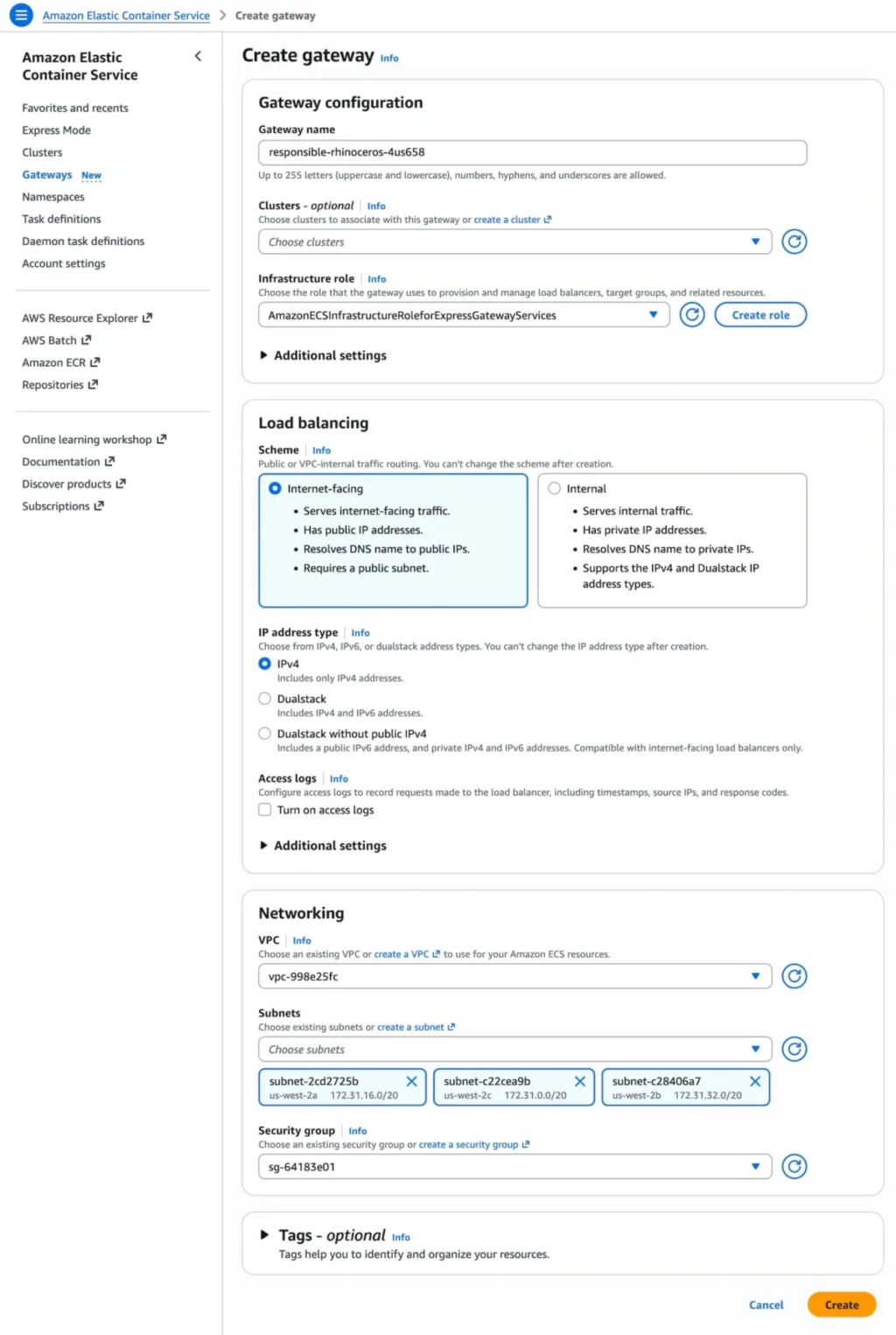
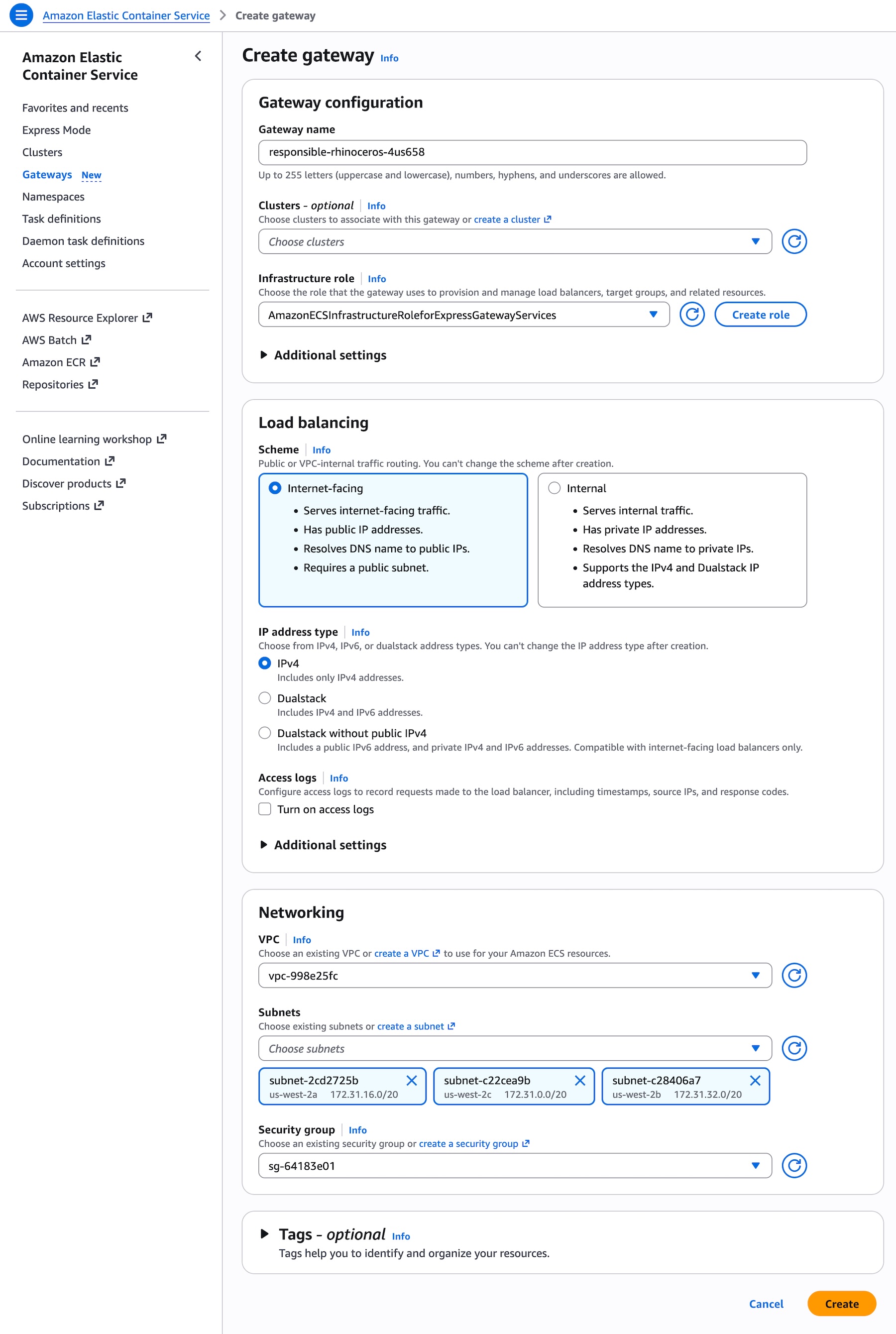
Platform teams begin by defining a gateway inside the Amazon ECS console or programmatically via the AWS Command Line Interface (AWS CLI). Creating a gateway requires a unique name within the account, an IAM infrastructure role that grants ECS permission to provision resources (such as ALBs and security groups), and a target configuration object.

For instance, provisioning a public-facing internet-facing gateway via the AWS CLI is executed with a straightforward command:
aws ecs create-gateway
  --name my-team-gateway
  --infrastructure-role-arn arn:aws:iam::123456789012:role/ECSGatewayRole
  --configuration '
    "HostSharedAlb":
      "networkConfiguration":
        "subnets": [
          "subnet-080779f9bd887757a",
          "subnet-03d5b2fead6bc6258",
          "subnet-0861210a397d31252",
          "subnet-06539e194023cb77a"
        ],
        "ipAddressType": "ipv4"
      ,
      "scheme": "internet-facing"

  '
Once the gateway is established, platform administrators associate it with one or more ECS clusters using the AssociateGatewayWithCluster API:
aws ecs associate-gateway-with-cluster
--gateway my-team-gateway
--cluster arn:aws:ecs:us-east-1:123456789012:cluster/my-cluster
Application Team Integration and Incremental Adoption
Application teams consume the gateway by embedding a gateway connector directly into their service definitions (CreateService or UpdateService).
Crucially, AWS has designed ECS Gateway to support incremental adoption. Organizations running legacy ECS services with dedicated, pre-existing load balancers do not need to execute risky, all-or-nothing migrations. By calling UpdateService to add a gateway connector alongside existing configurations, teams can run both ingress paths simultaneously. This dual-path capability allows developers to thoroughly validate the new gateway routing and DNS endpoints before decommissioning legacy load balancer configurations.
aws ecs create-service
  --cluster my-cluster
  --service my-api-service
  --task-definition my-api-service:1
  --gateway-connectors '[ "portName": "api", "filters": "accessTypes": ["PUBLIC"], "healthCheck": ... ]'
Behind the Scenes: Automated Resource Provisioning
When a service connects to an eligible gateway (verified via matching access types, shared VPC context, and overlapping Availability Zones), Amazon ECS automatically orchestrates the underlying infrastructure:
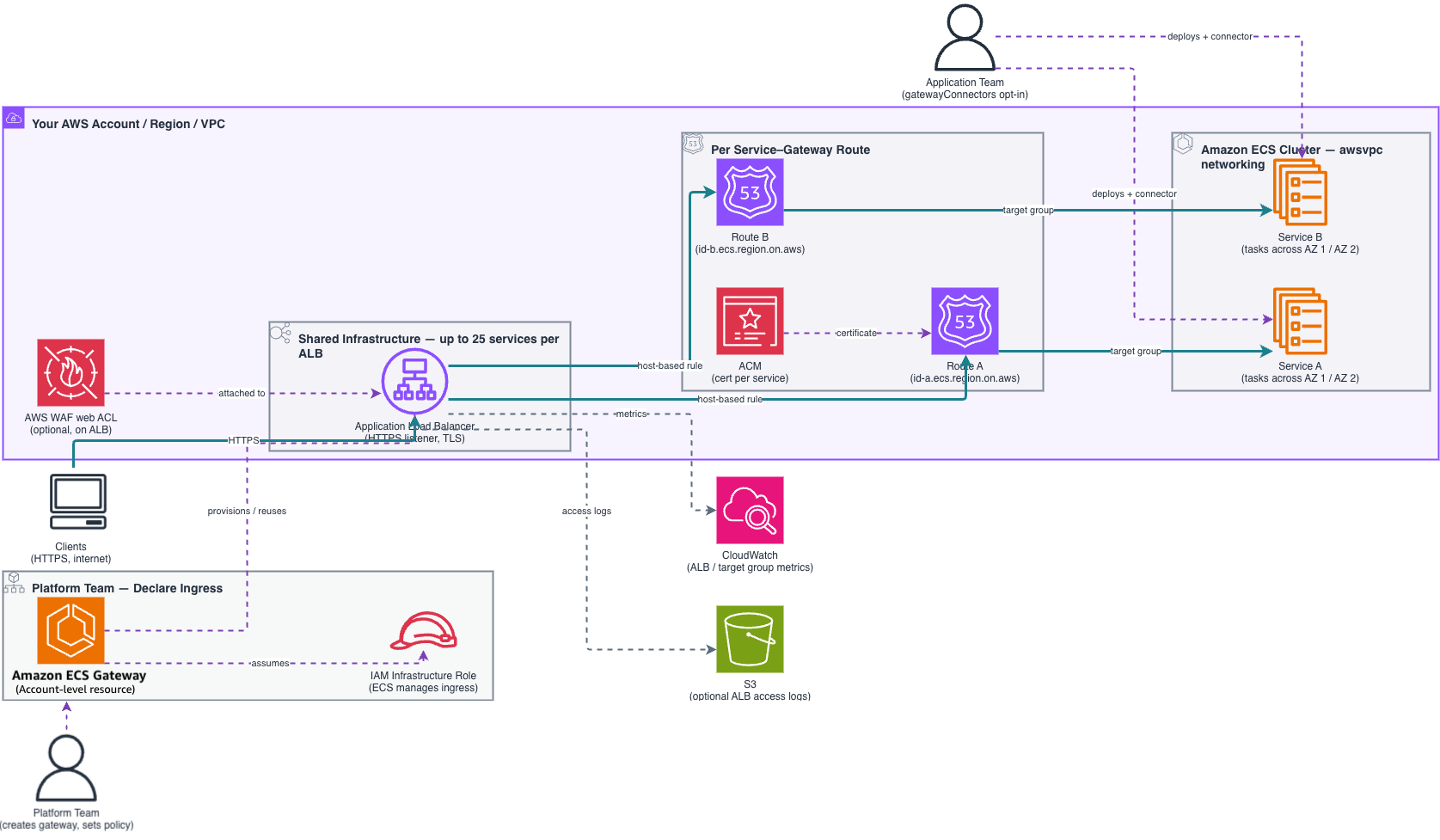
- Allocates an ALB with available capacity (or provisions a new one if limits are reached).
- Issues and validates an ACM certificate for the service endpoint.
- Generates a unique DNS hostname.
- Configures listener rules to direct traffic from the hostname to the target group.
- Establishes restrictive service security groups permitting inbound traffic exclusively from the ALB security group.
Official Responses and Industry Perspectives
AWS engineering leaders emphasize that Amazon ECS Gateway was built in direct response to customer feedback regarding cognitive load and operational friction in microservices architectures.
"Platform teams want to focus on delivering high-value developer self-service capabilities rather than writing custom automation scripts to wire up load balancers, certificates, and DNS records for every new microservice," notes AWS product management. "With ECS Gateway, we are abstracting away the undifferentiated heavy lifting of container ingress, giving organizations a secure, cost-optimized, and fully automated networking primitive right out of the box."
Early enterprise testers have echoed these sentiments, highlighting how the feature drastically reduces the time required to spin up new environments. By establishing a rigid yet flexible boundary between platform engineering guardrails and developer deployment velocity, organizations can maintain strict security compliance without sacrificing shipping speed.
Furthermore, AWS has integrated support for modern developer workflows. Engineering teams can create, manage, and query ECS Gateway configurations programmatically using the AWS MCP Server and associated plugins within their preferred AI coding assistants and IDE environments.
Strategic Implications and Pricing
The introduction of Amazon ECS Gateway carries profound implications for cloud architects, platform engineers, and financial operations (FinOps) teams.
1. Enhanced FinOps and Cost Optimization
By allowing up to 25 services to share a single Application Load Balancer, ECS Gateway directly combats resource sprawl. In traditional architectures, teams frequently provision dedicated ALBs for minor services, incurring fixed hourly baseline costs that scale inefficiently. Shared host-based routing drastically lowers infrastructure waste, maximizing resource utilization across development, staging, and production environments.
2. Radical Simplification of Security Governance
Configuration drift is a persistent vulnerability in containerized environments. When security groups, WAF rules, and certificates are managed manually per service, human error inevitably introduces gaps. ECS Gateway centralizes security policy enforcement through IAM infrastructure roles, cluster-level associations, and automated security group wiring, ensuring that zero-trust networking principles are maintained by default.
3. Pricing and Availability
Amazon ECS Gateway is available immediately at no additional charge across all commercial AWS Regions where Amazon ECS is supported. Customers do not pay any platform fee for using the gateway itself; they incur costs solely for the underlying AWS infrastructure provisioned within their accounts in accordance with standard pricing models—including applicable Application Load Balancer charges, Amazon CloudWatch logs and metrics, AWS Certificate Manager certificates, and standard data transfer fees.
Conclusion and Next Steps
Amazon ECS Gateway represents a paradigm shift in how containerized ingress is conceived, deployed, and maintained on AWS. By transforming manual networking checklists into a resilient, automated, account-level primitive, AWS has equipped platform teams to scale their microservices ecosystems with unprecedented confidence and efficiency.
Platform engineers and system administrators can get started immediately by provisioning their first gateway via the Amazon ECS Console, consulting the Official Amazon ECS Gateway Documentation, and sharing feedback through AWS re:Post or standard support channels.