Amazon S3 Vectors Unveils Metadata Pre-Filtering: A Breakthrough for High-Recall Semantic Search and Multi-Tenant RAG Applications
SEATTLE — In a major development for artificial intelligence and cloud-native data architecture, Amazon Web Services (AWS) has announced the immediate availability of metadata pre-filtering for Amazon S3 Vectors.
Designed to fundamentally improve how applications execute targeted searches across massive vector datasets, the new feature evaluates metadata constraints before initiating a similarity search. By reversing the traditional search sequence—resolving filters first rather than validating candidates on the fly—AWS aims to solve a persistent bottleneck in retrieval-augmented generation (RAG), semantic search, and autonomous AI agent applications: the loss of search recall when handling tightly scoped queries.
Available now across all commercial AWS regions where Amazon S3 Vectors is supported, as well as AWS China Regions, the capability comes with no additional pricing surcharges, requires zero re-ingestion of existing data, and operates transparently without altering existing application query syntax.
Main Facts: What is Metadata Pre-Filtering?
At its core, metadata pre-filtering addresses a structural inefficiency in modern vector search mechanics. Most production-scale applications—ranging from enterprise document repositories to multi-tenant SaaS platforms—rarely execute searches across an entire index. Instead, they query localized subsets defined by user accounts, operational statuses, specific categories, or distinct temporal windows.
Previously, vector databases often relied on post-filtering or simultaneous (classic) evaluation modes. In these models, a similarity search would cast a wide net across millions of vectors, filtering out non-matching candidates during or after computation. For highly selective queries—such as looking up a specific user’s private records inside a database of 8 million tickets—this approach often resulted in drastically diminished recall, returning only a fraction of the truly relevant items because the top-$k$ results were prematurely saturated by out-of-scope vectors.
With the introduction of Amazon S3 Vectors’ new ENHANCED index mode, the system flips this dynamic:
- Pre-Evaluation: The query engine resolves the metadata filter first, isolating only the subset of vectors that match the criteria.
- Targeted Similarity Search: The vector search then executes exclusively within that pre-scoped subset.
- Maximized Recall: On highly selective filters, developers can experience up to 5x more matching vectors returned compared to traditional processing architectures.
Each vector in an S3 Vectors index can now carry up to 2 KB of application-defined metadata, and a single query can support up to 100 distinct filter constraints. Furthermore, the service introduces powerful new operators, including $startsWith for precise hierarchical path, URL, and document ID prefix matching, seamlessly joining existing logical operators such as $and, $or, $gt, equality checks, and existence validations.
Chronology: The Evolution of S3 Vectors and the Push for Enhanced Filtering
The release of metadata pre-filtering represents the latest milestone in AWS’s ongoing strategy to streamline cloud-native machine learning and generative AI workflows.
- The Rise of S3 Vectors: AWS initially introduced Amazon S3 Vectors to give developers a scalable, cost-effective way to store, manage, and query high-dimensional vector embeddings natively within the world’s leading cloud storage architecture. As adoption surged among enterprises building RAG applications and semantic search engines, developers quickly ran into scaling walls concerning multi-tenancy.
- The Multi-Tenant Dilemma: In multi-tenant environments, ensuring data isolation while maintaining low latency and high relevance is paramount. Developers were forced to choose between complex application-level workarounds—such as partitioning indexes into hundreds of separate buckets—or suffering performance and recall degradations when querying massive, monolithic indexes with complex filters.
- The Development of
ENHANCEDMode: Recognizing these pain points, AWS engineers developed the architectural framework for pre-filtering, allowing indexes to operate under two distinct index modes:CLASSIC(the legacy tandem evaluation method) andENHANCED(the new pre-filtering paradigm). - General Availability (Today): AWS has officially rolled out the feature globally, ensuring that existing indexes can be seamlessly upgraded in-place via the
UpdateIndexModeAPI without requiring data re-ingestion, downtime, or codebase rewrites.
Supporting Data and Technical Architecture
To understand the tangible impact of metadata pre-filtering, consider a real-world enterprise support environment managing an index of 8 million customer service tickets.
The Problem in Classic Mode
An agent needs to research a recurring technical error across a specific customer’s history. That particular customer accounts for 400 tickets out of the total 8-million-record index. Under the legacy CLASSIC index mode, a query searching for semantic similarity while filtering by customer_id would execute the vector search globally across all 8 million entries, filtering out non-matching tickets during evaluation. Because the global vector space dominated the results, the returned set frequently missed vital historical context, leaving the agent with an incomplete picture of the customer’s prior occurrences.
The Solution in Enhanced Mode
When the index mode is updated to ENHANCED, the execution path changes fundamentally:
- Filter Resolution: S3 Vectors instantly evaluates the
customer_idfilter, reducing the candidate pool directly to the 400 relevant tickets. - Focused Computation: The cosine distance similarity search runs exclusively across those 400 vectors.
- Comprehensive Results: The agent receives a rich, highly accurate result set drawn comprehensively from that specific customer’s documented history.
Implementation Blueprint
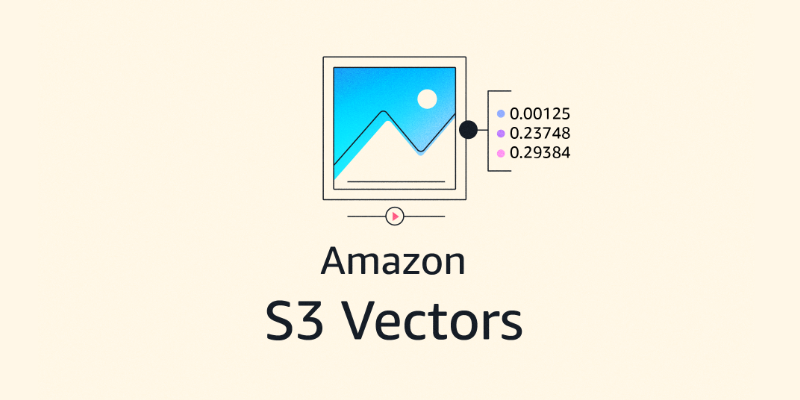
Getting started with metadata pre-filtering requires three straightforward steps using the AWS CLI or SDKs.
1. Create an Enhanced Vector Index
Developers initialize an index specifying dimensions matching their embedding model (such as 1536 for OpenAI models) and a compatible distance metric:
aws s3vectors create-index
  --index-name product-catalog
  --vector-bucket-name my-vector-bucket
  --dimension 1536
  --distance-metric cosine
2. Ingest Vectors with Rich Metadata
Using the PutVectors API, applications can embed up to 2 KB of structured metadata directly alongside vector arrays without defining a rigid upfront schema:
aws s3vectors put-vectors
  --index-name product-catalog
  --vector-bucket-name my-vector-bucket
  --vectors '[
    "key": "doc-001",
    "data": "float32": [0.1, 0.2, 0.3, ...],
    "metadata":
      "tenant_id": "t-10428",
      "category": "legal",
      "created_date": "2026-03-15",
      "active": true

  ]'
3. Execute Filtered Queries
Queries leverage compact JSON syntax to combine conditions. By passing --return-metadata, the response includes the associated contextual attributes alongside distance metrics:
aws s3vectors query-vectors
  --index-name product-catalog
  --vector-bucket-name my-vector-bucket
  --query-vector '"float32": [0.1, 0.2, 0.3, ...]'
  --top-k 50
  --return-metadata
  --filter '"$and": [
    "tenant_id": "t-10428",
    "category": "legal",
    "active": true
  ]'
For applications utilizing hierarchical folder structures or URLs, the new $startsWith operator simplifies subtree scoping:
aws s3vectors query-vectors
  --vector-bucket-name my-vector-bucket
  --index-name product-catalog
  --query-vector '"float32": [0.1, 0.2, 0.3, ...]'
  --filter '"$startsWith": "document_id": "matter-4417/exhibits/"'
Migrating existing infrastructure is equally frictionless. Administrators can upgrade an index in-place with a single command:
aws s3vectors update-index-mode
  --vector-bucket-name my-vector-bucket
  --index-name product-catalog
  --index-mode ENHANCED
Furthermore, to future-proof new deployments, bucket-level defaults can be updated so that all subsequently created indexes adopt ENHANCED mode automatically:
aws s3vectors put-vector-bucket-default-index-mode
  --vector-bucket-name my-vector-bucket
  --default-index-mode ENHANCED
Official Responses and Industry Context
According to technical documentation and rollout announcements authored by AWS engineering leadership, the release directly targets the architectural friction points reported by enterprise developers scaling generative AI production systems.
"Most applications never search a whole index. They search the part of it that belongs to a particular user, account, or category, and they express that scope as a metadata filter," noted Daniel Abib in the official AWS release notes. "Semantic search, retrieval-augmented generation, and agentic applications all need the same thing from a filtered query: a similarity search that covers the vectors matching the filter, and returns the closest of them. With pre-filtering, a filtered query returns more of the relevant matches your index contains."
Industry analysts and early enterprise adopters have praised the update for eliminating the historic trade-off between strict multi-tenant data isolation and search accuracy. In legacy vector database deployments, enforcing strict filters often required maintaining fragmented indexes or accepting severe recall degradation. By solving this at the storage infrastructure layer without imposing additional licensing or compute surcharges, AWS has significantly lowered the architectural barrier to building secure, enterprise-grade AI agents.
Implications for the Enterprise and Generative AI Ecosystem
The deployment of metadata pre-filtering carries far-reaching implications for software developers, enterprise architects, and organizations scaling artificial intelligence initiatives:
- Simplified Multi-Tenancy Architecture: SaaS providers operating multi-tenant environments can now consolidate vector data into shared buckets and indexes without risking cross-tenant data leakage or sacrificing search quality. Tenant boundaries can be enforced cleanly via metadata attributes (
tenant_id) evaluated at the foundational storage layer. - Enhanced Performance for Autonomous AI Agents: Agentic workflows—where AI systems autonomously query internal knowledge bases, code repositories, or customer logs on behalf of individual users—rely heavily on precise context scoping. Pre-filtering ensures that autonomous agents receive the highest possible recall when executing contextual lookups, reducing hallucinations and improving output accuracy.
- Cost-Effective Scalability: Because the feature introduces no auxiliary storage inflation, re-ingestion requirements, or query-processing price hikes, enterprises can upgrade their existing pipelines to
ENHANCEDmode seamlessly. Organizations continue to pay standard S3 Vectors pricing for storage, PUT requests, and queries while enjoying superior search fidelity. - Immediate Availability: With broad regional availability across all commercial AWS regions and AWS China Regions, engineering teams worldwide can begin integrating prefix matching (
$startsWith) and complex logical filters into production environments immediately.
As enterprise generative AI matures past proof-of-concept stages into high-stakes production deployments, infrastructure capabilities like Amazon S3 Vectors’ metadata pre-filtering provide the necessary reliability, security, and precision required to power the next generation of intelligent applications.