The Silicon Architect of Modernity: How Sun Microsystems Shaped the Digital Age
While the 1981 IBM PC is frequently hailed as the singular progenitor of modern personal computing—a machine whose architectural legacy remains embedded in the firmware of our contemporary devices—a more nuanced examination of technology history reveals a different, perhaps more influential, lineage. At the recent Vintage Computing Festival Berlin, researcher Michael Engel challenged the prevailing narrative of the “IBM-centric” digital evolution. Through his presentation, Engel traced the DNA of our modern high-performance world—from the graphical processing units (GPUs) powering our displays to the internet-routing infrastructure that sustains global connectivity—not back to Big Blue, but to the unlikely laboratory of Sun Microsystems.
The Genesis: Stanford and the SUN Project
To understand the ubiquity of Sun Microsystems’ influence, one must return to the late 1970s at Stanford University. During this era, computing was caught between the massive, centralized mainframes of the past and the nascent, underpowered hobbyist microcomputers of the future.
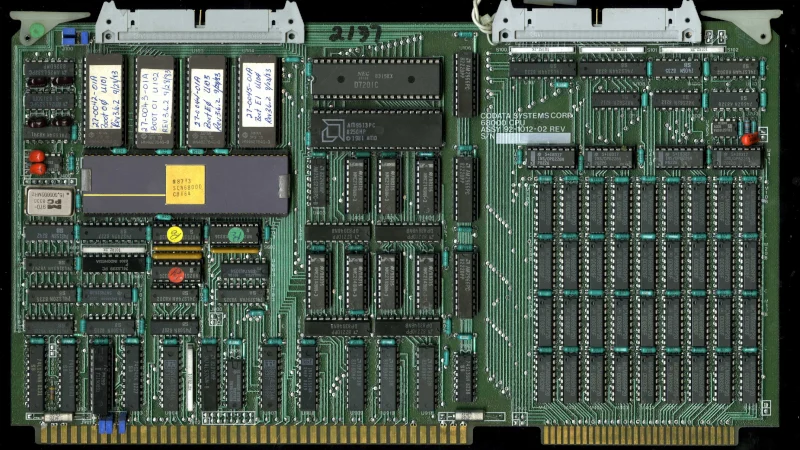
Andy Bechtolsheim, a postgraduate student at the time, was tasked with a challenge that would inadvertently define the next four decades of engineering. He was working on the Stanford University Network (SUN) project, a localized attempt to create a powerful, networked workstation. The hardware constraints of the time were significant. Bechtolsheim selected the Motorola 68000 microprocessor as the heart of his machine; however, the chip lacked a Memory Management Unit (MMU), a critical component required to run the robust, multi-user UNIX operating system.
Refusing to accept the hardware’s limitations, Bechtolsheim engineered a workaround. He designed an external MMU, utilizing a bank of static RAM (SRAM) to serve as a page table. This ingenious "hack"—a modular approach to CPU architecture—solved the performance bottleneck. By decoupling the processing unit from the memory management logic, Bechtolsheim created a design that was not only powerful but remarkably portable. This CPU board would eventually become the foundational engine for the first Sun workstation, and more importantly, a template for the burgeoning workstation industry.
Chronology of Influence: The Ripple Effect
The transition from a research project to a global standard occurred with surprising speed. The following timeline illustrates how the "Sun DNA" permeated the technological landscape:
- 1979–1980: The Stanford University Network project produces the first prototype workstation utilizing the custom Motorola 68000/MMU design.
- 1982: Sun Microsystems is officially incorporated, commercializing the design concepts developed by Bechtolsheim at Stanford.
- 1983–1984: Silicon Graphics (SGI) enters the market. Facing similar architectural hurdles, SGI adopts the Sun-derived CPU board architecture, cementing the relationship between high-end graphical computing and the Motorola 68000 workstation lineage.
- 1985: The emergence of laser printing technology sees the adoption of the Sun-style board design, as companies like Imagen integrate the architecture into their hardware to manage the high-speed processing required for page rendering.
- 1986–1987: The networking revolution gains momentum. The software and hardware logic initially developed for the Stanford router project is licensed and adapted, finding its way into the foundational product lines of Cisco Systems.
- 1990s: As the internet expands, the routing and switching technology refined by Sun’s early design philosophy becomes the backbone of the global network infrastructure.
Supporting Data: The Architecture of Connectivity
The technical brilliance of the original Sun board lay in its versatility. While the IBM PC was designed for singular, desktop-bound applications, the Sun architecture was built for interconnectivity.
Data from the Vintage Computing Festival Berlin archives suggests that the scalability of the 68000-based board allowed for rapid iteration. By implementing the MMU externally, Bechtolsheim allowed for a modular upgrade path that was years ahead of the competition.
The GPU Connection
Silicon Graphics (SGI) is often cited as the grandparent of modern computer graphics. By leveraging the same CPU board architecture as Sun, SGI was able to focus its engineering resources on the specialized hardware acceleration necessary for 3D rendering. Had SGI been forced to build their own CPU and memory management systems from scratch, the timeline for the development of modern 3D graphics, CAD software, and eventually the GPU, would have been significantly delayed.
The Router Revolution
Perhaps the most overlooked contribution is the role Sun played in the development of Cisco. The original Stanford board was intended to act as a router—a device to direct traffic between disparate network segments. The software stack developed to manage this traffic was ported into early commercial routers. Consequently, the core logic that manages the packets flowing through the modern internet can be traced back to the same intellectual lineage that produced the Sun workstation.
Official Perspectives and Academic Analysis
In his presentation, Michael Engel emphasized that we often mistake "market share" for "technological lineage." While IBM defined the consumer desktop experience, Sun Microsystems defined the industrial and infrastructure experience.
"We are living in a world built on Sun’s early ingenuity," Engel noted during his lecture. "When we look at a Cisco router, or a high-end graphics card, or even the underlying protocols of our networked printers, we aren’t seeing IBM technology. We are seeing the ghost of the Stanford University Network project."
Industry analysts corroborate this view, noting that Sun Microsystems’ culture of open innovation—even before the term was popularized—allowed their hardware and software designs to be adopted by companies that would later become tech giants. Unlike the proprietary, closed-box philosophy often associated with the early PC market, the Sun architecture was designed to be extended, modified, and integrated.
Implications for Modern Technology
The implications of this history are profound for how we view technological progress. We tend to view innovation as a series of isolated "Eureka!" moments, but the reality is one of iterative building. Sun Microsystems acted as a bridge between the academic research of the 70s and the commercial infrastructure of the 90s.
The Myth of the "Clean Slate"
The history of the Sun workstation serves as a reminder that no modern device is a clean-slate invention. The reliance on the 68000 and the external MMU design demonstrates that solving a bottleneck in one area (UNIX compatibility) can yield benefits in entirely unrelated fields (laser printing, routing, and 3D graphics).
Future-Proofing Through Modularity
Sun’s legacy underscores the importance of modular architecture. By creating a system that was not vertically integrated, Bechtolsheim and his team allowed other companies to innovate on top of their design. This ecosystem-first approach is arguably the precursor to the open-source software movement that currently dominates the cloud computing industry.
Conclusion
As we continue to iterate on the hardware of the future, it is vital to acknowledge the foundational pillars laid by companies like Sun Microsystems. While IBM may have provided the keyboard and screen that sat on our desks, Sun provided the logic, the routing, and the graphical processing capabilities that allowed those machines to talk to each other and display the world in high fidelity.
The story of the Stanford University Network is not merely a piece of vintage computing trivia; it is a vital chapter in the history of the modern world. It reminds us that the most impactful technologies are often those that are designed to be shared, adapted, and built upon. When we navigate the internet, print a document, or marvel at the performance of a modern GPU, we are participating in a legacy that began in a small university lab—a testament to the enduring power of modular, thoughtful engineering.