A Permanent Home for Scottish PostgreSQL: Inside the Thriving Edinburgh Community and Its Landmark August 2026 Gathering
Main Facts: A New Digital Anchor for Scottish Database Professionals
The database community in Scotland has officially planted its flag. With the launch of postgres.scot, PostgreSQL enthusiasts, engineers, and researchers north of the border finally possess a permanent, centralized digital home. Designed with intentional simplicity, the newly minted domain serves as a definitive anchor point, directing community members to the PostgreSQL Edinburgh User Group (PostgresEDI) on Cloomba for event RSVPs, calendar subscriptions, and RSS feeds.
Rather than chasing transient tech platforms that inevitably shift year over year, postgres.scot guarantees that Scottish Postgres events—from hyper-local user group meetups to major regional symposia—retain a single, reliable URL worth bookmarking and sharing. Organizers have opened the digital doors for collaboration, inviting anyone hosting PostgreSQL-related gatherings across Scotland to submit listings directly via email.
(Note: postgres.scot operates strictly as a volunteer-run community website and is entirely independent, unendorsed, and unaffiliated with either the official PostgreSQL project or the PostgreSQL Community Association.)
This infrastructural milestone arrives on the heels of one of the community’s most technically rigorous and well-attended gatherings to date: the August 2026 PostgresEDI meetup. Hosted at Paterson’s Land within the University of Edinburgh and generously fueled by pizza and refreshments courtesy of sponsor pgEdge, the evening offered a masterclass in modern database challenges. Attendees tackled everything from cloud vendor lock-in and open-source data sovereignty to deep theoretical flaws in how relational database management systems (RDBMS) handle missing information. Following the academic session, participants retired to the historic Tolbooth Tavern—one of the few nearby establishments miraculously insulated from the overwhelming chaos of the annual Edinburgh Fringe Festival.
Chronology: A Night of Deep Dives and Database Philosophy
The August 13th meetup followed a tried-and-true community format: doors opened in the early evening, followed by deep technical presentations, robust audience Q&A sessions, and post-event networking over pints.
Part 1: Torsten Fördertsch on Logical Replication and Cloud Repatriation
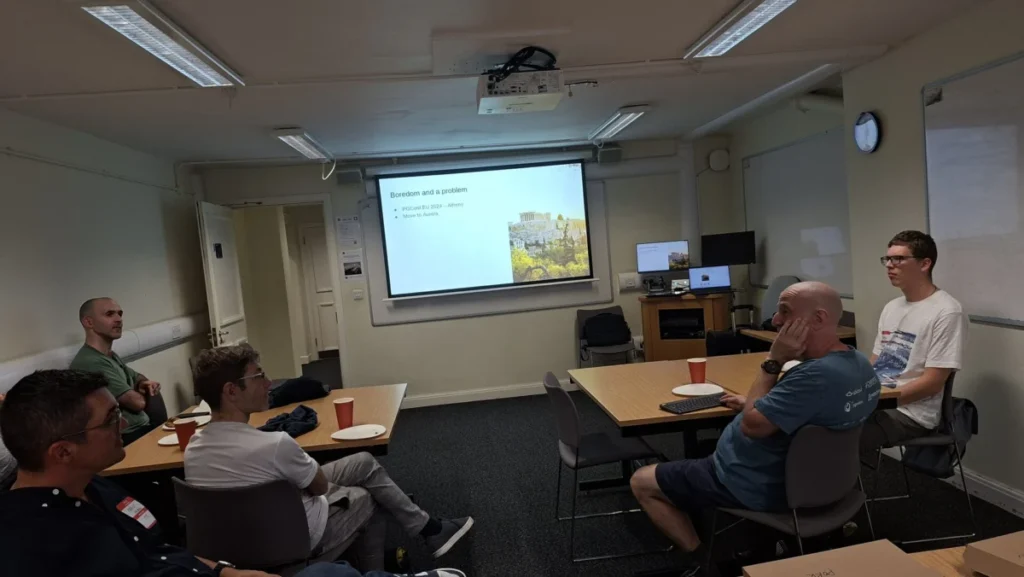
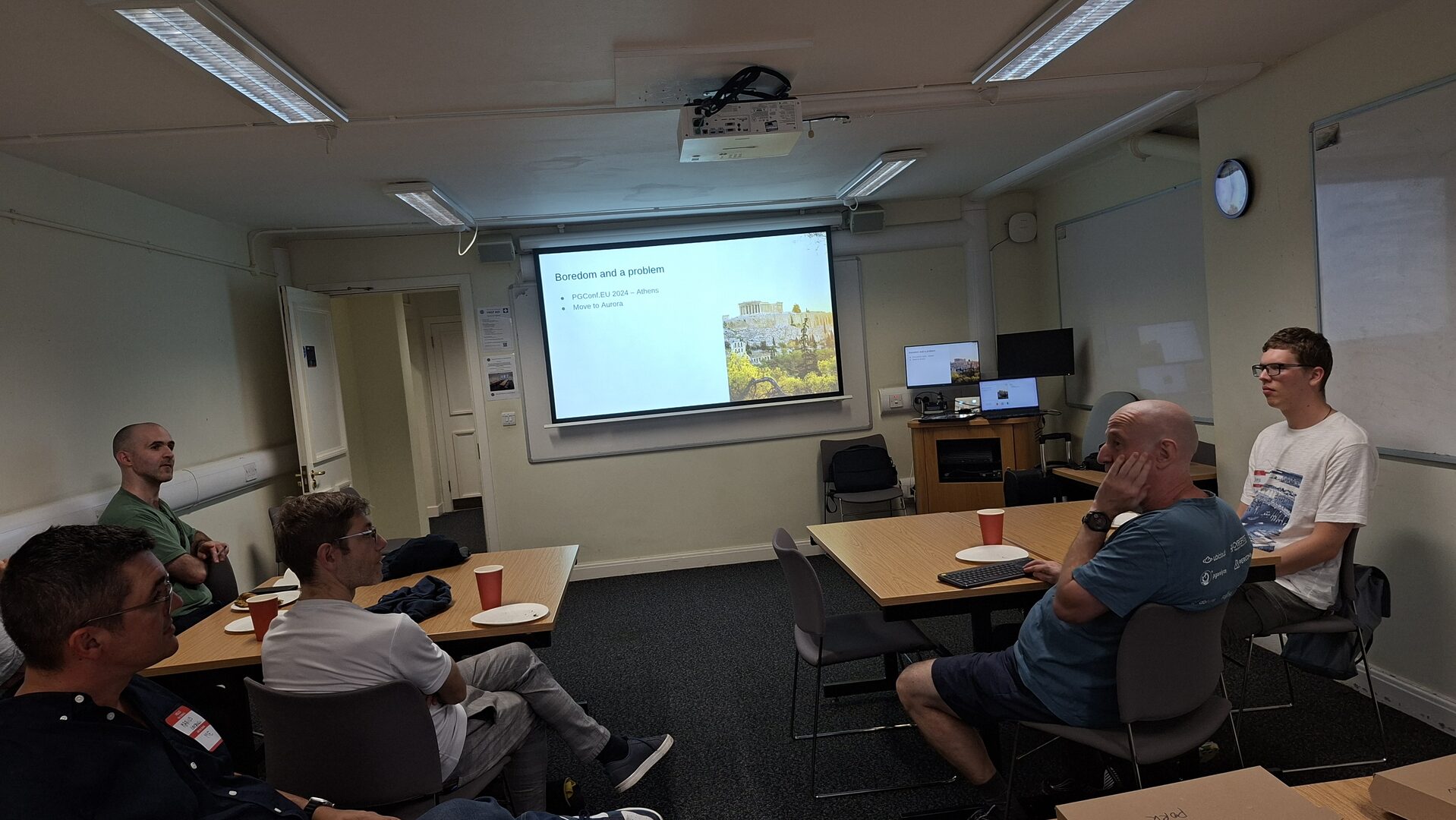
The evening kicked off with database veteran Torsten Fördertsch taking the floor to address a creeping anxiety facing modern enterprise architecture: cloud lock-in. Titled "Logical Replication: Escape the Cloud, Own Your Data," Fördertsch’s talk examined the subtle implications of migrating core infrastructure to managed services like Amazon Aurora. He posed a fundamental question to the room: what does data ownership actually mean when your database lives on someone else’s proprietary hardware and managed service layer?
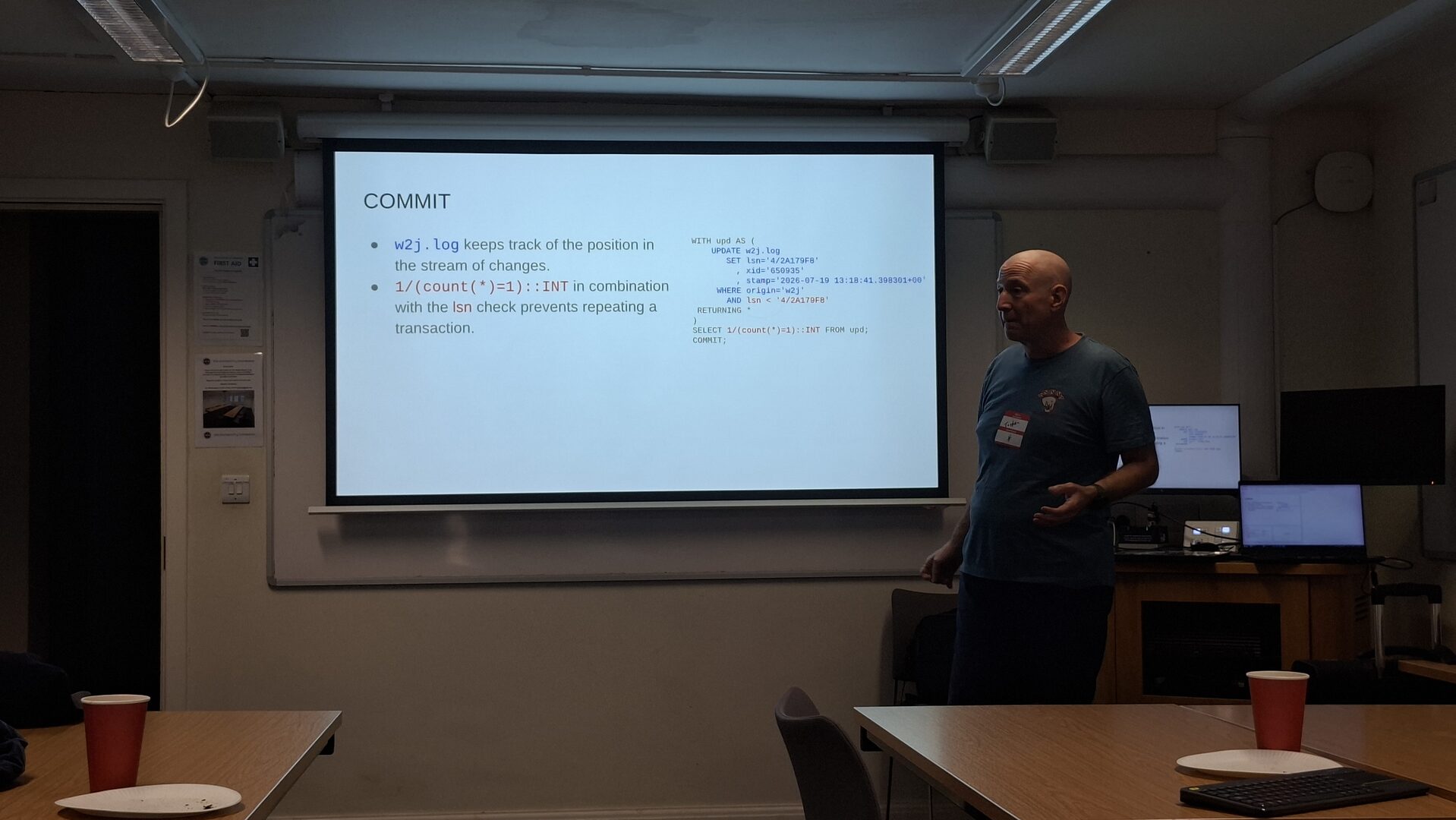
Fördertsch’s proposed remedy was a masterclass in grassroots engineering—rebuilding point-in-time recovery (PITR) entirely at the logical level. Eschewing traditional cloud provider lock-in mechanisms, he detailed a workflow utilizing a standard pg_dump for the immutable base copy, paired with a continuous stream of changes captured via wal2json in lieu of traditional, proprietary archived Write-Ahead Log (WAL) segments.
The mechanics were surprisingly lean. Fördertsch demonstrated that capturing and replaying the change stream could be accomplished using a mere 35 lines of jq script to translate raw JSON change streams into optimized SQL statements. However, he cautioned that the real engineering hurdle lies not in the translation, but in synchronization: mapping the exact position in the real-time stream that corresponds to the initial base dump to ensure zero data loss or duplication during replay. Fördertsch concluded his session by announcing plans to open-source the entire utility, much to the delight of the engineering-heavy audience. Attendees can review the technical breakdown via the Official Presentation Slides (PDF).
Part 2: Paolo Guagliardo on the Paradox of Relational Missing Values
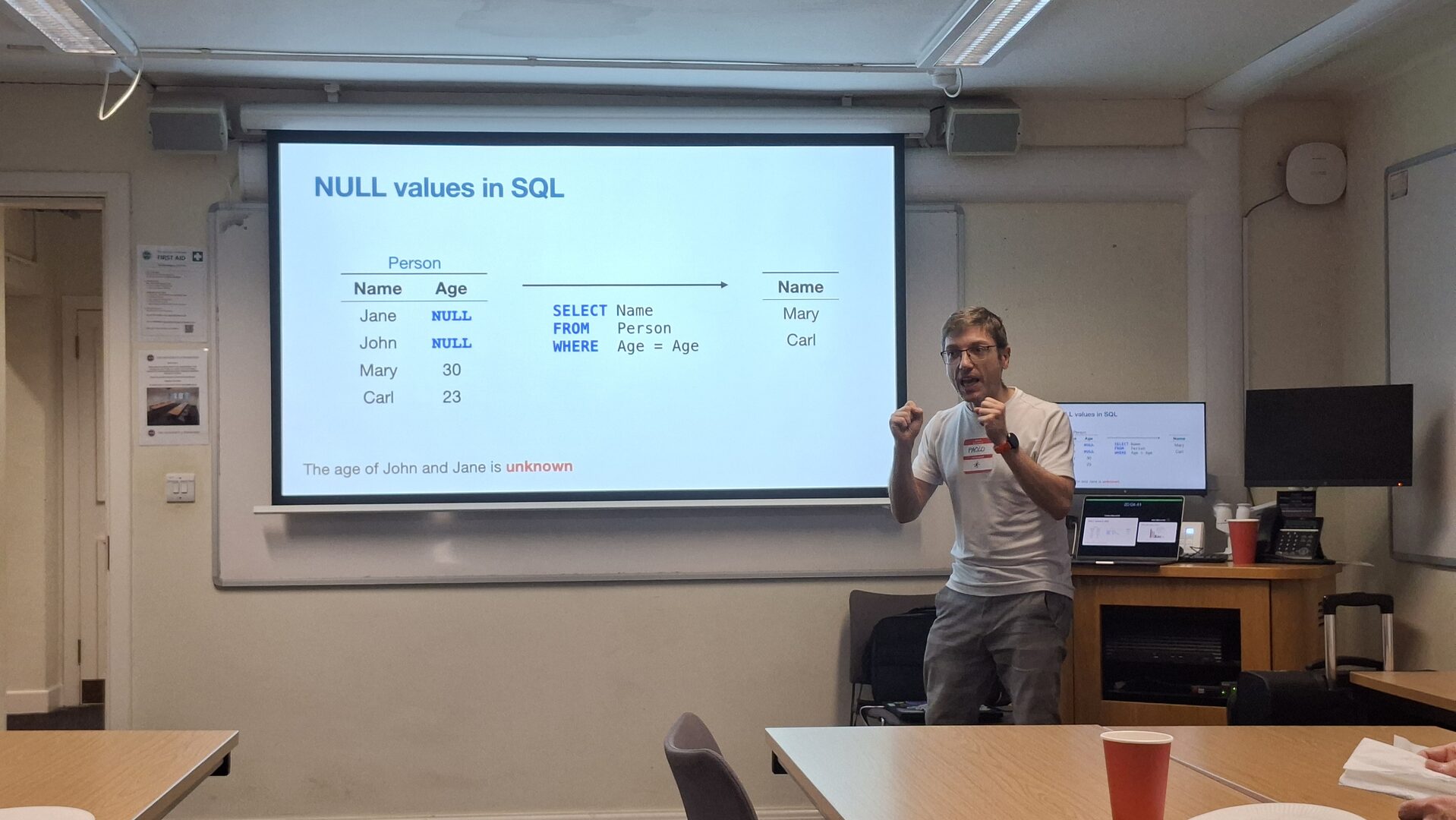
Shifting from infrastructure engineering to computer science theory, Dr. Paolo Guagliardo of the University of Edinburgh School of Informatics delivered a brilliant, eye-opening lecture titled "Expressive Representations of Missing Values in Relational Database Systems."
Guagliardo immediately hooked the room by exposing a notorious trap that has ensnared countless production SQL developers. He presented a hypothetical Person table containing records for Jane and John—both of whom have a NULL age—alongside Mary and Carl, whose ages are recorded as 30 and 23 respectively. He then asked the audience to evaluate a seemingly harmless query:
SELECT Name
FROM Person
WHERE Age = Age;
Intuition might suggest this query would return the entire table. In reality, it returns only Mary and Carl, aggressively pruning half the dataset. The culprit, as Guagliardo explained, is three-valued logic: comparing a NULL value to anything—even an identical NULL—yields an UNKNOWN evaluation rather than TRUE.
Guagliardo dug deeper into foundational database theory, noting that standard SQL offers only a single, homogenous NULL. This limitation makes it fundamentally impossible to record a nuance vital to advanced data modeling: establishing whether two unknown values are, in fact, the same unknown value. While "marked nulls" have long existed in academic literature as a theoretical solution, implementing them inside a production-grade engine like PostgreSQL presents immense engineering hurdles. Guagliardo shared empirical measurements tracking the storage overhead introduced by experimental implementations across standard TPC-H and TPC-DS benchmark datasets, providing a sobering look at the cost of semantic expressiveness.
For those looking to unpack the formal logic, Guagliardo’s materials are available via the Official Presentation Slides (PDF).
Supporting Data: The Metrics of Community Growth
The success of postgres.scot and the PostgresEDI user group is underscored by several key operational and technical metrics:
- Digital Permanence: 1 central domain (
postgres.scot) unifying event feeds, replacing fragmented annual social channels. - Hosting Partners: Regular monthly venues provided by the University of Edinburgh (spanning historic spaces like Paterson’s Land).
- Corporate Sponsorship: Financial and logistical backing from industry leaders such as pgEdge, ensuring free attendance, pizza, and refreshments for all participants.
- Code Efficiency: Torsten Fördertsch’s open-source logical replication pipeline relies on just 35 lines of
jqto bridge modern JSON change data capture (CDC) with relational SQL injection. - Theoretical Constraints: Evaluation of multi-terabyte analytical benchmarks (TPC-H and TPC-DS) to quantify the storage penalties associated with advanced missing-value representations in relational engines.
Official Responses and Community Perspectives
The launch of the new domain and the vibrant discourse at the August meetup reflect a broader maturation of the Scottish tech ecosystem. PostgreSQL, long established as the world’s most advanced open-source relational database, is experiencing a surge in enterprise adoption across the United Kingdom.
Organizers emphasized that the creation of postgres.scot was driven by a desire for autonomy and longevity. By decoupling local community announcements from the volatile algorithms and policies of commercial social media networks, Scottish database administrators (DBAs) and developers have ensured that knowledge-sharing remains open, accessible, and resilient.
Furthermore, the dual-track nature of the August meetup—pairing pragmatic, operational data engineering (cloud repatriation via logical replication) with fundamental computer science research (relational missing values)—highlights the unique value proposition of university-town user groups. It bridges the gap between theoretical computer science and daily enterprise firefighting, creating an environment where doctoral researchers and production-weary engineers learn side-by-side.
Implications: Looking Ahead to September 2026 and Beyond
As the dust settles on an eventful August, the momentum within the Scottish PostgreSQL community shows no signs of slowing down.
The September 24th Meetup Preview
The user group will return to the University of Edinburgh’s Paterson’s Land (Room 1.27) on Thursday, September 24th, with doors opening at 18:00 BST.
- Featured Presentation: Organizers will showcase ColdFront, an innovative architectural pattern that automatically tiers cold, infrequently accessed PostgreSQL data out to Apache Iceberg formats residing on cost-effective object storage, all while keeping historical rows transparently readable from within Postgres.
- Second Speaker Slot: At the time of publication, the second technical talk is still being finalized.
Call for Speakers
Community organizers have issued an open call for speakers for the September session and upcoming autumn/winter events. In keeping with the inclusive ethos of PostgresEDI, first-time speakers are strongly encouraged to step forward. The user group prides itself on providing a low-pressure, welcoming environment for technologists eager to share case studies, post-mortems, or deep dives into database internals. Prospective speakers can contact the organizers directly via email at vyruss000 (at) gmail.com.
With a permanent digital address now secured at postgres.scot, a robust calendar of technical events locked in, and an active network of engineers pushing the boundaries of what open-source data infrastructure can achieve, Scotland’s database community is poised for an exceptionally bright future.