A Pivotal Shift in GNOME Security: Michael Catanzaro Steps Down Amidst AI-Driven Vulnerability Landscape
The GNOME Project, one of the cornerstones of the Linux desktop ecosystem, is facing a significant transition in its security governance. Michael Catanzaro, the primary steward of GNOME’s security issue tracking since November 2020, has announced his departure from the role. His exit marks not only the end of an era of centralized oversight but also the beginning of a fundamental policy overhaul necessitated by the modern, AI-augmented threat landscape.
As GNOME prepares for this leadership transition, the project is tightening its disclosure timelines and re-evaluating its relationship with upstream projects that have opted to ban AI-generated contributions.
The Chronology of a Transition
The transition plan is deliberate, designed to ensure that no critical vulnerabilities fall through the cracks during the handoff. According to Catanzaro’s formal announcement, the timeline for this phase-out is structured as follows:
- August 1, 2026: The official policy shift takes effect. New vulnerability reports submitted to GNOME Security will be subject to a shortened 30-day disclosure deadline, down from the previous industry-standard 90-day window.
- November 1, 2026: Catanzaro will cease accepting or tracking newly reported security issues. From this date forward, his focus will strictly narrow to the resolution of the existing backlog.
- December 1, 2026: The final cutoff. Catanzaro expects that all disclosure deadlines for the remaining pipeline of issues will have expired, marking his complete withdrawal from the security tracking process.
This staged approach is intended to provide the GNOME community with sufficient notice to identify a successor while maintaining the operational integrity of the security team.
The Growing Burden: Why the Change?
Catanzaro’s departure brings to light the hidden, often "archaic" administrative labor required to maintain the security of a project as vast as GNOME. Since 2020, he has acted as a one-man regulatory hub, tracking each report from the moment of submission to the final CVE (Common Vulnerabilities and Exposures) request.
The Administrative Debt
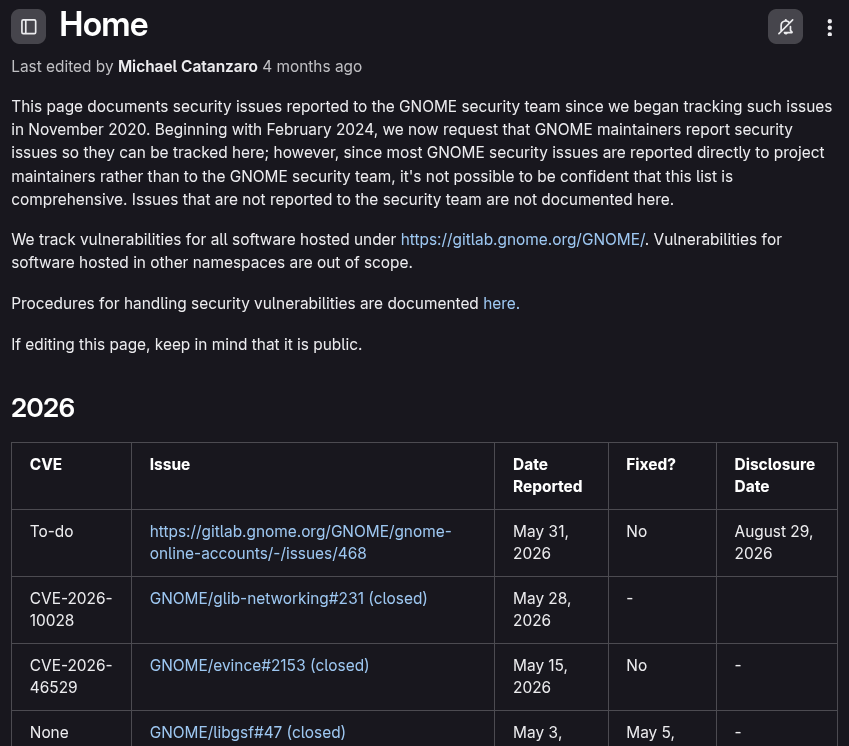
Currently, the process is heavily manual. Submissions arrive through a dedicated form on security.gnome.org, which triggers a confidential GitLab issue. The security lead must then manually update a central wiki page on GitLab, organizing vulnerabilities into tables by year and project.
This manual bookkeeping contrasts sharply with the automated, searchable databases used by larger Linux distributions. For instance, Ubuntu utilizes a robust, filterable security notice system, and Red Hat/Fedora leverage the power of Bugzilla to track parent bugs and sub-tasks. The disparity highlights the "security debt" that the GNOME project must eventually reconcile if it hopes to keep pace with modern software distribution standards.
The AI Complication
The most striking aspect of the policy change is the response to AI-generated vulnerability submissions. The proliferation of AI-assisted security research has resulted in a massive surge of reports. Catanzaro notes that a significant volume of current submissions carries clear evidence of AI involvement.
Because many downstream projects have explicitly banned AI-generated contributions to avoid the pitfalls of hallucinated bugs or low-quality code, GNOME is taking a defensive stance. Under the new policy, GNOME will no longer forward security reports to projects that prohibit AI-generated content. Instead, the security team will close the report internally and notify the maintainers directly, essentially washing their hands of the formal mediation process. This policy is a direct reaction to the friction caused by balancing "AI-speed" reporting with the conservative engineering standards of various open-source maintainers.
Implications for the GNOME Ecosystem
The departure of a long-term security lead is always a moment of vulnerability for any open-source project. However, the specific requirements Catanzaro has laid out for his successor signal a need for high-level expertise rather than mere administrative support.

The Search for a Successor
Catanzaro has been explicit: this is not a role for a newcomer. He is actively seeking an experienced GNOME community member—someone who understands the social dynamics, the release cycles, and the technical architecture of the GNOME desktop.
The complexity of the role lies in the "human" aspect of security management. It requires the ability to mediate between security researchers, who want rapid disclosure, and maintainers, who need time to develop, test, and deploy patches. The next security lead will inherit a workflow that demands a response to new reports within two business days—a rigorous standard for a volunteer-led initiative.
Shorter Deadlines: A Response to "AI Speed"
The decision to slash the disclosure deadline from 90 days to 30 days is perhaps the most controversial change. In the traditional cybersecurity world, 90 days is considered a grace period that allows for the creation of patches and testing. By reducing this to 30 days, GNOME is effectively betting that the nature of vulnerabilities has changed. If the influx of reports is increasingly automated, the response must also become more efficient. However, this creates a potential risk: if a complex vulnerability is reported, 30 days may not be sufficient for a volunteer developer to craft a secure, regression-free patch.
The Broader Context: Security in the Age of Open Source
GNOME’s situation serves as a microcosm of the challenges facing the wider Linux ecosystem. As tools like ChatGPT and specialized security LLMs make it easier for researchers (and bad actors) to find and report bugs, maintainers are being overwhelmed by volume.
Comparing Security Models
- The GNOME Model: Highly centralized, relying on a dedicated lead to manage the lifecycle of a bug. It is personal, agile, but susceptible to "single point of failure" risks when that lead decides to step down.
- The Enterprise Model (Fedora/Red Hat/Ubuntu): Heavily automated, integrated into bug-tracking systems, and backed by paid staff. This model is designed for scale but often lacks the intimate connection between the reporter and the project maintainer.
The GNOME project is now at a crossroads. It can either invest in automating its "archaic" wiki-based tracking system to reduce the administrative burden on future volunteers, or it can move toward a more distributed model where individual project maintainers take more direct responsibility for their own security disclosures.
Official Stance and Community Response
Catanzaro’s announcement, published on his personal blog, has sparked a conversation about the sustainability of GNOME’s current security infrastructure. While the community has expressed gratitude for his years of service, there is an underlying sense of urgency.
"The work is mostly administrative," Catanzaro wrote, underscoring the reality that security is often more about bureaucracy than coding. For the next lead, the challenge will be to streamline this bureaucracy. If the GNOME project fails to find someone with the requisite experience to fill this role, the burden may necessarily shift toward more radical automation or a decentralization of security responsibilities.
Conclusion: The Path Forward
The upcoming transition in November 2026 is more than a change in personnel; it is a recalibration of how the GNOME project perceives its role in the security lifecycle. By shortening disclosure times and distancing the project from the noise of AI-generated reports, GNOME is attempting to protect its maintainers from burnout.
The project’s future security posture will depend entirely on the caliber of the successor and the willingness of the GNOME Foundation to modernize the tools that support them. As the landscape of vulnerability disclosure becomes increasingly automated, the human element—the experienced maintainer who knows exactly which code is critical—remains the most vital, and most difficult, resource to secure.
For now, the GNOME community looks on with a mix of gratitude for the past and concern for the future. The next few months will be critical in determining whether this essential project can transition successfully into a new era of security management.