Beyond the Garden Gate: The Forensic Teardown of a Failed Insoma Water Timer
In the modern suburban landscape, automated irrigation systems have evolved from luxury installations to household staples. Among the most popular iterations of this technology is the multi-outlet water timer—a device designed to provide targeted, automated hydration to gardens and lawns. However, these devices occupy a precarious environmental niche, sitting at the volatile intersection of high-pressure water lines, battery-powered electronics, and the unpredictable outdoors.
When a multi-zone Insoma water timer owned by technical analyst [electronupdate] suddenly ceased operation, the user was faced with a binary choice: discard the unit as e-waste or treat it as a forensic puzzle. Choosing the latter, [electronupdate] performed a comprehensive teardown, peeling back layers of protective potting compound to reveal the fragility hidden behind the plastic casing. What began as a simple repair effort quickly turned into a masterclass in failure analysis, highlighting the persistent challenges of reliability in consumer-grade irrigation hardware.
Main Facts: The Anatomy of a Failure
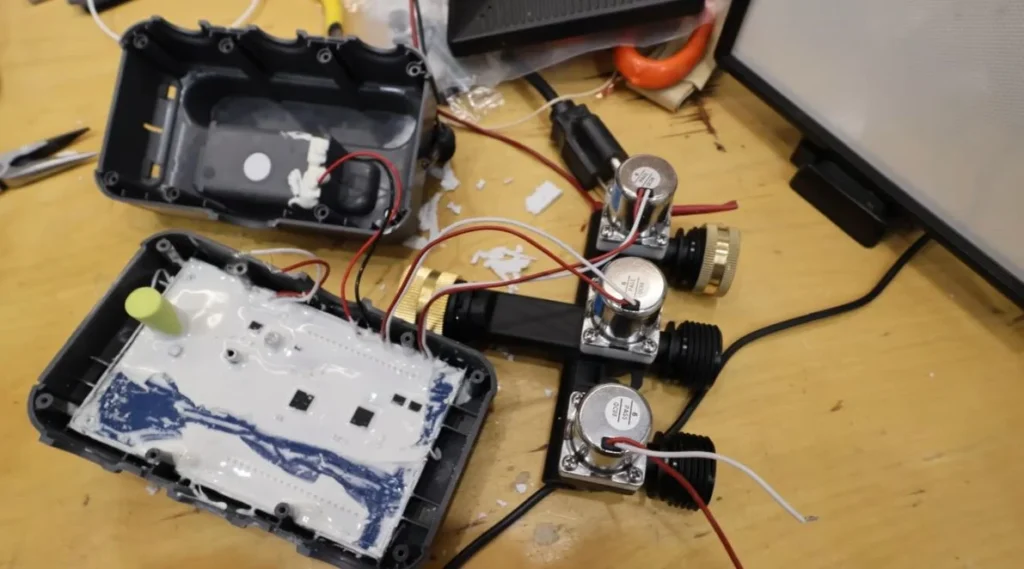
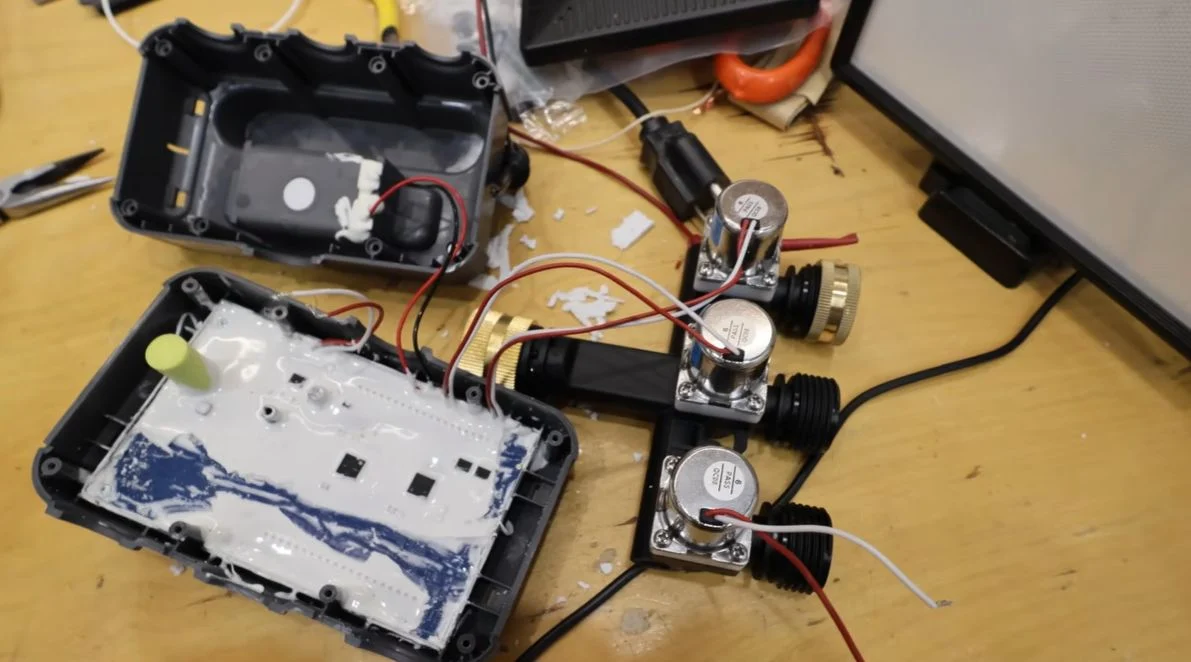
The Insoma water timer under investigation featured a three-zone control system, allowing users to schedule irrigation across different areas of their garden independently. At its core, the device relies on a trio of 6VDC solenoids, which actuate internal valves to regulate water flow. These solenoids are governed by a central microcontroller board that manages the user interface (LCD display and button inputs) and schedules the firing of each solenoid.
The failure was total: none of the three outlets would engage. Initial diagnostics performed by [electronupdate] confirmed that the solenoids themselves remained functional. When manually tested with a separate 6V power source, the valves clicked open and shut with consistent, reliable timing. This shifted the focus of the investigation from the electromechanical actuators to the electronic "brain" of the device.
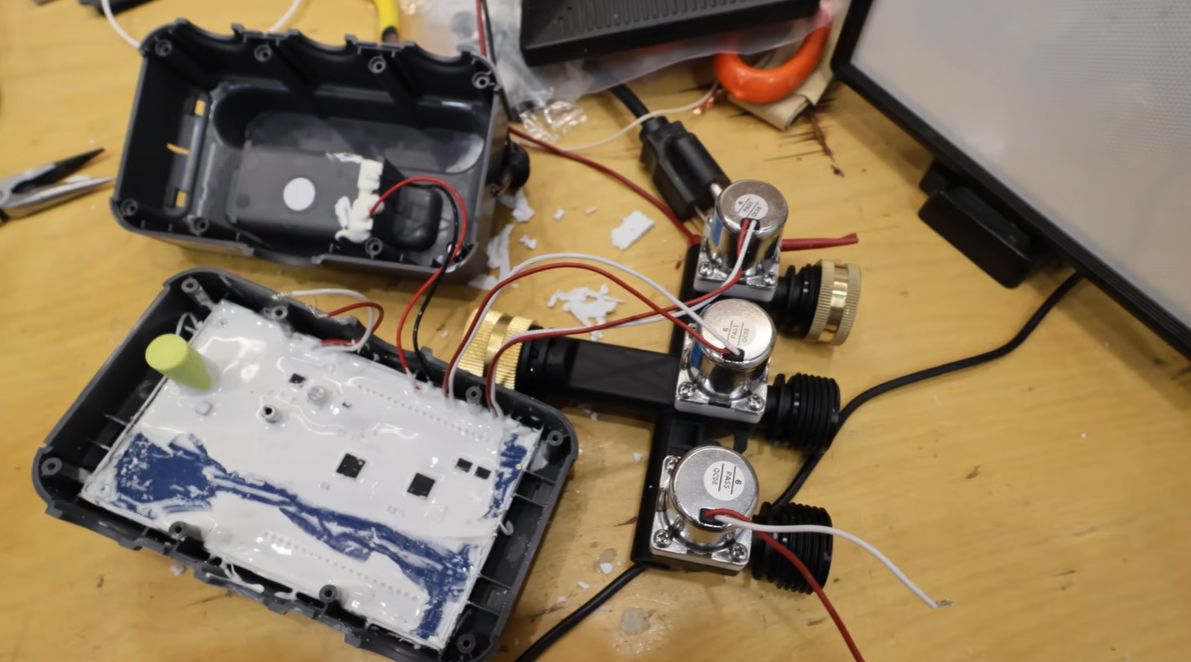
The central control board presented a significant hurdle: it was encased in a thick, white epoxy potting compound. While potting is a standard industrial practice intended to insulate delicate electronics from moisture and vibration, it also acts as a "keep out" zone for the end-user. Undeterred, [electronupdate] meticulously removed the compound to expose the PCB, revealing a circuit designed around a power boost architecture, H-bridge drivers for the solenoids, and a large electrolytic capacitor tasked with stabilizing the discharge current.
Chronology: From Fault to Resolution
The investigation followed a rigorous engineering workflow, moving from high-level observation to component-level surgery:
- Initial Symptom Verification: After confirming the timer was non-functional, [electronupdate] verified that the solenoids were not the point of failure. This ruled out a mechanical jam or a localized solenoid burnout.
- Voltage Analysis: Using an oscilloscope, the engineer measured the output at the solenoid terminals. The control board was providing only 2V—far below the 6V requirement—rendering the solenoids unable to actuate.
- Encapsulation Removal: The engineer subjected the PCB to a tedious process of mechanical removal of the white epoxy potting material. This process, while destructive, was necessary to gain visual access to the board’s components.
- Component Inspection: With the board exposed, the engineer identified the power boost circuit. A visual inspection of the electrolytic capacitor revealed a telltale sign: a small amount of leaking electrolyte fluid near the base of the component.
- Fault Confirmation: The capacitor, which serves as the primary energy reservoir to provide the "kick" needed for the solenoids to snap open, had failed. Its inability to hold a charge meant the boost circuit could not provide the necessary voltage to overcome the initial resistance of the solenoid valves.
- Resolution: The failing capacitor was identified as the single point of failure. Following a replacement, the system regained full functionality, proving that a device just four months into its service life had been sidelined by a single, cheap, and prematurely failing passive component.
Supporting Data: Why Timing Matters
The engineering behind these devices is surprisingly nuanced. The 6VDC solenoids require a rapid burst of power to overcome the static pressure of the water line. The solenoid design dictates that it takes approximately 20 milliseconds (ms) to fully transition states.
The oscilloscope data captured during the teardown is telling. It shows that the board’s boost converter was struggling to ramp up the voltage, peaking at a measly 2V instead of the target 6V. In electrical engineering terms, this is a classic "stiff" power supply failure. Because the solenoid is an inductive load, it requires a significant surge of current at the moment of activation. When the electrolytic capacitor—the component responsible for smoothing that ripple and providing the surge—loses its capacitance, the voltage sag becomes immediate.
This leads to a "dead" device that looks perfectly normal on the outside. The LCD still displays the time, and the user interface remains responsive, creating a deceptive user experience where the controller appears to be functioning even as the irrigation logic fails to execute.
Official Responses and Industry Standards
To date, manufacturers of low-cost irrigation timers have remained largely silent on the issue of component reliability. The standard "fix" offered by companies like Insoma is typically a replacement unit under warranty, rather than a design revision.
Industry analysts suggest that the use of low-grade electrolytic capacitors in outdoor irrigation equipment is a systemic issue. These capacitors are sensitive to temperature fluctuations—which are extreme in an outdoor garden environment—and the internal pressure generated by the epoxy potting can sometimes accelerate the degradation of the seal on the capacitor. While the potting protects against water ingress, it may, paradoxically, contribute to thermal stress on the components it surrounds, trapping heat that the circuit generates during operation.
Implications: The "Right to Repair" and Planned Obsolescence
The teardown of the Insoma timer serves as a potent case study in the broader "Right to Repair" movement. When a consumer buys a device for the garden, they expect it to last for several seasons. Yet, this specific failure occurred after only four months of operation.
The Sustainability Problem
The ease with which this device was repaired stands in stark contrast to the manufacturers’ design philosophy, which leans heavily toward non-serviceability. By potting the electronics, the manufacturer effectively declares the board a "black box" that is not meant to be serviced. If the user were not an engineer with access to an oscilloscope and the patience for chemical and mechanical potting removal, this device would have ended up in a landfill.
Lessons for the Home Tinkerer
For the average gardener, this serves as a cautionary tale. While the repair was technically successful, the time and equipment required to diagnose a failed capacitor make it an impractical path for most. The implications for the industry are clear: if manufacturers want to be considered "green" or "sustainable," they must shift away from destructive potting practices and toward modular designs that allow for the replacement of common failure points, such as capacitors or battery contacts, without needing to scrape away layers of epoxy.
Looking Toward the Future: Beyond Batteries
As noted by the hacking community, these devices remain tethered to the battery-swap cycle. The dream of a "forever timer"—perhaps powered by a small solar panel or even a mechanical water-clock mechanism—remains a niche curiosity rather than a commercial reality. However, as the cost of microcontrollers and energy-efficient actuators continues to drop, there is significant room for innovation.
Could we see a water timer that uses a supercapacitor instead of a chemical electrolytic one? Or perhaps a system that monitors the health of its own power delivery system and alerts the user before the garden dies of thirst?
The Insoma teardown proves that while the devices we use today are functional, they are built on a foundation of "good enough" engineering. For now, the DIY community will continue to bridge the gap between manufacturer indifference and the practical needs of the garden, one soldering iron at a time. The next time a lawn sprinkler fails to trigger, the lesson is clear: don’t just blame the batteries. There is a whole world of micro-circuitry beneath the plastic, and more often than not, the culprit is a component that costs pennies to replace but is designed to keep you from ever reaching it.