Claude Code Session Compaction in 2026: Mastering Context Summarization and Preventing Agent Memory Loss
Note: This article was compiled with the assistance of advanced AI tools and subjected to rigorous human editorial review.
The modern landscape of software engineering has been radically transformed by AI-driven coding agents. Among these, tools like Claude Code have emerged as indispensable partners for developers worldwide. Yet, as engineering teams increasingly rely on these agents for multi-day tasks and complex, long-running features, a silent operational bottleneck continues to trip up even the most seasoned practitioners: session compaction.
Too often, developers treat an AI model’s 200,000-token context window as an infinite, append-only hard drive. In reality, it operates as a dynamic, rolling buffer governed by aggressive context summarization mechanics. When an agent hits its memory threshold mid-conversation, it executes a lossy compression of its history, discarding nuanced reasoning chains while attempting to maintain operational continuity. The resulting failure modes are subtle, expensive, and notoriously difficult to debug: agents begin producing syntactically correct code that subtly violates constraints established dozens of messages prior.

This deep dive explores the mechanics of Claude Code session compaction, dissects what your agent inevitably forgets, and outlines robust architectural patterns required to build compaction-aware agents that maintain coherence through unlimited exchanges.
The Main Facts: Anatomy of the 200K Window and Auto-Compaction
At the heart of the issue lies a fundamental misunderstanding of memory limits. A 200K context window sounds massive—roughly equivalent to hundreds of pages of text. However, codebases, error logs, and multi-turn refactoring loops consume this space at an astonishing rate.
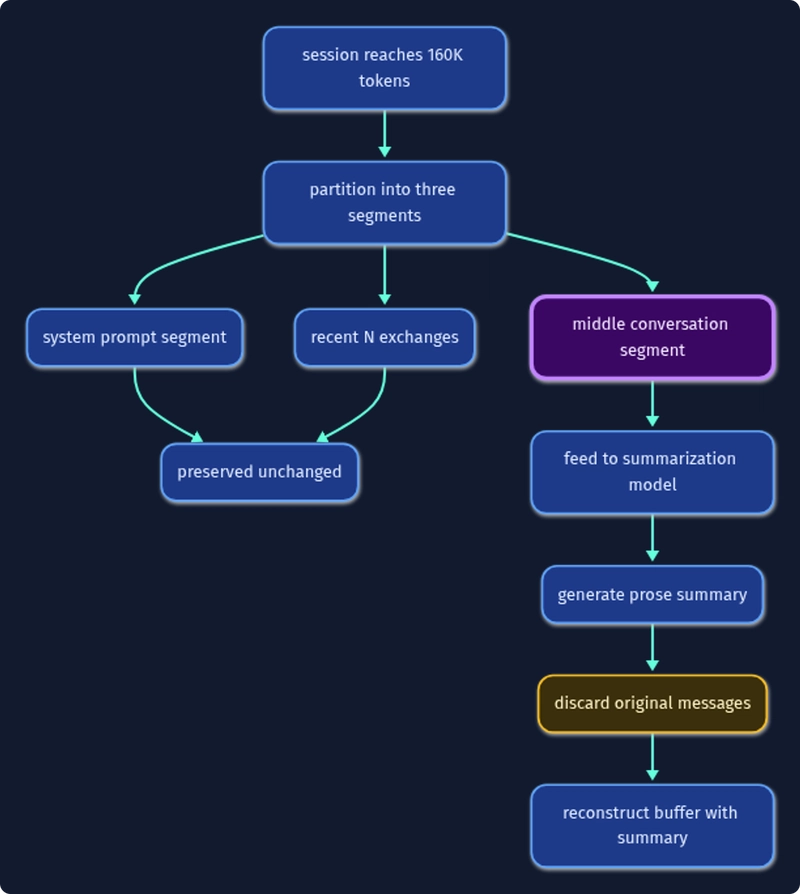
When a Claude Code session reaches approximately 160,000 tokens—roughly 80% of its total capacity—the runtime automatically triggers an unannounced, silent context summarization event. No warning dialog flashes across your terminal; no explicit error surfaces. The system simply partitions the conversation, preserves the foundational system prompt alongside the most recent 10 to 15 message exchanges, and compresses the massive middle block of conversation into a generalized prose summary.

[System Prompt (Survives)] ➔ [Middle Segment (Summarized & Lossy)] ➔ [Recent 10-15 Turns (Survives)]While this mechanism successfully drops the total token count and allows the session to push forward, it introduces a severe information tax. The detailed deliberation steps, rejected architectural strategies, and intricate edge-case discussions buried deep in the middle segment vanish into a high-level narrative.
For developers, the difference between failure and success comes down to state management. Those who treat sessions as raw, unmanaged logs inevitably watch their agents "drift" over time. Conversely, engineers who externalize constraints, design decisions, and active task lists into persistent artifacts maintain unbreakable coherence across compaction boundaries.
Chronology and Lifecycle: How Context Summarization Works Under the Hood
To understand why agents occasionally forget crucial directives, one must examine the three-phase pipeline that governs context summarization: retention selection, summary generation, and buffer reconstruction.

1. Partitioning the Conversation
When the runtime flags that the token threshold has been breached, it segments the conversation history into three distinct tiers:
- Tier 1 (The Anchor): The foundational system prompt, core configuration directives, and initial parameters. This remains entirely untouched.
- Tier 2 (The Variable Core): The bulk of the historical back-and-forth, containing the heavy lifting of the session. This is marked for condensation.
- Tier 3 (The Recency Buffer): The latest 10 to 15 exchanges. These remain fully intact to ensure immediate conversational flow.
2. Semantic Compression via Smaller Models
Tier 2 is fed into a designated summarization routine. Crucially, runtime environments often deploy a leaner, faster model for this task to preserve performance. This introduces a semantic compression bottleneck.
For example, a human-developer instruction phrased as, "Prefer functional programming patterns everywhere, except in performance-critical rendering loops where imperative loops are permitted," can easily be compressed into a lossy summary reading simply: "Use functional programming patterns." The vital exception clause is stripped away, permanently altering the agent’s behavioral guardrails.

3. Reassembly and Drift
The system pieces the new buffer back together using the untouched system prompt, the generated prose summary, and the recent recency buffer. The agent resumes execution instantly, completely unaware that a portion of its past cognitive journey has been erased and replaced with a synthetic summary.
Supporting Data: Monitoring Compaction Events and Token Discipline
Production-grade engineering requires observability, and AI agent sessions are no exception. Claude Code emits streaming metadata events—specifically context.compaction payloads—that allow developers to track when, why, and how aggressively their sessions are being compressed.
interface CompactionEvent
  type: "context.compaction";
  timestamp: string;
  preCompactionTokens: number;
  postCompactionTokens: number;
  messagesSummarized: number;
  summaryTokens: number;


function monitorCompaction(eventStream: AsyncIterable<Event>)
  for await (const event of eventStream)
    if (event.type === "context.compaction")
      const compressionRatio = event.preCompactionTokens / event.postCompactionTokens;
      console.warn(
        `Compaction at $event.timestamp: $event.messagesSummarized messages ` +
        `($event.preCompactionTokens ➔ $event.postCompactionTokens tokens, Ratio: $compressionRatio.toFixed(2))`
      );

      if (compressionRatio > 3.0)
        console.error("High compression ratio detected. Severe context loss and constraint drift likely.");
The Dangers of High Compression Ratios
A compression ratio exceeding 3.0 means that the resulting summary is less than one-third the size of the original data. This steep reduction points directly to massive information loss.

Data shows that specific types of information suffer most during high-ratio compactions:
- Rejected Approaches: If an agent proposed using Redis for caching, experienced a team pushback due to operational constraints, and pivoted to an in-memory solution, the summary will typically state: "Implemented in-memory caching." The contextual warning against Redis vanishes. Weeks later, the agent may boldly re-propose Redis.
- Nuanced Edge Cases: Analytical findings that didn’t immediately result in immediate code modifications are routinely purged.
- Clarifications on Constraints: Unit definitions (e.g., distinguishing between gzipped vs. uncompressed bundle sizes) frequently get flattened into vague placeholders like "optimized asset sizes."
Official Responses and Strategic Workarounds: Designing for Compaction
Because auto-compaction is an automated background process optimized for general continuity rather than strict engineering accuracy, teams must employ proactive design strategies to safeguard their agent workflows.
1. The Artifact Pattern (Externalizing State)
The single most effective defense against compaction-induced amnesia is the Artifact Pattern. Instead of forcing the AI to remember constraints through conversation history, developers must instruct the agent to maintain named, structured files (such as CONSTRAINTS.md, DECISIONS.md, or a typed JSON manifest) in the project workspace.

interface ConstraintManifest
  architectural:
    patterns: string[];
    forbidden: string[];
  ;
  performance:
    bundleSize:  max: string; measured: "gzipped" ;
    responseTime:  target: string; percentile: number ;
  ;
  dependencies:
    allowed: string[];
    prohibited: string[];
    rationale: Record<string, string>;
  ;
Because these files exist as discrete code artifacts rather than ephemeral chat logs, they survive compaction effortlessly. The agent can read and update these manifests continuously, preserving architectural ground-truth across infinite context resets.
2. Manual Compaction vs. Auto-Compaction
Relying entirely on auto-compaction leaves your session’s fate to chance. Utilizing manual compaction via API calls allows engineering teams to dictate precise phase boundaries—transitioning cleanly from requirements gathering to architecture design, and finally to implementation.
interface RetentionPolicy
  preserveConstraints: boolean;
  preserveRejectedApproaches: boolean;
  preserveEdgeCases: boolean;
  preserveDecisionRationale: boolean;
  customInstructions?: string;


async function forcePhaseCompaction(session: ClaudeSession, policy: RetentionPolicy)
  const result = await session.compact(
    retentionPolicy: policy,
    validateSummary: true
  );

  if (!result.success)
    throw new Error(`Manual compaction failed: $result.error`);


  console.log(`Successfully compacted phase. Tokens reduced from $result.preCompactionTokens to $result.postCompactionTokens.`);
By explicitly commanding the model to preserve rejected strategies and performance boundaries during a manual compaction call, teams bypass the generic limitations of automated summarization.

Implications for the Future of AI-Assisted Engineering
As AI coding assistants continue to mature through 2026 and beyond, the way engineering teams structure their interactions must evolve. Treating LLMs as conversational chatterboxes is no longer viable for enterprise-grade, large-scale software development.
Shifting from Logs to State Management
The industry is experiencing a necessary paradigm shift: moving away from the "append-only log" mentality toward managed state architectures. Developers who master token discipline, utilize strict artifact-driven manifests, and actively monitor compaction telemetry will see unprecedented gains in agent reliability.
Conversely, engineering organizations that ignore these boundaries will continue to suffer from mysterious regressions, erratic agent behavior, and unpredictable code drift. By acknowledging session compaction not as a system failure, but as an architectural reality, teams can build robust, compaction-aware workflows that scale effortlessly—ensuring your AI agent remains as sharp on message 1,000 as it was on message one.